Acts 4:15
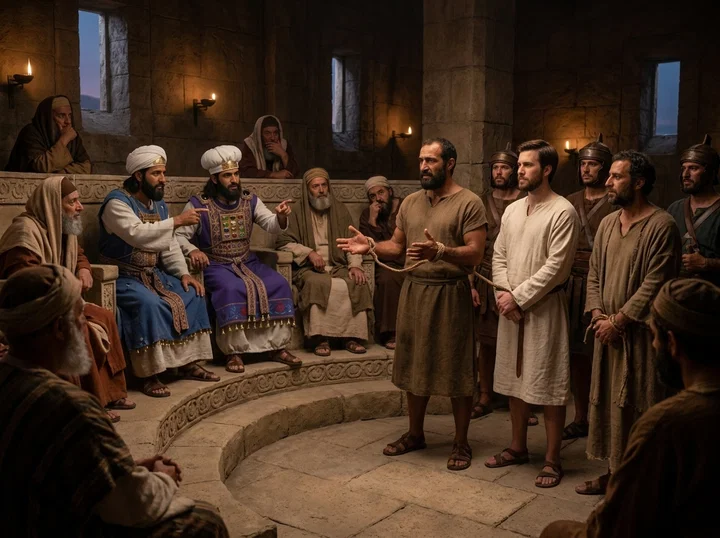
But when they had commanded them to go aside out of the council, they conferred among themselves,
Translations
American King James Version, King James Version, KJV Cambridge Paragraph Bible, Revised Version, American Standard Version, World English Bible
But when they had commanded them to go aside out of the council, they conferred among themselves,
But when they had commanded them to withdraw from the council, they conferred among themselves,
and having commanded them to go away out of the sanhedrim, they took counsel with one another,
but having commanded them to go out of the council they conferred with one another,
Howbeit, ordering them to go forth outside the high-council, they began to confer one with another,
Berean Standard Bible, Majority Standard Bible
So they ordered them to leave the Sanhedrin and then conferred together.
But when they had given them orders to go out of the Sanhedrin, they had a discussion among themselves,
Then they commanded them to goe aside out of the Council, and conferred among themselues,
Douay-Rheims (Challoner revision)
But they commanded them to go aside out of the council; and they conferred among themselves,
Pictures
Cross-references
- Acts 3:1-10
Now Peter and John went up together into the temple at the hour of prayer, being the ninth hour.
The healed man’s public restoration was the evidence before the council.
- Acts 4:19-20
But Peter and John answered and said unto them, Whether it be right in the sight of God to hearken unto you more than unto God, judge ye.
Peter and John insist they must obey God and speak what they have seen and heard.
- Acts 4:21
So when they had further threatened them, they let them go, finding nothing how they might punish them, because of the people: for all men glorified God for that which was done.
The rulers threaten the apostles but release them for fear of the people’s response.
- Acts 5:29
Then Peter and the other apostles answered and said, We ought to obey God rather than men.
The apostles obey God rather than human authorities who forbid their preaching.
- John 11:47
Then gathered the chief priests and the Pharisees a council, and said, What do we? for this man doeth many miracles.
The chief priests and Pharisees respond to Jesus’ miracles in council.
- Acts 5:40
And to him they agreed: and when they had called the apostles, and beaten them, they commanded that they should not speak in the name of Jesus, and let them go.
The Sanhedrin inflicted bodily punishment on the apostles.
- Acts 4:31
And when they had prayed, the place was shaken where they were assembled together; and they were all filled with the Holy Ghost, and they spake the word of God with boldness.
After praying together, the believers were filled with the Holy Ghost.
Commentary
Each commentary is drawn from primary sources: the writings of Ellen G. White and Adventist pioneers and periodicals. Each commentary is separate. Its own words are not a quotation; follow the references to read the source passages.
Ellen G. White
9 sources
This moment belongs to the account of the apostles witnessing to Jesus, coming after their clear, bold testimony given through the Holy Spirit.SPBC 139.23SP 281.2–4Lt 296, 1904, par. 1–5 Their words and works reflected their Teacher, carrying such power and such plain evidence of God's work that fear restrained their opponents from acting as they otherwise might have.SPBC 139.2Lt 296, 1904, par. 1–5 That consultation followed the bold testimony and the undeniable healing.3SP 281.2–4
Those testifying were Peter and John, whom the rulers dismissed as ignorant fishermen and expected to be overcome with embarrassment before priests, scribes and elders.AC1 18.1–2 Instead the rulers were amazed at their boldness, recognized they had been with Jesus, and saw they spoke as He spoke with a convincing power that silenced adversaries.AC1 18.1–2 The healed man stood before them as they heard Peter's testimony and saw the public miracle.RH Feb 2, 1911
The verse describes the rulers ordering Peter and John to go aside out of the council and removing them, sending them outside so the members could confer privately among themselves.Ms 22, 1900, par. 11–16AA 70.1–71.1RH Feb 2, 19117RED 18.2AC1 18.1–2 They did so to consider what to do and how to respond to them and their testimony.Ms 22, 1900, par. 11–16AA 70.1–71.1RH Feb 2, 19117RED 18.2AC1 18.1–2 Their discussion led them to threaten the apostles and try to stop them from speaking and teaching in Jesus' name.Ms 22, 1900, par. 11–16
The rulers withdrew to consult in private because they were perplexed by the apostles' bold defense.RH Feb 2, 1911AC1 18.1–23SP 281.2–4 They sought to conceal their perplexity after hearing that testimony.RH Feb 2, 1911AC1 18.1–2 Their consultation reflected both that perplexity and their desire to stop the spread of belief in Jesus.3SP 281.2–4
In that private counsel they all agreed it was useless to deny that the lame man had been healed by power given the apostles in the name of the crucified Jesus.RH Feb 2, 19117RED 18.2AC1 18.1–2 A public, notable miracle had occurred that could not be denied.Ms 22, 1900, par. 11–16RH Feb 2, 1911SG1 83.1 They would gladly have hidden the miracle by falsehood, but they could not because it was done in the full light of day before a crowd of people and was already known to thousands.7RED 18.2
Their discussion was driven by fear that the work would spread and belief in Jesus would increase.7RED 18.23SP 281.2–4SG1 83.1 They feared that spread would weaken their own power, bring their disgrace, and expose them as guilty of the murder of the Son of God and responsible for Jesus' death.7RED 18.2SG1 83.1 They felt the work had to be stopped at once, and so decided to threaten the disciples and forbid them to speak and teach in Jesus' name.Ms 22, 1900, par. 11–16RH Feb 2, 19117RED 18.2SG1 83.1
Sources
Pioneers and periodicals
18 sources
The verse records the moment in the trial of Peter and John before the Sanhedrin when the rulers ordered the apostles to leave the council chamber so they could deliberate privately about what to do.ST Jul 22, 1897ST Mar 11, 1897 It took place soon after Pentecost, after the apostles had boldly testified and the rulers had seen the healed man standing with them, leaving them perplexed and unable to deny the publicly known miracle done in Jesus' name.ST Jul 22, 1897ST Mar 11, 1897RH Jun 11, 1901ST Jul 16, 1902RH Feb 12, 1861 In private they acknowledged that a clear miracle had occurred, yet conferred on how to stop the work and keep it from spreading, then warned the apostles not to speak or teach in Jesus' name, to which the apostles answered that they must speak what they had seen and heard.RH Feb 2, 1911ST Jul 16, 1902ST Jul 22, 1897 Their boldness before the combined power of church and state came from being filled with the Holy Spirit, showing that human rule must not take the place of conscience and God, and that opposition to Christ continued after His resurrection in the persecution of His witnesses.ST Sep 11, 1884ST Apr 23, 1912RH Jun 11, 1901RH Jun 8, 1916RH Apr 7, 1863
Council's Private Deliberation
The council commanded Peter and John to go aside out of the council so that its members could confer privately among themselves about what to do with them.ST Jul 22, 1897ST Mar 11, 1897RH Feb 12, 1861RH Feb 16, 1911 The sending out came after the hearing and trial, as part of the outcome of the healing and of the apostles' imprisonment and trial.ST Mar 11, 1897 It belongs to the account of the apostles' witness and the opposition they faced. The setting is the trial of Peter and John before the Sanhedrin, the powerful Jewish court of rulers and elders, soon after Pentecost amid the early church's growth, witness, imprisonment, and persecution.ST Mar 11, 1897RH Jun 11, 1901ST Jan 14, 1897
The council acted after hearing the apostles' bold testimony and seeing the healed man with them.RH Feb 2, 1911 The priests and rulers were perplexed by the bold defense and ordered the apostles out so they could confer among themselves and consider how to respond.RH Feb 2, 1911 They had witnessed evidence of a notable miracle performed in Jesus' name that was publicly known and could not be denied.ST Jul 22, 1897ST Jul 16, 1902RH Feb 12, 1861 In private they acknowledged that a clear miracle had occurred, yet they discussed how to stop the apostles' work and keep the news from spreading.RH Feb 2, 1911ST Jul 16, 1902ST Jul 22, 1897 They then warned them not to speak or teach in Jesus' name, to which the apostles answered that they must speak what they had seen and heard.ST Jul 16, 1902ST Jul 22, 1897
The account belongs to the apostles' ministry after Pentecost, when the Holy Spirit's power was restored to them after they put away selfishness and discord and became united in humility and love.RH Feb 10, 1916 It belongs to Peter and John's imprisonment and God's deliverance, as part of the early church's record of victory and God's power at work among people.ST Jun 2, 1909 Through the council's deliberations and Gamaliel's counsel the disciples were given opportunity to continue preaching, so that their claim that the Christian message would spread through the world, which could have seemed impossible before the Sanhedrin, became reality.RH Jun 27, 1865RH Feb 16, 1911
Opposition and Religious Liberty
Peter and John stood before the rulers and elders, and the opposition they faced did not make them afraid to stand for what was right because Peter was filled with the Holy Spirit who gave boldness before the combined power of Church and State.RH Jun 11, 1901 The sending of the apostles out while the council conferred shows religious authorities deliberating after restricting public teaching about Jesus, and human rule must not take the place of conscience or God.ST Sep 11, 1884ST Apr 23, 1912 Leaving belief and worship formally unrestricted does not turn a ban on religious practice or speech into an act of liberty.ST Sep 11, 1884
The ordering aside out of the council belongs to the continued opposition to Jesus after his death and resurrection, when those who killed Christ persecuted the apostles for preaching Christ.RH Jun 8, 1916RH Sep 15, 1868 The first-century church authorities opposed Christ, the gospel, and the apostles' witness to the truth rather than supporting it.RH Apr 7, 1863RH Apr 7, 1863 That resistance to the apostles as they bore witness to the truth follows the same pattern as the opposition of church leaders to Luther and other reformers.RH Apr 7, 1863RH Apr 7, 1863
After acknowledging the notable miracle performed in Jesus' name, the council discussed what to do and then ordered the apostles to stop teaching in that name.ST Jul 16, 1902 Their hostility toward preaching in Jesus' name makes it conspicuous that no accusation of Sabbath-breaking is recorded, though it was a charge they could have used.ST Jul 16, 1902
Sources