Acts 4:16
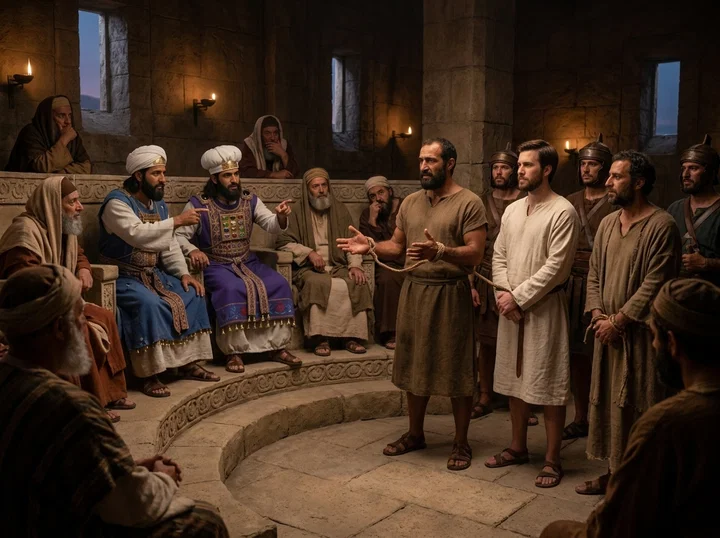
Saying, What shall we do to these men? for that indeed a notable miracle hath been done by them is manifest to all them that dwell in Jerusalem; and we can not deny it.
Translations
Saying, What shall we do to these men? for that indeed a notable miracle has been done by them is manifest to all them that dwell in Jerusalem; and we cannot deny it.
Saying, What shall we do to these men? for that indeed a notable miracle hath been done by them is manifest to all them that dwell in Jerusalem; and we can not deny it.
saying, What shall we do to these men? for that indeed a notable miracle hath been done by them is manifest to all them that dwell in Jerusalem; and we cannot deny it.
Saying, What shall we do to these men? for that indeed a notable miracle hath been done by them is manifest to all them that dwell in Jerusalem, and we cannot deny it.
Revised Version, American Standard Version
saying, What shall we do to these men? for that indeed a notable miracle hath been wrought through them, is manifest to all that dwell in Jerusalem; and we cannot deny it.
saying, 'What shall we do to these men? because that, indeed, a notable sign hath been done through them, to all those dwelling in Jerusalem [is] manifest, and we are not able to deny [it];
saying, What shall we do to these men? for that indeed an evident sign has come to pass through their means is manifest to all that inhabit Jerusalem, and we cannot deny it.
Saying—What are we to do with these men? For, indeed, that a notable sign hath come to pass through their means, unto all who are dwelling in Jerusalem, is manifest, and we cannot deny [it]!
Berean Standard Bible, Majority Standard Bible
“ What shall we do with these men?” they asked. “ It is clear to everyone living in Jerusalem that a remarkable miracle has occurred through them, and we cannot deny it.
saying, “ What shall we do to these men? Because indeed a notable miracle has been done through them, as can be plainly seen by all who dwell in Jerusalem, and we can’ t deny it.
Saying, What are we to do with these men? for certainly it is clear to all who are living in Jerusalem that a most important sign has been done by them, and it is not possible to say that it is not so.
Saying, What shall we doe to these men? for surely a manifest signe is done by them, and it is openly knowen to all them that dwell in Hierusalem: and we cannot denie it.
Douay-Rheims (Challoner revision)
Saying: What shall we do to these men? for indeed a known miracle hath been done by them, to all the inhabitants of Jerusalem: it is manifest, and we cannot deny it.
Pictures
Cross-references
- Acts 3:1-10
Now Peter and John went up together into the temple at the hour of prayer, being the ninth hour.
The healed man’s public cure is the notable miracle the rulers could not deny.
- Acts 4:10
Be it known unto you all, and to all the people of Israel, that by the name of Jesus Christ of Nazareth, whom ye crucified, whom God raised from the dead, even by him doth this man stand here before you whole.
Peter identifies Jesus’ name as the source of the man’s healing.
- John 11:47-48
Then gathered the chief priests and the Pharisees a council, and said, What do we? for this man doeth many miracles.
The leaders acknowledge Jesus’ miracles and fear their consequences.
- Acts 5:29
Then Peter and the other apostles answered and said, We ought to obey God rather than men.
The apostles declare that they must obey God rather than human authorities.
- Acts 4:21
So when they had further threatened them, they let them go, finding nothing how they might punish them, because of the people: for all men glorified God for that which was done.
The people glorify God for the healing, limiting the rulers’ response.
- Acts 4:33
And with great power gave the apostles witness of the resurrection of the Lord Jesus: and great grace was upon them all.
The apostles testified powerfully to Jesus’ resurrection.
- Acts 4:12
Neither is there salvation in any other: for there is none other name under heaven given among men, whereby we must be saved.
Salvation is found in Jesus alone.
- Acts 4:22
For the man was above forty years old, on whom this miracle of healing was shewed.
The healed man was over forty years old.
- Acts 2:22
Ye men of Israel, hear these words; Jesus of Nazareth, a man approved of God among you by miracles and wonders and signs, which God did by him in the midst of you, as ye yourselves also know:
Both describe miracles and signs as publicly evident works of God.
- Acts 4:2
Being grieved that they taught the people, and preached through Jesus the resurrection from the dead.
The rulers oppose the apostles’ teaching about Jesus’ resurrection.
- Acts 5:12
And by the hands of the apostles were many signs and wonders wrought among the people; ( and they were all with one accord in Solomon’s porch.
The apostles continue performing signs and wonders among the people.
- Hebrews 2:4
God also bearing them witness, both with signs and wonders, and with divers miracles, and gifts of the Holy Ghost, according to his own will?
Miracles serve as evidence of God’s hand.
- Acts 3:4
And Peter, fastening his eyes upon him with John, said, Look on us.
Peter and John’s focused attention begins the encounter leading to the miracle.
- Acts 5:28
Saying, Did not we straitly command you that ye should not teach in this name? and, behold, ye have filled Jerusalem with your doctrine, and intend to bring this man’s blood upon us.
The leaders complain that the disciples have spread their teaching throughout Jerusalem.
- John 11:43-44
And when he thus had spoken, he cried with a loud voice, Lazarus, come forth.
The raising of Lazarus intensified the rulers’ opposition.
- Acts 2:4
And they were all filled with the Holy Ghost, and began to speak with other tongues, as the Spirit gave them utterance.
The Spirit empowered the disciples’ preaching.
- Acts 6:8
And Stephen, full of faith and power, did great wonders and miracles among the people.
Stephen’s powerful works drew opposition.
Commentary
Each commentary is drawn from primary sources: the writings of Ellen G. White and Adventist pioneers and periodicals. Each commentary is separate. Its own words are not a quotation; follow the references to read the source passages.
Ellen G. White
13 sources
The council speaking here is Jerusalem's rulers, elders, priests and scribes conferring privately about Peter and John after ordering them out.5MR 264.1–3RH Feb 2, 1911AC1 18.1–2 The notable miracle they mean is the open daytime healing of the man crippled from birth, done through the name of Jesus of Nazareth, which was known to thousands throughout Jerusalem.Ms 22, 1900, par. 11–165MR 264.1–3AA 57.2–58.2RH Feb 2, 19117RED 18.2 They openly agreed the work was genuine and widely known, admitting it was useless to deny it though they would have covered it with falsehood if they could.EW 161.1Ms 22, 1900, par. 11–16Ms 47, 1886, par. 5–9 Yet though moved upon with a message they could have accepted, they were grieved and arrayed against the truth, seeking to stop its spread by threatening the apostles not to speak in Jesus' name.Ms 22, 1900, par. 11–16Ms 47, 1886, par. 5–95MR 264.1–3RH Feb 2, 1911 Their fear was that wider belief in Jesus would weaken their authority, disgrace them, and expose them as guilty of killing the Son of God, showing that plain evidence does not guarantee acceptance when truth is unwelcome.EW 161.1Ms 47, 1886, par. 5–9SG1 83.17RED 18.2
The Miracle and Admission
Acts 4:16 belongs to the account of the disciples' public witness after Pentecost, when the Holy Spirit gave them boldness so that their words and works represented Jesus.SPBC 139.2 It is part of that same service in which they pressed forward despite their own weakness, because prayer and reliance on Christ equipped them for the work.AA 57.1
The notable miracle in view is the healing of the man crippled from birth, the impotent man, done by Peter and John through power given in the name of Jesus of Nazareth, the crucified Jesus.5MR 264.1–3AA 57.2–58.27RED 18.2AC1 18.1–23SP 281.2–4 His recovery was plain evidence that such power had been given to the apostles in that name.7RED 18.2AC1 18.1–23SP 281.2–4
That healing was done openly in full light of day before a crowd, with the healed man himself present and recognized, and the work was manifest and already known to thousands throughout all Jerusalem.Ms 22, 1900, par. 11–16AA 57.2–58.2RH Feb 2, 19117RED 18.2AC1 18.1–2 It was so public and unmistakable that the people of the city recognized him, and its testimony was publicly evident.Ms 22, 1900, par. 11–16AA 57.2–58.2RH Feb 2, 1911
Those speaking the words are Jerusalem's rulers in council, the Sanhedrin, including the high priest, rulers, elders, Sadducees, priests and scribes.5MR 264.1–3AC1 18.1–2 They ordered Peter and John out of the council to confer privately among themselves, in order to conceal their perplexity at the apostles' boldness.RH Feb 2, 1911AC1 18.1–2
They openly agreed together that the miracle was genuine, remarkable, and widely known, and admitted it was useless to deny it and they could not deny it.EW 161.1Ms 22, 1900, par. 11–16Ms 47, 1886, par. 5–95MR 264.1–3AA 57.2–58.2 They would gladly have covered it with falsehoods if denial had been possible, but with the healed man's presence before them they were left unable to challenge the evidence.Ms 22, 1900, par. 11–16RH Feb 2, 1911AC1 18.1–2
Opposition Despite Clear Evidence
The undeniable evidence left the rulers perplexed, unable to deny what had been done and unable to stop the work done in Jesus' name.RH Feb 2, 1911 They were grieved at the preaching of Jesus and the resurrection of the dead, and though moved upon by the Holy Ghost with a message they had the privilege to accept, they were arrayed against the truth and refused it.5MR 264.1–3 Their perplexity exposed their helplessness before plain evidence of God's work through the disciples.RH Feb 2, 1911
They feared that if the report spread it would weaken their authority and power.EW 161.1SG1 83.1 They feared the undeniable miracle would gain many believers in Jesus.7RED 18.2AC1 18.1–2 They feared their own disgrace would follow and the people would see them as guilty of killing Jesus, the Son of God, responsible for His death and murderers of Him.EW 161.1SG1 83.17RED 18.2AC1 18.1–2
They concluded the work must be stopped immediately and its testimony kept from spreading further among the people.5MR 264.1–3AC1 18.1–2 They sought to conceal the miracle and suppress the apostles' message by threatening the apostles and commanding them not to speak or teach in the name of Jesus.Ms 22, 1900, par. 11–16Ms 47, 1886, par. 5–95MR 264.1–3AC1 18.1–23SP 281.2–4 Although the healed man's presence left them unable to challenge the evidence, they chose suppression over acceptance.Ms 22, 1900, par. 11–16Ms 47, 1886, par. 5–9
The evidence of God's work through the disciples was so plain that their opponents were afraid to act against them as they otherwise would have.Lt 296, 1904, par. 1–5 Clear evidence of God's work does not guarantee acceptance of the truth, since opposition may arise even among professed people of God when the truth is unwelcome.Ms 47, 1886, par. 5–9
Sources
Pioneers and periodicals
38 sources
After the healing of the lame man at the Beautiful Gate, Peter and John were brought before the Sanhedrin, where the council admitted that a notable miracle had been done through them that was manifest to all in Jerusalem and could not be denied.ST Sep 23, 1908ST Jul 22, 1897ST Jan 21, 1897ST Mar 11, 1897RH Jun 8, 1916 The evidence was undeniable because the healed man himself stood present, over forty years old and healed openly before crowds who knew him, so it could not be hidden or explained away.RH Feb 2, 1911ST Feb 24, 1914ST Jan 22, 1902 The power at work was the Holy Spirit given after united prayer and consecration, which made the apostles bold, and the healing done in the name of the crucified and risen Jesus stood as proof that salvation is in no other name.ST Feb 7, 1884ST Sep 23, 1908RH Feb 10, 1916RH Jun 11, 1901ST Mar 1, 1905 Yet though they acknowledged the miracle as real and widely known, the rulers asked what to do with the apostles and sought to stop the report from spreading and forbid their speaking and teaching in Jesus' name, restrained from worse only by fear of the people and of losing influence and being held guilty for His death.RH Feb 2, 1911ST Jul 22, 1897ST Apr 23, 1912ST Sep 11, 1884RH Jun 8, 1916 Their course shows that seeing fulfilled signs and undeniable miracles did not bring them to believe, but illustrates how religious leaders may recognize the evidence of truth yet reject its messengers and turn to threats, imprisonment, and force when they cannot answer it.RH May 10, 1915RH Jul 25, 1854RH Apr 7, 1863ST Jan 8, 1880ST Jan 9, 1879
Setting and Admission
The saying belongs to the imprisonment and trial of Peter and John before the Sanhedrin after the healing of the lame man at the temple's Beautiful Gate described in chapter 3.ST Mar 11, 1897ST Jun 2, 1909RH Jul 15, 1858 It stands soon after Pentecost in Jerusalem, amid the early church's growth, the Spirit's work, persecution, and opposition, recording the bold witness of the apostles and its outcome.ST Jan 21, 1897ST Jan 14, 1897 The healing and God's deliverance of the apostles form part of the early church's testimony to God's power, and the publicly known miracle performed by the apostles could not be denied by the Jerusalem authorities.ST Jan 21, 1897ST Jun 2, 1909 The opponents themselves acknowledged that a notable miracle had taken place and could not be denied when the apostles stood before the council.ST Mar 11, 1897ST Dec 24, 1912
The trial over the healing comes before the selling of possessions into a common fund and the contrast of true and false givers in Ananias and Sapphira.ST Mar 11, 1897 The fourth chapter has as its main topic the apostles' witness before the authorities after a notable miracle, and its last part contains a report.ST Jun 2, 1898 The apostles were summoned before the Sanhedrin several times after Pentecost, and Gamaliel's counsel temporarily allowed them to continue preaching the gospel.RH Feb 16, 1911
The word rendered miracle is an example of the Greek semeion, also translated sign, token, or wonder.ST Oct 17, 1895 The council admitted that a notable miracle had been done through Peter and John, manifest and plainly known to all who dwelt in Jerusalem, and that they could not deny it.ST Sep 23, 1908ST Jul 22, 1897ST Jul 29, 1897 The authorities acknowledged the apostles' miracle was publicly known throughout the city even as they persecuted them for preaching Christ, showing that even opponents recognized it as real.RH Jun 8, 1916RH Feb 12, 1861ST Jul 22, 1897 The questions on the account ask readers to relate how, after the lame man was healed, the rulers acknowledged the notable miracle known throughout Jerusalem and impossible to deny.ST Jul 29, 1897
The evidence was undeniable because the man who had been healed was present, and the healing was known throughout Jerusalem, leaving the rulers perplexed and exposed in their inability to stop the work done in Jesus' name.RH Feb 2, 1911 His being over forty years old further made the miracle remarkable, plainly known to the people and impossible for the rulers to deny.ST Jan 22, 1902 Because the healing had happened openly before a crowd and was known to thousands, it could not be concealed with falsehoods.ST Feb 24, 1914 The healed man's presence made the evidence undeniable, yet the leaders considered how to stop the news from spreading.ST Jul 22, 1897
Witness Despite Opposition
The power at work through the apostles was the Holy Spirit given in fullness after the disciples put aside their differences and became united in prayer, humility and love.RH Feb 10, 1916 Their consecration and trust in God's word gave them boldness to speak despite persecution, and the chapter stands as part of the account of God's power in the apostolic church.ST Sep 23, 1908 Peter's boldness before the combined power of Church and State shows that being filled with the Holy Spirit banishes fear of opposition and strengthens a person to stand for what is right.RH Jun 11, 1901
The healing had been performed in the name of the crucified Jesus, and its evidence threatened the rulers' influence because it could lead many to believe in Him.ST Feb 7, 1884 It supported the apostles' claim that Jesus had risen from the dead and their teaching that salvation is found in no other name, and unable to refute these claims the rulers resorted to imprisonment and bodily punishment to stop the preaching.ST Mar 1, 1905 The undeniable miracle, acknowledged by the Jerusalem authorities as publicly known and impossible to deny, is evidence of the supernatural power behind Christianity's establishment, which overcame formidable opposition through the work of a few weak and obscure people.RH Jun 27, 1865
The council admitted that a notable miracle had been done through Peter and John, that its reality was clear to everyone living in Jerusalem, and that it could not be denied, yet the leaders considered how to stop the news from spreading.ST Jul 22, 1897 Though they recognized the miracle as undeniable and widely known, they sought to stop the apostles from speaking and teaching in Jesus' name, showing that acknowledged evidence did not prevent religious restriction.ST Sep 11, 1884ST Jul 16, 1902 They publicly recognized the miracle as real and known throughout Jerusalem, yet used the occasion to try to stop preaching in Jesus' name, and asked what action to take in connection with fear that people would believe in Him.ST Jul 16, 1902ST Aug 23, 1899 This is an illustration of the limit of human authority, that civil rule must not take the place of conscience or of God, and an example of law interfering with religion.ST Apr 23, 1912RH Oct 22, 1908
The undeniable evidence left the rulers perplexed and exposed their inability to stop the work done in Jesus' name.RH Feb 2, 1911 Because the healing had happened openly before a crowd and was known to thousands, they could not conceal it with falsehoods; instead they sought to stop the disciples' teaching, fearing that Jesus would gain more followers and that they would be held guilty for His death.ST Feb 24, 1914 The evidence threatened their influence because it could lead many people to believe in Him, and though they wanted to stop the apostles, fear of the people kept them for the moment from doing more than threatening them, even as they persecuted them for preaching Christ.ST Feb 7, 1884RH Jun 8, 1916
Still they confronted the apostles despite clear evidence of their work.RH Jul 25, 1854 They had to acknowledge that notable miracles had been done and could not be denied, yet they still did not believe despite the signs being fulfilled before them.ST Jan 9, 1879RH Apr 17, 1855 Their recognition did not lead them to accept Jesus or His followers.RH Sep 15, 1868 What was plainly evident illustrated their unbelief despite the signs of Christ's first advent being fulfilled before them, including notable miracles done by Jesus which the Jewish rulers had to acknowledge yet still rejected.ST Jan 8, 1880RH Jan 11, 1870
Their response shows how religious leaders may recognize the evidence of truth but reject its messengers and turn to force when they cannot answer them.RH Apr 7, 1863 The first-century conflict in which religious leaders opposed the apostles even though their work could not be denied illustrates that the church's leaders did not support the truth or its messengers, and this opposition is like the resistance Luther and the Reformation faced from church authorities.RH Apr 7, 1863 Their condemnation and persecution of the apostles after Christ's resurrection helped bring Jerusalem's guilt to its fullness.RH May 10, 1915
What Spirit-filled men did then they can do now, speaking and suffering while remaining patient and earnest, bold and kind, for God is just as willing to work today and the name of Jesus is no less powerful.
Sources