Acts 6:2
Then the twelve called the multitude of the disciples unto them, and said, It is not reason that we should leave the word of God, and serve tables.
Translations
Then the twelve called the multitude of the disciples to them, and said, It is not reason that we should leave the word of God, and serve tables.
King James Version, KJV Cambridge Paragraph Bible
Then the twelve called the multitude of the disciples unto them, and said, It is not reason that we should leave the word of God, and serve tables.
Then the twelve called the multitude of the disciples, and said, It is not reason that we should leave the word of God, and serve tables.
Revised Version, American Standard Version
And the twelve called the multitude of the disciples unto them, and said, It is not fit that we should forsake the word of God, and serve tables.
and the twelve, having called near the multitude of the disciples, said, 'It is not pleasing that we, having left the word of God, do minister at tables;
And the twelve, having called the multitude of the disciples to [ them], said, It is not right that we, leaving the word of God, should serve tables.
And the Twelve, calling near the throng of the disciples, said—It doth not seem, right, that, we, forsaking the word of God, should be ministering unto tables.
Berean Standard Bible, Majority Standard Bible
So the Twelve summoned all the disciples and said, “ It is unacceptable for us to neglect the word of God in order to wait on tables.
The twelve summoned the multitude of the disciples and said, “ It is not appropriate for us to forsake the word of God and serve tables.
And the Apostles sent for all the disciples and said, It is not right for us to give up preaching the word of God in order to make distribution of food.
Then the twelue called the multitude of the disciples together, and sayd, It is not meete that we should leaue the worde of God to serue the tables.
Douay-Rheims (Challoner revision)
Then the twelve calling together the multitude of the disciples, said: It is not reason that we should leave the word of God, and serve tables.
Pictures
Cross-references
- 1 Timothy 3:8-12
Likewise must the deacons be grave, not doubletongued, not given to much wine, not greedy of filthy lucre;
Gives qualifications for deacons whose service addresses the practical needs described in Acts 6.
- Acts 21:8
And the next day we that were of Paul’s company departed, and came unto Cæsarea: and we entered into the house of Philip the evangelist, which was one of the seven; and abode with him.
Philip is identified as one of the seven and as an evangelist.
- Acts 6:7
And the word of God increased; and the number of the disciples multiplied in Jerusalem greatly; and a great company of the priests were obedient to the faith.
After responsibilities were assigned, the word spread and the church grew.
- 1 Timothy 3:13
For they that have used the office of a deacon well purchase to themselves a good degree, and great boldness in the faith which is in Christ Jesus.
Faithful service as a deacon brings spiritual strength and boldness in faith.
- Acts 6:6
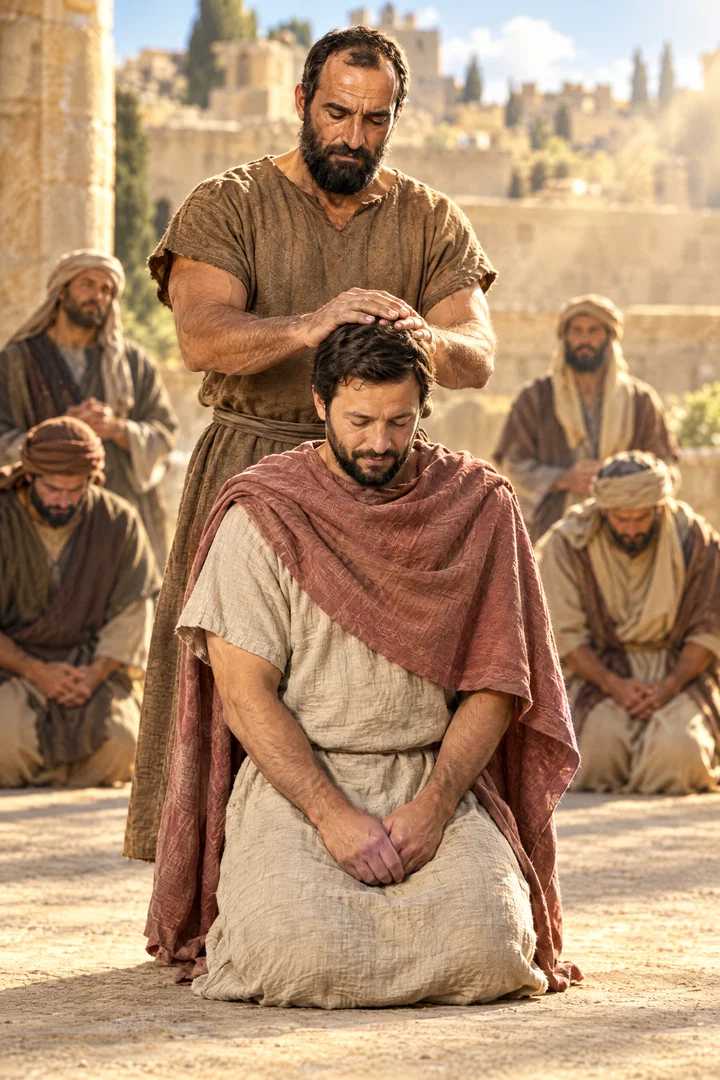
Whom they set before the apostles: and when they had prayed, they laid their hands on them.
The apostles prayed and laid hands on the seven.
- Acts 4:34-37
Neither was there any among them that lacked: for as many as were possessors of lands or houses sold them, and brought the prices of the things that were sold,
Believers share their possessions, requiring care for the distribution.
- Acts 6:8
And Stephen, full of faith and power, did great wonders and miracles among the people.
Stephen, chosen to serve, also performs wonders and miracles.
- Acts 2:45
And sold their possessions and goods, and parted them to all men, as every man had need.
Believers shared their possessions to provide food according to each person’s need.
- 1 Corinthians 9:14
Even so hath the Lord ordained that they which preach the gospel should live of the gospel.
Those who proclaim the gospel are to live from their work.
- 1 Timothy 3:12
Let the deacons be the husbands of one wife, ruling their children and their own houses well.
Both texts concern qualifications and duties of deacons.
- Acts 8:5
Then Philip went down to the city of Samaria, and preached Christ unto them.
Philip, one of the seven, preaches Christ.
Commentary
Each commentary is drawn from primary sources: the writings of Ellen G. White and Adventist pioneers and periodicals. Each commentary is separate. Its own words are not a quotation; follow the references to read the source passages.
Ellen G. White
63 sources
The twelve gathered the whole body of believers to lay the complaint about neglected widows before them and act promptly to keep dissatisfaction from dividing the church.AA 87.1–88.113MR 187.3–188.2Ms 33, 1895, par. 5 Serving tables meant the daily distribution of food and aid to the poor and the handling of practical business and temporal affairs, and to leave the word of God for it would have been a wrong and improper neglect of preaching and teaching.3SP 292.1AC1 28.1–2ST Feb 14, 188421MR 97.2–4AA 88.2 The Holy Spirit opened a way to relieve the apostles of apportioning aid and like burdens by sharing the work with seven qualified men who would oversee care for the poor, so the apostles could give themselves to prayer and the ministry of the word.3SP 292.1AC1 28.1–213MR 187.3–188.2Lt 164, 1902, par. 17–18Ms 104, 1899, par. 5–6 This sharing of responsibility is the approved Bible plan and gospel order for the church now, with spiritual workers freed from business they are not called to bear and temporal matters directed by wise and devoted men.RH Oct 5, 1905Ms 104, 1902, par. 25–27ST Nov 28, 1878ST Feb 14, 18847RED 29.3 Gospel ministers therefore are to keep free from secular, political, business, and financial duties and from temporal cares that consume time needed for study, prayer, and Scripture, giving their strength to Christian service and the proclamation of the message in many places.7T 252.2–3RH Oct 5, 1905Ms 104, 1902, par. 25–2714MR 278.1–279.2Lt 39, 1887, par. 17–18
Words and Setting
When complaint arose that widows were being neglected, the twelve took prompt action to keep dissatisfaction from dividing the believers by calling the whole multitude of disciples together and laying the matter before the community instead of deciding it alone.AA 87.1–88.113MR 187.3–188.2Ms 33, 1895, par. 5Ms 91, 1899, par. 30–337RED 28.2 They set before the gathered believers that they should not leave their work of proclaiming God's word to manage the daily distribution, and the practical responsibility was then entrusted to seven qualified men while the apostles continued in prayer and the ministry of the word.13MR 187.3–188.2Ms 33, 1895, par. 5Ms 91, 1899, par. 30–337RED 28.2 The work was in this way shared rather than placed on one person alone.13MR 187.3–188.2
To serve tables is to handle the daily distribution of food and aid to the poor, including widows, fatherless children, and others in need.AC1 28.1–2ST Feb 14, 1884Lt 9, 1899, par. 1–8ST Nov 28, 1878AA 88.2 It also means more broadly managing the church's practical care for the needy and handling its practical business and temporal affairs.ST Feb 14, 1884AA 88.23T 500.3–502.3 Such personal handling of distribution and business would take those whose central work was teaching God's word away from that special work, so qualified men were chosen to oversee fair distribution and care while spiritual leaders gave themselves to the ministry of the word.ST Feb 14, 1884AA 88.23T 500.3–502.3
To say it is not reason to leave the word of God and serve tables is to say it would be wrong and an improper neglect for the apostles to abandon preaching and teaching the word in order to manage distribution and similar practical duties.3SP 292.121MR 97.2–47RED 28.2ST Nov 28, 1878RH Feb 16, 1911 The care of the poor was necessary work, but it was not their primary calling.Lt 9, 1899, par. 1–8RH Feb 16, 1911 A leader's office does not make every task his personal responsibility nor make him the only one qualified to do it, so trustworthy, wise, unselfish and qualified people were to be delegated the practical work and those responsible for preaching were to remain devoted to the word, with both preaching and practical service carried out.21MR 97.2–4Lt 9, 1899, par. 1–8RH Feb 16, 1911
Division of Responsibilities
The Holy Spirit provided a way to relieve the apostles of apportioning aid to the poor and similar practical burdens so they would not abandon preaching the word of God to manage the daily distribution of food.3SP 292.1AC1 28.1–2Ms 104, 1899, par. 5–67RED 28.2 Serving tables meant handling that daily distribution to the poor, including widows, and the work of distributing aid to widows and others in need was entrusted to appointed men.AC1 28.1–2Ms 104, 1899, par. 5–6ST Nov 28, 1878 In this way the apostles were left free to preach Christ and to give themselves to prayer and the ministry of the word.3SP 292.1AC1 28.1–2Ms 104, 1899, par. 5–67RED 28.2ST Nov 28, 1878
The practical responsibility was not placed on one person alone but was shared, with seven qualified men assigned to oversee care for the poor and the fair distribution of means while the apostles continued in prayer and the ministry of the word.13MR 187.3–188.2Lt 164, 1902, par. 17–1821MR 97.2–4Lt 9, 1899, par. 1–8 The twelve brought the matter of the neglected widows before the whole community of believers rather than deciding it alone, and the church chose the seven rather than leaving the apostles to handle the service themselves.13MR 187.3–188.2Ms 91, 1899, par. 30–33 Those chosen were of good character, full of the Spirit, wise, trustworthy, unselfish, devoted, and fit for their positions, including care for widows, fatherless children, and others in need.Lt 164, 1902, par. 17–1821MR 97.2–4Lt 9, 1899, par. 1–8 A leader's office does not make every task his personal responsibility or make him the only one qualified to do it, so leaders should delegate practical work, keep spiritual and practical responsibilities distinct, and give priority to the work of the Word rather than take up tasks others can carry.Lt 164, 1902, par. 17–1821MR 97.2–4Lt 9, 1899, par. 1–8 The same example of sharing important leadership among chosen, honest, Spirit-filled men rather than leaving it under one person applies to appointing at least seven men to share the work of the General Conference president.Lt 194, 1898, par. 4–5
This is God's approved Bible plan and gospel order for organizing His work, to be studied, followed, and kept in the church now.RH Oct 5, 19057RED 29.33SP 293.2 No laborer is to take upon himself responsibilities belonging to another, but every laborer is to do well his own part and leave entrusted duties to others.RH Oct 5, 1905 Those engaged in spiritual work are not to leave the word of God to bear business responsibilities they are not called to bear, and ministers should not be tied to one place by oversight of business affairs but freed to proclaim the message in many places, including camp-meetings and open-air meetings.RH Oct 5, 1905Ms 104, 1902, par. 25–27RH Oct 5, 1905 Business matters connected with God's work are to be directed by wise men devoted to God who know the principles of heaven, have learned to walk with God, and are capable in financial affairs, while others look after spiritual matters and give themselves to preaching and spiritual preparation.RH Oct 5, 1905RH Oct 5, 1905
Those chosen to lead with general oversight of the spiritual interests of the church and those called to minister in word and doctrine must be relieved as far as possible from temporal cares, perplexities, and lesser details of business.ST Nov 28, 1878RH Feb 16, 19117RED 29.3AC1 29.33SP 293.2 They need time for meditation, prayer, and study of the Scriptures, because entering into business details and dealing with differing temperaments dims clear spiritual discernment and takes the time needed for that preparation.ST Feb 14, 18847RED 29.33SP 293.2 The prosperity of the cause depends very largely on its various departments being conducted by men of ability who are qualified for their positions.7RED 29.33SP 293.2 All matters of a temporal nature properly belong before the proper officers to be adjusted by them, and only matters so difficult as to baffle their wisdom should be carried into the council of those who have oversight of the entire church.ST Feb 14, 1884RH Feb 16, 19117RED 29.3AC1 29.33SP 293.2
Arranging responsibilities in this way ensured that both preaching and practical service were carried out, with qualified men overseeing the distribution of aid so the widows and other poor were cared for fairly while the apostles were freed for their special work of teaching.ST Feb 14, 1884AA 88.2AA 89.2–3 Assigning the care of practical needs to the seven gave the apostles greater freedom for their ministry and helped the church grow in strength and number.AA 89.2–3AC1 29.2RH Feb 16, 1911 The seven's special responsibility did not prevent them from teaching the faith, for though appointed for a special work they were qualified to instruct others and did so with zeal and success.AA 89.2–3RH Feb 16, 1911SLP 15.1
Choosing Qualified Leaders
The practical work was entrusted not to any willing hands but to seven men chosen for honesty, good character, fullness of the Holy Spirit, fullness of wisdom, devotion, faithfulness, prayerfulness, unselfishness, ability, and fitness for their positions.Lt 164, 1902, par. 17–1821MR 97.2–4Lt 9, 1899, par. 1–8Ms 33, 1895, par. 5Lt 194, 1898, par. 4–5 They were to be capable men whose leadership had already been proven first in their own households.Lt 164, 1902, par. 17–18Lt 9, 1899, par. 1–8EW 80.3–81.1 The church was to select trustworthy, wise, and unselfish people to oversee care for the poor and the fair distribution of its means, while those responsible for preaching remained devoted to the word.Lt 164, 1902, par. 17–1821MR 97.2–4Lt 9, 1899, par. 1–8 Devoted, faithful men of prayer were to be chosen and set apart to handle those business responsibilities so the ministry of God's word would not be left for practical business.Lt 164, 1902, par. 17–18Lt 9, 1899, par. 1–8Ms 33, 1895, par. 5
The choice was not to be made hastily but with earnest prayer, trembling, and reliance on God.1MR 191.3EW 80.3–81.121MR 262.2–4Ms 8, 1863, par. 8–9 Even though the apostles themselves were faithful, full of the Holy Spirit, and had performed miracles, they prayed and relied on God before choosing those who would carry the church's burdens.EW 80.3–81.121MR 262.2–4Ms 8, 1863, par. 8–9 Candidates were to be known and shown to be fit for the work, with character and fitness made evident before appointment.EW 80.3–81.121MR 262.2–4Ms 8, 1863, par. 8–9 After the approval of the church and of the Holy Spirit they were set apart by the laying on of hands.1MR 191.3EW 80.3–81.1 The selection of people for church positions was thus brought before God in earnest prayer because the responsibility to preach and teach God's word took priority over administering practical aid.1MR 191.3EW 80.3–81.1Ms 8, 1863, par. 8–9
Support for widows and fatherless people was to come through special donations, while the tithe was consecrated to God and reserved for supporting the ministry.1MR 191.3 The example of sharing important leadership among chosen men of God rather than leaving it under the control of one person applies to appointing at least seven men to share the work of the General Conference president.Lt 194, 1898, par. 4–5 Those appointed served the church in practical ways that also included baptizing and administering the ordinances of the Lord.EW 80.3–81.1 Philip was one of the seven, and after persecution scattered believers from Jerusalem he preached Christ in Samaria, showing that one of the seven carried the gospel beyond Jerusalem.ST Mar 3, 1914
Applying Principle Today
Gospel ministers are to keep their work free from secular, political, business, and financial duties and give their time and abilities to Christian service, for it is not right to leave the ministry of God's word to manage practical business.7T 252.2–314MR 278.1–279.2RH Oct 5, 1905 Placing the ongoing oversight of church business on a minister is not the Bible plan and does not foster spiritual life, since God's approved order divides responsibilities according to the work entrusted to each person.7T 252.2–3RH Oct 5, 1905 Business matters connected with God's work are to be directed by wise, devoted, faithful men who know heavenly principles and have learned to walk with God, while others look after spiritual matters, each laborer doing well his own part and leaving entrusted duties to others.RH Oct 5, 190514MR 278.1–279.2RH Oct 5, 1905
Ministers should not be tied to one place by oversight of business affairs but freed to proclaim the message in many places, including camp-meetings and open-air meetings and large meetings where people are ready to hear.Ms 104, 1902, par. 25–2717MR 53.2–417MR 52.1–2Ms 104, 1902, par. 12–19 The Bible plan is that the apostles were not to leave teaching God's word to manage practical service and financial details, and those details should be handled by others so ministers can give their strength to preaching and reaching people.Ms 104, 1902, par. 25–2717MR 53.2–417MR 52.1–2Ms 104, 1902, par. 12–19
Skilled workers who handle the Word should be liberally supported so they are not diverted to serve tables but can devote time and strength to effective labor in God's vineyard.Ms 3, 1861, par. 49Lt 122, 1906, par. 5–6 Their priority is explaining Scripture and bringing people to knowledge of the truth rather than being tied up in service work that does little to teach the way of life.Ms 3, 1861, par. 49Lt 122, 1906, par. 5–6
Those engaged in ministry and personal labor should not let temporal responsibilities or minor concerns consume needed time and strength but should avoid burdens that occupy thought and time.Lt 39, 1887, par. 17–1820MR 136.2GW92 341.1 They are to give themselves to earnest study, prayer, and diligent study of Scripture, pursuing the work with perseverance and zeal and bringing each interest to a thorough and careful close so those deciding can find the way to life.Lt 39, 1887, par. 17–1820MR 136.2GW92 341.1
Buying and selling that divide the mind can distract from God's work and weaken spiritual growth and usefulness.4T 356.3–357.12T 641.3–643.1 Willingness to bear burdens outside the calling, as with Bro. D whose mind and time were engrossed in temporal matters, hinders gospel labor when time and strength are needed for God's work, and domestic or selfish concerns likewise distract ministers from saving souls.2T 641.3–643.1Ms 24, 1885, par. 36–40 Physical or practical service may bless ministers when occasion requires it, but taking it on when strength is needed for God's cause robs God of that service, and repeatedly leaving an active mission interest for household matters is leaving the work to serve tables.2T 641.3–643.1Ms 24, 1885, par. 36–40Lt 20, 1886, par. 1–2
Family burdens can absorb time and interests so that husband and wife are both serving tables instead of giving themselves fully to warning the world and caring for people in spiritual need.Lt 51a, 1878, par. 13–14 Caring for domestic needs becomes a distraction from the special work God calls people to do.Lt 51a, 1878, par. 13–14
Serving tables in restaurant work is practical service that must not displace the work of the word, and it is not sufficient gain if youth serving there are losing interest in the truth.Ms 122, 1902, par. 15–16Ms 84, 1903, par. 10–11 Their spiritual welfare must be guarded, and such work is worthwhile only if it produces favorable spiritual results; otherwise the Lord's people should take up work that strengthens spiritual power and helps growth in grace.Ms 122, 1902, par. 15–16Ms 84, 1903, par. 10–11
Attending to practical needs and petty church disputes that the congregation could settle itself can consume a worker's time and cloud judgment of the truth, holding back one fitted for wider labor abroad.TCBMP 166.1–169.1 So it was when A. C. B. was held by such burdens instead of being free to labor abroad and help in preaching.TCBMP 166.1–169.1
Taking on too much serving tables means spending time and strength on little, simple, commonplace and even frivolous matters, doing other people's thinking and planning and being mind and brains for them.Ms 4a, 1885, par. 42–46Lt 1, 1885, par. 16–1718MR 290.2–291.2 This wrongs both the overburdened leader and the helpers, weakens their reasoning faculties, and keeps them dependent machine men instead of self-reliant, independent, wise and capable workers.Ms 4a, 1885, par. 42–4618MR 290.2–291.2 The leader should train and trust helpers to think, plan, act for themselves, share burdens, and grow in capacity and judgment, while reserving his own time and powers for larger responsibilities that require them, for God does not demand such taxing service and every ounce of burden that can be lifted should be lifted.Ms 4a, 1885, par. 42–46Lt 1, 1885, par. 16–1718MR 290.2–291.2
A person already carrying heavy responsibilities should not be burdened with serving tables as well, as when Brother Rousseau, who was handling difficult school cases and trying to do the work of three men, should not also have to carry financial responsibilities.Lt 16, 1894, par. 10–12 Serving tables is a responsibility distinct from other work and should not be added to such a load.Lt 16, 1894, par. 10–12
Those whose experience has been merely serving tables may be narrow and not far-seeing and therefore unfit to impose their mold on the wider mission.STMW6 64.1–65.1 Different responsibilities should be assigned according to ability rather than letting one person control everything, keeping serving tables distinct from directing and advancing the wider mission.STMW6 64.1–65.1
Misdirecting time and talents toward other duties while missionary work is left undone allows the neglected field to be occupied against the truth.Lt 31, 1886, par. 17 Serving tables can take people away from teaching God's word.Lt 31, 1886, par. 17
Absorbing temporal cares must not be mixed with ministering solemn truths in a way that harms influence and soul.TEPD 41.2GW92 196.1Lt 13, 1888, par. 6 Ministers should not divide time and strength between their sacred calling and separate business, because this weakens ability to pray, think clearly, understand those needing help, and give timely counsel.TEPD 41.2GW92 196.1 Those entrusted with presenting solemn truths must keep attention on that work.TEPD 41.2Lt 13, 1888, par. 6
Presenting the word of God is distinct from serving tables, involving a calling to present the truth clearly to many people and to bring both new and old things from the treasure house of Scripture.Ms 199, 1898, par. 4
Sources
Pioneers and periodicals
85 sources
The twelve gathered the whole body of believers at Jerusalem because rapid growth had multiplied practical cares and complaints had arisen that the Grecian widows were being overlooked in the daily distribution from the common fund.RH Aug 24, 1916ST Feb 12, 1902 Serving tables was attending to those temporal necessities, overseeing the fair distribution of food, money, clothing and other supplies to poor widows and needy believers.RH Sep 27, 1870ST Aug 12, 1897ST Sep 19, 1900 Their first and specific work was preaching and teaching the word of God with continual prayer, and it was not right for them to leave that work to manage routine business and financial affairs.RH Jan 9, 1855ST Jun 7, 1883 The care itself remained necessary, so others were to take charge of it while the apostles gave themselves to their distinctive ministry, and both kinds of service belonged to the church and helped the word spread.ST Feb 14, 1884ST Jun 7, 1883RH Sep 27, 1870 From this need came the seven who are the first deacons and the origin of the regular office, chosen by the brethren for good reputation, fullness of the Holy Spirit and wisdom, and set apart by prayer and laying on of hands, after which the word increased and disciples multiplied.RH Aug 24, 1916ST Mar 26, 1885RH Sep 27, 1870RH Aug 29, 1854RH Feb 12, 1901
Words and Historical Setting
The twelve called the whole multitude of the disciples together at Jerusalem when rapid growth increased administrative detail and burdens in caring for the needy from the common treasury.RH Aug 24, 1916ST Feb 12, 1902 The gathering was a mass meeting of all nearby believers to settle a public question, after many disciples had been added and Grecian believers murmured that their widows were neglected in the daily distribution of funds and food compared with Hebrew widows.RH Aug 24, 1916ST Feb 12, 1902ST Dec 3, 1894 The difficulty had arisen because the apostles had given more attention to presenting Christ as the promised Messiah than to perfecting organization for temporal matters.ST Feb 12, 1902 The twelve acted together in considering the complaint and deciding what should be done, rather than Peter deciding alone, and they set the situation before the gathered believers for united decision.RH Aug 24, 1916ST Feb 12, 1902ST Dec 3, 1894 The occasion was a dispute over alms that led to the choice of seven men to be sought out and appointed over that necessary work, so the apostles could keep preaching and teaching the word of God rather than leave that work to serve in temporal affairs.RH Aug 24, 1916ST Feb 12, 1902ST Jun 1, 1882
Serving tables means attending to secular and temporal needs and supplying necessities, by overseeing the proper distribution of food, funds, clothing, offerings, and other necessities to poor widows and needy believers who shared their possessions and were supported from a common fund.RH Sep 27, 1870ST Aug 12, 1897ST Sep 19, 1900ST Feb 4, 1897RH Nov 5, 1872 The twelve regarded attending to that distribution as a task they should not let displace preaching the word of God, judging it not appropriate to leave the ministry of God's word to serve food.ST Aug 12, 1897ST Sep 19, 1900ST Feb 4, 1897RH Nov 5, 1872 Qualified men were therefore chosen and selected to handle and oversee that work while the apostles continued to give themselves to the ministry of the word, an arrangement that led to the office of deacon.RH Sep 27, 1870ST Aug 12, 1897ST Feb 4, 1897 The practical service was distinct from those devoted to the ministry of the word, yet not unimportant or beneath the apostles, and ministers' time and strength should be devoted to the spiritual work of studying and preaching rather than being consumed by business cares.RH Sep 27, 1870ST Aug 12, 1897RH Nov 5, 1872 The daily ministration and the ministry of the word rest on the same Greek word for service, meaning an attendant or waiter, so practical distribution and preaching are both forms of serving with different duties.ST May 24, 1883
The verse confirms Matthias with the eleven as one of the twelve apostles, numbering him among the twelve.ST Mar 14, 1911 It falls within Acts 4-8, when the apostles and Christ's people were condemned and persecuted after the resurrection.RH May 10, 1915 At the time of Pentecost the apostles, elders, and deacons had oversight of the church as a God-set agency to direct and control the movement, as with the exodus from Egypt and the return from Babylon, with leaders appointed by God and strict order observed.RH Jun 3, 1862
Priority of Word and Prayer
The first and specific work of the twelve was preaching and teaching the word of God, with continual prayer, and it was not right or reasonable for them to leave that work to manage tables, routine business, manual labor, and financial affairs.RH Jan 9, 1855RH Aug 24, 1916ST May 24, 1883CO 34.1 When growth brought heavier administrative detail they called all the believers together rather than setting aside that ministry to manage material matters and the daily distribution of aid from the common treasury.ST Jun 7, 1883RH Aug 24, 1916ST May 24, 1883CO 34.1 Their spiritual work was thus distinguished from the practical work assigned to the seven, who by virtue of that office at the time were not ministers of the word.RH Jan 9, 1855CO 34.1 Care for the community was still presented as necessary, with that practical responsibility assigned to others so the apostles could remain devoted to the word.ST Jun 7, 1883RH Aug 24, 1916ST May 24, 1883
That refusal did not mean practical care was unimportant or beneath the apostles, who were willing to do any service.RH Sep 27, 1870ST May 24, 1883 Fair provision for widows and the poor and the church's material needs remained necessary, but others could take charge of distribution while the apostles gave themselves to their distinctive ministry.ST Feb 14, 1884ST Nov 28, 1878ST Jun 7, 1883ST May 24, 1883 Both practical service and preaching were forms of serving, for the daily ministration and the ministry of the word rest on the same word for service, meaning an attendant or waiter, and both duties served the church and helped the word spread.RH Sep 27, 1870ST May 24, 1883 The apostles' teaching and spiritual leadership required time for prayer and study, so responsibility for ordinary church business was assigned to qualified officers to oversee aid fairly.ST Feb 14, 1884ST Nov 28, 1878RH Sep 27, 1870
Heaven demands undivided service from ministers of the word, just as the consecrated life requires an undivided heart.ST Feb 14, 1884RH Jul 10, 1913RH Aug 20, 1908 A mind largely occupied with business cares and perplexities cannot be in the best condition to appreciate and present spiritual truth, and preaching so burdened will not lift hearers above the ordinary plane of Christian experience.RH Jul 10, 1913RH Aug 20, 1908 Such temporal responsibilities can cloud spiritual discernment.ST Feb 14, 1884RH Feb 16, 1911RH Aug 20, 1908
The verse therefore establishes an order in which suitable officers handle ordinary business and business details to free spiritual leaders for prayer, meditation, study of Scripture, and ministry.ST Feb 14, 1884RH Feb 16, 1911 Responsibilities are to be handled in their proper channels to preserve apostolic order, with matters too difficult for those officers and especially perplexing or difficult temporal matters brought before the council and the leaders overseeing the whole church.ST Feb 14, 1884RH Feb 16, 1911
Even though they had received the Holy Spirit at Pentecost, the apostles needed to keep seeking the Spirit through continual prayer to receive from God and then give to people through the word, since teaching required constant prayer for their daily work.ST Dec 22, 1887ST Aug 12, 1897ST May 24, 1883 The distinction between the ministry of the word and the practical work assigned to the first deacons did not make that practical work less spiritual.ST Dec 22, 1887ST Aug 12, 1897 The church's material affairs and the men responsible for financial and material work also needed the Holy Spirit's presence and wisdom.ST Dec 22, 1887ST Aug 12, 1897ST May 24, 1883
Origin of Deacons Office
Acts 6:2 belongs to the institution of the office of deacon, for the seven chosen over this business are the first deacons and the origin of the later regular office, even though Acts does not give them that title.ST Mar 26, 1885RH Sep 27, 1870RH Sep 8, 1874 The apostles assigned the practical care of the congregation, including serving tables, to other church officers so that they could remain focused on the word of God, presenting that service as work too secular to occupy their time and attention.ST Mar 26, 1885RH Sep 27, 1870RH Sep 8, 1874 As the disciples multiplied the church at Jerusalem needed an additional office to help manage its practical responsibilities, with growth increasing administrative burdens and murmuring arising over distribution for the needy from the common treasury.RH Aug 24, 1916 The proposal to select seven men to be appointed over this business and ordained by prayer and laying on of hands shows the Spirit-guided church organizing workers and offices as needs arise, with church work divided among different offices that cooperate harmoniously and adapt to changing circumstances.RH Aug 24, 1916ST Feb 12, 1902 The wisdom of the action was shown by the immediate increase of the word of God, adding to the recognized working force of the church and relieving the apostles from heavy temporal burdens that they might give themselves exclusively to the ministry of the word.ST Feb 12, 1902
The work was divided so that different offices cooperate harmoniously, continuing the two classes of ministers in the Jewish church, one ministering in spiritual things and the other in temporal things.RH Oct 15, 1861RH Sep 8, 1910RH Nov 10, 1874 When the need for deacons appeared no special new instruction was required because the way was already made plain from Scripture, so the apostles followed it in selecting these officers while keeping themselves to the word of God and appointing others to serve tables, each class solemnly set apart to its sacred office.RH Sep 8, 1910 Elders attend to the spiritual interests of the church while deacons attend to its temporal care, and ordained evangelists travel to preach the gospel.RH Oct 15, 1861RH Nov 10, 1874 The episode therefore serves as a model for appointing church officers, assigning the church's temporal care to deacons while elders care for spiritual interests.RH Oct 15, 1861RH Nov 10, 1874
The plan was settled in council and then laid before the believers for united decision, with the whole multitude of disciples gathered together when growth brought heavier administrative detail.RH Aug 24, 1916 The brethren were to select seven qualified men to be appointed over this business, strengthening regular channels by calling in other helpers to share responsibility instead of setting aside systematic cooperation for independent action.RH Aug 24, 1916 Those holding oversight appointed and ordained the chosen men to their office by prayer and the laying on of hands, after the seven had been set apart for the service of distributing food so the apostles could devote themselves to prayer and the ministry of the word.RH Aug 24, 1916RH Jul 31, 1856RH Aug 29, 1854RH May 30, 1854 This appointment with prayer and laying on of hands provides evidence and apostolic precedent for ordaining deacons and for seeking God's guidance in the choice.RH Jul 31, 1856RH Aug 29, 1854ST Jul 28, 1881RH May 30, 1854 The church continued to grow after this united arrangement.RH Aug 29, 1854RH Feb 12, 1901
Those chosen must be men of good reputation, full of the Holy Spirit and wisdom, devoted to God, knowing heavenly principles and walking with God.ST Feb 12, 1902RH Feb 12, 1901 The difficulty arose because attention had been given more to presenting Christ as the promised Messiah than to perfecting organization for temporal matters, with Grecian believers complaining their dependent widows did not receive due care compared with Hebrew widows in the distribution of funds, so seven men of good reputation, full of the Holy Ghost, were to be sought out and appointed over that necessary work.ST Feb 12, 1902 Fullness of the Holy Spirit is essential to reaching the qualifications required of deacons.RH Sep 27, 1870 The disciples chose seven reputable, Spirit-filled and wise men for the practical responsibility, and the apostles appointed them after prayer and laying on of hands while continuing in prayer and ministry of the word, an arrangement the whole church approved.RH Feb 12, 1901
Deacons' duties are largely practical, for they assist the elders and serve the local church.CO 34.2RH Oct 22, 1903CO 59.1 They serve the local church in its practical service, attend to detail management, keep the building clean and in order, provide seats and hymn-books for strangers, and take the collections.CO 34.2RH Oct 22, 1903RH Jul 22, 1909 Their responsibilities include managing the church's resources, caring for the poor, distributing necessities, attending to temporal and financial matters, and ensuring that no one lacks what is needed for life.RH Aug 20, 1908RH Jul 22, 1909CO 59.1 At quarterly meeting they are to supply basins, towels, buckets, and water for the ordinance of humility, while deaconesses supply unfermented bread and wine with dishes, decanter, goblets, and linen cloths for the Lord's supper.RH Jul 22, 1909 Deacons are to be ordained as soon as possible after election and are not entitled to assist in administering the Lord's supper until ordained, and faithfulness in the office brings spiritual strength and boldness in faith.CO 34.2RH Jul 22, 1909
Deacons Preaching Beyond Tables
The seven were not ministers of the word by virtue of that office at the time, for the office was distinct from those devoted to the ministry of the word, and it was judged unreasonable to leave the ministry of God's word to serve food to the poor widows.RH Jan 9, 1855 Preaching by Philip and others of the seven afterward was not part of their office as deacons.RH Jan 9, 1855 The division of duties to share the burden, especially the practical service, left the apostles free to devote themselves to prayer and preaching, yet it did not confine the seven to that service.CO 34.2RH Aug 29, 1854RH Aug 29, 1854 Stephen taught powerfully and Philip became an evangelist.RH Aug 29, 1854
Serving tables meant overseeing the proper distribution of food among believers who shared their possessions, and that distribution was assigned to others so the apostles could give themselves to preaching.ST Sep 19, 1900 Stephen was chosen for this practical service, yet he also became powerful in spiritual work, performing wonders and miracles and speaking with wisdom and the Spirit.ST Sep 19, 1900RH Aug 27, 1901 The appointment added to the recognized working force of the church and relieved the apostles from heavy temporal burdens that they might give themselves exclusively to the ministry of the word, and the wisdom of the action was shown by the immediate increase of the word of God.ST Feb 12, 1902 Stephen was first on the list of those chosen by the people, and the deacon office did not preclude him from spiritual work but gave him increased opportunity to develop the work of the Spirit begun in his heart and to manifest it in an eminent degree, showing that assigning practical work to a humble Christian heart is the best way to call out its possibilities.ST Feb 12, 1902 Deacons' duties are largely practical to assist the elders and serve the church, but this service does not prevent them from preaching when God leads and provides opportunity, as Stephen and Philip did, for they were qualified to instruct others and did so with zeal and success, and faithfulness in the office brings spiritual strength and boldness in faith.RH Feb 16, 1911CO 34.2
Whether Philip preached and baptized by virtue of being a deacon or after a separate ordination as an evangelist is not settled, which raises the possibility that a deacon's duties were not limited to the church's temporal matters if he preached and baptized in that office.RH Jan 7, 1862 Philip was one of the seven believers chosen to serve at Jerusalem while the apostles remained there and continued their work of preaching the word of God, rather than Philip the apostle.ST Jun 7, 1883ST Jan 16, 1901 He later preached in Samaria and baptized the Ethiopian eunuch.ST Jun 7, 1883 The seven chosen for distributing food and clothing were the church's first deacons, and Stephen and Philip also served as evangelists, with Philip the evangelist distinct from Philip the apostle.ST Sep 16, 1897ST Feb 4, 1897 That Philip who lived at Caesarea and hosted Paul and his company was one of those seven deacons, and after persecution scattered the believers he carried the gospel beyond Jerusalem.ST Jun 7, 1883ST Apr 15, 1903 Stephen was one of the seven appointed to serve before his public work, first on the list, and he later became known for faith, power, and miracles among the people.ST Feb 12, 1902RH Aug 27, 1901
Collective Church Decision Making
The twelve acted together in considering the complaint about the daily distribution to the widows and in deciding what should be done, rather than Peter deciding it alone.ST Dec 3, 1894 Important church business was handled by calling the gathered disciples together before the church, rather than by one person ruling alone.ST Dec 3, 1894RH Jul 3, 1856
When growth brought heavier administrative detail and murmuring among the Grecians over distribution for the needy from the common treasury, the twelve gathered all the believers at Jerusalem because their first work is preaching the word of God and they must not set that aside to manage tables and the material and financial side of gospel work.RH Aug 24, 1916 The temporal side belongs in regular channels under other helpers, keeping systematic cooperation instead of independent action and strengthening those channels by calling in other helpers to share responsibility.RH Aug 24, 1916 The plan was settled in council and then laid before the believers for united decision, with the brethren selecting seven qualified men to be appointed over this business and those holding oversight ordaining them by prayer and laying on of hands, showing the Spirit-guided church organizing workers and offices as needs arise and later developed into the regular office of deacon.RH Aug 24, 1916 Such service is assigned within the church rather than relying on traveling messengers, helping the church maintain order and be ready to observe the Lord's Supper.RH Dec 27, 1853 Lay members raise funds systematically and in cooperation so that God's servants can devote themselves to the ministry of the word they should not leave to manage material needs.ST Jul 22, 1875
The apostles distinguished their work of teaching God's word from the practical work of serving tables, setting an example of setting apart qualified people for particular duties so that different kinds of work could be carried out without leaving the church's other needs unmet.ST Apr 9, 1896 Assigning the administration of practical affairs to others so ministers could give their minds fully to their ministry illustrates that important work is done better when people are not worn down by unrelated duties.RH Oct 27, 1859 Serving tables is a distinct work suited to those gifted for it, freeing those responsible for proclaiming a spiritual message to shape and deliver it.RH Aug 26, 1909
Application to Present Ministry
God's approved Bible plan for organizing work is that no laborer take responsibilities belonging to another but do well his own part.RH Oct 5, 1905RH Oct 5, 1905 Those engaged in spiritual work and those ordained to preach must not leave the word of God to bear business burdens and serve tables, but give undivided attention wholly to gospel ministry.RH Oct 5, 1905RH Oct 5, 1905RH Jun 12, 1913RH Jun 12, 1913RH Jun 12, 1913 Their specific work is to preach the gospel with earnest effort to make it efficient by prayerful study of the Word, personal consecration to winning souls, constant striving for self-improvement by systematic private study and ministerial reading courses, and training-school preparation for candidates, so as to approach the apostolic standard of efficiency.RH Jun 12, 1913RH Sep 18, 1913RH Jun 12, 1913 The strength of the work lies in the ministry giving itself fully to evangelistic soul-winning labor, reviving churches, Bible study and prayer, while business responsibilities are left to others.RH Jun 12, 1913RH Sep 18, 1913
Business matters connected with God's work are to be directed by wise men devoted to God who know heavenly principles and walk with God, by capable, experienced business people, treasurers, secretaries, helpers, and suitably qualified and trained laymen.RH Oct 5, 1905RH Oct 5, 1905RH Aug 8, 1871RH Jun 12, 1913 They are to be selected to manage institutional business, buying and selling, care of tents, boards, finances, mechanical work, and details of administration, so ministers gain more time and strength for ministry and are not hindered by temporal concerns.RH Jun 12, 1913RH Aug 8, 1871RH Aug 22, 1871RH Jun 12, 1913 Conference presidents are gospel ministers whose leadership of a conference is ministry, but they lose refreshing, life-giving power when wrapped up in administrative business details, so the change toward distributing business burdens must go forward.RH Jun 12, 1913 Seven men were appointed to attend to the cause's finances and the needs of its ministers, that ministers might continue in prayer and the ministry of the word.RH Nov 12, 1857
As the work grows, ministers at camp meetings should leave routine business, manual labor, and outward details to others so they can focus on ministry.ST Oct 8, 1885 Committees should prepare the grounds and manage arrangements and outward details, so the preacher can give counsel without leaving work with the word of God.ST Oct 8, 1885ST Aug 1, 1878 The church should provide for the temporal and family needs of ministers so they can carry out their mission without being hindered by family needs or practical burdens.RH Nov 12, 1857RH Aug 25, 1859 Deacons were chosen to handle practical care for the church when the apostles could not because of preaching and teaching, to care for church matters in the ministers' absence or when their labors make it impracticable, their appointment by laying on of hands and the gift of the Holy Spirit equipping them, including helping an aggrieved member follow proper steps for bringing a grievance before the church.RH Mar 1, 1860RH Mar 1, 1860
Serving tables can stand for work that keeps capable believers from giving effort to the word of God, as with talented believers not yet using abilities in the Lord's work, especially in educating children and preparing people of all ages to share the final warning message.RH Feb 12, 1914 Elaborate meal preparations and table service at gatherings can take time away from sharing God's word and keep some from receiving the meeting's spiritual benefits.RH Jun 3, 1873 When believers become many and live far from the center, a new church should be organized among them and its burdens laid largely upon leading men from among themselves, with elders, a deacon, a clerk, and a treasurer elected and ordained to bear responsibility for one another so they develop faster than under distant supervision.RH Dec 2, 1915 Church leaders should not be diverted from proper work by managing secular church business into choosing worldly trustees to help run the church.ST Jun 4, 1885 God's servants must not become absorbed in worldly speculation and neglect service to Him, and the work of sharing faith is not left to preachers alone but all believers take part in missionary labor rather than preachers spending energies on serving tables.ST Sep 16, 1880RH Nov 11, 1909
The apostles treated service to the church as a distinct responsibility not to take them from preaching the word, and directed disciples to appoint others to practical service while guarding teaching of God's word.RH Jan 28, 1902 That pattern is reflected when a church chooses brethren as deacons and ordains them to that office, providing apostolic precedent for choosing and ordaining deacons and seeking God's guidance and blessing in the choice by prayer. At Malolos prayer brought the church to a clear choice accompanied by the Spirit's presence, recalling the apostles' practice. The direction of disciples to appoint others is an example of God directing people through others to assigned work.RH Jan 28, 1902
Growth and Scriptural Connections
The division of labor proved wise by its immediate results, for when the twelve declined to leave teaching to manage tables and entrusted practical service to seven appointed men, the word of God increased, disciples multiplied, and the church continued to grow.RH Aug 29, 1854ST May 24, 1883RH Feb 12, 1901ST Jul 29, 1913ST Feb 12, 1902 The refusal did not mean such service was beneath them, for they were willing to do any work, but they recognized that others could take charge of distribution while they gave themselves to their distinctive ministry of prayer and the word with whole-church approval after prayer and laying on of hands.RH Aug 29, 1854ST May 24, 1883RH Feb 12, 1901 Practical distribution and preaching are both forms of service, since the same word for an attendant or waiter lies behind the daily ministration and the ministry of the word, and relieving the apostles of heavy temporal burdens to give themselves exclusively to the word added to the recognized working force while giving humble hearts increased opportunity to develop the Spirit's work.ST May 24, 1883ST Feb 12, 1902
The appointment of the seven was a proper exercise of apostolic authority establishing an office, and it did not change the Sabbath, since Stephen's later testimony still pointed to the commandments as the lively oracles received by Moses and said nothing about a new Sabbath.RH Nov 21, 1871 The episode arose from a dispute over the distribution of alms that led to the choice of seven deacons so the apostles could keep preaching and teaching rather than serve tables, and it contains no announcement about sanctifying the first day of the week.ST Jun 1, 1882 Setting apart people within the church for practical needs rather than relying on traveling messengers, so the apostles could remain devoted to the word, helps the church maintain order and a healthy condition and be ready to observe the Lord's Supper.RH Dec 27, 1853RH Dec 27, 1853
The apostles came to think they must do nothing but preach, yet serving in another capacity did not prevent preaching, and manual labor is no bar to good preaching.ST Jun 3, 1908 A man called of God to preach must know his call, have it recognized by ministering brethren when his gift is proved by fruits, and then be set apart and ordained to the work by laying on of hands of the presbytery or elders. The dispute over neglected widows that gave occasion for deacons, with its daily ministration suggesting a common fund from which widows were supported, presents a historically credible detail of time and place.ST Apr 5, 1883
The practical service kept the ministry of the word from being displaced by serving tables, addressing temporal needs while those appointed also helped meet spiritual needs.RH Mar 5, 1857 Their service was a serious and sacred responsibility, solemnly set apart, involving care for people in need and sharing the Christian message.ST Nov 11, 1897
Sources