Daniel 5:21
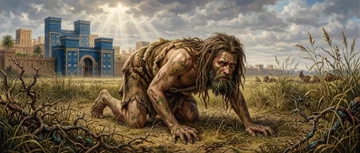
And he was driven from the sons of men; and his heart was made like the beasts, and his dwelling was with the wild asses: they fed him with grass like oxen, and his body was wet with the dew of heaven; till he knew that the most high God ruled in the kingdom of men, and that he appointeth over it whomsoever he will.
Translations
And he was driven from the sons of men; and his heart was made like the beasts, and his dwelling was with the wild asses: they fed him with grass like oxen, and his body was wet with the dew of heaven; till he knew that the most high God ruled in the kingdom of men, and that he appoints over it whomsoever he will.
And he was driven from the sons of men; and his heart was made like the beasts, and his dwelling was with the wild asses: they fed him with grass like oxen, and his body was wet with the dew of heaven; till he knew that the most high God ruled in the kingdom of men, and that he appointeth over it whomsoever he will.
and he was driven from the sons of men; and his heart was made like the beasts, and his dwelling was with the wild asses: they fed him with grass like oxen, and his body was wet with the dew of heaven; till he knew that the most high God ruled in the kingdom of men, and that he appointeth over it whomsoever he will.
And he was driven from the sons of men; and his heart was made like the beasts, and his dwelling was with the wild asses: they fed him with grass like oxen, and his body was wet with the dew of heaven; till he knew that the most high God ruleth in the kingdom of men, and that he appointeth over it whomsoever he will.
and he was driven from the sons of men; and his heart was made like the beasts, and his dwelling was with the wild asses; he was fed with grass like oxen, and his body was wet with the dew of heaven: until he knew that the Most High God ruleth in the kingdom of men, and that he setteth up over it whomsoever he will.
and he was driven from the sons of men, and his heart was made like the beasts’, and his dwelling was with the wild asses; he was fed with grass like oxen, and his body was wet with the dew of heaven; until he knew that the Most High God ruleth in the kingdom of men, and that he setteth up over it whomsoever he will.
and from the sons of men he is driven, and his heart with the beasts hath been like, and with the wild asses [is] his dwelling; the herb like oxen they cause him to eat, and by the dew of the heavens is his body wet, till that he hath known that God Most High is ruler in the kingdom of men, and whom He willeth He raiseth up over it.
and he was driven from the sons of men, and his heart was made like the beasts, and his dwelling was with the wild asses; they fed him with grass like oxen, and his body was bathed with the dew of heaven; till he knew that the Most High God ruleth over the kingdom of men, and that he appointeth over it whomsoever he will.
And, from among the sons of men, was he driven, and, his heart, to a wild beast’s, became equal, and, with the wild asses, was his dwelling, and, grass—like oxen, they suffered him to eat, and, with the dew of the heavens, his body, was drenched—until that he came to know that the Most High God, hath dominion, over the kingdom of men, and, whomsoever he pleaseth, he setteth up over it.
Berean Standard Bible, Majority Standard Bible
He was driven away from mankind, and his mind was like that of a beast. He lived with the wild donkeys and ate grass like an ox, and his body was drenched with the dew of heaven until he acknowledged that the Most High God rules over the kingdom of mankind, setting over it whom He wishes.
He was driven from the sons of men, and his heart was made like the animals’, and his dwelling was with the wild donkeys. He was fed with grass like oxen, and his body was wet with the dew of the sky, until he knew that the Most High God rules in the kingdom of men, and that he sets up over it whomever he will.
And he was sent out from among the sons of men; and his heart was made like the beasts', and he was living with the asses of the fields; he had grass for his food like the oxen, and his body was wet with the dew of heaven, till he was certain that the Most High is ruler in the kingdom of men, and gives power over it to anyone at his pleasure.
And hee was driuen from the sonnes of men, and his heart was made like the beastes, and his dwelling was with the wilde asses: they fed him with grasse like oxen, and his body was wet with the dewe of the heauen, till he knewe, that the most high God bare rule ouer the kingdome of men, and that he appointeth ouer it, whomsoeuer he pleaseth.
Douay-Rheims (Challoner revision)
And he was driven out from the sons of men, and his heart was made like the beasts, and his dwelling was with the wild asses, and he did eat grass like an ox, and his body was wet with the dew of heaven: till he knew that the most High ruled in the kingdom of men, and that he will set over it whomsoever it shall please him.
Pictures
Cross-references 20 of 23
- Daniel 4:32
And they shall drive thee from men, and thy dwelling shall be with the beasts of the field: they shall make thee to eat grass as oxen, and seven times shall pass over thee, until thou know that the most High ruleth in the kingdom of men, and giveth it to whomsoever he will.
Nebuchadnezzar is humbled until he acknowledges God’s rule.
- Daniel 4:17
This matter is by the decree of the watchers, and the demand by the word of the holy ones: to the intent that the living may know that the most High ruleth in the kingdom of men, and giveth it to whomsoever he will, and setteth up over it the basest of men.
Nebuchadnezzar’s experience shows that the Most High rules human kingdoms and appoints their rulers.
- Daniel 4:25
That they shall drive thee from men, and thy dwelling shall be with the beasts of the field, and they shall make thee to eat grass as oxen, and they shall wet thee with the dew of heaven, and seven times shall pass over thee, till thou know that the most High ruleth in the kingdom of men, and giveth it to whomsoever he will.
Nebuchadnezzar is humbled until he acknowledges that God rules over human kingdoms.
- Daniel 4:34-35
And at the end of the days I Nebuchadnezzar lifted up mine eyes unto heaven, and mine understanding returned unto me, and I blessed the most High, and I praised and honoured him that liveth for ever, whose dominion is an everlasting dominion, and his kingdom is from generation to generation:
Nebuchadnezzar is humbled and acknowledges God’s rule over human kingdoms.
- Daniel 2:21
And he changeth the times and the seasons: he removeth kings, and setteth up kings: he giveth wisdom unto the wise, and knowledge to them that know understanding:
Both affirm that God removes and appoints kings.
- Daniel 5:26-28
This is the interpretation of the thing: MENE; God hath numbered thy kingdom, and finished it.
The writing announces God’s judgment on Belshazzar and the division of his kingdom.
- Daniel 2:37-38
Thou, O king, art a king of kings: for the God of heaven hath given thee a kingdom, power, and strength, and glory.
Daniel recalls that God gave Nebuchadnezzar his kingdom and ruled over kings.
- Daniel 4:33
The same hour was the thing fulfilled upon Nebuchadnezzar: and he was driven from men, and did eat grass as oxen, and his body was wet with the dew of heaven, till his hairs were grown like eagles’ feathers, and his nails like birds’ claws.
Both describe Nebuchadnezzar’s humiliation, with his body wet from heaven’s dew.
- Psalms 75:7
But God is the judge: he putteth down one, and setteth up another.
Both affirm that God rules over kingdoms and appoints or removes their rulers.
- Jeremiah 50:31
Behold, I am against thee, O thou most proud, saith the Lord GOD of hosts: for thy day is come, the time that I will visit thee.
Both describe judgment on proud Babylon and its fall.
- Romans 13:1
Let every soul be subject unto the higher powers. For there is no power but of God: the powers that be are ordained of God.
same truth that all power is of God
- Daniel 4:37
Now I Nebuchadnezzar praise and extol and honour the King of heaven, all whose works are truth, and his ways judgment: and those that walk in pride he is able to abase.
quoted as Nebuchadnezzar's acknowledgment God abases the proud
- Daniel 4:30-31
The king spake, and said, Is not this great Babylon, that I have built for the house of the kingdom by the might of my power, and for the honour of my majesty?
Both show rulers taking glory and then being humbled.
- Psalms 103:19
The LORD hath prepared his throne in the heavens; and his kingdom ruleth over all.
Both affirm that God’s kingdom rules over all.
- Daniel 4:36
At the same time my reason returned unto me; and for the glory of my kingdom, mine honour and brightness returned unto me; and my counsellors and my lords sought unto me; and I was established in my kingdom, and excellent majesty was added unto me.
shows restoration when Nebuchadnezzar learned the lesson
- Jeremiah 27:6
And now have I given all these lands into the hand of Nebuchadnezzar the king of Babylon, my servant; and the beasts of the field have I given him also to serve him.
God gives kingdoms into the hands of rulers he appoints.
- Isaiah 13:17-22
Behold, I will stir up the Medes against them, which shall not regard silver; and as for gold, they shall not delight in it.
predicts taking fulfilled in Daniel 5 night
- Daniel 3
Nebuchadnezzar the king made an image of gold, whose height was threescore cubits, and the breadth thereof six cubits: he set it up in the plain of Dura, in the province of Babylon.
The furnace episode shapes Nebuchadnezzar’s dealings with God.
- Jeremiah 51
Thus saith the LORD; Behold, I will raise up against Babylon, and against them that dwell in the midst of them that rise up against me, a destroying wind;
Both concern Babylon and its destruction under divine judgment.
- Daniel 4:8-9
But at the last Daniel came in before me, whose name was Belteshazzar, according to the name of my god, and in whom is the spirit of the holy gods: and before him I told the dream, saying,
states Nebuchadnezzar's acknowledgment of source of Daniel's wisdom
Commentary
Each commentary is drawn from primary sources: the writings of Ellen G. White and Adventist pioneers and periodicals. Each commentary is separate. Its own words are not a quotation; follow the references to read the source passages.
Ellen G. White
14 sources
God drove proud Nebuchadnezzar from human society to live with wild animals, eating grass and exposed to dew, with a mind debased like a beast and stripped of kingly wisdom and power until he acknowledged that the Most High rules over human kingdoms and sets over them whomever He chooses.Ms 79, 1908, par. 8–12RH Sep 24, 1908Ms 50, 1893, par. 27–30 His humbling and restoration show that pride brings judgment and loss, and that God makes His sovereignty known by bringing down exalted rulers.Ms 79, 1908, par. 8–12RH Sep 24, 1908Ms 50, 1893, par. 27–30 Belshazzar knew of this lesson yet refused to humble himself, and in sacrilegious revelry with his lords he profaned the sacred vessels of Jehovah and praised idols until he was weighed and found wanting and heard his doom pronounced.RH Sep 24, 1908Ms 50, 1893, par. 27–30PK 522.25T 244.4–5Lt 40a, 1878, par. 6–12 Babylon was shattered in an hour of feasting because in prosperity its rulers deemed themselves independent of God and ascribed the kingdom's glory to human achievement, fulfilling divine prophecy in the history of nations.PK 501.3Lt 109a, 1898, par. 5–8Ms 47a, 1898, par. 2–5 The Most High still rules and appoints rulers, working continually in human affairs, and He punishes those who make light of what He has made sacred, keeping faithful record of injustice and oppression against His people.5T 244.4–5PK 501.3Ms 47a, 1898, par. 2–5Ms 168, 1898, par. 1–3
Nebuchadnezzar's Humbling Described
Pride hardened Nebuchadnezzar's mind, and by God's decree he was driven and banished from human society, stripped of the wisdom God had given him and of his kingly power.Ms 50, 1893, par. 27–30PK 522.2RH Feb 6, 1900 This humbling of so proud a king shows that God can bring low the exalted ruler.RH Sep 24, 1908
His heart was made like the beasts, and his dwelling was with the wild asses and wild animals.Ms 79, 1908, par. 8–12Ms 50, 1893, par. 27–30 They fed him with grass like oxen, and his body was wet with the dew of heaven.Ms 79, 1908, par. 8–12Ms 50, 1893, par. 27–30
This beast-like state lasted till he knew and acknowledged that the Most High God, the God of Israel who has power to create and destroy, rules in the kingdom of men and appoints over it whomsoever He will.Ms 79, 1908, par. 8–12RH Sep 24, 1908Ms 50, 1893, par. 27–30RH Feb 6, 1900 After that acknowledgment he was restored.PK 522.2 His experience demonstrates that pride brings judgment and loss of power, and that God's sovereignty is made known through the humbling of rulers.Ms 79, 1908, par. 8–12RH Sep 24, 1908
Belshazzar's Defiance and Fall
The verse belongs to the account of changes near the end of Daniel's life, when Babylon passed from Nebuchadnezzar to his successors and began to decline, and its fall came in an hour of feasting and revelry under God's providence.PK 522.1Lt 109a, 1898, par. 5–8 Belshazzar knew the history of his predecessor's humbling and restoration, how Nebuchadnezzar was driven from human society and lived like an animal until he learned that the Most High God rules human kingdoms and appoints their rulers.RH Sep 24, 1908Ms 50, 1893, par. 27–30 He was banished from human society by God's decree after pride hardened his mind, living among wild animals, eating grass, and exposed to the dew, until he recognized God's rule, yet Belshazzar failed to humble himself or honor God and ignored its lesson.Ms 50, 1893, par. 27–30PK 522.2 His pride and defiance were therefore inexcusable because he knew this history but refused its warning.RH Sep 24, 1908PK 522.2
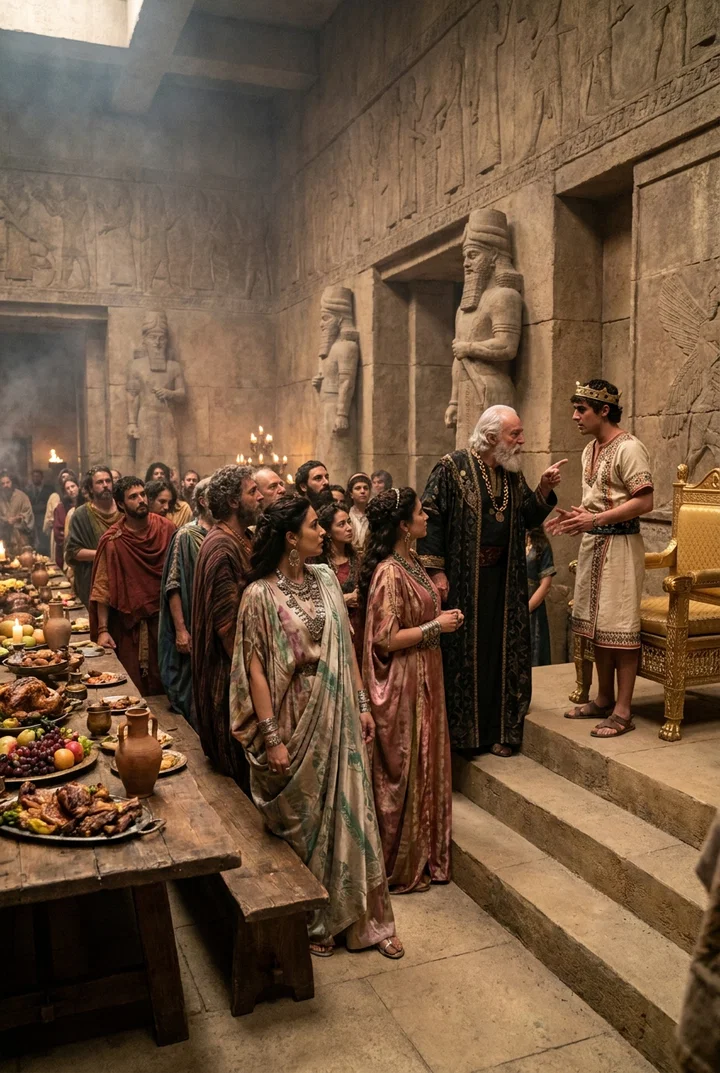
His coming calamity resulted from disregarding the light God had given through Nebuchadnezzar's experience, for neglecting and failing to practice God's lessons brings judgment.Lt 201, 1899, par. 3–4 Against the background of God's sovereignty and judgment, Belshazzar with his thousand lords profaned the golden vessels of Jehovah chosen as sacred and praised the idols of Babylon in sacrilegious mirth and revelry.5T 244.4–5Lt 40a, 1878, par. 6–12 The God whom they defied witnessed the unholy scene, and Belshazzar was weighed and found wanting.5T 244.4–5Lt 40a, 1878, par. 6–12 In the midst of that mirth a bloodless hand traced mysterious characters upon the palace wall, and in terror king and courtiers heard their doom pronounced by the servant of the Most High.5T 244.4–5
Babylon's fall came in an hour of feasting and revelry and shows the literal fulfillment of divine prophecy in the history of nations.PK 501.3Lt 109a, 1898, par. 5–8Ms 168, 1898, par. 1–3 It was at last shattered and broken because in prosperity its rulers regarded themselves as independent of God and ascribed the glory of the kingdom to human achievement.PK 501.3 Though God in providence incessantly at work over human affairs had given light to Nebuchadnezzar through Daniel's interpretation exalting Jehovah as more powerful than earthly kings, and though Nebuchadnezzar was wrought upon to acknowledge and believe in God's superior power after Christ walked in the fiery furnace with the three faithful servants, the fall still came in that hour of revelry.Ms 47a, 1898, par. 2–5Ms 168, 1898, par. 1–3 Belshazzar's presumption and defiance follow the pattern of that earlier king, showing that people can persist in insolence and blasphemy until they pass the limits of God's forbearance, after which God intervenes to end their defiance.6MR 391.1–3
God's Sovereign Dealings Applied
Daniel 5:21 declares that the Most High rules in the kingdom of men and appoints over it whomsoever He will, and the history of nations bears out that providence as always and incessantly at work in human affairs.PK 501.3Ms 47a, 1898, par. 2–5Ms 168, 1898, par. 1–3 He had light for Nebuchadnezzar, and for a purpose came in close contact even with that idolatrous mind through Daniel.Ms 47a, 1898, par. 2–5Ms 168, 1898, par. 1–3 Through Daniel's interpretation of Nebuchadnezzar's dream Jehovah was exalted as more powerful than earthly kings, and things foretold in prophecies against Babylon and other kingdoms were presented to the king.Ms 47a, 1898, par. 2–5Ms 168, 1898, par. 1–3 God brought the king into reasoning relation with Daniel because Daniel, while doing his assigned work as a statesman, plainly refused any work that would militate against God.Ms 47a, 1898, par. 2–5Ms 168, 1898, par. 1–3
Nebuchadnezzar perverted the light by reading the interpretation in accordance with his own idolatrous mind, setting up a golden image representing the glory of himself and Babylon to convert all nations to its worship.Ms 47a, 1898, par. 2–5Ms 168, 1898, par. 1–3 But after Christ walked in the fiery furnace with the three faithful servants who would not bow, he was wrought upon to acknowledge and believe in God and His superior power.Ms 47a, 1898, par. 2–5Ms 168, 1898, par. 1–3 Men are not to read the Scriptures and God's providences in the light of their dreams and fancies but to read their dreams in the light of the living oracles.Ms 47a, 1898, par. 2–5Ms 168, 1898, par. 1–3 So it will be at the end of the world, in this momentous period when students of God's Word must work away from the customs of the world's counselors, and only those prepared like wise virgins with oil will meet the Bridegroom.Ms 47a, 1898, par. 2–5Ms 168, 1898, par. 1–3
The verse also shows how God punishes those who make light of what He has chosen as sacred to Himself.5T 244.4–5 Belshazzar with his thousand lords profaned the golden vessels of Jehovah and praised the idols of Babylon, but the God whom they defied witnessed the unholy scene.5T 244.4–5 In the midst of their sacrilegious mirth a bloodless hand traced mysterious characters upon the palace wall, and king and courtiers in terror heard their doom pronounced by the servant of the Most High.5T 244.4–5 The same hand that traced the characters on Belshazzar's wall keeps faithful record of every act of injustice or oppression against God's people, so those who trace words of calumny and falsehood against the servants of Christ profane not soulless vessels but the characters of those whom Christ purchased by His blood, and God is witness of their deeds.5T 244.4–5
Sources
Pioneers and periodicals
80 sources
Nebuchadnezzar was driven out from human society and rule, with his mind made like a beast's, living and feeding like an animal until he acknowledged God's sovereignty.ST Jun 28, 1899ST Sep 20, 1905ST Nov 17, 1914 He dwelt with the wild asses, was fed grass like oxen, and his body was wet with the dew of heaven and exposed to the elements.ST Jun 28, 1899RH May 11, 1869ST Jan 23, 1912 His humiliation teaches that the Most High God rules in the kingdom of men and sets over it whomever He will.ST Jan 23, 1912ST Jun 28, 1899ST Sep 20, 1905 Belshazzar knew all this history yet refused to humble himself or give God glory, but lifted himself against the Lord of heaven by drinking from His holy temple vessels and praising gods of gold and silver.RH Sep 24, 1908RH May 11, 1869STST Oct 5, 1904 That same night he was weighed in the balances and found wanting, his numbered kingdom was divided and given to the Medes and Persians, and he was slain when they entered Babylon and Darius the Median took the kingdom.RH Nov 26, 1857ST Sep 6, 1899ST Feb 13, 1907ST May 20, 1897RH Nov 11, 1862
Nebuchadnezzar's Beastlike Humiliation
Nebuchadnezzar was driven from the sons of men and from human society and rule, with his heart made like the beasts, living and feeding like a beast or animal until he acknowledged God's sovereignty.ST Jun 28, 1899ST Sep 20, 1905ST Nov 17, 1914RH May 11, 1869ST Jun 28, 1899 His humiliation brought him low to live like a beast and eat grass until he knew that the Most High God rules in the kingdom of men and appoints over it whomsoever He will.ST Jun 28, 1899ST Sep 20, 1905ST Nov 17, 1914ST Jun 28, 1899ST Feb 13, 1907 That humiliation ended only when he recognized God's sovereignty, teaching that earthly power is subject to God's authority.ST Jun 28, 1899ST Sep 20, 1905ST Feb 13, 1907
His dwelling was with the wild asses, they fed him with grass like oxen or cattle, and his body was wet with the dew of heaven and exposed to the elements.ST Jun 28, 1899RH May 11, 1869ST Jan 23, 1912RH Jun 27, 1878ST Apr 12, 1905 He lived among wild asses and ate grass like oxen, enduring the dew until he acknowledged that God rules human kingdoms and appoints their rulers.ST Jun 28, 1899ST Jan 23, 1912RH Jun 27, 1878ST Jan 23, 1912 His pride was thus brought low until he recognized that the Most High rules and appoints as He chooses.ST Apr 12, 1905ST Jan 23, 1912
His downfall followed pride and failure to acknowledge God as the source of his greatness, reducing a king of great power and dominion to madness and seven years of insanity and exile.RH Aug 22, 1907RH Jun 12, 1900ST Apr 12, 1905ST Aug 13, 1896 The tree that reached heaven and sheltered and fed living creatures represents his vast dominion.ST Apr 12, 1905 He exalted himself against God and was driven from men to live like a beast until he knew that the Most High rules and appoints over the kingdom whom He will.RH Aug 22, 1907RH Jun 12, 1900ST Aug 13, 1896
He lost his throne, kingdom, place among men, power, and the wisdom God had given him, showing that God can humble a proud king and take away his power and that the God of Israel has power to create and destroy.RH Feb 6, 1900RH Jun 12, 1900RH Aug 22, 1907RH Jun 12, 1900RH Oct 7, 1902 His removal from the throne and beastlike life continued until he learned that human greatness and power are gifts from God, leaving no ground for pride or self-glorification and making known God's sovereignty and the smallness of humanity.RH Jun 12, 1900RH Aug 22, 1907RH Jun 12, 1900 His affliction transformed him and brought him to know God and His righteousness, and his restoration became a testimony to God's goodness and wisdom.ST Nov 26, 1912ST Aug 13, 1896RH Oct 7, 1902 Excellent majesty was added to him when he learned that every man from king to lowliest is a servant of God, and his acknowledgment that God does according to His will in heaven and earth and is able to abase those who walk in pride stands as public record with useful lessons for life.ST Aug 13, 1896RH Oct 7, 1902
Belshazzar's Feast and Fall
Daniel 5:21 belongs to the night Babylon fell, when Belshazzar made a great feast for a thousand of his lords and drank wine with his princes, wives and concubines.RH Nov 26, 1857ST Jan 15, 1880 The wine was drunk from the vessels of gold and silver that Nebuchadnezzar had taken from the temple of God at Jerusalem, while those feasting praised gods of gold and silver.RH Nov 26, 1857ST Jan 15, 1880ST Apr 23, 1912 The king and the whole city gave themselves to feasting, drunkenness, revelry and riot in apparent security, and in that profanation of the sacred vessels Belshazzar reached the limit of mercy, for such presumption brings sure and sore consequences.ST Jan 15, 1880ST May 20, 1913ST Mar 18, 1903ST Apr 23, 1912
Part of a man's hand wrote upon the wall, and Daniel interpreted it as MENE, that God had numbered the kingdom and finished it, TEKEL, that it was weighed in the balances and found wanting, and PERES, that the kingdom was divided and given to the Medes and Persians.RH Nov 26, 1857ST Feb 13, 1907 That same night the sentence was executed when the Medes and Persians entered through the river gates and Babylon was taken.RH Nov 26, 1857ST May 20, 1897 The two-leaved gates were opened and not shut, while the mighty men of Babylon forbore to fight, remained in their holds, lost their might and became as women.RH Nov 11, 1862 Despite his confidence and mighty walls Belshazzar king of the Chaldeans was slain, his doom having been declared that night, and Darius the Median took the kingdom and Medo-Persia under Cyrus overthrew Babylon in B.C. 538 after two hundred and nine years.RH Nov 26, 1857ST May 20, 1897ST Apr 9, 1896RH Mar 8, 1915 Belshazzar's confidence that no enemy could capture the city ended with the Persians taking it, showing that when rulers take all glory to themselves their days are numbered.ST Apr 9, 1896RH Mar 8, 1915
Nebuchadnezzar was Belshazzar's grandfather and ancestor, called father after the Scripture custom of calling any ancestor father and any descendant son, and Belshazzar was the grandson of Nebuchadnezzar.RH Nov 26, 1857ST Jan 15, 1880ST Belshazzar was the son of Nabonadius, or Nabonidus, not Nabonadius himself, and was son and heir associated with his father upon the throne, reigning conjointly with him while his father gave his last days to religious devotions and temple-building and left the grave affairs of state to the pleasure-loving Belshazzar.ST Jul 10, 1901STST May 20, 1913ST Dec 27, 1905 His reign is dated from 549 B.C., reaching its third year in 538 B.C., the year he was overthrown and succeeded by Darius.ST Jul 10, 1901 The account is historically confirmed, for inscriptions report that Nabonidus left his son Belshazzar in command of the city before Cyrus captured it, and historical records confirm the biblical account of Belshazzar's death.ST Jul 23, 1885RH May 13, 1909 The cuneiform testimony of Nabonidus praying for himself and for Belshazzar his son concurs as a second, non-collusive and absolutely conclusive witness to the reliability of the record, and the hall where the feast took place is said to have been uncovered in Babylon.ST May 20, 1913RH Apr 6, 1911
The chapter recounts Belshazzar's feast and ends with his death and Darius taking the kingdom, recording the termination of the Babylonian kingdom near the end of its allotted career.ST It belongs to the historical part of Daniel concerning Belshazzar king of Babylon, the same Belshazzar in whose first year Daniel received the dream of chapter 7, so that chapter 7 chronologically follows chapter 4 with history set by itself before the prophetical part.ST Apr 5, 1877 It belongs to the last years of Babylon and the handwriting on the wall, studied together with the captivity of Judah and the experiences of Daniel and his companions in Daniel 1-2 as part of the gospel message for all the world.RH Jul 1, 1902 Babylon under Nebuchadnezzar rose by rapid conquests and ruling power to the height of power, while under the last king Belshazzar it came to an end.ST May 3, 1877 Belshazzar was the last of the kings of rich, proud, luxurious, voluptuous Babylon, a weak, dissolute, sacrilegious and pusillanimous king who instead of driving away his foes like a lion shut himself up in the city feasting and drinking with his lords till he was killed.STST Mar 5, 1912RH Feb 8, 1870ST May 3, 1877 That cowardice is given as one possible meaning of the plucking of the lion's wings, with the humiliation of Nebuchadnezzar as the other.RH Feb 8, 1870 The chapter presents God as Judge and Vindicator, records the end of Babylon's kingdom that had shaped the world from its founding by Nimrod, and belongs to the account of Belshazzar who was found wanting.ST Jan 23, 1912ST Jul 16, 1912ST Oct 23, 1901ST Jan 23, 1912
God Rules Human Kingdoms
The Most High God rules in the kingdom of men and appoints over it whomsoever He will, and Nebuchadnezzar was driven from human society to live and feed like a beast, dwelling with the wild asses, eating grass like oxen and wet with the dew of heaven, until he was humbled and chastened to know and acknowledge that sovereignty.ST Jan 23, 1912ST Jun 28, 1899ST Sep 20, 1905ST Nov 17, 1914RH Jun 12, 1900 His humiliation ended when he recognized God's sovereignty, and it taught that earthly power is subject to God's authority.ST Jun 28, 1899ST Sep 20, 1905RH May 11, 1869 God uses a nation while it can serve His glory, then sets it aside and raises up another, and in this He is displayed as Judge.ST Jan 23, 1912 He manages the nations and can use them to carry out His purposes without their being Christian nations.ST Sep 29, 1898 He is the first cause of everything good whose kingdom rules over all, overruling all things, and though He does not directly intervene in everything, He has special care for His children on whose behalf He often directly intervenes.RH Nov 8, 1870
Royal power, honor and dominion over earthly kingdoms come from God and are His gifts, so pride must give way to acknowledging His sovereignty and homage is due to Him.RH Jun 12, 1900ST Oct 18, 1905RH Jun 12, 1900 Human greatness and power leave no ground for pride or self-glorification, and through this history God's sovereignty and the smallness of humanity were made known.RH Jun 12, 1900 Rulers and nations must submit to God's righteous rule, and only those in harmony with it can endure.ST Dec 1, 1914 Rulers who act tyrannically remain accountable to God.
God worked for His people in overthrowing Babylon in proof of this rule, and that display together with association with Daniel led Cyrus to recognize the true God as great over all others.ST Dec 19, 1892 The transfer of power when Babylon fell that same night after Belshazzar's feast profaned the sacred vessels and the kingdom was numbered and given to the Medes and Persians opened the way for the Hebrews to regain liberty and religious privileges.ST Apr 23, 1912 This rule also exemplifies God's long-suffering mercy toward nations, that He does not overthrow a people until their iniquity is full and there is no more hope of good from them, and Grecia was no exception but was overthrown only when the transgressors were come to the full.ST Feb 10, 1898
That ruling God gave Daniel foreknowledge more than two hundred years beforehand of a two-division kingdom succeeding Babylon with the stronger part coming up last, its overthrow by a kingdom from the west, the speed of the third kingdom's conquests, its king's death without a successor to keep the crown to his posterity, and the division of the empire into just four parts.RH Dec 3, 1857ST Feb 5, 1880 Only an omniscient mind could have foreseen and inspired such accurate writing of future events.RH Dec 3, 1857ST Feb 5, 1880 Every accomplished prophecy stands as proof graven in eternal rock that the Lord Omnipotent reigns and no word or purpose of His will ever fail, and things of present and worldwide interest in which the whole world now has a stake will be fulfilled with the same certainty and accuracy.RH Dec 3, 1857ST Feb 5, 1880 The same rule is at work in the last days in fixing the beginning of the great prophetic period reaching to 1844 when the cleansing of the sanctuary was to come and the judgment hour in heaven was to open, and in bringing at the right time the great advent movement proclaiming the judgment hour at hand, followed by the third angel's message spreading with its call to reformation and the coming of the Lord, bringing out a people keeping the commandments of God and the faith of Jesus.RH May 12, 1910
Belshazzar Rejected Known Warning
Belshazzar knew all that had happened to Nebuchadnezzar, how pride drove him from human society and rule to live and feed like a beast with grass like oxen and body wet with dew until he acknowledged that the Most High rules in the kingdom of men and appoints over it whomsoever He will.RH Sep 24, 1908RH May 11, 1869RH Aug 22, 1907ST Oct 18, 1905ST Sep 20, 1905 That humiliation stood as a known warning that Babylon's power came from God and that he must humble himself before God, yet he failed to heed it, learn it, take it to heart, humble himself, honor God or give Him glory.RH Sep 24, 1908RH May 11, 1869STRH Aug 22, 1907ST Sep 20, 1905 By knowing the lesson and rejecting it he sinned against light received, and his pride and defiance were inexcusable and brought judgment on himself and his kingdom and contributed to Babylon's fall.RH Sep 24, 1908RH Aug 22, 1907ST Oct 18, 1905
Though dependent on God for life and breath, with his breath in God's hand and all his ways belonging to Him, he lifted himself against the Lord of heaven instead of giving God first and highest service.ST Oct 5, 1904ST Oct 23, 1901STRH Oct 7, 1902 He did not humble his heart though he knew all this, but exalted himself against God on whom he depended for life and faced judgment for his defiance.ST Oct 5, 1904ST Oct 23, 1901ST He profaned holy things by commanding the gold and silver vessels taken from the temple at Jerusalem to be brought, drinking from them with his princes, wives and concubines while drunken with wine and vanity, and by praising gods of gold and silver that are no gods, failing to glorify the true God.STST Aug 13, 1896 He acted as if he himself ruled and as if Babylon would stand forever, trusting its mighty walls to resist attack even while the victorious Medes and Persians were outside, and boasting in nightly revel of his own puny power and cheap glory.ST Aug 13, 1896
God had humbled Nebuchadnezzar for pride and for taking all glory to himself and refusing to honor God, while Belshazzar remained proud and defied God.RH May 11, 1869ST Apr 9, 1896RH Feb 18, 1904 When Babylon's rulers took all glory to themselves, as Nebuchadnezzar did and Belshazzar did, the day of humiliation was at hand, for God humbles proud rulers to teach that the Most High rules in the kingdom of men and gives it to whomever He will.ST Apr 9, 1896 If men even in wrath and rebellion serve God's purpose it is well, but if otherwise their days are numbered.ST Apr 9, 1896
After Nebuchadnezzar had accepted God's correction and returned to true worship, later kings turned back to apostasy and the empire ended in rebellion against God.ST Jul 6, 1915 In that wider account ancient Babylon rejected the true gospel taught to Nebuchadnezzar and fell as a consequence, serving as a prophecy of modern Babylon.RH Oct 11, 1915 God punished Babylon's king for persisting in sin despite seeing how God had punished the Jews.ST Jun 21, 1883
Prophecy Judgment and Fulfillment
Daniel 5 presents the handwriting on the wall as prophecy whose meaning was explained and whose prediction of Babylon's overthrow was fulfilled soon afterward.RH Sep 2, 1909 Belshazzar's kingdom was numbered and finished, weighed in the balances and found wanting, then divided and given to the Medes and Persians, so Medo-Persia under Cyrus overthrew it.RH Nov 26, 1857ST Feb 13, 1907 The weighing belongs to the account of Babylon near the end of its allotted career, when the kingdom faced judgment after Nebuchadnezzar had been humbled until he knew that God rules human kingdoms and appoints their rulers.ST Sep 6, 1899ST Feb 13, 1907 Babylon was weighed in the balances of God's righteous purposes and found wanting, and when its rulers took all glory to themselves, as Nebuchadnezzar did and Belshazzar did, the day of humiliation was at hand.ST Apr 9, 1896 The sentence weighed in the balances and found wanting applies not to Belshazzar alone but to all weighed by the scales by which God estimates moral worth.RH Nov 26, 1857
The fifth chapter records the termination of the Babylonian kingdom. Its fall serves as a prophecy of modern Babylon, for ancient Babylon rejected the true gospel taught to Nebuchadnezzar and fell as a consequence.RH Oct 11, 1915 The chapter's lesson for the present depends on the meaning the Lord gives the name Babylon and its application in Scripture.RH Jul 31, 1900 Daniel could read the writing's meaning because the Spirit of prophecy enabled him to see complete sentences behind the words.RH Jun 19, 1900 Understanding God's message therefore requires more than knowing literal wording and depends on the Spirit's wisdom and revelation.RH Jun 19, 1900
Destruction came suddenly upon king and city while giving themselves to feasting, drunkenness and revelry in apparent security before they were aware.ST Jan 15, 1880 Belshazzar saw the warning, but too late to escape judgment; he died that night and his kingdom passed away.ST May 22, 1907 Proclamations of peace do not prevent such sudden destruction.ST May 22, 1907 The verse belongs to the wonderful book of Daniel for the last days revealing a God interested in affairs of men and nations now as then.ST Aug 9, 1910 The feast of Belshazzar with its mysterious handwriting and most tragic end, recalling the insane king, draws very large congregations and increasing interest when taught together with the wonderful deliverances from the fiery furnace and the den of lions.ST Nov 28, 1892
Faithful Witness and Application
When a Medo-Persian command required disobedience to God, Daniel was right to refuse it because the government had overstepped the bounds of its authority set by God, and servants of God are exonerated from censure in such refusal since duty to God is paramount to duty to man.ST Apr 14, 1898 His interpreting of God's dealings with rulers and kingdoms shows what a faithful messenger does, reading God's hand in the course of events and explaining it to others.RH Feb 20, 1900 Nebuchadnezzar's misfortune came when he refused to recognize himself as servant of the God who rules in the kingdom of men and appoints over it whomsoever He will, and he learned that every man from king to lowliest is God's servant and must give Him first and highest service, with excellent majesty added to him afterward, while Belshazzar knew what had happened yet lifted himself against the Lord of heaven instead and Babylon fell.RH Oct 7, 1902
Nebuchadnezzar's being wet with the dew of heaven uses in the Greek Old Testament bapto in an acquired secondary sense of wet rather than its normal sense of dip, the only place in all Scripture where even bapto carries any other signification than dip, while baptizo never takes such secondary meanings.ST Apr 22, 1880 Baptism is always designated by baptizo, which means immerse and that only, and bapto is carefully excluded from baptism texts, so the verse gives opponents of immersion nothing and leaves baptism standing solely on baptizo.ST Apr 22, 1880 Strong drink is a cause of a nation's ruin, and Chaldea under Belshazzar is an example of a nation that lost its existence through intemperance.ST Feb 20, 1901 Belshazzar's feast belongs to God's judgment against wrongdoing, and like the destruction of San Francisco it warns to recognize God and turn from sin, since judgments that do not lead to repentance can harden people and bring greater divine displeasure.RH Feb 20, 1908
The fall of Belshazzar, last of the kings of rich, proud, luxurious, voluptuous Babylon, is a most striking lesson pre-eminently applicable today and was written for learning and is profitable to study.STST He was not sole king but reigned conjointly with his father Nabonadius, who gave his last days to religious devotions and temple-building and left the grave affairs of state to the pleasure-loving Belshazzar.ST He was the grandson of Nebuchadnezzar, Babylon's mightiest king, whose humbling the verse recounts.ST He reached the limit of mercy by profaning the sacred vessels of the Lord's house at a riotous feast and praising silver and gold gods, and that presumption brings sure and sore consequences, so Babylon was overthrown.ST May 20, 1913ST Mar 18, 1903 Though judged, he still granted Daniel the promised honor of third ruler after Daniel interpreted the writing on the wall announcing Babylon's final doom, and he was slain that night in a momentous act in the history of the empire whose significance its wise and learned could not discern.ST May 20, 1913ST Jul 20, 1915
Sources