Deuteronomy 1:26
Notwithstanding ye would not go up, but rebelled against the commandment of the LORD your God:
Translations
Notwithstanding you would not go up, but rebelled against the commandment of the LORD your God:
Notwithstanding ye would not go up, but rebelled against the commandment of the LORD your God:
Notwithstanding ye would not go up, but rebelled against the commandment of the Lord your God:
Notwithstanding, ye would not go up, but rebelled against the commandment of the LORD your God:
Yet ye would not go up, but rebelled against the commandment of the LORD your God:
Yet ye would not go up, but rebelled against the commandment of Jehovah your God:
'And ye have not been willing to go up, and ye provoke the mouth of Jehovah your God,
But ye would not go up, and rebelled against the word of Jehovah your God;
Nevertheless ye were not willing to go up,—but rebelled against the bidding of Yahweh, your God;
Berean Standard Bible, Majority Standard Bible
But you were unwilling to go up; you rebelled against the command of the LORD your God.
Yet you wouldn’t go up, but rebelled against the commandment of the LORD your God.
But going against the order of the Lord your God, you would not go up:
Notwithstanding, ye would not go vp, but were disobedient vnto the commandement of the Lord your God,
Douay-Rheims (Challoner revision)
And you would not go up, but being incredulous to the word of the Lord our God,
Pictures
Cross-references
- Numbers 14:1-4
And all the congregation lifted up their voice, and cried; and the people wept that night.
Israel refuses the command to enter Canaan and proposes returning to Egypt.
- Numbers 13
And the LORD spake unto Moses, saying,
The spies’ report and the people’s response explain Israel’s refusal to enter Canaan.
- Numbers 14:33-34
And your children shall wander in the wilderness forty years, and bear your whoredoms, until your carcases be wasted in the wilderness.
Their refusal brings forty years of wilderness wandering and the consequence of disobedience.
- Numbers 14:40-45
And they rose up early in the morning, and gat them up into the top of the mountain, saying, Lo, we be here, and will go up unto the place which the LORD hath promised: for we have sinned.
Israel’s disobedient advance without God’s favor ends in defeat.
- Numbers 32:8-9
Thus did your fathers, when I sent them from Kadesh-barnea to see the land.
Recalls Israel’s refusal to enter the land and the resulting discouragement.
- Exodus 16:2-3
And the whole congregation of the children of Israel murmured against Moses and Aaron in the wilderness:
Israel grumbles in the wilderness and longs for Egypt.
- Deuteronomy 4:34
Or hath God assayed to go and take him a nation from the midst of another nation, by temptations, by signs, and by wonders, and by war, and by a mighty hand, and by a stretched out arm, and by great terrors, according to all that the LORD your God did for you in Egypt before your eyes?
God’s mighty acts brought Israel out of Egypt.
Commentary
Each commentary is drawn from primary sources: the writings of Ellen G. White and Adventist pioneers and periodicals. Each commentary is separate. Its own words are not a quotation; follow the references to read the source passages.
Ellen G. White
11 sources
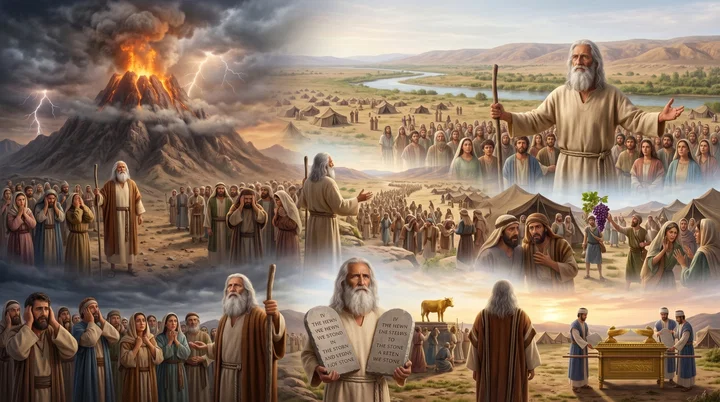
Israel stood on the very borders of Canaan when the command came to go up and enter and take possession of the promised land, and would not go up but rebelled against the commandment of the Lord their God even after the spies brought back a good report.Ms 9, 1903, par. 7–9RH Dec 31, 1903 Fear and unbelief took hold, and murmuring and fearful complaints spread through the people and through the camp.Ms 9, 1903, par. 7–9RH Dec 31, 1903 They murmured that God had brought them out of Egypt to destroy them, though He had promised them the land and had gone before them.RH Dec 31, 1903
The refusal broke the people's agreement to follow the Lord's directions, for they acted against that agreement in murmuring and complaining.RH Dec 31, 1903Ms 9, 1903, par. 6 It was rooted in distrust and unbelief, and in pride, impatience, and fear.RH Dec 31, 1903ST Mar 3, 1881PP 464.2 Their disobedience showed that cooperating with God's plans mattered for their present and future good and for their eternal welfare.Ms 9, 1903, par. 6
Because they did not wholly follow Him but discouraged the heart of Israel from entering, the Lord refused entrance to the adult army that left Egypt, to the men from twenty years old and upward, save Caleb and Joshua who wholly followed Him.15MR 292.3Lt 106, 1897, par. 21–24 He altered His purpose toward them and made Israel wander in the wilderness forty years until all that evil generation was consumed.15MR 292.3Lt 106, 1897, par. 21–24 In this way their disobedience and broken pledge brought delay and forfeited the fathers' favor.Lt 106, 1897, par. 21–24ST Mar 3, 1881
The long wandering and delay in possessing Canaan was not God's fault or a failure of His faithfulness.ST Mar 3, 1881PP 464.2 God was more grieved by the delay than they were, for He wanted to bring them into immediate possession to display His mighty and protecting power in their deliverance before all nations.PP 464.2 They were unprepared to enter or to represent a people whose God is the Lord because they did not bear His character of purity, goodness, and benevolence, and had they yielded in faith to His direction, governed by His judgments and walking in His ordinances, they would long before have been settled in Canaan as a prosperous, holy, happy people.ST Mar 3, 1881PP 464.2 Their perversity prevented that display, while their delay to enter the goodly land dishonored God and detracted from His glory before surrounding nations.ST Mar 3, 1881PP 464.2 His promised blessings would not fail, but they are upon condition of obedience and holiness, of keeping His statutes and judgments, which is the condition of life in them.15MR 292.3ST Mar 3, 1881
The refusal belongs to the failures and victories of the forty years of wandering given through Moses in the book of Deuteronomy just before the possession of Jericho.Lt 204, 1908, par. 2–3 Moses was instructed to repeat such lessons over and over.Lt 204, 1908, par. 2–3 They are to be kept before God's people to strengthen faith and to be rehearsed more often, showing that every new move is to be a carrying out of the principles God gave Israel at that time.Lt 204, 1908, par. 2–3
The chapter with Deuteronomy 8 is the word of the Lord to be read and heeded as admonition to those living at the end of the world, on whom the ends of the world are come.STMW9 52.3Lt 73, 1896, par. 30–31 It warns against refusing God's command and rebelling against Him, against trusting personal judgment, following His guidance only up to the point that agrees with personal judgment, then holding to one's own ideas, resisting His guidance, and refusing to be molded after His similitude.STMW9 52.3Lt 73, 1896, par. 30–3120MR 111.2–112.2 Everything must be tested by asking if it is the will of the Lord and viewed in the light of the example of Christ, who is the truth, rejecting feeble human standards for the Lord's standard of perfection of character in self-denial and self-sacrifice.Lt 73, 1896, par. 30–31 For the same disobedience, unthankfulness, and unholiness now hinders God's work, delays the sealing of His servants, and prolongs time so all may hear the last message of mercy.Lt 106, 1897, par. 21–24
Sources
Pioneers and periodicals
15 sources
Moses in his closing addresses east of the Jordan rehearsed how Israel stood at the very borders of the promised land and would not go up to take possession of it at God's command.RH Feb 24, 1916ST Mar 1, 1910ST May 23, 1911 Their refusal was rebellion rooted in fear, distrust and unbelief after the spies returned with a good report, though God had promised the land and gone before them.RH Dec 31, 1903ST Mar 3, 1881 That unbelief turned a journey that could have taken eleven days into thirty-eight years of wandering, with loss of the land for that generation.ST Nov 24, 1887ST Mar 1, 1910 Delay does not defeat God's appointed work, but it makes easy duty hard, so refusing to go up and contend against entrenched iniquity when He commands is the same rebellion and unbelief today.RH Oct 19, 1905ST Nov 24, 1887
Setting in Deuteronomy
Deuteronomy is the repetition or second law, a second statement of the law that recounts God's dealings with His children and His wonderful deliverances by the way at the close of the forty years' wandering before passing over into the promised land.ST Mar 11, 1913ST Feb 27, 1912 There Moses does not always give the exact words of laws already written but calls attention to them, sometimes giving additional reasons for keeping them.ST Feb 27, 1912 Its great moral principles and rich righteous precepts remain applicable in the present day.ST Feb 27, 1912
The verse belongs to Moses' addresses just before his death, delivered in his final year as Israel waited east of the Jordan to enter the promised land.RH Feb 24, 1916ST May 23, 1911 It stands in the first of his three addresses, in Deuteronomy 1 to 4:40, rehearsing God's goodness to Israel and the lessons taught during the wilderness years before crossing the Jordan.RH Feb 24, 1916ST Mar 1, 1910 That address gives warning and instruction and recalls the refusal to go up in rebellion against God's command.ST May 23, 1911 By repetition of the law together with recounting of early experiences it revived the people's resolve to cross the Jordan and enter the promised land.RH Aug 20, 1903 This rehearsal after the forty-year sojourn stands in contrast with the original commandment given in the third month after leaving Egypt.RH Jan 7, 1862
In this recounting Moses sets out the people's history alongside God's goodness and their unbelief and stumbling.RH Dec 17, 1901 The book's teaching on public life stresses that the welfare of the state depends on the righteousness of its citizens.RH Dec 17, 1901
Israel's Rebellion Explained
Israel would not go up to take possession of Canaan at God's command after the spies returned with a good report.RH Dec 31, 1903 The rebellion broke out at the very borders of the promised land, where fear and unbelief turned into murmuring that God had brought them out of Egypt to destroy them.RH Dec 31, 1903 This was said though He had promised them the land and had gone before them, and their fearful complaints spread through the camp.RH Dec 31, 1903
The refusal was rebellion rooted in distrust and unbelief, not in any failure of God's faithfulness.ST Mar 3, 1881 By disobedience and broken pledge they lost the favor that had rested on their fathers, and they stood unprepared either to enter the land or to represent a pure, good, and benevolent character.ST Mar 3, 1881 Their course dishonored God before the surrounding nations, and their perversity kept Him from displaying His protecting power.ST Mar 3, 1881 Yet His promised blessings would not fail where the conditions of obedience and holiness were met.ST Mar 3, 1881 Reluctance to go forward went with longing for Egypt and its comforts and with turning to idolatry, expressing ingratitude for deliverance and a desire to return to bondage and darkness.RH Nov 14, 1854
The refusal came from lack of confidence in His ability and willingness to lead them safely, and trusting instead in a return to Egypt under a chosen leader brought defeat in battle.ST Nov 24, 1887 The fact that only two of those who left Egypt entered the land does not prove that all the rest were disobedient when they left Egypt. Those under twenty were not included in that reckoning, and the number who were rebellious is unknown.
Consequences and Present Application
Israel's refusal to enter the promised land turned what could have been an eleven-day journey into a prolonged delay before entering the land.ST Mar 1, 1910 That unbelief and lack of confidence in God's ability and willingness to lead safely brought thirty-eight more years of wandering in the wilderness and loss of the promised land for that generation.ST Nov 24, 1887ST Mar 1, 1910 Their trust in returning to Egypt under a chosen leader led to defeat in battle.ST Nov 24, 1887 The verse thus illustrates how neglecting a simple duty can bring long, wearisome consequences.ST Mar 1, 1910
Though the land was finally taken afterward, delay made the work much harder than prompt obedience would have made it.RH Oct 19, 1905 God's appointed work will still be done, but rebellion and putting off obedience turn easy duty into hardship.RH Oct 19, 1905 Therefore the gospel message appointed to go to the world through the printed page must be carried out now even under hardships.RH Oct 19, 1905
Refusing to go up and fight when God commands is rebellion against His commandment rooted in unbelief and doubt about His faithfulness.ST Nov 24, 1887 It means refusing to contend against popular iniquity entrenched in the customs and habits of society, pleading that there are giants in the way and charging God with requiring exposure of business and reputation to loss and ruin.ST Nov 24, 1887 Such refusal displeases God, who requires courage added to faith.ST Nov 24, 1887 It leaves the disobedient unhappy with an uneasy conscience, weakens delight in worship and prayer, leads to neglect of the family altar and abandonment of earnest Christian work as a burden, and is knowing duty and not doing it.ST Nov 24, 1887
Sources