Deuteronomy 21:7
And they shall answer and say, Our hands have not shed this blood, neither have our eyes seen it.
Translations
American King James Version, King James Version, Webster Bible
And they shall answer and say, Our hands have not shed this blood, neither have our eyes seen it.
KJV Cambridge Paragraph Bible, Revised Version, American Standard Version
and they shall answer and say, Our hands have not shed this blood, neither have our eyes seen it.
and they have answered and said, Our hands have not shed this blood, and our eyes have not seen —
and shall answer and say, Our hands have not shed this blood, neither have our eyes seen it.
and shall respond, and say,—Our hands, shed not this blood, neither did, our eyes, see [the deed].
Berean Standard Bible, Majority Standard Bible
and they shall declare, “ Our hands did not shed this blood, nor did our eyes see it.
They shall answer and say, “ Our hands have not shed this blood, neither have our eyes seen it.
Will say, This death is not the work of our hands and our eyes have not seen it.
And shall testifie, and say, Our handes haue not shed this blood, neither haue our eies seene it.
Douay-Rheims (Challoner revision)
And shall say: Our hands did not shed this blood, nor did our eyes see it.
Pictures
Commentary
Each commentary is drawn from primary sources: the writings of Ellen G. White and Adventist pioneers and periodicals. Each commentary is separate. Its own words are not a quotation; follow the references to read the source passages.
Ellen G. White
1 source
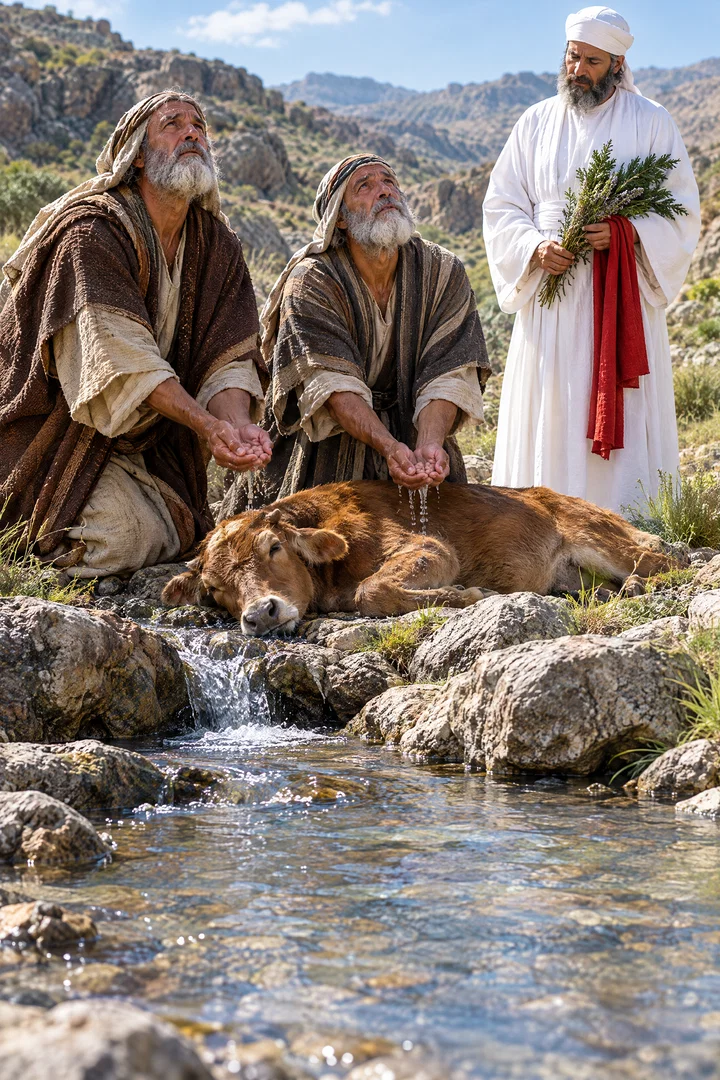
The declaration belongs to a public ceremony appointed for a murder whose perpetrator could not be found.ST Jan 20, 1881 It was spoken by the elders only after diligent efforts had been made to discover the killer.ST Jan 20, 1881 As they spoke, they washed their hands over the sacrificed heifer, solemnly disavowing that they had shed the blood or witnessed the crime.ST Jan 20, 1881
The rite was no empty form to excuse neglect, but an open expression of abhorrence for murder.ST Jan 20, 1881 It affirmed the solemn responsibility resting on leaders to seek justice and to do all in their power to bring wrong to light.ST Jan 20, 1881 To shield the guilty through carelessness was to share in the wrong itself.ST Jan 20, 1881 Innocent blood left unavenged brought guilt upon those who failed to act.ST Jan 20, 1881
Sources
Pioneers and periodicals
4 sources
The declaration stands in Deuteronomy 18-21, at the close of the portion beginning with Numbers 35-36 and running through Deuteronomy 1-21.ST Mar 1, 1910 Deuteronomy means repetition of the law, a rehearsal of the wonderful things God had done for His people and of some of the chief laws connected with Israel.ST Mar 1, 1910 It was given by Moses before the Israelites crossed the Jordan River into the promised land, after he had cared for them through forty years of wilderness wandering.ST Mar 1, 1910 He could not go over with them because in impatience he had spoken hasty words glorifying himself instead of God, and the rehearsal was to bring God's lessons to their remembrance and to impress the sacred import of God's holy law and the necessity of keeping it.ST Mar 1, 1910
The words belong to a public ceremony for an unsolved murder, performed by the elders of the city nearest the unidentified slain person.ST Jan 20, 1881RH May 16, 1912 It followed diligent efforts to find the killer, and in it they washed their hands over the sacrificed heifer and declared that their hands had not shed the blood and their eyes had not seen the killing.ST Jan 20, 1881RH May 16, 1912 Cities and towns were held responsible for crime committed near them.ST Jan 20, 1881ST Mar 11, 1908 The ceremony showed abhorrence of murder and responsibility to seek justice, and the declaration did not excuse neglect.ST Jan 20, 1881
The declaration was a plea that the elders were not responsible for the death, asking God not to hold the innocent blood against them.ST Jan 20, 1881RH May 16, 1912 Anyone who carelessly shields the guilty is regarded as sharing in the wrong.ST Jan 20, 1881 Innocent blood brings guilt upon those who fail to act.ST Jan 20, 1881
Sources