Deuteronomy 27:5
And there shalt thou build an altar unto the LORD thy God, an altar of stones: thou shalt not lift up any iron tool upon them.
Translations
And there shall you build an altar to the LORD your God, an altar of stones: you shall not lift up any iron tool on them.
And there shalt thou build an altar unto the LORD thy God, an altar of stones: thou shalt not lift up any iron tool upon them.
And there shalt thou build an altar unto the Lord thy God, an altar of stones: thou shalt not lift up any iron tool upon them.
And there shalt thou build an altar to the LORD thy God, an altar of stones: thou shalt not lift up any iron tool upon them.
And there shalt thou build an altar unto the LORD thy God, an altar of stones: thou shalt lift up no iron tool upon them.
And there shalt thou build an altar unto Jehovah thy God, an altar of stones: thou shalt lift up no iron tool upon them.
and built there an altar to Jehovah thy God, an altar of stones, thou dost not wave over them iron.
And there shalt thou build an altar to Jehovah thy God, an altar of stones; thou shalt not lift up an iron [ tool] upon them;
And thou shalt build there an altar unto Yahweh thy God,—an altar of stones, thou shalt not wield thereupon any tool of iron.
Berean Standard Bible, Majority Standard Bible
Moreover, you are to build there an altar to the LORD your God, an altar of stones. You must not use any iron tool on them.
There you shall build an altar to the LORD your God, an altar of stones. You shall not use any iron tool on them.
There you are to make an altar to the Lord your God, of stones on which no iron instrument has been used.
And there shalt thou build vnto the Lord thy God an altar, euen an altar of stones: thou shalt lift none yron instrument vpon them.
Douay-Rheims (Challoner revision)
And thou shalt build there an altar to the Lord thy God, of stones which iron hath not touched,
Pictures
Cross-references
- Joshua 8:30-32
Then Joshua built an altar unto the LORD God of Israel in mount Ebal,
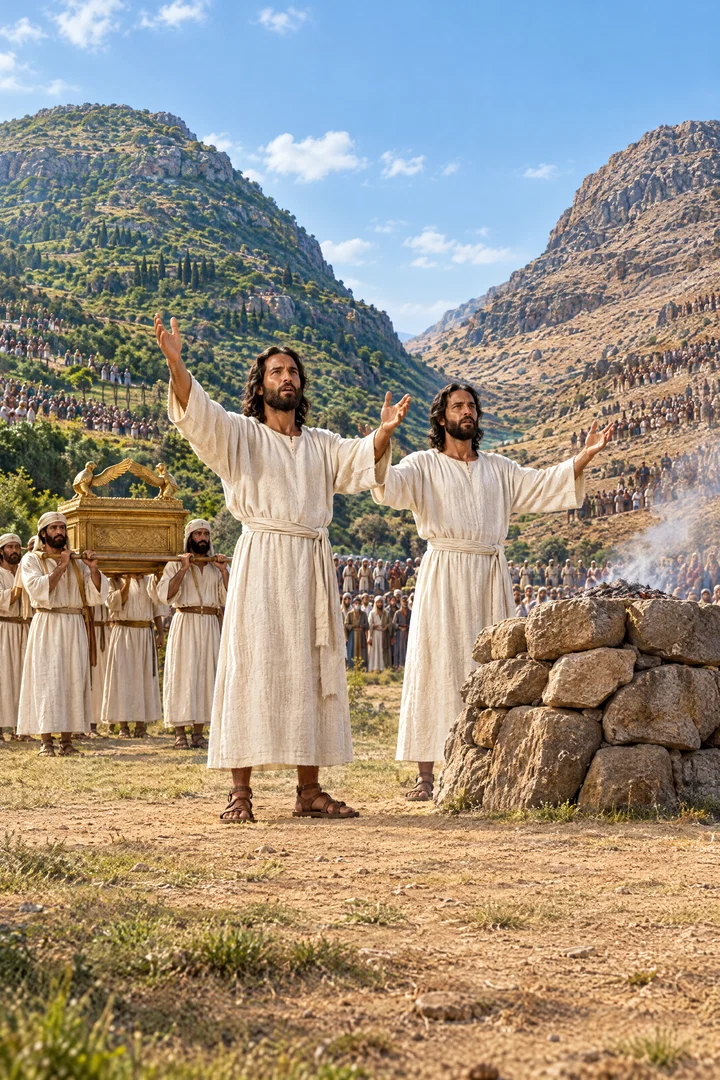
Joshua builds on Mount Ebal the altar commanded by Moses, using unhewn stones.
- 1 Kings 6:7
And the house, when it was in building, was built of stone made ready before it was brought thither: so that there was neither hammer nor axe nor any tool of iron heard in the house, while it was in building.
The temple stones were prepared away from the building site, so no iron tool was used there.
- Joshua 8:33-35
And all Israel, and their elders, and officers, and their judges, stood on this side the ark and on that side before the priests the Levites, which bare the ark of the covenant of the LORD, as well the stranger, as he that was born among them; half of them over against mount Gerizim, and half of them over against mount Ebal; as Moses the servant of the LORD had commanded before, that they should bless the people of Israel.
Both describe Israel’s assembly at Gerizim for the reading of the law’s blessings.
Commentary
Each commentary is drawn from primary sources: the writings of Ellen G. White and Adventist pioneers and periodicals. Each commentary is separate. Its own words are not a quotation; follow the references to read the source passages.
Ellen G. White
7 sources
The command is to build an altar to the Lord of whole, unhewn stones, with no iron tool lifted to shape them.Ms 17, 1899, par. 13–15Ms 92a, 1898, par. 24–27PP 500.2 It was to be carried out after passing over Jordan on entering the promised land, before taking possession of it, with the altar set on Mount Ebal in connection with the gathering at Mounts Ebal and Gerizim.Ms 92a, 1898, par. 24–27PP 500.26MR 373.3–374.1Ms 7, 1904, par. 126–128PP 499.2–3 There Israel was to set up plastered stones inscribed with the commandments of God, offer burnt and peace offerings on the altar, and eat, worship, and rejoice before God in solemn recognition of His law as a renewal of covenant loyalty.Ms 17, 1899, par. 13–15Ms 92a, 1898, par. 24–276MR 373.3–374.1Ms 7, 1904, par. 126–128PP 499.2–3
The exact, specific directions show particular care for a forgetful people, stating plainly the blessings of obedience and the principles of the law of God's kingdom so that minds are not left in ignorance and uncertainty.Ms 68, 1900, par. 3–56MR 373.3–374.1Ms 7, 1904, par. 126–128 The words were spoken not by a human voice but by Christ Himself enshrouded in the pillar of cloud, to keep Israel from forgetting and to remind them that obedience to God's commandments is for present and future good, bringing prosperity, while disobedience results in a curse.Ms 68, 1900, par. 3–5 This involved a repetition of the law from two prominent positions, with the advantages of the blessing pronounced from Mount Gerizim as the mount of blessings and the disadvantages of the curse pronounced from Mount Ebal as the mount of curses.6MR 373.3–374.1Ms 7, 1904, par. 126–128
Standing on the mountain where the curse was pronounced, the altar signified that Israel had rightly incurred the consequences of breaking God's law, and the sacrifices offered there represented Christ's atonement by which the curse would not be visited on them.PP 500.2 These Scriptures lay a never-ceasing obligation on all blessed with life, health, and temporal and spiritual advantages to publicly acknowledge His special favor, so that God's name will be glorified as a testimony that His Word is verity and truth.Ms 68, 1900, par. 3–5
Sources
Pioneers and periodicals
5 sources
After entering the promised land Israel was to build an altar to the Lord on Mount Ebal of stones, with no iron tool lifted upon them, leaving the stones whole, rough, and unhewn.RH Mar 17, 1910RH Sep 6, 1864 The altar was to stand beside the law inscribed there, as part of the solemn blessings and curses pronounced from Mount Gerizim and Mount Ebal.ST Mar 11, 1908 The blessings were read on Mount Gerizim.ST Mar 11, 1908ST Sep 3, 1894
The command was fulfilled when Joshua built the altar with a copy of the law of Moses written on its stones.RH Sep 6, 1864 Those Ebal stones are distinct from the two tables of testimony Moses brought down from Sinai with the writing of God graven on them.RH Sep 6, 1864 They are not the stones of the ministration of death written and engraven in 2 Corinthians 3.RH Sep 6, 1864 On the mountain associated with the curse, where Israel's transgressions had justly brought God's wrath, the altar and its sacrifices represented Christ's atonement through which that punishment would be averted.
The chapter's instructions are part of God's revealed will given so His people may do what He commands.ST Mar 11, 1908 Chapters 27 and 28 together lay explicit conditions for the literal seed of Abraham to meet in order to keep the promised territory.ST Jul 22, 1913 From the days of Solomon onward Israel departed from God and refused to meet them despite every compassionate divine effort through His messengers, until wrath arose with no remedy and the Babylonian captivity came as expressly foretold, including its seventy-year period.ST Jul 22, 1913 The Gerizim setting later figured in the Samaritan claim that that mountain, the Mount of Samaria, was the true place of worship against the Jewish claim for Jerusalem alone, where their ancestors had worshiped for more than four hundred years before Christ.ST Sep 3, 1894 The same prohibition on iron tools meant the temple stones were cut to their required dimensions in the quarry, so they could be placed in the temple without iron tools being used there and the construction could proceed in reverent silence.RH Mar 17, 1910
Sources