Joshua 8:30
Then Joshua built an altar unto the LORD God of Israel in mount Ebal,
Translations
American King James Version, Webster Bible
Then Joshua built an altar to the LORD God of Israel in mount Ebal,
Then Joshua built an altar unto the LORD God of Israel in mount Ebal,
Then Joshua built an altar unto the Lord God of Israel in mount Ebal,
Then Joshua built an altar unto the LORD, the God of Israel, in mount Ebal,
Then Joshua built an altar unto Jehovah, the God of Israel, in mount Ebal,
Then doth Joshua build an altar to Jehovah, God of Israel, in mount Ebal,
Then Joshua built an altar to Jehovah the God of Israel, in mount Ebal,
Than, built Joshua, an altar, unto Yahweh, God of Israel,—in Mount Ebal:
Berean Standard Bible, Majority Standard Bible
At that time Joshua built an altar on Mount Ebal to the LORD, the God of Israel,
Then Joshua built an altar to the LORD, the God of Israel, on Mount Ebal,
Then Joshua put up an altar to the Lord, the God of Israel, in Mount Ebal,
Then Ioshua built an altar vnto the Lord God of Israel, in mount Ebal,
Douay-Rheims (Challoner revision)
Then Josue built an altar to the Lord the God of Israel in mount Hebal,
Pictures
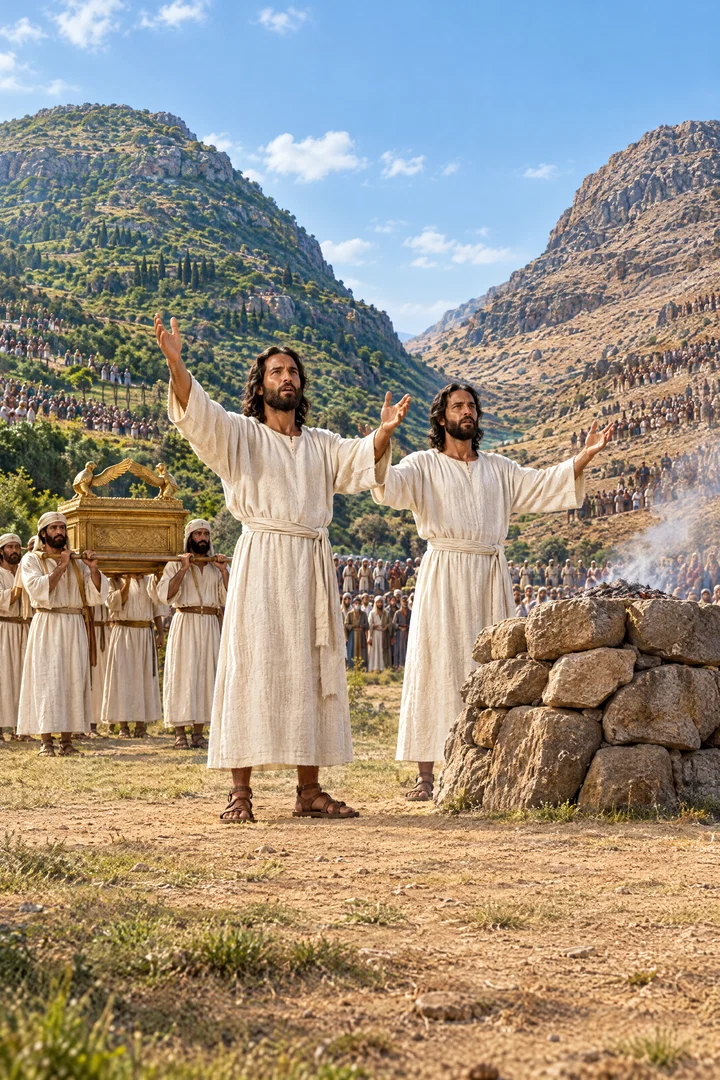
Cross-references
- Deuteronomy 27:2-8
And it shall be on the day when ye shall pass over Jordan unto the land which the LORD thy God giveth thee, that thou shalt set thee up great stones, and plaister them with plaister:
Moses commands an altar and law-inscribed stones on Mount Ebal, which Joshua sets up.
- Deuteronomy 27:12-13
These shall stand upon mount Gerizim to bless the people, when ye are come over Jordan; Simeon, and Levi, and Judah, and Issachar, and Joseph, and Benjamin:
Names the tribes assigned to Mount Ebal and Mount Gerizim for the covenant proclamation.
- Deuteronomy 11:29
And it shall come to pass, when the LORD thy God hath brought thee in unto the land whither thou goest to possess it, that thou shalt put the blessing upon mount Gerizim, and the curse upon mount Ebal.
gives the command for the Ebal-Gerizim service
- Deuteronomy 27:8
And thou shalt write upon the stones all the words of this law very plainly.
It commands writing the law plainly on stones at the altar.
- Genesis 12:6-7
And Abram passed through the land unto the place of Sichem, unto the plain of Moreh. And the Canaanite was then in the land.
Shechem is associated with God’s covenant promise to Abraham.
- Deuteronomy 28:1-14
And it shall come to pass, if thou shalt hearken diligently unto the voice of the LORD thy God, to observe and to do all his commandments which I command thee this day, that the LORD thy God will set thee on high above all nations of the earth:
Lists the covenant blessings associated with obedience.
- Genesis 33:20
And he erected there an altar, and called it El-elohe-Israel.
Jacob built an altar at Shechem.
- Joshua 7
But the children of Israel committed a trespass in the accursed thing: for Achan, the son of Carmi, the son of Zabdi, the son of Zerah, of the tribe of Judah, took of the accursed thing: and the anger of the LORD was kindled against the children of Israel.
Records the defeat that preceded Israel’s return to Ai.
Commentary
Each commentary is drawn from primary sources: the writings of Ellen G. White and Adventist pioneers and periodicals. Each commentary is separate. Its own words are not a quotation; follow the references to read the source passages.
Ellen G. White
4 sources
This verse belongs to Israel's covenant-renewal service at Shechem, held before the people took possession of their inheritance.PP 499.2–3 The whole people — including women, children, and resident strangers — gathered to acknowledge God's law, while military operations were suspended.PP 499.2–3 Though Israel traveled through territory surrounded by unconquered enemies to assemble, they were kept safe under God's protection as long as they remained faithful to Him.PP 499.2–3
Joshua built an altar to the Lord God of Israel on Mount Ebal.PP 500.2PP 522.4Ms 135, 1899, par. 7 Ebal was the mountain associated with the curse.PP 500.2 Ebal and Gerizim stood as witnesses to Israel's solemn covenant vows made on entering Canaan, which were renewed at Shechem before Joshua.PP 522.4Ms 135, 1899, par. 7 Placing the altar on Ebal signified that Israel had justly incurred God's wrath by transgressing His law.PP 500.2 The altar and its sacrifices showed that the deserved wrath would be withheld through Christ's atonement.PP 500.2
Sources
Pioneers and periodicals
17 sources
Just after Israel returned to conquer Ai following its earlier defeat, Joshua obeyed the command given through Moses in Deuteronomy 27 and built an altar to the Lord God of Israel on Mount Ebal, the mount of the curse, of whole rough unhewn stones with burnt-offerings and peace-offerings sacrificed upon it.RH Apr 30, 1857ST Apr 7, 1909RH Sep 6, 1864ST Sep 26, 1906 Beside the altar he set up great plastered stones inscribed very plainly with a copy of the law of Moses, and before all Israel assembled in the valley between Ebal and Gerizim — half toward the mount of cursing and half toward the mount of blessing, with elders, women, little ones, strangers, and the ark with its mercy-seat resting midway — he read all the words of the law, its blessings and its cursings, omitting nothing commanded.RH Apr 30, 1857ST Apr 7, 1909RH Sep 6, 1864RH Apr 29, 1875 The Levites pronounced the blessings from Gerizim and the curses from Ebal, and the tribes answered with a solemn united Amen, those on Gerizim assenting to blessing on keepers of His law and those on Ebal to cursing on its violators.ST Apr 7, 1909RH Apr 29, 1875RH Jan 4, 1912 Setting the altar of sacrifice on the mountain of the curse showed that Israel's transgressions had justly incurred wrath that would at once fall except for the atonement of Christ represented by the altar, and the service pictures the time when every person will by character stand on the mount of blessing or the mount of cursing and God's character will be fully vindicated.ST Apr 7, 1909 What Joshua wrote on plastered stones forty years after Sinai is distinct from the ministration written and engraved in stones in 2 Corinthians 3:7, which is the decalogue itself received by Moses in Exodus 34 when his shining face was veiled, not what was commanded in Deuteronomy 27 nor done on Ebal.RH Jun 18, 1901ST Jun 5, 1879RH Sep 6, 1864
Setting and Ceremony
The altar on Mount Ebal was raised after Israel had crossed the Jordan and entered Canaan, as their first duty there after gaining the promised land and after the conquest of Canaan.ST Oct 16, 1884RH Apr 29, 1875 It belongs to the conquering of the Canaanites and the division of the land, coming after the lesson of Achan's sin and its fearful consequences.ST Mar 17, 1909 The gathering was at Shechem.ST Sep 8, 1898
It was carried out just after the taking of Ai, when Israel returned to Ai after an earlier defeat and went again under different circumstances and conquered.ST Sep 26, 1906 In this Joshua obeyed the command given through Moses concerning the stones on Mount Ebal, also recorded in Deuteronomy 27.RH Apr 30, 1857 He later read the words of the law written in the book of the law, omitting nothing Moses commanded.RH Apr 30, 1857
Joshua built an altar to the Lord God of Israel on Mount Ebal, the mountain of the curse.RH Sep 6, 1864 It was made of whole rough unhewn stones over which no iron tool was lifted.RH Sep 6, 1864 Burnt-offerings and peace-offerings were sacrificed there. A stone stood there for each tribe.RH Jan 4, 1912
Beside the altar stood a monument of great plastered stones, inscribed very plainly in the presence of Israel with a copy of the law of Moses. That copy was not only the ten precepts spoken from Sinai but the laws Moses wrote in a book. The writing was on the stones or on the plaster covering them, not written and engraved in stones as the decalogue in its ten precepts was.RH Sep 6, 1864RH Jun 18, 1901 Afterward Joshua read all the words of that law, the blessings and cursings.
All Israel assembled between the two mountains in the lovely verdant valley of Sychar a short distance east of Shechem, half over against Mount Gerizim the mount of blessing and half over against Mount Ebal the mount of cursing.RH Apr 29, 1875ST Sep 8, 1898 Six tribes stood on each mountain, with elders, officers, judges, women, little ones, and strangers.ST Sep 8, 1898 Before them rested the ark holding the mercy-seat and cherubim with the Lord's Shekinah that had guided through the Red Sea, the desert, and Jordan's parted waters as cloudy pillar by day and flame by night, midway in the valley with the Levitical priests and Levites near.ST Apr 7, 1909RH Apr 29, 1875 The hosts were divided with Rachel's children and all Leah's sons save Zebulun and Reuben on Gerizim's high honor and all the rest on Ebal.RH Apr 29, 1875
The Levites pronounced the law's blessings from Gerizim and its curses from Ebal. The priests turned first to Gerizim to speak blessing on the man that never makes a graven image and then northward to Ebal to chant cursing on the man that makes any molten image.RH Apr 29, 1875 Those on Gerizim gave hearty assent to the blessings on keepers of His law, and those on Ebal responded to the curses on violators with a solemn united Amen in loud deep voices that might shake the mountain's foundations.ST Apr 7, 1909RH Apr 29, 1875RH Jan 4, 1912 The people assented with fear and awe while sunbeams glinting down the valley lit the ark's pure gold into radiant beauty, an imposing wonderful array that listening gazing children would never forget to their dying day.RH Apr 29, 1875
Shechem sits in the saddle between Mount Ebal and Mount Gerizim on the watershed between the Jordan and the Mediterranean.ST Sep 8, 1898 Jacob's well lies between them, and the valley opening to the east is fertile but now indifferently cultivated.ST Sep 8, 1898 Gerizim the mount of blessing rises nearly a thousand feet above the valley, is 2,848 feet high and green with verdure at the foot, while Ebal the mount of cursing is 3,077 feet high and barren from the base.RH Apr 29, 1875ST Sep 8, 1898 From Ebal's summit the view is extensive over the hills of Samaria, the Mediterranean, the site of Caesarea in clear weather, Mount Carmel, the hills of Galilee, Mount Hermon, and a long range east of the Jordan to the Dead Sea, with the view from Gerizim nearly as extensive.ST Sep 8, 1898
Meaning and Prophecy
The placing of the altar of sacrifice on the mountain of the curse denotes that Israel's transgressions of God's law had justly incurred His wrath, which would at once have been visited upon them except for the atonement of Christ represented by the altar. What Joshua wrote on Mount Ebal forty years after Moses came down from Sinai with the stone tablets is distinct from the ministration written and engraved in stones in 2 Corinthians 3:7, which is the decalogue in its ten precepts.RH Jun 18, 1901RH Sep 6, 1864RH Sep 6, 1864 For the law of Moses on Ebal was written on the stones or on the plaster with which the stones were covered, not written and engraved in stones as the decalogue was.RH Jun 18, 1901RH Sep 6, 1864RH Sep 6, 1864 Joshua's writing on those plastered stones was not the writing engraved on the tablets associated with the glory of Moses' face.RH Sep 6, 1864RH Sep 6, 1864 Paul's words about the veiled shining face refer to Moses coming down from the mount after forty days and forty nights communing with the Lord with the two tables in his hands, his face shining with glory so the people could not look on it and he put a veil over it while speaking, as in Exodus 34, not to what was commanded in Deuteronomy 27 nor to what Joshua did with plastered stones.RH Jun 18, 1901ST Jun 5, 1879
The service pictures the time when God's will as set forth in the Ten Commandments contained in the ark and His purpose in the plan of salvation as set forth in the mercy-seat shall be fully comprehended by all.ST Apr 7, 1909 It pictures when every member of the human family by choice in harmony with or against God's law shall have fully developed a good or bad character and thus placed himself on the mount of blessing or on the mount of cursing.ST Apr 7, 1909 It pictures when God's character shall be so fully vindicated by the unfolding of His plan that even those under the curse will be compelled to recognize His wisdom and justice.ST Apr 7, 1909
The curses pronounced from Mount Ebal have been literally fulfilled, as seen in the present state of the land about Shechem.ST Sep 8, 1898 They belong to the pronouncing of the blessings and the curses from Gerizim and Ebal by Shechem and by Jacob's well between Gerizim and Ebal.ST Sep 8, 1898 There the valley opening to the east is fertile but now indifferently cultivated.ST Sep 8, 1898
Worship and Victory
Ebal and Gerizim with the ark standing there marked for a time the place where God's name was placed and where Israel worshiped before the ark was removed to Jerusalem.ST Apr 7, 1909 That worship after entering Canaan was one of the most remarkable services of that people, with all Israel assembled between the two mountains, the ark of God standing there with the priests beside it, and the people divided into two companies of six tribes each.ST Apr 7, 1909 One company stood on Mount Gerizim the mount of blessing and the other on Mount Ebal the mount of cursing, listening to the reading of the blessings on those who keep His law and then the curses on those who violate that law.ST Apr 7, 1909 Those on Gerizim gave hearty assent to the blessings on keepers, and those on Ebal responded to the curses on violators with a solemn Amen.ST Apr 7, 1909
After the ark was lost at the captivity, this history gave occasion for the Samaritans to claim Gerizim as the true place of worship.ST Apr 7, 1909ST Sep 3, 1894 They built a rival temple on Gerizim the mount of blessing, and the ceremony in which Israel's blessings were read on Mount Ebal, also recorded in Deuteronomy 27, was thus drawn into their claim that Mount Gerizim was the true place of worship.ST Apr 7, 1909ST Sep 3, 1894 That dispute was still living in Christ's day.ST Apr 7, 1909 It was answered that neither Jerusalem nor Gerizim is the true place of worship, but each individual in whom God's Spirit and truth is constitutes a shrine where true worship is conducted.ST Apr 7, 1909
In Israel's experience at Ai their humiliation came because of self-sufficiency and their final triumph over that place came by faith.RH Apr 20, 1911 The lesson of the altar built after that triumph is that victory over sin is already given and must be taken by faith.RH Apr 20, 1911 That victory is victory over sins of commission and sins of omission, over indolence and slothfulness and every besetment, over pride and love of the world and selfishness, and over every wrong word and action.RH Apr 20, 1911 It is taken in order to enter into the freedom of the children of the King.RH Apr 20, 1911
Sources