Deuteronomy 34:3
And the south, and the plain of the valley of Jericho, the city of palm trees, unto Zoar.
Translations
And the south, and the plain of the valley of Jericho, the city of palm trees, to Zoar.
And the south, and the plain of the valley of Jericho, the city of palm trees, unto Zoar.
and the south, and the plain of the valley of Jericho, the city of palm trees, unto Zoar.
And the south, and the plain of the valley of Jericho, the city of palm-trees, to Zoar.
and the South, and the Plain of the valley of Jericho the city of palm trees, unto Zoar.
and the South, and the Plain of the valley of Jericho the city of palm-trees, unto Zoar.
and the south, and the circuit of the valley of Jericho, the city of palms, unto Zoar.
and the south, and the plain of the valley of Jericho, the city of palm-trees, to Zoar.
and the South,—and the circuit of the valley of Jericho, the city of palm trees as far as Zoar.
Berean Standard Bible, Majority Standard Bible
the Negev, and the region from the Valley of Jericho ( the City of Palms) all the way to Zoar.
and the south, and the Plain of the valley of Jericho the city of palm trees, to Zoar.
And the South, and the circle of the valley of Jericho, the town of palm-trees, as far as Zoar.
And the South, and the plaine of the valley of Iericho, the citie of palmetrees, vnto Zoar.
Douay-Rheims (Challoner revision)
And the south part, and the breadth of the plain of Jericho the city of palm trees as far as Segor.
Pictures
Cross-references
- Deuteronomy 3:27
Get thee up into the top of Pisgah, and lift up thine eyes westward, and northward, and southward, and eastward, and behold it with thine eyes: for thou shalt not go over this Jordan.
God allows Moses to view the promised land from Pisgah but not enter it.
- Numbers 20:12
And the LORD spake unto Moses and Aaron, Because ye believed me not, to sanctify me in the eyes of the children of Israel, therefore ye shall not bring this congregation into the land which I have given them.
Connects Moses’ exclusion from the land with his actions at Meribah.
- Deuteronomy 32:49
Get thee up into this mountain Abarim, unto mount Nebo, which is in the land of Moab, that is over against Jericho; and behold the land of Canaan, which I give unto the children of Israel for a possession:
God places Moses on Mount Nebo, overlooking the land of Canaan.
- Genesis 15:18
In the same day the LORD made a covenant with Abram, saying, Unto thy seed have I given this land, from the river of Egypt unto the great river, the river Euphrates:
Gives the broader boundaries of the land promised to Abraham.
- Numbers 27:12-13
And the LORD said unto Moses, Get thee up into this mount Abarim, and see the land which I have given unto the children of Israel.
Moses is told to view the promised land before his death, but not enter it.
- Jude 1:9
Yet Michael the archangel, when contending with the devil he disputed about the body of Moses, durst not bring against him a railing accusation, but said, The Lord rebuke thee.
Michael disputes with the devil over Moses’ body, which God raised and took to heaven.
- Exodus 3:8
And I am come down to deliver them out of the hand of the Egyptians, and to bring them up out of that land unto a good land and a large, unto a land flowing with milk and honey; unto the place of the Canaanites, and the Hittites, and the Amorites, and the Perizzites, and the Hivites, and the Jebusites.
It describes the land flowing with milk and honey that Moses viewed.
- Joshua 1:2
Moses my servant is dead; now therefore arise, go over this Jordan, thou, and all this people, unto the land which I do give to them, even to the children of Israel.
God declares Moses dead before Israel crosses the Jordan.
- Judges 3:13
And he gathered unto him the children of Ammon and Amalek, and went and smote Israel, and possessed the city of palm trees.
also calls Jericho city of palm trees
- 2 Chronicles 28:15
And the men which were expressed by name rose up, and took the captives, and with the spoil clothed all that were naked among them, and arrayed them, and shod them, and gave them to eat and to drink, and anointed them, and carried all the feeble of them upon asses, and brought them to Jericho, the city of palm trees, to their brethren: then they returned to Samaria.
also calls Jericho city of palm trees
- Deuteronomy 32:52
Yet thou shalt see the land before thee; but thou shalt not go thither unto the land which I give the children of Israel.
Moses is told he will see the land but not enter it.
- Genesis 17:8
And I will give unto thee, and to thy seed after thee, the land wherein thou art a stranger, all the land of Canaan, for an everlasting possession; and I will be their God.
God promises Abraham and his descendants the land.
- Numbers 13:23
And they came unto the brook of Eshcol, and cut down from thence a branch with one cluster of grapes, and they bare it between two upon a staff; and they brought of the pomegranates, and of the figs.
The grapes offer a foretaste of Canaan to encourage perseverance.
Commentary
Each commentary is drawn from primary sources: the writings of Ellen G. White and Adventist pioneers and periodicals. Each commentary is separate. Its own words are not a quotation; follow the references to read the source passages.
Ellen G. White
12 sources
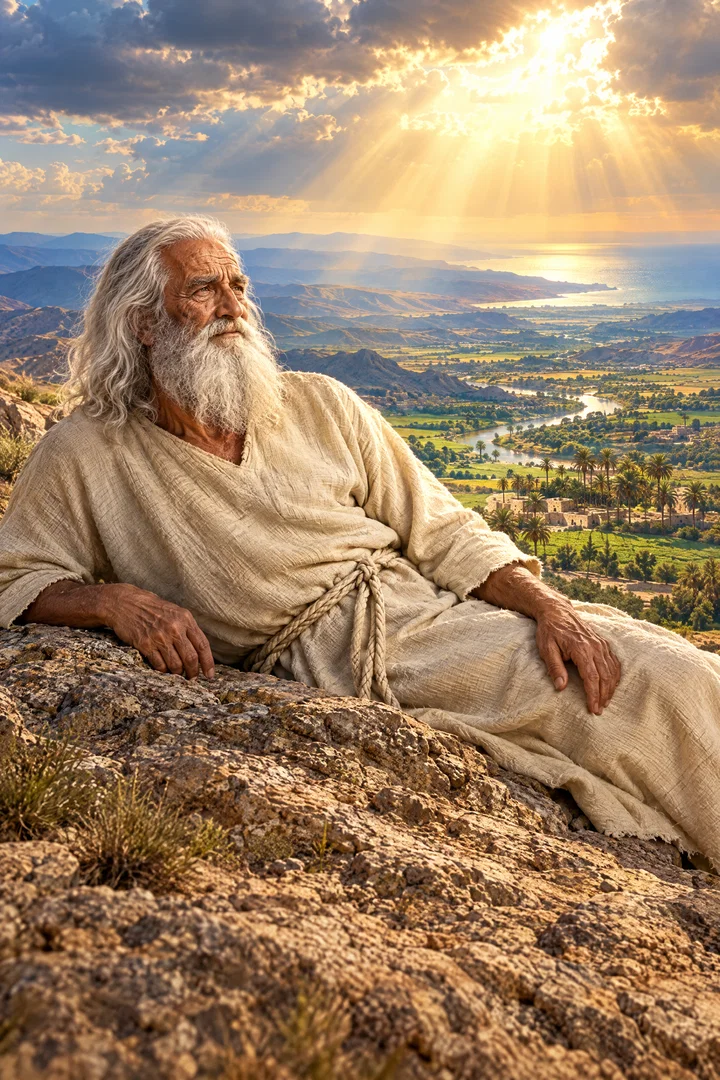
From Pisgah on Mount Nebo Moses was shown the whole land of Canaan, including the southern district and the palm-filled plain of the valley of Jericho stretching to Zoar.1SP 335.21SP 341.2–31SP 336.1 He stood there alone with God and the angels on the highest point over against Jericho, looking in every direction until he had seen it all to his satisfaction.SG4 56.2–57.2ST Mar 31, 188110MR 151.1–2 Though one hundred and twenty years old with undimmed eye and unabated strength, he was there to die, and after the view angels buried him where Israel could never find him, and Christ soon raised him and took him to heaven.1SP 341.2–3SG4 56.2–57.21T 658.3–659.2 What he saw was the fertile, well-watered inheritance sworn to Abraham, Isaac, and Jacob, passing before him like a second Eden, that he might fully realize the rich blessings Israel would enjoy through faithful obedience.1SP 335.21SP 336.1SG4 56.2–57.21T 658.3–659.2Ms 69, 1912, par. 22–23 The same view reached beyond to Christ's first coming and rejection and death, and to His second coming and the resurrection when the two Adams shall meet and Eden shall bloom again, showing that communion with God in the mount refreshes and reveals His glory before life's work is laid down.1T 658.3–659.2ST Jul 27, 1915
Moses Views from Pisgah
The south, the plain of the valley of Jericho, the city of palm trees which is Jericho, and the country unto Zoar were part of the whole land of Canaan shown to Moses from Pisgah, from Mount Nebo, from the mountaintop.1SP 335.21SP 336.1SG4 56.2–57.210MR 151.1–2Ms 69, 1912, par. 22–23 The southern territory and the plain of the Jericho valley extending to Zoar belonged to the promised inheritance sworn to Abraham, Isaac, and Jacob, which Moses was permitted to see though he was not to enter it.1SP 335.21SP 341.2–31SP 336.1 He saw the whole land, Israel's promised home, and the places where the tribes would live.1SP 341.2–31SP 336.1Ms 69, 1912, par. 22–23 The regions of the panoramic view were pointed out to him by angels.SG4 56.2–57.210MR 151.1–2
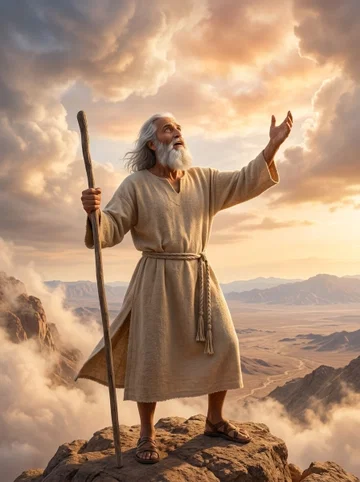
He was called to the top of Pisgah, the highest prominence attainable over against Jericho, and there stood alone in the presence of God and heavenly angels.SG4 56.2–57.2 From that mountain he looked out over the promised land in every direction.SG4 56.2–57.2ST Mar 31, 1881 He continued looking until he had viewed Canaan to his satisfaction.1SP 341.2–3SG4 56.2–57.2
The plain is the plain of the Jordan near Jericho, extending southward to Zoar.ST Nov 18, 1880 Jericho is identified as the city of palm trees, and the abundance of palms across the river made this fertile plain remind some Israelites of the Nile region.ST Nov 18, 1880
He was one hundred and twenty years old, with eye not dimmed and natural force not abated, with clear sight and firm, unabated strength, yet he was there to die.SG4 56.2–57.21T 658.3–659.2 After he had viewed Canaan to his satisfaction he lay down like a tired warrior to rest in the sleep of death on Mount Nebo.1SP 341.2–3SG4 56.2–57.2Lt 21, 1867, par. 4–6 Angels buried his body in the valley where Israel could never find it, to prevent idolatry over his body.SG4 56.2–57.2 The Son of God soon came down and raised him from the dead and took him to heaven.1T 658.3–659.2
Promise, Prophecy, and Preparation
The south and the plain of the valley of Jericho unto Zoar shown to Moses were part of the promised inheritance sworn to Abraham, Isaac, and Jacob.1SP 335.2 It was Israel's promised home opened before him, though he himself was not to enter it.1SP 335.21SP 336.1SG4 56.2–57.2 From Mount Nebo he was shown the places where the tribes of Israel would live.Ms 69, 1912, par. 22–23
The country thus spread before him was fertile, well watered, and rich in grain fields and fruit trees.Ms 69, 1912, par. 22–23 Its landscape belonged to an abundant land bearing fruit trees, flowers, water, grain, vineyards, and honey.1SP 339.1 With God's blessing upon it, it passed before him as a panorama like a second Eden.1T 658.3–659.2
From that view he understood and fully realized the rich blessings Israel would enjoy if they faithfully obeyed God's commandments.1SP 336.1SG4 56.2–57.2 The same view carried him beyond Canaan to the appearing of Christ at His first advent.1T 658.3–659.2 He was shown Christ's rejection by the Jewish nation and His death on the cross, then Christ's second advent and the resurrection of the just, and the meeting of the two Adams, Adam the first and Christ the second Adam, when Eden shall bloom on earth again.1T 658.3–659.2
God called Moses to the top of Pisgah before he laid down his life with his burden for Israel, and spread out before him the glory of the promised land.ST Jul 27, 1915 That communion with God in the mount prepares for laying down life's work, giving spiritual refreshing and a view of God's glory before the close.ST Jul 27, 1915
Sources
Pioneers and periodicals
60 sources
The verse names the southern district and the low plain around Jericho, called the city of palm trees for its date palms, stretching as far as Zoar as part of the land shown to Moses.ST Aug 31, 1915ST Mar 24, 1898RH Aug 25, 1868ST Oct 1, 1902RH Feb 7, 1854 It belongs to the closing scene of Deuteronomy, where Moses, after leading Israel forty years to the border of the promised land, climbs Nebo to the top of Pisgah alone to view it before he dies.ST Mar 12, 1912ST Sep 17, 1902ST Apr 26, 1905ST Dec 22, 1881ST May 19, 1914 From that height he is given a clear and far-reaching view of the beautiful inheritance promised to Abraham, Isaac, and Jacob, a land flowing with milk and honey spread beyond the Jordan which he may see but not enter.ST Mar 31, 1881RH Feb 19, 1867ST Jun 15, 1904ST Sep 10, 1902 He is barred from entering because of his sin at the waters of strife in failing to give God glory, yet God buries him with honor and brings him to a better, heavenly Canaan.ST Mar 12, 1912ST Sep 17, 1902ST Sep 29, 1881ST Oct 31, 1906ST May 19, 1914 That distant preview stands as the pattern of how faith now glimpses the eternal reward and the Sabbath rest as from a Pisgah height, giving strength to the weary traveler before arrival.RH Nov 14, 1854RH May 30, 1854RH Jan 12, 1864RH Feb 3, 1863
Place Names Explained
The verse names the south and the plain of the valley of Jericho, identifying Jericho as the city of palm trees and marking the extent of the land shown as far as Zoar.ST Aug 31, 1915ST Mar 24, 1898RH Feb 7, 1854ST Nov 7, 1878 It belongs to the view of the land given to Moses from Pisgah and Nebo before his death in Moab.ST Aug 31, 1915RH Aug 3, 1916ST Nov 7, 1878RH Feb 19, 1861 Jericho is called the city of palm trees because of the date palms that grew there, which marks the palm as one of the trees especially noted in Scripture.RH Aug 25, 1868ST Oct 1, 1902 Several palms were still to be found near Jericho even when palms had become rare in Palestine generally.RH Aug 25, 1868
The fertile plain of the Jordan near Jericho extended southward to Zoar, and the abundance of palms across the river made it reminiscent of the Nile region to some Israelites.ST Nov 18, 1880 The southern region thus shown included the plain of the Jericho valley and the land extending to Zoar, seen to its farthest borders.ST Aug 31, 1915RH Aug 3, 1916 It revealed the beauty of the land before Israel entered it, which Moses was allowed to see though not permitted to enter.
Chapter Setting Authorship
The verse stands in the closing part of Deuteronomy that brings to the close of the life of Moses after he had led the Lord's people forty years in the wilderness to the border of the promised land, near the close of the forty years of wandering.ST Mar 12, 1912ST Sep 17, 1902ST Apr 26, 1905 It belongs to the account of the death of Moses, one of the greatest men of all history.ST Mar 12, 1912ST Sep 17, 1902 It marks the end of Moses' life and completes the historical span from creation to his death, a period of more than twenty centuries.ST Oct 14, 1880 Its place in the Bible's concise history shows that only certain events were selected from a vast amount of possible material, with God directing the choice of what was essential.ST Oct 14, 1880
The last chapter of Deuteronomy records the death of Moses and was added by Joshua the son of Nun as an account of Moses' death, or by Joshua or another servant of the Lord.ST Mar 24, 1898ST Mar 8, 1910 The presence of that account of Moses' death and burial does not disprove Moses' authorship of the Pentateuch.ST Jan 24, 1900 The chapter could have been added by Joshua, or God could have inspired Moses to write a prophetic account of his own death and burial.ST Jan 24, 1900
Moses told Israel they were to pass over Jordan that day, then died and Israel mourned for him thirty days, with further time for Joshua to take command and send spies so that Israel crossed likely two months later.RH May 26, 1874 His use of this day therefore meant the crossing had become certain and would take place in a very short time rather than on that same day.RH May 26, 1874
Moses Views the Land
The verse belongs to the account of Moses viewing the beautiful promised land from the mountain before his death, though he could not enter it.ST Dec 22, 1881ST Oct 31, 1906RH May 17, 1860 After being refused his wish to go over Jordan, though he had talked with Jehovah as a man talks with his friend, he turned toward the heights of Nebo and climbed Mount Nebo to the top of Pisgah alone toward death.ST May 19, 1914ST Oct 31, 1906ST May 19, 1914 The southern region and the plain around Jericho, the city of palm trees, extending as far as Zoar, are named as part of the land spread before him that he had longed for but was not permitted to enter.ST Dec 22, 1881ST May 19, 1914RH May 17, 1860 He was to die before crossing into it, despite his long service and his prayer for his own life.ST Oct 31, 1906ST May 19, 1914
With tear-dimmed eyes he turned sorrowfully toward the far west, seeing the turbulent waters of the Jordan rushing from the distant north with the inheritance of Israel stretched beyond.ST May 19, 1914 From lone Nebo his dark eyes, still piercing and bright as an eagle's, eyes that had looked unflinchingly upon the glory of Sinai, looked out over the land in every direction.ST Mar 31, 1881ST May 19, 1914 He was given a clear, full view of the Promised Land with the promised land in full view from the mount.ST Mar 31, 1881ST Oct 31, 1906RH Apr 16, 1901 He saw the land to its farthest borders, including its southern region and the plain of the Jericho valley extending to Zoar, before he died in Moab.RH Aug 3, 1916
The view from Nebo, the highest summit of Pisgah, was more extended than was possible with the natural eye even from that height, reaching beyond what Moses could see naturally and was also prophetic.ST Sep 10, 1902ST Sep 10, 1902 It was comprehensive yet from afar, giving only the dim outline of its beautiful hills, lovely lakes, rivers and plains, majestic forests, fruitful orchards and fields.ST Jun 15, 1904 That transporting view of the glory of all lands included the south and the plain of the valley of Jericho unto Zoar.ST Sep 10, 1902ST Jun 15, 1904 It was a land flowing with milk and honey and yielding mammoth clusters of grapes, spread out before him in its glory before he laid down his life with his burden for Israel, and he longed to go over and examine more closely and live on its delicious productions but had to be content to view its contents from afar, not allowed to cross the narrow stream that separated him from it.RH Feb 19, 1867ST Jun 15, 1904
The view included the land the Lord had sworn to give Abraham, Isaac, and Jacob, extending from the river of Egypt unto the great river Euphrates.ST Sep 10, 1902 The south, the plain of Jericho, and the other regions named were the primary objective of the people under Moses' immediate command and the land he was prohibited from entering.ST Sep 10, 1902 From there he could see Mount Hermon when the Lord showed him the land as far as Dan.ST Jun 26, 1901 He was given a goodly view of the Promised Land and of the future of his people, and his prophetic view of the land flowing with milk and honey also included the sight of the cross, showing that reaching the promised land would involve sacrifice.ST Aug 27, 1896
The view also looks back over the path of Israel's forty years of wandering.RH Nov 5, 1861 From this vantage point on Mount Nebo the wilderness journey and its places of rebellion, murmuring, and death could be surveyed alongside the land ahead.RH Nov 5, 1861RH Nov 5, 1861 Nebo stands among the mountains of Moab, seen by looking southwest beyond the Dead Sea and across a long stretch of mountains rising higher and higher, and stands as a geographical witness to the Bible's account.RH Aug 29, 1871ST Nov 3, 1898 The Dead Sea lies in a deep depression, 1,300 feet lower than the Mediterranean and 3,900 feet lower than the Mount of Olives, which explains why it appears to lie so deep below.ST Nov 3, 1898
Exclusion Death Vindication
Moses was permitted to see Canaan from the mountain, including the southern region and the plain of the valley of Jericho extending to Zoar, but as a consequence of disobedience and sin he was not permitted to enter it.ST Sep 29, 1881ST Oct 31, 1906 The exclusion came because on one occasion he failed to give God the glory as provider of needed water, speaking unbelieving words at the waters of strife and once growing impatient.ST Oct 7, 1880ST Sep 17, 1902 He died by God's decree for that unbelief, not because of a grave crime by ordinary human standards.ST Oct 7, 1880 He was to die before crossing into the land he had longed for, despite long service leading the Lord's people forty years in the wilderness to the border of the promised land and despite his prayer for his own life.ST Oct 7, 1880ST Sep 17, 1902ST May 19, 1914
God was not selfish in this refusal, but the welfare of the people required that they must in everything recognize dependence upon Him.ST Sep 17, 1902 The words Without me ye can do nothing were true then as today, and not even a Moses was an exception to this truth.ST Sep 17, 1902 God showed tenderness toward Moses after his error at the waters of strife where taking glory to himself marred his work.RH Sep 13, 1906 Though the people had grievously erred and provoked his spirit, God reserved correction of His prophet to Himself and did not leave it to the people, correcting him by giving the view of the land of promise and reminding him of his mistake, in marked contrast to His dealing with Korah, Dathan, and Abiram who criticized Moses and Aaron.RH Sep 13, 1906
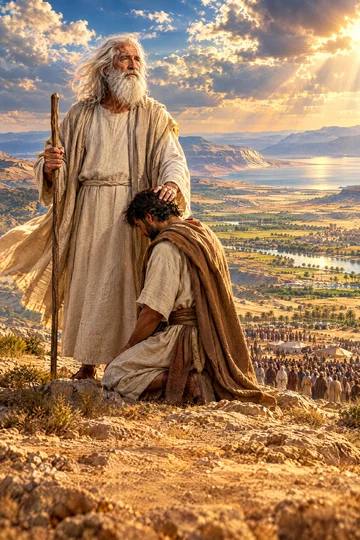
God did not deprive Moses of the gift of prophecy for his error but through him pointed out Joshua, through whom He would continue to lead Israel after Moses' death.RH Sep 13, 1906 As Moses' work as bearer of God's splendor shining in his face was about to end on Mount Nebo just before his death and disappearance from Israel, provision had to be made for the light of God's glory and visible proof of His presence to remain with the people without him.RH Feb 3, 1910RH Sep 13, 1906 Moses failed in one instance and therefore could not be a perfect type of Jesus Christ, who carries His people safely through without failure.ST Mar 12, 1912
Yet in death Moses is honored as no other was ever honored, for God buried him with heavenly angels alone as attendants.ST Mar 12, 1912ST Aug 27, 1896 He went to Pisgah's summit and then entered heaven, last seen of old on lone and cold Nebo with eye not dim viewing the land toward Zoar.RH Jan 8, 1875RH Jun 29, 1869ST Aug 27, 1896 He was not to cross the Jordan bar into earthly Canaan but winged his way with angels to his celestial Canaan far.RH Jan 8, 1875 God later brought him forth wearing a crown of light brighter than Egypt's crown to talk with Jesus just before the crucifixion and on the mount of transfiguration about His agony and cross and the trials the Saviour must pass through, proving his undisputed interest in the greater inheritance.ST Mar 12, 1912ST Jan 15, 1880RH Jan 8, 1875
Promise Inheritance Doctrine
The south and the plain of the valley of Jericho, the city of palm trees, unto Zoar, belong to the land of Canaan promised to Abraham's descendants as the immediate inheritance promised to Israel.ST Sep 10, 1902RH Feb 7, 1854 That land was shown to Moses in a vision reaching beyond what could be seen naturally and prophetic in its scope.ST Sep 10, 1902 Moses was not permitted to enter it, yet he nevertheless shared in the greater inheritance promised to Abraham and his spiritual descendants.ST Sep 10, 1902
The Canaan seen from the top of Pisgah is the land of promise which believers with Abraham's seed shall possess, willed to them by Abraham's God and ratified by the New Testament of Christ His Son.RH May 30, 1854 It is viewed during this pilgrimage with the eye of faith as a redeeming spot for the soul to feast on, seen now dimly, giving firm confidence and support that makes the weak strong against enemies visible and invisible.RH May 30, 1854 It points to the earth as the future home of the faithful, the place of future bliss, rather than a distant heavenly world.RH Jan 23, 1872
That same land is a picture of the everlasting home of God's people, toward which believers by faith can look to the promised heavenly country and its future inheritance.RH Jan 19, 1864 It is the heavenly Canaan which is better, far better than the earthly.ST May 19, 1914 The earthly inheritance beyond Jordan was withheld from Moses because God had something better for His faithful servant, and God took Moses because He wanted him, just as He wants the disappointed today.ST May 19, 1914
Moses saw the land of Canaan only once, from the top of Pisgah, and that one distant sight could not have been the pattern he followed to erect a building thirty cubits long and ten broad, because there is no resemblance between the land and that building.RH Oct 2, 1856 Therefore the land of Canaan is not the pattern of the tabernacle and is not the antitypical sanctuary, which must have in it what answers to the two apartments, the golden candlestick, the altar of incense, the ark of the covenant, and the earthly priesthood and their continual service.RH Oct 2, 1856 Moses' prophetic view of the land flowing with milk and honey also included the sight of the cross, and reaching the promised land would involve sacrifice. His loss of the promised land through disobedience warns that disobedience to God's command, including the Sabbath command, can forfeit the heavenly Canaan.ST Apr 25, 1906
Moses' view of the promised land from Mount Nebo is a model for visions of heavenly Canaan granted to some faithful people near death.RH Apr 24, 1913 Those visions are not Christ's second coming.RH Apr 24, 1913 Moses died after telling Israel they were to pass over Jordan that day, Israel mourned for him thirty days, and only after further time for Joshua to take command and send spies did Israel cross the Jordan, likely two months later.RH May 26, 1874 This proves that his use of this day did not mean same-day fulfillment but meant the crossing had become certain and would take place in a very short time, and so justifies reading Christ's to-day to the thief the same way as certainty and very short time rather than immediate fulfillment.RH May 26, 1874
Pisgah Pattern Application
The south and the plain of Jericho unto Zoar is a preview of good things set before the traveler before arrival, like tasting the grapes of Canaan before coming to Canaan and seeing the crown and white robe ahead, and this preview puts life into one who is weary and faint and resolves him not to be weary till he is at his journey's end.RH Nov 14, 1854 Its green, promised land is how faith lets a person appreciate the eternal reward, catching a glimpse of the promised land with the eye of faith as a redeeming spot for the soul to feast on, seen now dimly.RH May 30, 1854RH Feb 3, 1863ST Jan 2, 1893 That glimpse gives firm confidence and support that makes the weak strong against enemies visible and invisible.RH May 30, 1854 The view of Israel's home is nearing the final shore where the home comes into sight and faith gives way to sight, and it is seeing the heavenly home by faith.RH Dec 24, 1861
The Sabbath is a Pisgah-like height from which believers look toward their promised land, and each laborer's Pisgah offers a glimpse of the promised land.RH Jan 12, 1864ST Aug 19, 1875 Faith still has a Pisgah of gloryland, for as Moses was given a view from the mount so faith is given a vista through the surrounding woods of trial and above present grievous sorrow. That sorrow looks like a mountain beside man but is only a cloudy moment in God's eternal plan, where God's sunlight glimmers through the branches, sorrow dwells with hope, and the stars of promise are seen, so the afflicted are not to grieve. Communion with God in the mount prepares for laying down life's work, giving spiritual refreshing and a view of God's glory before the close, when God calls servants to the top of Pisgah before they lay down life with its burden for Israel.ST Jul 27, 1915
The moment is faithful service in which God's servants labor for His cause until they are allowed to see its triumph or until they pass to eternal life, and seeing the promised land without entering it shows that faithful workers for reform may die before its triumph.ST Feb 15, 1905RH Jan 1, 1867 Its landscape is a congregation led to behold the promised land and to feel the solemn force of spiritual truth. It pictures an aged believer near the end of life favored with wonderful views of the heavenly Canaan and its metropolis the New Jerusalem and the beautiful mansions Jesus has gone to prepare for His redeemed, rejoicing and constantly praying for His very soon coming to gather His saints and take them to that glorious kingdom. Reaching Pisgah after long years of preparation and service, seeing the promised land and a vision of paradise restored though dying in the wilderness rather than entering it, is the outcome of patient faithfulness in contrast to the many Israelites who began the journey but did not remain faithful to its end.RH Feb 4, 1904
Standing just on the border of the goal of his hopes looking over what he would not enter, after rejecting a throne with its wealth and glory to herd sheep and lead men for eighty years and cast his lot with slaves, with another leader taking his place while he was called to a lonely grave on a mountain outside the goal, looks by worldly standards of success like stupendous failure.ST Sep 9, 1930 In heaven's lexicon it is faithfulness, for he was faithful in all his house, and success is faithfulness.ST Sep 9, 1930 The scene expresses longing to cross into Canaan and sorrow at nearing life's end without that final step.RH Oct 23, 1900 That disappointment means God wants the disappointed today as He wanted Moses, for He withheld the earthly inheritance because He had something better for His faithful servant, the heavenly Canaan which is better, far better than the earthly, and He took him because He wanted him.ST May 19, 1914 That kind of distant predicted Pisgah preview is no longer needed, because standing on time's high pinnacle gives direct sight of the real things themselves, to live being vision and to know being sublime, as witness that the consummation is on the threshold of eternity.ST Nov 9, 1915
Sources