Deuteronomy 34:4
And the LORD said unto him, This is the land which I sware unto Abraham, unto Isaac, and unto Jacob, saying, I will give it unto thy seed: I have caused thee to see it with thine eyes, but thou shalt not go over thither.
Translations
And the LORD said to him, This is the land which I swore to Abraham, to Isaac, and to Jacob, saying, I will give it to your seed: I have caused you to see it with your eyes, but you shall not go over thither.
King James Version, Revised Version
And the LORD said unto him, This is the land which I sware unto Abraham, unto Isaac, and unto Jacob, saying, I will give it unto thy seed: I have caused thee to see it with thine eyes, but thou shalt not go over thither.
And the Lord said unto him, This is the land which I sware unto Abraham, unto Isaac, and unto Jacob, saying, I will give it unto thy seed: I have caused thee to see it with thine eyes, but thou shalt not go over thither.
And the LORD said to him, This is the land which I swore to Abraham, to Isaac, and to Jacob, saying, I will give it to thy seed: I have caused thee to see it with thy eyes, but thou shalt not go over thither.
And Jehovah said unto him, This is the land which I sware unto Abraham, unto Isaac, and unto Jacob, saying, I will give it unto thy seed: I have caused thee to see it with thine eyes, but thou shalt not go over thither.
And Jehovah saith unto him, 'This [is] the land which I have sworn to Abraham, to Isaac, and to Jacob, saying, To thy seed I give it; I have caused thee to see with thine eyes, and thither thou dost not pass over.'
And Jehovah said unto him, This is the land that I swore unto Abraham, unto Isaac, and unto Jacob, saying, Unto thy seed will I give it: I have caused thee to see it with thine eyes, but thou shalt not go over thither.
And Yahweh said unto him—This, is the land which I sware to Abraham, to Isaac, and to Jacob, saying, Unto thy seed, will I give it. I have let thee see with thine own eyes, But thither, shalt thou not pass over.
Berean Standard Bible, Majority Standard Bible
And the LORD said to him, “ This is the land that I swore to give Abraham, Isaac, and Jacob when I said, ‘ I will give it to your descendants.’ I have let you see it with your own eyes, but you will not cross into it.”
The LORD said to him, “ This is the land which I swore to Abraham, to Isaac, and to Jacob, saying, ‘ I will give it to your offspring.’ I have caused you to see it with your eyes, but you shall not go over there.”
And the Lord said to him, This is the land about which I made an oath to Abraham, Isaac, and Jacob, saying, I will give it to your seed: now I have let you see it with your eyes, but you will not go in there.
And the Lord said vnto him, This is the lande which I sware vnto Abraham, to Izhak and to Iaacob saying, I will giue it vnto thy seede: I haue caused thee to see it with thine eyes, but thou shalt not goe ouer thither.
Douay-Rheims (Challoner revision)
And the Lord said to him: This is the land, for which I swore to Abraham, Isaac, and Jacob, saying: I will give it to thy seed. Thou hast seen it with thy eyes, and shalt not pass over to it.
Pictures
Cross-references 20 of 35
- Numbers 20:12
And the LORD spake unto Moses and Aaron, Because ye believed me not, to sanctify me in the eyes of the children of Israel, therefore ye shall not bring this congregation into the land which I have given them.
Moses’s disobedience at the rock brought God’s sentence excluding him from the land.
- Genesis 12:7
And the LORD appeared unto Abram, and said, Unto thy seed will I give this land: and there builded he an altar unto the LORD, who appeared unto him.
God promises Abraham that the land will be given to his descendants.
- Matthew 17:3
And, behold, there appeared unto them Moses and Elias talking with him.
Moses, who died as recorded in Deuteronomy, appears alive with Christ.
- Jude 1:9
Yet Michael the archangel, when contending with the devil he disputed about the body of Moses, durst not bring against him a railing accusation, but said, The Lord rebuke thee.
Michael’s dispute over Moses’ body is linked to Moses’ resurrection and heavenly inheritance.
- Genesis 28:13
And, behold, the LORD stood above it, and said, I am the LORD God of Abraham thy father, and the God of Isaac: the land whereon thou liest, to thee will I give it, and to thy seed;
God confirms the promised land to Jacob and his descendants.
- Deuteronomy 3:27
Get thee up into the top of Pisgah, and lift up thine eyes westward, and northward, and southward, and eastward, and behold it with thine eyes: for thou shalt not go over this Jordan.
God lets Moses see the promised land but not enter it.
- Genesis 26:3
Sojourn in this land, and I will be with thee, and will bless thee; for unto thee, and unto thy seed, I will give all these countries, and I will perform the oath which I sware unto Abraham thy father;
God confirms to Isaac the oath to give the land to Abraham’s seed.
- Luke 9:30-31
And, behold, there talked with him two men, which were Moses and Elias:
Moses appears in glory, speaking with Jesus on the mountain.
- Deuteronomy 32:52
Yet thou shalt see the land before thee; but thou shalt not go thither unto the land which I give the children of Israel.
God tells Moses he will see the promised land but not enter it.
- Joshua 1:2
Moses my servant is dead; now therefore arise, go over this Jordan, thou, and all this people, unto the land which I do give to them, even to the children of Israel.
God states that Moses had died.
- Hebrews 11:13-16
These all died in faith, not having received the promises, but having seen them afar off, and were persuaded of them, and embraced them, and confessed that they were strangers and pilgrims on the earth.
The faithful saw the promised inheritance afar off and sought a heavenly country.
- Numbers 14:30
Doubtless ye shall not come into the land, concerning which I sware to make you dwell therein, save Caleb the son of Jephunneh, and Joshua the son of Nun.
Caleb and Joshua would enter the promised land, while the condemned generation would not.
- Exodus 33:11
And the LORD spake unto Moses face to face, as a man speaketh unto his friend. And he turned again into the camp: but his servant Joshua, the son of Nun, a young man, departed not out of the tabernacle.
Moses’ face-to-face communion with God recalls his final encounter before Nebo.
- Genesis 13:14-15
And the LORD said unto Abram, after that Lot was separated from him, Lift up now thine eyes, and look from the place where thou art northward, and southward, and eastward, and westward:
Both promise the land Abraham sees to his seed.
- Genesis 15:18
In the same day the LORD made a covenant with Abram, saying, Unto thy seed have I given this land, from the river of Egypt unto the great river, the river Euphrates:
Defines the boundaries of the land promised to Abraham’s seed.
- Romans 4:13
For the promise, that he should be the heir of the world, was not to Abraham, or to his seed, through the law, but through the righteousness of faith.
Expands the promise to Abraham and his seed into an inheritance of the world.
- Hebrews 11:24-26
By faith Moses, when he was come to years, refused to be called the son of Pharaoh’s daughter;
Moses chose hardship with God’s people over Egypt’s riches.
- Genesis 17:8
And I will give unto thee, and to thy seed after thee, the land wherein thou art a stranger, all the land of Canaan, for an everlasting possession; and I will be their God.
God’s promise of the land to Abraham’s descendants.
- Genesis 35:12
And the land which I gave Abraham and Isaac, to thee I will give it, and to thy seed after thee will I give the land.
Both texts affirm the land promised to Abraham, Isaac, and Jacob.
- Exodus 6:8
And I will bring you in unto the land, concerning the which I did swear to give it to Abraham, to Isaac, and to Jacob; and I will give it you for an heritage: I am the LORD.
Both affirm God’s sworn promise of the land to the patriarchs.
Commentary
Each commentary is drawn from primary sources: the writings of Ellen G. White and Adventist pioneers and periodicals. Each commentary is separate. Its own words are not a quotation; follow the references to read the source passages.
Ellen G. White
14 sources
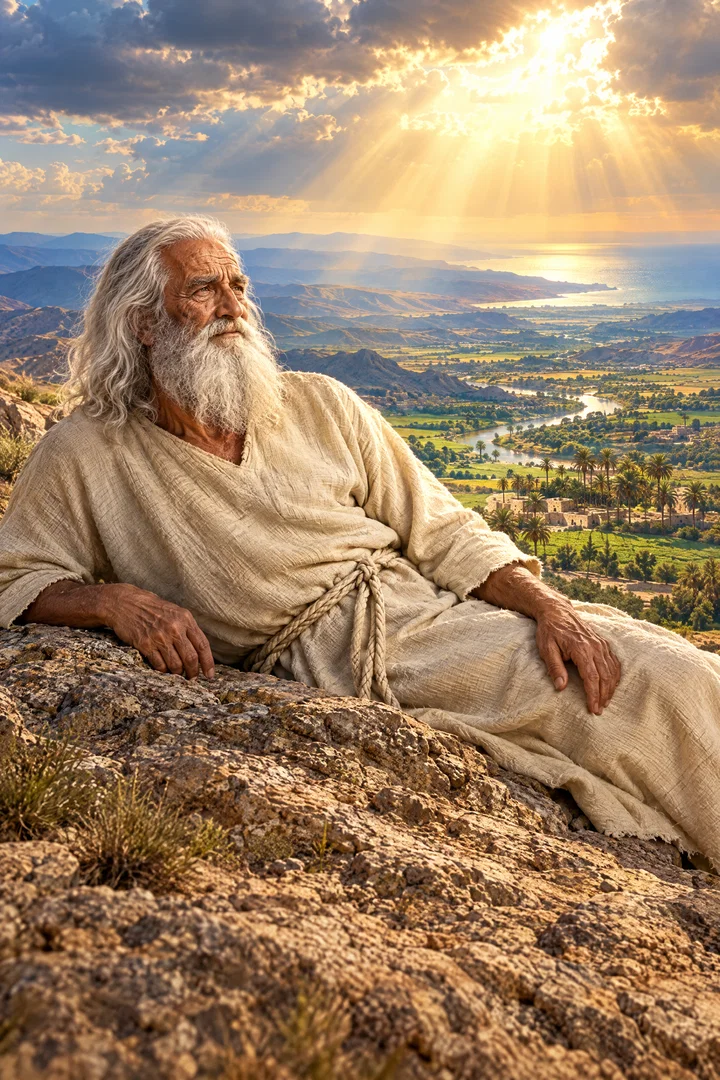
On the top of Pisgah Moses stands alone with God and the angels and is shown the whole of the land sworn by oath to Abraham, Isaac and Jacob to give to their seed, yet is told he shall not go over into it.1SP 335.21SP 341.2–3SG4 56.2–57.21SP 336.1ST Aug 31, 1915 Though about to die he is still strong with clear undimmed eyes, and is caused to see it fully to his satisfaction as a fertile, beautiful, well-watered country rich in soil and abundance under God's watchful care.1SP 341.2–3SG4 56.2–57.21T 658.3–659.210MR 151.1–2Ms 69, 1912, par. 22–23 He is shown where the tribes will settle established in their inheritance, and fully realizes the rich blessings they will enjoy there if they faithfully obey God's commandments, as he lays down his burden in this final view.SG4 56.2–57.21SP 336.1ST Mar 31, 188110MR 151.1–2Ms 69, 1912, par. 22–23 His exclusion is for his one wrong act that marred his record, so after the view he lies down like a tired warrior and dies, and angels bury him secretly in an unknown sepulchre in Moab lest Israel idolize it, until his return to life in resurrection.1SP 341.2–3SG4 56.2–57.2ST Mar 31, 1881Ms 177, 1907, par. 19–21Lt 21, 1867, par. 4–6 With the earthly land he is also shown Christ's first appearing and rejection and death on the cross, then Christ's second advent and the resurrection of the just when Eden shall bloom on earth again, for this solitary communion before the close of his work gives moral power for every great trial and duty.1T 658.3–659.2ST Jul 27, 1915
The View from Pisgah
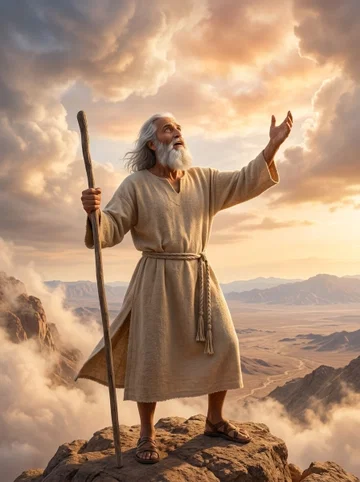
Moses was brought alone to the top of Pisgah, the highest prominence attainable on Nebo, with no one permitted to go up with him, and there he stood in the presence of God and heavenly angels.SG4 56.2–57.2 Though facing death he was still strong, with clear and undimmed eyes not dimmed by age.SG4 56.2–57.21T 658.3–659.2 God caused him to see the whole land fully and to his satisfaction with his own eyes.1SP 341.2–3SG4 56.2–57.2
The land spread before him was the land sworn by oath to Abraham, to Isaac, and to Jacob, with the promise to give it to their seed as the promised home and inheritance of Israel.1SP 335.2SG4 56.2–57.21SP 336.1ST Mar 31, 188110MR 151.1–2 It was confirmed to him as that same promised land even as he was told he would view it but not enter it.ST Aug 31, 1915 It appeared as a fertile, beautiful, well-watered country, rich in soil and water, in grain fields and fruit trees and other abundance.10MR 151.1–2Ms 69, 1912, par. 22–231SP 339.1 It passed before him like a panorama, as a second Eden under God's blessing and watchful care resting upon it throughout the year.1T 658.3–659.210MR 151.1–2Ms 69, 1912, par. 22–23
He was shown where the tribes of Israel would settle, and he saw the people he had led standing established within their inheritance.10MR 151.1–2Ms 69, 1912, par. 22–23 In that view he fully realized the rich blessings and good things Israel would enjoy in the land if they faithfully obeyed God's commandments.SG4 56.2–57.21SP 336.1ST Mar 31, 1881
Exclusion, Death, and Hope
Moses was permitted to look upon the promised land sworn to Abraham, Isaac, and Jacob to give to their descendants, yet he was told he would not cross over into it, and the sight spread before his own eyes was his final view as he laid down his burden for Israel.1SP 335.2ST Aug 31, 1915MH 508.2Lt 21, 1867, par. 4–6 He beheld it fully without entering, for the viewing from Pisgah before death was the fulfillment of being caused to see with his eyes what he would not be allowed to enter.1SP 335.21SP 341.2–3ST Aug 31, 1915 This last sight was given as he faced death on the mountain where his life and work for the people came to their close.MH 508.2Lt 21, 1867, par. 4–6
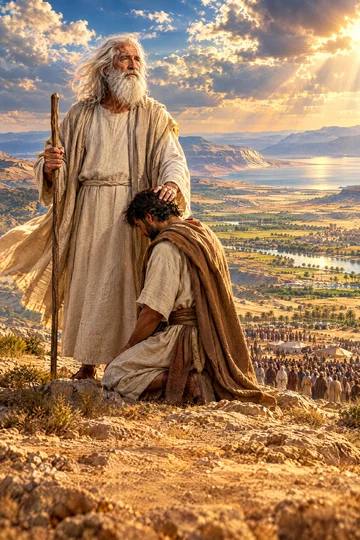
The exclusion rested upon his one wrong act or mistake, which marred his record, so that he must die on the mountain while Joshua took his place.ST Mar 31, 1881Ms 177, 1907, par. 19–21 Knowing that Israel would receive the promised good things when faithful and obedient, he accepted this sentence, confessed his wrong, and asked pardon in faith in Jesus, the Promised One who would die as man's sacrifice.ST Mar 31, 1881 After the view he lay down like a tired warrior and died, and angels took his body and buried it secretly in the valley in Moab in an unknown sepulchre.1SP 341.2–3SG4 56.2–57.2 The burial was hidden so that Israel could never find it and be led into the sin of idolatry over it, and his later resurrection was his return to life.1SP 341.2–3SG4 56.2–57.2Lt 21, 1867, par. 4–6
Together with the earthly land and God's blessing upon it, appearing like a panorama as a second Eden, he was also shown the appearing of Christ at His first advent, His rejection by the Jewish nation, and His death upon the cross.1T 658.3–659.2 Then followed Christ's second advent and the resurrection of the just, and finally the meeting of Adam the first with Christ the second Adam when Eden shall bloom on earth again.1T 658.3–659.2 The call to the top of Pisgah before he laid down his life with his burden for Israel was solitary communion with God granted before the close of his work to prepare him to finish and die.ST Jul 27, 1915 That final communion matches the communion granted before every great trial and task, showing that fresh communion with God gives moral power for every great trial, task, and duty.ST Jul 27, 1915
Sources
Pioneers and periodicals
63 sources
The Lord stood Moses on Pisgah, on Nebo in Moab over against Jericho, and caused him to see with his own eyes the land sworn to Abraham, to Isaac and to Jacob to give to their seed, yet told him he should not go over into it.RH Mar 2, 1916RH Oct 2, 1856ST Jun 17, 1886ST Oct 31, 1906RH Aug 29, 1871 He was shut out because of his one failure at the waters of strife at Meribah and Kadesh, where he spoke angrily and failed to give God the glory, showing that exact obedience is required and neither long service nor high position exempts a leader.ST Oct 14, 1880ST Mar 12, 1912ST Sep 17, 1902ST Sep 29, 1881RH Mar 17, 1904 Though he died outside earthly Canaan and was buried by God Himself in an unknown grave in Moab, he was honored above all in being raised from the dead, rescued from Satan's power, and taken glorified to the heavenly Canaan to appear with Jesus at the Transfiguration.ST Mar 12, 1912ST Mar 20, 1879ST Apr 26, 1905ST Sep 10, 1902RH May 17, 1860 The land sworn to the patriarchs was the literal land of Canaan possessed by Israel as its typical fulfillment, while its emphatic fulfillment comes when the saints possess the new earth as Abraham's greater inheritance.ST Sep 10, 1902RH Feb 7, 1854RH Sep 17, 1872ST Sep 10, 1902 That Pisgah sight has become the image of seeing the heavenly home by faith, for the pilgrim is carried to Pisgah's height to glimpse from afar the border of heavenly Canaan and the reward beyond this life, which is better than the earthly inheritance withheld from Moses.RH Feb 19, 1867ST May 19, 1914
Setting and Wording
The closing chapter of Deuteronomy records Moses' vision of the land and his death at the end of Israel's forty years of wandering.ST Mar 12, 1912ST Apr 26, 1905 It closes the life of Moses, one of the greatest men of all history, and closes the third forty-year period of his life, from the exodus out of Egypt to Mount Nebo, the first being from infancy to flight to Midian and the second from flight till return to Egypt.ST Mar 12, 1912ST Nov 7, 1878 Its account of Moses' death provides the setting for his later appearance with Jesus.ST Apr 26, 1905
The last chapter of the last book of Moses was added by Joshua or some other servant of the Lord to give an account of Moses' death, while Moses himself wrote the first five books.ST Mar 24, 1898 Alternatively, God could have inspired Moses to write prophetically of his own death and burial.ST Jan 24, 1900 The account ending with Moses' death marks the endpoint of the period counted from the creation of humanity, a span of more than twenty centuries.ST Oct 14, 1880
The verse is an example of the Lord speaking to Moses at Pisgah near the end of his life.ST Jun 17, 1886 Moses did not act on his own authority, but the authority behind his words and work was God's.ST Jun 17, 1886 Moses stood on Mount Pisgah, Mount Nebo in Moab over against Jericho, before he went up to the heavenly hills.RH Aug 29, 1871 God honored Mount Nebo by letting Moses see from its height the goodly promised land and the future of his people without going over into it, and there Moses died.ST Aug 27, 1896
Nebo stands among the mountains of Moab beyond the Dead Sea to the southeast, visible from the Mount of Olives looking across and beyond the Dead Sea.ST Nov 3, 1898 The mountain where Moses saw God's heritage is identified as where God showed him the land.RH Aug 29, 1871ST Apr 8, 1889 God said the land Moses saw was the land sworn to Abraham, to Isaac, and to Jacob, saying He would give it to their seed and descendants.ST Aug 31, 1915ST Mar 10, 1881RH Mar 2, 1916ST Oct 31, 1906ST Jan 15, 1880 He caused Moses to see it with his own eyes from Pisgah and Nebo, seeing it only once, but Moses would not go over into it and was not permitted to enter.ST Aug 31, 1915RH Mar 2, 1916RH Oct 2, 1856ST Oct 31, 1906ST Jan 15, 1880
Moses' vision reached farther than natural sight in a broad prophetic view beyond what the eye could reach from that height.ST Sep 10, 1902ST Sep 10, 1902 The promised territory stretched from the river of Egypt to the great river Euphrates.ST Sep 10, 1902ST Sep 10, 1902 Being shown all the land of Gilead unto Dan included Mount Hermon to the north, a lofty snow-capped landmark of great beauty seen in clear air from Moab, Gilead, Bashan, and nearly every prominent point in Palestine closing the northern horizon, afterward plainly seen from the plain of Esdraelon and Nazareth.ST Jun 26, 1901
Moses was shown the dim outline of hills, lakes, rivers, plains, forests, orchards and fields, the glory of all lands flowing with milk and honey and yielding mammoth clusters of grapes.ST Jun 15, 1904 He longed to cross the narrow stream that separated him from it to examine its objects more closely and live on its productions, but had to be content to view the land and its contents from afar.ST Jun 15, 1904 After viewing its beauty and his people's future triumph and glory he was laid to rest on Mount Nebo.
Moses died at least several days after telling Israel they would pass over Jordan that day.RH May 26, 1874 The people then mourned thirty days for him, and still more days passed for Joshua to take command and send spies and receive their report before the crossing, likely about two months in all.RH May 26, 1874 This proves Israel did not cross that day and Moses did not expect them to, so his this day meant certainty and nearness in time.RH May 26, 1874
Reason Moses Excluded
Moses was barred from crossing over because of his single failure at the rock at the waters of strife at Meribah and Kadesh, where on one occasion he failed to give God the glory as the provider of needed water, spoke angrily and unadvisedly, took the glory to himself after being provoked in spirit, and so marred his record.ST Mar 31, 1881ST Mar 12, 1912ST Sep 17, 1902RH Mar 17, 1904RH May 17, 1860 That exclusion stood even though the land before him was the goal of his hopes for more than forty years, and he was allowed only to see the land promised to Abraham, Isaac, and Jacob for their seed and then to die after viewing it.ST Mar 12, 1912ST Sep 29, 1881RH May 17, 1860 God did not act from selfishness in this, but the welfare of His people required that they must in everything recognize dependence upon Him, for without Him nothing can be done, as the words of Jesus, Without Me ye can do nothing, were true then as today, and not even Moses after forty years leading the Lord's people in the wilderness to the border was an exception to this truth.ST Sep 17, 1902
The sentence was not revoked, and it illustrates that God expects exact obedience and holds people accountable even after long and faithful service.RH Mar 17, 1904 Faithful service and high position did not exempt Moses from the penalty for disobedience when he spoke angrily at the rock and sinned at Kadesh, for God does not let the sins of leaders pass unpunished.ST Oct 14, 1880RH Mar 17, 1904 Moses knew that Israel received God's promised good things when faithful and obedient, and he accepted that his one wrong act marred his record, confessing it and asking pardon in faith in Jesus the Promised One who would die as man's sacrifice.ST Mar 31, 1881
He stood alone on the mountain seeing the beautiful land he would not enter, his exclusion a sorrowful fate from God connected with remembered sin.ST Dec 22, 1881 After talking with Jehovah as a man talks with his friend he was denied passage over Jordan and turned with tear-dimmed eyes to take the lonely journey to the towering heights of cloud-wrapped Nebo, climbing in silent grief with dark eyes still piercing and bright as an eagle's, eyes that had looked unflinchingly upon the glory-mantled summit of Sinai, now turned sorrowfully toward the far west to behold the inheritance stretched beyond the Jordan which he was caused to see with his eyes but not to enter.ST May 19, 1914 At the end of forty weary years of looking longingly toward the good land as the center of all his hopes and the goal of his ambition, he was required to die alone with no sympathizing hand of brother or wife to minister to him in the struggle with death, not decrepit and bent and weary of life but in the full strength of manhood with eye undimmed and great unselfish loyal heart beating strong and vigorous as nearly a century before when heir to the proud throne of Egypt, whose unselfish prayer had many times prevailed for the life of his ungrateful nation yet whose prayer for his own life in this extremity availed nothing.ST May 19, 1914
After being led into transgression by the people's sin he was laid to rest on Nebo because of that one transgression, for by God's decree he must die before Israel took possession, seeing the land and its future triumph and glory but not permitted to enter it.ST Mar 10, 1881 God corrected him in a tender way, not leaving it to the people to correct His servant but taking the correction into His own hands, and when giving the view of the land of promise reminding him of his mistake at the waters of strife where he took the glory to himself after Israel grievously erred and provoked his spirit, and that he would not go over.RH Sep 13, 1906 Even in correcting him God did not take away the gift of prophecy from him, and through him pointed out Joshua to continue leading Israel after his death, a tender dealing standing in marked contrast to God's dealing with Korah, Dathan, and Abiram, who criticized Moses and Aaron instead of repenting and were destroyed without remedy.RH Sep 13, 1906
Death Burial Resurrection
Despite his failure Moses was honored in death as no other ever was, for God Himself buried him attended only by heavenly angels.ST Mar 12, 1912 He rests in an unknown grave in Moab where no one knows the place, the goal of his hopes for more than forty years calling him to rest after disobedience at Meribah.ST Mar 12, 1912RH May 17, 1860 Afterward God placed his spirit upon his successor Joshua.ST Mar 12, 1912
Moses died outside earthly Canaan after leading Israel to its borders, ending his work as bearer of God's splendor.AUST Jun 21, 1920 Last seen of old on lone and cold Mount Nebo, he saw the promised land with eyes not dim yet did not cross the Jordan bar into it.RH Jan 8, 1875 From Pisgah's summit he stepped into heaven's open doorway.RH Jun 29, 1869 From there he winged his way with seraphim to his far celestial Canaan.RH Jan 8, 1875
He did not appear as a conscious soul separated from his body, but had been raised from the dead before he later appeared alive on the mount with Christ.ST Mar 20, 1879 His death near the end of Israel's forty years of wilderness wandering provides the setting for that later appearance with Jesus at the Transfiguration.ST Apr 26, 1905 He was rescued from Satan's power and glorified in the heavenly Canaan.RH Aug 3, 1916 His resurrection is proof of his undisputed share in the greater inheritance promised to Abraham and his spiritual seed, beyond the immediate Canaan that was the goal of the people under his command.ST Sep 10, 1902ST Sep 10, 1902 His victory came through implicit trust in God's unfailing promises.AUST Jun 21, 1920
God afterward brought him forth to speak with Jesus just before the crucifixion about the trials Jesus must pass through.ST Mar 12, 1912 He later appeared to comfort Jesus at the Transfiguration.AUST Jun 21, 1920 He now wears a crown of light brighter than Egypt's crown and stands again with Jesus on the mount of transfiguration.RH Jan 8, 1875 The land he never trod is where he will stand again, risen in glory before the judgment day, clothed in glory on the hill he never trod, speaking of the strife and struggle through which the incarnate Son of God won life.ST Apr 5, 1905RH Nov 20, 1860
Land Promise Meaning
The land sworn to Abraham, to Isaac, and to Jacob was the literal land of Canaan given as the second blessing included in the promise to Abraham for his natural seed.RH Feb 7, 1854 Moses was caused to see that same land with his eyes from Pisgah and Nebo though he would not go over into it.RH Feb 7, 1854 This proves the promise meant literal Canaan to be possessed by Israel, not the New Earth.RH Feb 7, 1854
The temporary possession of literal Canaan was the typical fulfillment of the land sworn to the patriarchs, while the emphatic fulfillment comes when the saints possess the new earth.RH Sep 17, 1872 The land immediately before Israel was the primary objective of the people under Moses’ command, the immediate Canaan they were about to possess and enter after his death.ST Sep 10, 1902ST Sep 10, 1902 Moses’ vision reached farther than natural sight in a broad prophetic view beyond what the eye could reach from that height, taking in the whole promised territory stretching from the river of Egypt to the great river Euphrates.ST Sep 10, 1902ST Sep 10, 1902 Yet Moses also shared in Abraham’s greater inheritance for his spiritual descendants and keeps an undisputed share in it, proved by his resurrection and appearance with Christ.ST Sep 10, 1902ST Sep 10, 1902
The land promised to Abraham and his descendants is an inheritance for Abraham’s seed secured by God’s promise and ratified through Christ.RH May 30, 1854 Seen from Pisgah while God’s people are still on their pilgrimage, it pictures the hope set before them beyond the flood.RH May 30, 1854RH Jan 23, 1872 That promised land to Abraham’s descendants is the earth that will be the future home of the righteous.RH Jan 23, 1872 Moses saw the land of Canaan only once, from the top of Pisgah, showing the land was not a pattern for the sanctuary Moses built.RH Oct 2, 1856 God let Moses see from a distance the land sworn to Abraham, Isaac, and Jacob and promised to their descendants, reminding him he would not enter it, and Israel’s entrance into the land followed after Moses’ death.
Types and Prophecy
Because of his one failure Moses could not be a perfect type of Jesus Christ who carries His people safely through without failure.ST Mar 12, 1912 The closing of his life as one of the greatest men of all history shows him the land promised to Abraham, to Isaac, and to Jacob for their seed while forbidding him to go over into it.ST Mar 12, 1912 Notwithstanding that failure he was honored as no other was ever honored in death, with God Himself burying him attended only by heavenly angels.ST Mar 12, 1912 God afterward brought him forth to speak with Jesus just before the crucifixion about the trials Jesus must pass through, while the spirit of Moses was placed upon his successor Joshua.ST Mar 12, 1912
The people entered Canaan only after Moses' death, and this serves as a picture of Christ's death opening heaven to believers through His atoning blood.RH Feb 19, 1861 With that removal just before him his work ended as bearer of God's splendor to Israel.RH Feb 3, 1910 He was the greatest of all prophets, more than a prophet, permitted to talk with God mouth to mouth and face to face as a man speaks to his friend.RH Feb 3, 1910 He was not to continue always as the carrier of that glory, so provision had to be made for the symbol of God's presence and the light of His glory to remain with the people through the portable tabernacle for God's indwelling and the pillar of His presence to direct their wilderness journeys night and day.RH Feb 3, 1910
The chapter explains why Christ's to-day to the thief does not mean Paradise was entered that day.RH May 26, 1874 Moses died at least several days after telling Israel they were to pass over Jordan that day, the people then mourned for him thirty days, and still more days passed for Joshua to assume command and send spies and receive their report before the crossing, likely about two months in all.RH May 26, 1874 Israel therefore did not cross on the day of the promise and Moses did not expect them to, so that his this day meant the certainty of the event and its nearness in time.RH May 26, 1874 God let Moses see the promised land but did not allow him to enter it, and Moses died before Israel crossed the Jordan.
His prophetic view of the land flowing with milk and honey also took in the cross, and reaching the promised land required sacrifice. The vision therefore calls people not to halt or turn back in the face of hardship. That Pisgah sight was distant and unentered, but those dwelling on time's high pinnacle need no such Pisgah.ST Nov 9, 1915 To live now is vision and to know is sublime, viewing the real things once predicted to the seer as present witness that the consummation is here.ST Nov 9, 1915
Moses on the heights of Nebo viewing the promised land he would not enter pictures how the Lord draws near in a spiritual and personal sense to His dying children to give them a vision of the heavenly Canaan before they enter the dark valley.RH Apr 24, 1913 Angel hands sweep back the curtain to reveal celestial glory and angel forms about their bedsides even as was given to the martyr Stephen when sealing his testimony with his blood.RH Apr 24, 1913 However blessed this experience it is not the second coming of Christ.RH Apr 24, 1913 He comes not one by one in the quietness of night but in glory with all His holy angels to open the prison-house of death and take His loved ones home.RH Apr 24, 1913
Faith and Application
The sight of the promised land from Pisgah becomes by faith a Pisgah view of gloryland, the heavenly home awaiting the faithful pilgrim glimpsed from afar on the journey before possession.RH Feb 19, 1867RH Dec 24, 1861RH Feb 3, 1863 Faith will give way to sight when that home appears and hopes will be renewed. Standing on Pisgah's top viewing promised Canaan across the Jordan pictures standing on the border of the heavenly Canaan with wonderful views of that land and its metropolis the New Jerusalem and the beautiful mansions Jesus has gone to prepare, rejoicing that He is very soon coming to gather His saints to that glorious kingdom.
The Sabbath is a Pisgah-like height from which believers view their promised land.RH Jan 12, 1864 A Pisgah of faithful labor, facing life squarely and working faithfully, brings a high point where the coming reward is seen ahead.ST Aug 19, 1875
Moses' longing on Nebo to cross into Canaan images longing for the promised haven beyond this life.RH Oct 23, 1900 Faith still has its vista of gloryland, for the far mount seen amid surrounding woods of trial pictures the broader view God gives in present sorrow and sore affliction, with sunlight glimmering between barred branches and stars of promise seen with hope. Today's most grievous sorrow, though a mountain to man, is only a cloudy moment in God's eternal plan, so the afflicted should not grieve, because sorrow dwells with hope.
The sight serves as encouragement to keep going toward the promised reward, as a weary traveler is strengthened by seeing the town ahead, its good things anticipated before they are reached.RH Nov 14, 1854 It calls people not to halt or turn back in hardship, and supplies the image for leading a congregation to see the promised land.RH Nov 14, 1854 Reaching God's promised glory, pictured as paradise restored, follows a path of patient toil and hardship after a life of costly service leading from Egypt and enduring years of tending sheep and dealing with a rebellious people, not an easy ascent.RH Feb 4, 1904
God withheld the earthly inheritance because He had something better for His faithful servant, for the heavenly Canaan is better than the earthly.ST May 19, 1914 God took Moses because He wanted him, and God still wants disappointed people today.ST May 19, 1914 Just on the border of the goal of his hopes, seeing another leader take his place while called to a lonely grave on a mountain outside the goal, after rejecting a throne with its wealth and glory to herd sheep and men for eighty years and cast his lot with a race of slaves, looks by worldly standards like stupendous failure, but in heaven's lexicon success is faithfulness.ST Sep 9, 1930
Moses was barred from crossing into the land because he once grew impatient, a lesson in the cost of failing to obey God patiently. His disobedience cost him the earthly Canaan, for God let him see the land sworn by oath to Abraham, Isaac, and Jacob and their descendants, but reminded him he would not enter it.ST Apr 25, 1906 His sorrowful view warns that disobedience can likewise cost a person the heavenly Canaan.ST Apr 25, 1906 A faithful person may see the promised goal from afar and die before its fulfillment.RH Jan 1, 1867 In providence Moses was asked at the close of leading Israel through wilderness wanderings, after seeing the glories of the promised land with his eyes, to rest from the conflict for a little while under the power of death until the Reaper comes to garner the harvest, rather than going over into the goodly heritage.
Miriam and Aaron also made serious mistakes and did not enter the land, and those who found fault, grumbled, and complained likewise died in the wilderness. Yet Caleb, Joshua, and many others entered because they trusted God's leading and promises instead of fixing attention on others' faults. God calling Moses to the top of Pisgah before he laid down his life with his burden for Israel, spreading out before him the glory of the promised land, was communion with God granted in solitude before the close of his work, matching the communion granted before every great trial and task.ST Jul 27, 1915 That fresh communion gives moral power for every great trial and duty and prepares to finish work and die, and like coming down from the mount from secret prayer it leaves greater separation from sin and the world, increased spirituality, and stronger likeness to God.ST Jul 27, 1915RH Apr 16, 1857
The view from Nebo serves as a vantage from which to look back over the path traveled and forward toward the promised destination after the long wilderness years, standing wistfully looking into the land sworn to Abraham, Isaac, and Jacob though not entering it.RH Nov 5, 1861 From that height the wilderness route is seen where rebellion, murmuring, and limiting God brought wrath and where thousands fell, making the consequences of those choices visible.RH Nov 5, 1861
Sources