Deuteronomy 7:5
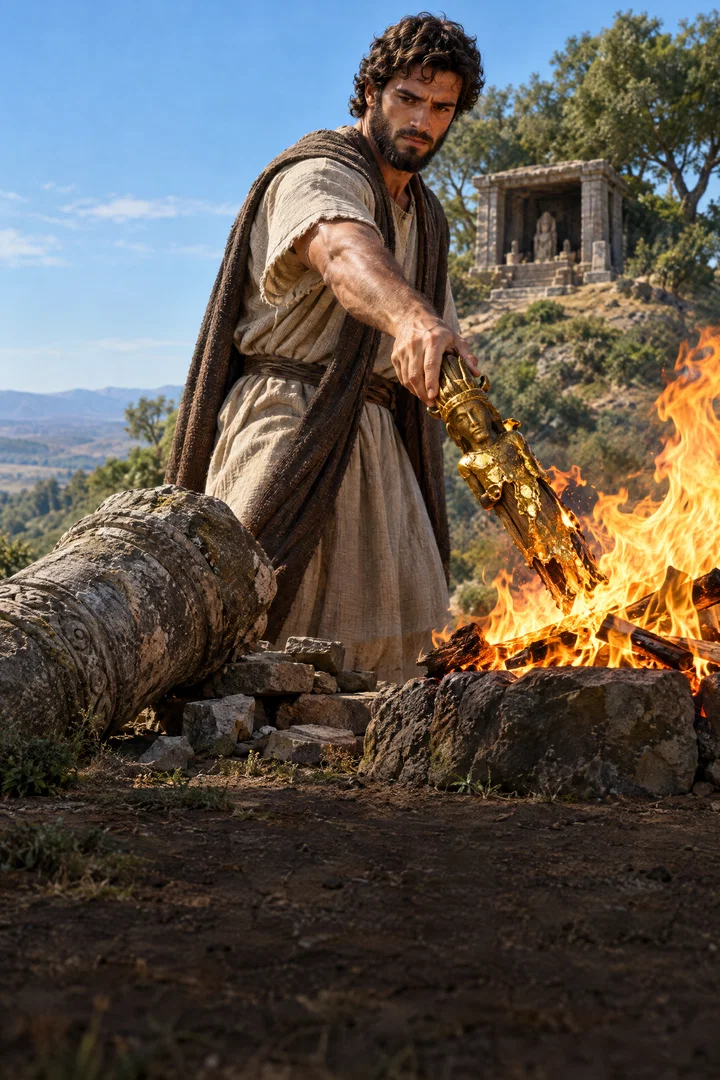
But thus shall ye deal with them; ye shall destroy their altars, and break down their images, and cut down their groves, and burn their graven images with fire.
Translations
But thus shall you deal with them; you shall destroy their altars, and break down their images, and cut down their groves, and burn their graven images with fire.
King James Version, KJV Cambridge Paragraph Bible, Webster Bible
But thus shall ye deal with them; ye shall destroy their altars, and break down their images, and cut down their groves, and burn their graven images with fire.
But thus shall ye deal with them; ye shall break down their altars, and dash in pieces their pillars, and hew down their Asherim, and burn their graven images with fire.
But thus shall ye deal with them: ye shall break down their altars, and dash in pieces their pillars, and hew down their Asherim, and burn their graven images with fire.
'But thus thou dost to them: their altars ye break down, and their standing pillars ye shiver, and their shrines ye cut down, and their graven images ye burn with fire;
But thus shall ye deal with them: ye shall break down their altars, and shatter their statues, and hew down their Asherahs, and burn their graven images with fire.
Verily, thus, shall ye do unto them: Their altars, shall ye tear down, And their pillars, shall ye break in pieces,—And their sacred stems, shall ye hew down, And their carved images, shall ye burn up in the fire.
Berean Standard Bible, Majority Standard Bible
Instead, this is what you are to do to them: tear down their altars, smash their sacred pillars, cut down their Asherah poles, and burn their idols in the fire.
But you shall deal with them like this: you shall break down their altars, dash their pillars in pieces, cut down their Asherah poles, and burn their engraved images with fire.
But this is what you are to do to them: their altars are to be pulled down and their pillars broken, and their holy trees cut down and their images burned with fire.
But thus ye shall deale with them, Ye shall ouerthrowe their altars, and breake downe their pillars, and ye shall cut downe their groues, and burne their grauen images with fire.
Douay-Rheims (Challoner revision)
But thus rather shall you deal with them: Destroy their altars, and break their statues, and cut down their groves, and burn their graven things.
Pictures
Cross-references
- Exodus 34:13
But ye shall destroy their altars, break their images, and cut down their groves:
Both command Israel to destroy Canaanite altars, images, and groves.
- Deuteronomy 12:2-3
Ye shall utterly destroy all the places, wherein the nations which ye shall possess served their gods, upon the high mountains, and upon the hills, and under every green tree:
Commands Israel to destroy pagan worship sites and images.
- Numbers 33:52
Then ye shall drive out all the inhabitants of the land from before you, and destroy all their pictures, and destroy all their molten images, and quite pluck down all their high places:
Both command Israel to destroy Canaanite images and places of worship.
- Exodus 23:24
Thou shalt not bow down to their gods, nor serve them, nor do after their works: but thou shalt utterly overthrow them, and quite break down their images.
Commands Israel to reject foreign gods and destroy their worship objects.
- Judges 2:2
And ye shall make no league with the inhabitants of this land; ye shall throw down their altars: but ye have not obeyed my voice: why have ye done this?
Israel disobeyed the command to throw down the inhabitants’ altars.
- Deuteronomy 7:25
The graven images of their gods shall ye burn with fire: thou shalt not desire the silver or gold that is on them, nor take it unto thee, lest thou be snared therein: for it is an abomination to the LORD thy God.
Both forbid keeping or coveting the idols and their precious metals.
- Joshua 11:12-15
And all the cities of those kings, and all the kings of them, did Joshua take, and smote them with the edge of the sword, and he utterly destroyed them, as Moses the servant of the LORD commanded.
Describes Israel carrying out the commanded destruction of Canaanite cities and peoples.
- Psalms 106:34-36
They did not destroy the nations, concerning whom the LORD commanded them:
Israel failed to destroy the nations and adopted their idolatrous worship.
- Deuteronomy 20:16-18
But of the cities of these people, which the LORD thy God doth give thee for an inheritance, thou shalt save alive nothing that breatheth:
Israel must destroy the Canaanite peoples lest their idolatrous practices lead Israel to sin.
- 1 Kings 11:7-8
Then did Solomon build an high place for Chemosh, the abomination of Moab, in the hill that is before Jerusalem, and for Molech, the abomination of the children of Ammon.
Solomon builds high places and altars for foreign gods.
- Judges 2:11-13
And the children of Israel did evil in the sight of the LORD, and served Baalim:
Israel turns from the LORD to Baal and other gods.
Commentary
Each commentary is drawn from primary sources: the writings of Ellen G. White and Adventist pioneers and periodicals. Each commentary is separate. Its own words are not a quotation; follow the references to read the source passages.
Ellen G. White
20 sources
The verse commands Israel to completely destroy every place and object of Canaanite worship — tearing down altars, breaking sacred pillars, cutting down Asherah poles, and burning carved images with fire, sparing nothing even if valuable.RH Aug 4, 1904Ms 132, 1903, par. 1–6Ms 146, 1906, par. 51–545T 328.1–329.1Lt 51, 1901, par. 14–17 It was spoken by Christ Himself as Israel's invisible leader when God delivered the seven nations before them — Hittites, Girgashites, Amorites, Canaanites, Perizzites, Hivites and Jebusites — to be utterly destroyed and dispossessed with no covenant, mercy or intermarriage, because Israel was a holy people chosen and redeemed to be special above all people.Ms 38, 1898, par. 2–5Ms 83, 1910, par. 22–24Ms 134, 1899, par. 5–6 Such total removal was required for them to be holy and separate from idolatry, since alliances and marriages with idolaters would turn them and their children from following God to serve other gods and kindle His anger to sudden destruction.7MR 309.1–3Ms 38, 1898, par. 2–5RH Aug 4, 1904Ms 132, 1903, par. 1–65T 328.1–329.1 The beautiful groves, shrines and altars would deceive the senses and displace God in the mind, so rejecting them kept Israel from corruption and preserved sacred truth to restore God's moral image in man and share its light with the world.Ms 151, 1901, par. 47–49ST Jan 13, 1881Ms 134, 1899, par. 5–6Lt 25b, 1892, par. 263T 263.2 The command still speaks as God's voice for admonition upon those on whom the ends of the world are come, requiring full surrender and daily obedience to all His commandments from greatest to least in preparation to stand in review before God.7MR 309.1–3STB 628.4–629.2Ms 146, 1906, par. 51–54Lt 42, 1910, par. 6STMW9 52.3
Command and Its Setting
The command required Israel to deal with the Canaanites by destroying their altars, breaking down their images or sacred pillars, cutting down their groves or Asherah poles, and burning their graven or carved images with fire, thus completely removing every place and object of false worship.RH Aug 4, 1904Ms 132, 1903, par. 1–6Ms 146, 1906, par. 51–54Ms 158, 1902, par. 74–75Lt 112, 1909, par. 22–24 The work was to be total, leaving no idolatry to remain and preserving nothing, not even articles that were valuable or finely made.5T 328.1–329.1Lt 51, 1901, par. 14–17ST Jan 13, 1881 That thorough clearing belonged among the important teachings to be brought before the people, including the rejection of illustrations of heathen shrines in church publications.Lt 259, 1902, par. 3–5
The speaker was Christ Himself, the same One who healed the sick in Palestine, speaking as Israel's invisible leader, guide and protector enshrouded in the pillar of cloud, instructing them and preparing their way at every difficulty.Ms 38, 1898, par. 2–5Ms 134, 1899, par. 5–6 In its setting the charge was to smite and utterly destroy the seven nations when God delivered them before Israel — the Hittites, Girgashites, Amorites, Canaanites, Perizzites, Hivites and Jebusites — dispossessing them and occupying all the territory God specified, with borders enlarged as numbers increased.Ms 38, 1898, par. 2–5Ms 83, 1910, par. 22–24Ms 134, 1899, par. 5–6 With that destruction Israel was to make no covenant with them, show them no mercy, and make no marriages with them, neither giving daughter nor taking daughter.Ms 38, 1898, par. 2–5Ms 83, 1910, par. 22–24
The command was given because Israel was a holy people chosen to be a special people above all people on the earth, loved not because they were more in number, for they were the fewest of all people.Ms 38, 1898, par. 2–5Ms 83, 1910, par. 22–24 He loved them to keep the oath sworn to their fathers, and because He had redeemed them with a mighty hand from the house of bondmen, from Pharaoh king of Egypt.Ms 38, 1898, par. 2–5Ms 83, 1910, par. 22–24 He is the faithful God who keeps covenant and mercy to a thousand generations with those who love Him and keep His commandments, and repays those who hate Him to their face.Ms 38, 1898, par. 2–5
Reasons and Warnings
The thorough clearing of altars, sacred pillars, Asherah poles and carved idols was what holiness unto God required, a complete separation from idolatry by which His people were kept distinct from surrounding worship.7MR 309.1–3RH Aug 4, 1904Ms 132, 1903, par. 1–6Lt 112, 1909, par. 22–24 That removal was to be total, leaving no place or object of false worship standing, and it shows how strictly His people must guard themselves against worldliness.RH Aug 4, 1904Ms 132, 1903, par. 1–6Ms 158, 1902, par. 74–75 Holiness therefore meant active rejection, breaking down and burning rather than allowing idolatry to remain.Ms 132, 1903, par. 1–6Ms 158, 1902, par. 74–75Lt 112, 1909, par. 22–24
With that rejection went the prohibition of covenant, alliance, intermarriage, commingling and intimate companionship with idolaters, worldlings and those who reject the truth.Ms 38, 1898, par. 2–5Ms 151, 1901, par. 47–49Lt 51, 1901, par. 14–17 Such unions were forbidden because they would turn Israel and their children away from following God to serve other gods and to sin and dishonor Him.Ms 38, 1898, par. 2–5Ms 132, 1903, par. 1–65T 328.1–329.1Ms 151, 1901, par. 47–49 That turning would kindle the anger of the Lord to sudden destruction.Ms 38, 1898, par. 2–5Ms 151, 1901, par. 47–49 Association with unbelievers corrupts, making sin lose its offensiveness, and alliances that compromise faith must be avoided in order to remain separate.Ms 151, 1901, par. 47–49Lt 51, 1901, par. 14–17
The danger lay in influence and appeal, for the attractive groves, shrines, temples and altars could deceive the senses, displace God in the mind, and draw the people into worship of other gods.ST Jan 13, 18813T 263.2 Not even valuable or finely made articles of heathen worship were to be preserved, lest their appeal draw Israel into idolatry.ST Jan 13, 1881 To spare the Canaanites and their worship would have exposed Israel to spiritual ruin, so the severity of the command was not cruelty but protection.ST Jan 13, 1881 Safety lay not in substituting human ideas of clemency for the divine command but in obeying the expressed will without hesitation.ST Jan 13, 1881
Rejection of idolatrous worship kept Israel from corruption so that sacred truth could be preserved and its light shared with the world.Ms 134, 1899, par. 5–6Lt 25b, 1892, par. 26 Worship of the true God with righteous principles in life would restore the moral image of God in man.Ms 134, 1899, par. 5–6 Keeping His commandments, statutes and judgments was therefore to be strictly observed as conditions of life and not as arbitrary compulsion.Ms 38, 1898, par. 2–5 Obedience to His righteous law was the way to become all that God proposed, with God Himself as teacher ennobling His people and giving skill and wisdom.Ms 63, 1899, par. 3–6Ms 134, 1899, par. 5–6 That obedience would bless with vigor of intellect, preserve from the diseases afflicting other nations, protect from disease, and make them marvels of prosperity before the nations in which His majesty and power would be seen until Christ's kingdom extends over all the earth.Ms 63, 1899, par. 3–6Ms 134, 1899, par. 5–6
Present-Day Application
The command was written for admonition upon those on whom the ends of the world are come and still speaks as God's own voice to the present generation.STMW9 52.3 It is to be studied with profit now together with the fourth through the eighth chapters of Deuteronomy, and with the whole of chapter 7 especially verse 6 together with chapters 1 and 8, while the broader charge spans Deuteronomy 4 through 11.7MR 309.1–3STMW9 52.3 The reason for earnest study is that the day of God's great final review is near and the time of investigation is now, when every character will be investigated and every case decided for eternity before standing before the Judge of all the earth to answer for deeds done.7MR 309.1–3
It is part of the charge in Deuteronomy 4-8 that must be read to the people, read carefully and regarded, revealing God's dealings with His people.STB 628.4–629.2Lt 42, 1910, par. 6 It must be searched out personally and made the study book, with special interest in doing what it says, and it means much to those who carry responsibilities in sanitarium work.STB 628.4–629.2Lt 42, 1910, par. 6 Every soul must sanctify himself daily according to it, lest he be found in rebellion, so that the Lord will be glorified through His people.Lt 42, 1910, par. 6
What it requires is full surrender and continuing simplicity of obedience to all the Lord's commandments according to His special directions, from the greatest to the least, with none of the important things specified in His Word neglected.STB 628.4–629.2Lt 42, 1910, par. 6 Those who are a holy and peculiar people chosen by the Lord must purify their souls from all commonness, bring character into harmony with Him, and honor Him.STB 628.4–629.2Ms 83, 1910, par. 22–24 This means putting away fretting, crossness and irritability even in the family and speaking kindly, being prepared to stand in review before God with strength and to call Him Father.Ms 83, 1910, par. 22–24 Obedience matters to God, and those who love Him and keep His commandments will be welcomed into the heavenly city.Ms 146, 1906, par. 51–54
Applied to the home from babyhood, it requires complete separation from idolaters, forbidding marriages with worldlings and all commingling and intimate companionship with the openly wicked and unbelieving, with active rejection of idolatry by tearing down its places of worship and destroying its sacred objects.Ms 151, 1901, par. 47–49 Parents must guard and shield their children from the words, practices, sentiments and temptations of disobedient associates, teach obedience to parental requirements, keep their own spirit in subjection to God's will, and teach righteousness and justice by example as well as precept with no half-hearted work.Ms 151, 1901, par. 47–49 The urgency is that association with unbelievers corrupts and makes sin lose its offensiveness, turning sons away from following God to serve other gods and to sin and dishonor Him, kindling the anger of the Lord to sudden destruction.Ms 151, 1901, par. 47–49
Applied to sacred work, those who are holy and peculiar must be clean, set a consecrated example in word and deportment before children and households, and serve God with fear, love and wholehearted obedience to His commandments and statutes.STB 628.4–629.2 It belongs among the important teachings that should be brought before the people, and it supports rejecting illustrations of heathen shrines in church publications because it requires the destruction of objects and places used in idolatrous worship.Lt 259, 1902, par. 3–5
Sources
Pioneers and periodicals
14 sources
God commanded Israel to tear down every Canaanite place and object of worship, destroying altars, breaking down sacred pillars, cutting down Asherah poles, and burning carved images with fire so their gods would be removed from the land.RH Aug 4, 1904ST Aug 5, 1897RH Apr 3, 1879 The removal was to be total, leaving no visible trace and preserving nothing even if valuable or finely made.ST Jan 13, 1881ST Aug 5, 1897RH Mar 19, 1861 It was part of the charge to remain a separate and holy people to Jehovah by making no covenant or partnership with the peoples of Canaan, permitting no intermarriage with unbelievers, and bowing to no other gods.ST Aug 5, 1897 Its purpose was separation from idolatry, to keep Israel from being turned away from the Lord by the influence of heathen worship and to strengthen them in true religion.RH Aug 4, 1904ST Jan 13, 1881RH Mar 19, 1861 Its severity was not cruelty, for sparing Canaanite worship would have brought spiritual ruin, and Israel learned by this commissioned judgment how serious idolatry is, though this commission gives no authority for men to take life on their own.ST Jan 13, 1881RH Mar 19, 1861
Command and Setting
The command requires the destruction of every Canaanite place and object of worship, so that their gods and worship would be removed from the land: their altars are to be destroyed and overthrown, their pillars and images or sacred pillars broken down, their groves or Asherah poles called Asherim cut down and burned, and their graven or carved images burned with fire.RH Aug 4, 1904ST Aug 5, 1897RH Apr 3, 1879 The removal was to be total, leaving no visible trace and preserving nothing, not even valuable or finely made items or works of art.ST Jan 13, 1881ST Aug 5, 1897RH Mar 19, 1861
The verse belongs to Moses' repetition and rehearsal of God's laws and past dealings with Israel before crossing the Jordan into the promised land, recalling lessons from the wilderness years, stressing the sacred importance of God's law and the need to keep it, and appealing to Israel to serve the Lord and turn away from the sins that had ruined other nations.ST Feb 27, 1912ST Mar 3, 1909ST Mar 1, 1910 It is part of the command in Deuteronomy 7:1-6 for Abraham's descendants to continue a separate, distinctive existence as God's light-bearers and a holy people set apart to Jehovah, by forming no affiliation, partnership, or covenant with the peoples of Canaan, permitting no intermarriage of sons and daughters with unbelievers, and bowing to no other gods, so as to maintain the holy character and exalted position to which God called them.ST Aug 5, 1897
The command was an act of God's judgment on the people of Canaan, who were given over to degrading and sinful rites.ST Oct 8, 1902RH Mar 19, 1861 It states moral principles that apply in every age and belongs among the laws given as enduring after Israel entered the promised land, in contrast with temporary wilderness regulations such as the prohibition on kindling fires on the Sabbath.ST Feb 27, 1912RH Jan 7, 1862
Purpose, History, Application
The thorough clearing away of altars, sacred pillars, Asherah poles, and carved idols expresses separation from idolatry and guards against being turned away from the Lord to other gods.RH Aug 4, 1904ST Jan 13, 1881RH Mar 19, 1861 Nothing was to be preserved, not even valuable or finely made articles, and no visible trace of false worship was to be left.ST Jan 13, 1881RH Mar 19, 1861 This protected Israel from being drawn into idolatry through the influence and appeal of heathen worship, and strengthened the people in true religion.RH Aug 4, 1904ST Jan 13, 1881RH Mar 19, 1861 Its severity was not cruelty, for sparing the Canaanites and their worship would have exposed Israel to spiritual ruin.ST Jan 13, 1881 Israel was not to substitute its own ideas of clemency for God's expressed will, but to obey without hesitation.ST Jan 13, 1881
By being commissioned as God's instrument to execute this judgment on a people given over to degrading and sinful rites, Israel would learn the seriousness of idolatry and the danger of incurring His displeasure.RH Mar 19, 1861 That commission does not authorize men to take life on their own authority.RH Mar 19, 1861 Solomon disobeyed the command to destroy the altars of all false gods when, to gratify his idolatrous wives, he built altars to Ashtoreth, Milcom, Chemosh, and Molech, acting as if his superior wisdom and strength left him in no danger and exempted him from a law meant for others.RH Jan 12, 1869 Israel was promised spiritual and temporal blessings in the land if the commandments were kept, but the people failed to destroy idolatrous practices, mingled with the nations, adopted their worship, and were drawn into further sins.RH Aug 19, 1873RH Apr 3, 1879 That disobedience forfeited the promised blessings and brought snares, defeat, and captivity instead, so that heathen worship returned, with groves replanted and images set up.RH Aug 19, 1873RH Apr 3, 1879
Objects used in idol worship are to be destroyed, which applies to removing images from the home and burning them rather than continuing to treat them as sacred.RH May 25, 1916 The Canaanite presence is an image of severe duty, representing evil that must be driven out with fire and sword by crushing it through harsh discipline without kindness.ST Nov 4, 1889
Sources