1 Kings 11:7
Then did Solomon build an high place for Chemosh, the abomination of Moab, in the hill that is before Jerusalem, and for Molech, the abomination of the children of Ammon.
Translations
American King James Version, King James Version
Then did Solomon build an high place for Chemosh, the abomination of Moab, in the hill that is before Jerusalem, and for Molech, the abomination of the children of Ammon.
Then did Solomon build a high place for Chemosh, the abomination of Moab, in the hill that is before Jerusalem, and for Molech, the abomination of the children of Ammon.
Then Solomon built a high place for Chemosh, the abomination of Moab, in the hill that is before Jerusalem, and for Molech, the abomination of the children of Ammon.
Then did Solomon build an high place for Chemosh the abomination of Moab, in the mount that is before Jerusalem, and for Molech the abomination of the children of Ammon.
Then did Solomon build a high place for Chemosh the abomination of Moab, in the mount that is before Jerusalem, and for Molech the abomination of the children of Ammon.
Then doth Solomon build a high place for Chemosh the abomination of Moab, in the hill that [is] on the front of Jerusalem, and for Molech the abomination of the sons of Ammon;
Then did Solomon build a high place for Chemosh the abomination of the Moabites, on the hill that is before Jerusalem, and for Molech the abomination of the children of Ammon.
Then, did Solomon build a high place for Chemosh, the abomination of Moab, in the hill that is before Jerusalem,—and for Molech, the abomination of the sons of Ammon;
Berean Standard Bible, Majority Standard Bible
At that time on a hill east of Jerusalem, Solomon built a high place for Chemosh the abomination of Moab and for Molech the abomination of the Ammonites.
Then Solomon built a high place for Chemosh the abomination of Moab, on the mountain that is before Jerusalem, and for Molech the abomination of the children of Ammon.
Then Solomon put up a high place for Chemosh, the disgusting god of Moab, in the mountain before Jerusalem, and for Molech, the disgusting god worshipped by the children of Ammon.
Then did Salomon build an hie place for Chemosh the abomination of Moab, in the mountaine that is ouer against Ierusalem, and vnto Molech the abomination of the children of Ammon.
Douay-Rheims (Challoner revision)
Then Solomon built a temple for Chamos the idol of Moab, on the hill that is over against Jerusalem, and for Moloch the idol of the children of Ammon.
Pictures
Cross-references 20 of 34
- 2 Kings 23:13
And the high places that were before Jerusalem, which were on the right hand of the mount of corruption, which Solomon the king of Israel had builded for Ashtoreth the abomination of the Zidonians, and for Chemosh the abomination of the Moabites, and for Milcom the abomination of the children of Ammon, did the king defile.
Josiah defiled the high places Solomon had built for these idols.
- Deuteronomy 7:3-4
Neither shalt thou make marriages with them; thy daughter thou shalt not give unto his son, nor his daughter shalt thou take unto thy son.
Warns that marriage to pagan peoples would turn Israel to other gods.
- 1 Kings 11:11-13
Wherefore the LORD said unto Solomon, Forasmuch as this is done of thee, and thou hast not kept my covenant and my statutes, which I have commanded thee, I will surely rend the kingdom from thee, and will give it to thy servant.
Solomon’s disobedience leads to the kingdom being taken from him and divided.
- Deuteronomy 17:17
Neither shall he multiply wives to himself, that his heart turn not away: neither shall he greatly multiply to himself silver and gold.
The king is forbidden to multiply wives lest his heart turn away, as Solomon’s did.
- 2 Chronicles 33:6
And he caused his children to pass through the fire in the valley of the son of Hinnom: also he observed times, and used enchantments, and used witchcraft, and dealt with a familiar spirit, and with wizards: he wrought much evil in the sight of the LORD, to provoke him to anger.
Manasseh caused his children to pass through the fire.
- 1 Kings 9:4-7
And if thou wilt walk before me, as David thy father walked, in integrity of heart, and in uprightness, to do according to all that I have commanded thee, and wilt keep my statutes and my judgments:
The promise of blessing for obedience warns of judgment for turning to other gods.
- 1 Kings 3:12-13
Behold, I have done according to thy words: lo, I have given thee a wise and an understanding heart; so that there was none like thee before thee, neither after thee shall any arise like unto thee.
Solomon’s God-given greatness contrasts with his later apostasy.
- 1 Kings 11:33
Because that they have forsaken me, and have worshipped Ashtoreth the goddess of the Zidonians, Chemosh the god of the Moabites, and Milcom the god of the children of Ammon, and have not walked in my ways, to do that which is right in mine eyes, and to keep my statutes and my judgments, as did David his father.
Names the foreign gods whose worship led to the kingdom’s division.
- 2 Kings 23:10
And he defiled Topheth, which is in the valley of the children of Hinnom, that no man might make his son or his daughter to pass through the fire to Molech.
Josiah defiled Topheth to stop sacrifices to Molech.
- Jeremiah 48:7
For because thou hast trusted in thy works and in thy treasures, thou shalt also be taken: and Chemosh shall go forth into captivity with his priests and his princes together.
Names Chemosh in a prophecy concerning Moab.
- Nehemiah 13:26
Did not Solomon king of Israel sin by these things? yet among many nations was there no king like him, who was beloved of his God, and God made him king over all Israel: nevertheless even him did outlandish women cause to sin.
Foreign women caused even Solomon to sin.
- Numbers 21:29
Woe to thee, Moab! thou art undone, O people of Chemosh: he hath given his sons that escaped, and his daughters, into captivity unto Sihon king of the Amorites.
Names Chemosh as Moab’s deity.
- Jeremiah 48:13
And Moab shall be ashamed of Chemosh, as the house of Israel was ashamed of Beth-el their confidence.
Moab is ashamed of Chemosh, the god Solomon honored with a high place.
- Exodus 20:3
Thou shalt have no other gods before me.
Solomon broke the commandment against having other gods.
- Exodus 20:4-5
Thou shalt not make unto thee any graven image, or any likeness of any thing that is in heaven above, or that is in the earth beneath, or that is in the water under the earth:
Solomon’s idols violated the prohibition against making and worshipping images.
- Jeremiah 48:46
Woe be unto thee, O Moab! the people of Chemosh perisheth: for thy sons are taken captives, and thy daughters captives.
Names Chemosh and describes Moab’s affliction.
- Exodus 34:16
And thou take of their daughters unto thy sons, and their daughters go a whoring after their gods, and make thy sons go a whoring after their gods.
Foreign wives turn Israel to their gods.
- 1 Kings 11:3
And he had seven hundred wives, princesses, and three hundred concubines: and his wives turned away his heart.
Reports Solomon’s wives immediately before the account of his turning to other gods.
- Numbers 33:52
Then ye shall drive out all the inhabitants of the land from before you, and destroy all their pictures, and destroy all their molten images, and quite pluck down all their high places:
Commands the destruction of pagan altars.
- Deuteronomy 7:5
But thus shall ye deal with them; ye shall destroy their altars, and break down their images, and cut down their groves, and burn their graven images with fire.
Both describe pagan altars and images that Israel was commanded to destroy.
Commentary
Each commentary is drawn from primary sources: the writings of Ellen G. White and Adventist pioneers and periodicals. Each commentary is separate. Its own words are not a quotation; follow the references to read the source passages.
Ellen G. White
54 sources
Solomon built shrines and altars for Chemosh of Moab and Molech of Ammon and other foreign gods near Jerusalem for the worship of his heathen wives.PK 57.1Ms 47, 1898, par. 33–376T 249.4–250.2 The hill before Jerusalem was the Mount of Olives, on its southern slopes opposite the temple of Jehovah on Mount Moriah across the Kidron, impiously confronting the house of God.PK 57.1RH Jul 29, 1915PK 402.6 Before those imposing unholy images degrading heathen rites were practiced, including licentious and cruel rites and the offering of children as living sacrifices.PK 57.1RH Dec 21, 1905RH Dec 28, 1905 Those memorials of apostasy stood for more than three centuries as mute witnesses until Josiah destroyed them, and were called the Mount of Offense by the true-hearted in Israel.RH Jul 29, 1915PK 402.6 His fall was gradual, as pride, desire for political power and wealth, alliances with heathen nations, and polygamous marriages contrary to God's law led step by step to open idolatry, warning that even God-given wisdom cannot keep safe one who abandons principle and that watchfulness and separation from the world are needed to the end.CTBH 128.22T 305.3RH Dec 21, 1905RH Aug 17, 1905
Place and Worship Described
Solomon built high places, shrines and altars for Chemosh of Moab and Molech of Ammon and for other gods near Jerusalem for the worship of his foreign wives.PK 57.1Ms 47, 1898, par. 33–376T 249.4–250.2ED 48.3–4Ms 94, 1899, par. 20 His political marriages drew him away from loyalty to God, corrupted his faith, and brought idolatry into his religious life until he turned from worship at God's temple to worship in groves prepared for idols.Ms 47, 1898, par. 33–376T 249.4–250.2ED 48.3–4Ms 94, 1899, par. 20Lt 209, 1899, par. 19 Though beloved of God and entrusted with building the temple, he allied himself with idolatrous nations contrary to the law against such marriages and reared places of worship for their idols.ED 48.3–4Ms 94, 1899, par. 20Lt 209, 1899, par. 19
The hill before Jerusalem where he built was the Mount of Olives, on its southern slopes and eminence opposite the temple of Jehovah on Mount Moriah.PK 57.1RH Jul 29, 1915PK 402.6RH Dec 21, 1905 It crowned Olivet across the Kidron and the Jehoshaphat ravine, impiously confronting the temple of God.RH Dec 21, 1905RH Mar 10, 1910 The shrines stood there to serve his foreign wives' worship, as evidence that one once devoted to God and renowned for wisdom had allowed pagan worship to corrupt his religion.PK 57.1RH Dec 21, 1905RH Mar 10, 1910
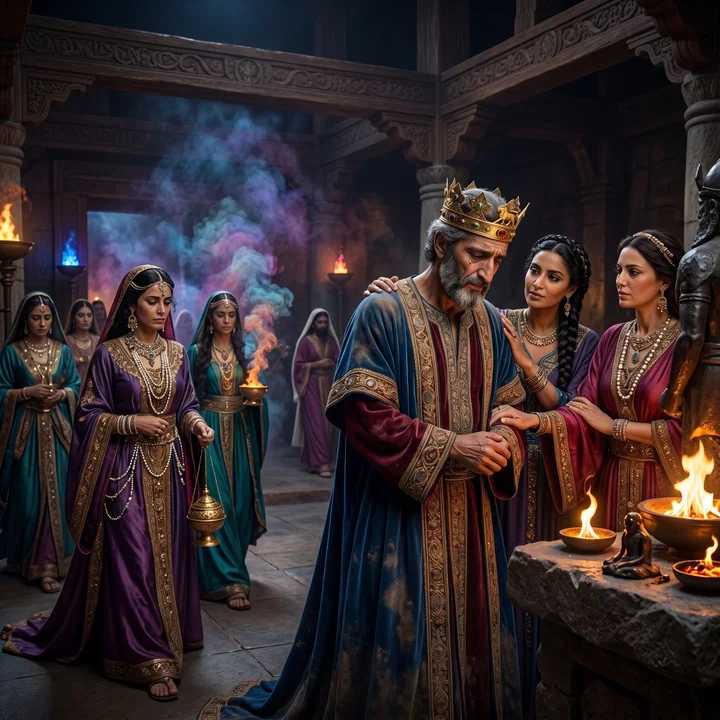
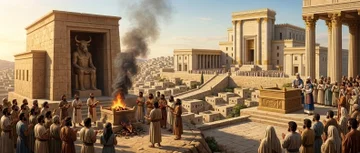
The shrines were imposing and unholy, set among groves of myrtle and olive with great, misshapen and gigantic unseemly images of wood and stone.RH Jul 29, 1915RH Dec 21, 19057MR 74.1–3 Chemosh is the abomination of Moab and Molech the abomination of the Ammonites, and before their altars degrading heathen rites were practiced.PK 57.1RH Dec 21, 1905 Those rites were licentious and revolting, cruel and dishonoring to God, including human sacrifice in which children were offered as living sacrifices.RH Dec 21, 1905RH Dec 28, 19057MR 74.1–3RH Dec 21, 1905
Solomon built them to please his idolatrous heathen wives, persuaded by them and failing to give God glory.PK 57.1RH Jul 29, 1915PK 402.6RH Dec 21, 1905 Misled by them he mingled error with truth and betrayed sacred trusts, countenancing and sustaining paganism directly opposed to the law of Jehovah.RH Mar 10, 19107MR 74.1–3Ms 94, 1899, par. 20
Long Standing Memorial
The images and shrines Solomon raised stood for upward of three centuries, for more than three centuries, as mute witnesses and signs of the apostasy of Israel's wisest king.RH Jul 29, 1915PK 402.6 They remained until Josiah removed and destroyed them, demolishing the buildings and images more than three centuries later.RH Jul 29, 1915PK 402.6 When they were broken down their fragments rolled down into the Kidron, leaving damaged debris and ruins behind.Ms 40, 1898, par. 14–16Lt 8b, 1891, par. 12–15
The place was called the Mount of Offense, and by all the true-hearted in Israel.RH Jul 29, 1915RH Mar 10, 19107MR 74.1–3Ms 47, 1898, par. 38 Though Solomon repented, the evil he had set up lived after him, remaining from generation to generation for hundreds of years to testify against him. The shrines thus outlived him far longer than he thought, showing the lasting effects of apostasy.7MR 74.1–3Ms 47, 1898, par. 39–40
Great masses of ruins were still to be seen in the days of Christ, their ruins remaining visible even then.RH Mar 10, 19107MR 74.1–3Ms 47, 1898, par. 38Ms 47, 1898, par. 39–40 Shiloh when He came looked upon the melancholy sight as a sad testimony to the Messiah.7MR 74.1–3 Had Solomon foreseen that sight when rearing them, he would have started back in horror.
Steps Toward Apostasy
Solomon's departure from God was gradual after once walking uprightly with divine wisdom, losing sight of the need for full obedience and increasingly following the customs of surrounding nations, where one false step prepares the way for a second and a third.RH Dec 21, 1905RH Aug 17, 1905 Encouraged by prosperity and high position, he was led onward step by step until open idolatry was reached.RH Dec 21, 1905RH Aug 17, 1905 His earlier sacrificing in high places not made sacred by the Lord's presence but dedicated to idol worship mingled the sacred and the profane and removed something of the repulsion that should have been felt toward the horrible practices of idolaters.Ms 5, 1912, par. 8–9 That first compromise led him to suppose the Lord was not particular about the worship of His people, and by it he was educating himself for still greater departures, until little by little his heathen wives led him to build altars for their gods.Ms 5, 1912, par. 8–9
Pride, self-sufficiency, self-exaltation, and desire for political power, self-aggrandizement, wealth and power led him to form alliances with heathen nations and to associate with idolaters, which corrupted his faith.7T 217.4–218.2RH Aug 17, 1905ST Jul 1, 1903 Conformity to worldly customs and looking to heathen standards of right made him lose sight of God's law, sacrifice principle and integrity, and break down the barriers God had erected for the safety of His people.RH Aug 17, 1905ST Jul 1, 1903 Prosperity and high position did not protect him but placed him in danger of self-exaltation and following his own desires, which weakened faith and harmed religious life, darkening a life that had begun with great promise, divine favor, worldwide fame for wisdom and uprightness, and honor brought to the God of Israel.RH Dec 21, 1905PK 51.2Ms 40, 1898, par. 20 His once pure and elevated character and God-given wise mind became marred, degraded, and weak in moral power, dishonoring himself, dishonoring Israel, and dishonoring God.7T 217.4–218.2RH Aug 17, 1905
Uniting in marriage with worshipers of false gods corrupted his faith and led step by step to open idolatry, contrary to the law of Jehovah against such marriages.CTBH 128.22T 305.3RH Aug 17, 1905 His political and polygamous alliances and marriages with Phoenicia, Egypt, Edom, Moab, Ammon and other nations that bowed at idolatrous shrines mingled error with truth and betrayed sacred trusts, countenancing and sustaining paganism with licentious and cruel rites dishonoring to God.Ms 47, 1898, par. 33–377MR 74.1–3 Uncontrolled love of women and indulgence of lustful passion, appetite and passion separated him from God, cost him the strength and firmness of character received through divine wisdom, and made him corrupt, so that to please his foreign wives he built places of worship, high places, groves and idol shrines for Chemosh of Moab and Molech of Ammon and other gods on the hill before Jerusalem.CTBH 128.22T 305.3Ms 47, 1898, par. 33–377MR 74.1–32T 306.2 Even God-given wisdom and strength cannot preserve one who abandons principle and yields to temptation, so that watchfulness and strength from God are needed to the end, and no one is safe without them, for even a small departure from integrity is dangerous.CTBH 128.22T 305.3
Close contact through commerce with nations having no love for God lessened love for Him and deadened the sense of His high, holy character, leaving minds confused about true and false worship.PK 58.2 Excessive wages encouraged luxury and extravagance, the rich oppressed the poor, and covetousness, greed, luxury, extravagance, oppression and corruption spread through the kingdom, weakening the spirit of self-sacrifice in God's service and helping bring the terrible apostasy.PK 64.3SSP 7.2–3STB 782.2–3 Relying on himself instead of God, his God-given wisdom was perverted when he sought wisdom from other sources, and his great abilities made him a more effective agent of Satan and of evil when he yielded to temptation.GC 509.3GC88 509.2–34SP 329.1FE 414.2 Even remarkable manifestations of God's power and precious knowledge of God's character did not keep him faithful when he turned from the temple he had built to worship idols.Ms 16, 1889, par. 17–18 He began to depart from the Lord in order to gain something unclear, going to other nations to secure facilities and workmen for building the temple when he could have built it with the facilities God had provided, linking up with unbelievers and surrendering distinctiveness for advantage instead of remaining forever a peculiar people holding the beginning of confidence steadfast unto the end and standing true to principle.Ms 169, 1902, par. 8–919MR 41.3–42.2Ms 169, 1902, par. 15–16
Fall and National Effects
He who had been called Jedidiah, Beloved of the Lord, honored with remarkable tokens of divine favor, whose wisdom and uprightness gained worldwide fame and led others to honor the God of Israel, turned from the worship of Jehovah to bow before heathen idols.PK 51.2 The king who had wisely restored a helpless babe to its unfortunate mother fell so low as to consent to the erection of an idol to whom children were offered as living sacrifices.RH Dec 21, 1905 The man endowed with discretion in youth, and inspired in strong manhood to write that a way seeming right ends in death, departed from purity to countenance the licentious, revolting rites connected with the worship of Chemosh and Ashtoreth.RH Dec 21, 1905 The king who at the dedication of the temple had prayed that the heart be perfect with the Lord denied his own words in heart and life, mistaking license for liberty and trying to unite light with darkness, Christ with Belial, purity with impurity, good with evil.RH Dec 21, 1905
From being one of the greatest kings renowned throughout the world for wisdom he became a profligate, the tool and slave of others.RH Dec 21, 1905 His once noble and manly character became enervated and effeminate, his faith in the living God was shaken and supplanted by atheistic doubts, his happiness was marred by unbelief, his principles were weakened, his life was degraded, and his early justice and magnanimity were changed to despotism and tyranny.RH Dec 21, 1905 This shows how little can be done for men who lose their sense of dependence on God.RH Dec 21, 1905 Erecting altars to heathen gods taught him bitterly that these gods could not give rest to the spirit.PK 76.2 He was troubled night and day by gloomy, soul-harassing thoughts, lost joy and peace of mind, and the future seemed dark with despair.PK 76.2RH Dec 21, 1905
In years of apostasy he united his interests with satanic agencies, and that union caused steady spiritual decline in Israel.PK 58.2 Through those agencies minds were confused about true and false worship, leaving Israel an easy prey, while close contact through commerce with nations having no love for God lessened Israel's love for Him and deadened their sense of His high, holy character.FE 499.1PK 58.2 Refusing obedience, they transferred allegiance to the enemy of righteousness, and the pure religious service instituted by God was in some lives replaced by idolatry of the darkest hue.FE 499.1PK 58.2 Intermarriage with idolaters became common practice, abhorrence of idol worship was rapidly lost, polygamy was countenanced, idolatrous mothers brought up children to observe heathen rites, and heathen customs spread until faith became confused and the nation fell into apostasy.FE 499.1PK 58.2
Idolatry entered Israel through those alliances with heathen nations, and turning from God's ways to heathen worship led many to violate God's law.RH Dec 28, 1905 It replaced the worship God had instituted, with pagan practices including human sacrifice and licentious rites.RH Dec 28, 1905 Building idol shrines for foreign wives near Jerusalem in direct opposition to the temple he had dedicated to God embodied his apostasy: instead of leading the heathen to truth, he let pagan beliefs become part of his religion and turned from God as the only true and living God.RH Mar 10, 1910 In his later years, under the influence of heathen wives, his alliances and marriages led him away from worship at God's temple toward worship in groves he had prepared for their idols, turning from God's temple to prepare places for their idols.6T 249.4–250.2Ms 169, 1899, par. 25 Its effects continued in Rehoboam, whose Ammonite mother influenced his vacillating character, and he eventually turned from God.PK 88.2
The plain, unvarnished record of one so favored and entrusted with great responsibility being overcome by temptation into idolatrous sin is required by justice and given for benefit and warning.ST May 31, 1910 It teaches that disobedience brings retribution, that the wages of sin is death, that retributive justice never fails, and that strict regard for the commandments is exacted.ST May 31, 1910 It gives no excuse for sin, but shows that men then as now strive, waver and fall into error and need pardoning mercy.ST May 31, 1910 It encourages that through grace the fallen can gain fresh vigor to rise above evil nature, renew the conflict, recover ground and be blessed, for crime is faithfully punished yet the repenting sinner is pitied and forgiven.ST May 31, 1910
Warning for Later Generations
Solomon's gradual fall ends in building high places for Chemosh and Molech, and it stands as a warning not to mingle pagan error with true religion or to cherish the errors of the world.RH Aug 17, 19057MR 74.1–3RH Mar 10, 1910Ms 47, 1898, par. 39–40 Exalted to sacred trust, he at first brought glory to the God of Israel, but pride, self-sufficiency, self-exaltation and desire for political power and self-aggrandizement led him to form alliances with heathen nations, to associate with idolaters, to conform to worldly customs and to look to heathen standards of right until he lost sight of God's law.RH Aug 17, 1905 Uniting in marriage with worshipers of false gods led him step by step to open idolatry, breaking down the barriers God had erected for the safety of His people, and his once pure and elevated character and God-given wise mind became marred, degraded and weak in moral power, dishonoring himself, dishonoring Israel and dishonoring God.RH Aug 17, 1905 His political alliances and polygamous marriages with Phoenicia, Egypt, Edom, Moab, Ammon and other nations bowed at idolatrous shrines with licentious and cruel rites dishonoring to God and directly opposed to the law of Jehovah, so that he mingled error with truth, betrayed sacred trusts, and countenanced and sustained paganism.7MR 74.1–3 That history portrays the result of separation from God, where one false step prepares the way for a second and a third, and it is left on record to warn all who know the word of God not to cherish error alongside truth, for Satan presents worldly error in attractive style to deceive, to destroy simplicity of faith and to mar the precious landmarks of truth.RH Aug 17, 19057MR 74.1–3RH Mar 10, 1910
Followers of Christ must therefore refuse conformity to the world's standard of right, keep Holy Writ as the standard of right, and guard against every worldly influence that weakens moral power.RH Aug 17, 1905 Solomon's alliances with idolatrous nations and his yielding to corrupting influences carried him from faithfulness to the worship of false gods, teaching that breaking down God's safeguards through one wrong step leads to further compromise and moral decline.RH Aug 17, 1905Lt 21, 1894, par. 6–9 His fall teaches that no one is safe from temptation without strength from God, and that even a small departure from integrity is dangerous.CTBH 128.2 His love of women became an uncontrolled passion and his failure to control lustful passion separated him from God, for his many wives from heathen nations led him into idolatry and cost him the strength and firmness of character he had received through divine wisdom, with the building of places of worship for the gods of his foreign wives as the outcome of his departure from principle.CTBH 128.22T 305.3
Even God-given wisdom and strength cannot preserve a person who abandons principle and yields to temptation, so watchfulness and strength from God are needed to the end.CTBH 128.22T 305.3 God had promised to bless Solomon with wisdom, riches and honor on condition that he walk in the ways of the Lord and keep His statutes and His judgments, but Solomon departed from the right by marrying idolatrous women and by going to other nations to secure facilities and workmen for building the temple when he could have built it with the facilities the Lord had provided.19MR 53.4–519MR 39.3–40.1Ms 169, 1902, par. 61–63 That idolatrous connection with the world greatly displeased God.19MR 53.4–5Ms 169, 1902, par. 61–63 While Solomon kept separate from the world he was blessed, and the same blessing comes from remaining a distinct people separate from the world.19MR 53.4–5Ms 169, 1902, par. 61–63
The Lord ever desires to encircle His people with His protecting arm, blessing them above all other people and preserving them in all purity if they remain closely connected with Him, but if they depart from Him they will share the sorrows of Solomon that come from departing from God.19MR 39.3–40.1 God puts His blessing and signature upon work done in accordance with the light He gives while workers look steadfastly to Him as teacher and example and walk with Him, but He cannot cooperate with those who turn aside as Solomon did to work contrary to God's designs.10MR 357.1–358.1Ms 58, 1904, par. 6 Those whom the Lord has assigned, blessed and set His signature upon in their work stand under the same rule: if they turn aside as Solomon did, the Lord cannot cooperate with them.Ms 58, 1904, par. 6 Solomon stood in refusal of the testimonies God sent him by following a course of action God had forbidden in building high places for false gods, and that same standing is taken by one who will not receive the testimonies sent by God.Ms 168, 1905, par. 33–34Ms 135, 1906, par. 27–30
Sources
Pioneers and periodicals
71 sources
Solomon built idol shrines for Chemosh the god of Moab and Molech the god of Ammon on the hill east of Jerusalem opposite the temple he had dedicated to God.RH Mar 10, 1910ST Nov 19, 1896ST Oct 30, 1884RH Jan 12, 1869 He did this to honor the worship of his foreign wives, turning from the true God to bow before false gods in direct opposition to his former faithfulness.ST Dec 9, 1889ST Nov 19, 1896RH Jan 12, 1869 His fall came gradually through multiplying wives, pride and political alliances, prosperity and indulgence, until he tried to unite light with darkness.RH Dec 28, 1905RH Dec 21, 1905ST Dec 9, 1889RH Jul 2, 1914ST May 20, 1913 Because of this disobedience God judged him by dividing the kingdom, yet the shrines stood for more than three centuries until Josiah destroyed them.RH Jul 29, 1915ST Oct 22, 1894ST May 20, 1913ST Jan 27, 1904ST Jun 25, 1885 His history warns that wisdom and greatness alone cannot keep anyone from falling without obedient faith, and that when leaders fail the people fail with them.ST Apr 26, 1910ST Sep 24, 1902ST Dec 9, 1889RH Aug 31, 1869RH Aug 31, 1869
Place and Wording
The hill before Jerusalem is the Mount of Olives, its southernmost and lowest eminence standing opposite Jerusalem and opposite the temple of Jehovah on Mount Moriah across the Kidron and the Jehoshaphat ravine.RH Jul 29, 1915RH Dec 21, 1905ST Nov 19, 1896RH Jan 6, 1859 Solomon built there places of worship for Chemosh and Molech to provide for the idolatrous worship of his foreign wives, to gratify them and honor their gods.RH Jul 29, 1915ST Nov 19, 1896ST Oct 30, 1884RH Jan 12, 1869RH Mar 31, 1910 The verse records his fall into idolatry, building a high place near Jerusalem for Chemosh the god of Moab and for Molech the god of Ammon, both called abominations, marking the shameful reversal of his earlier worship of God.ST Oct 30, 1884RH Jan 12, 1869RH Mar 31, 1910 It was part of his worship of the heathen gods of his foreign wives and a violation of God's command to destroy the altars of false gods.ST Oct 30, 1884RH Jan 12, 1869RH Mar 31, 1910
High places were idolatrous sanctuaries, first built on hills and later a name for heathen shrines in any location.ST Jul 19, 1905 Because Solomon's idolatrous worship defiled it, the hill was called the Mount of Offense and formerly the Mount of Corruption, a name later confined to the southern peak.RH Jul 29, 1915RH Jan 6, 1859RH Mar 31, 1910 Those who held that its northern peak received the name placed the shrine for Chemosh and Molech on an eminence before Jerusalem evidently the Mount of Olives whose northern peak was later called the Mount of Offense or Mount of Corruption.ST Nov 19, 1896ST Nov 19, 1896 The buildings were imposing unholy shrines crowning Olivet and impiously confronting the temple of God.RH Dec 21, 1905RH Mar 31, 1910
Three sanctuary altars stood on its three summits, for Ashtoreth, Chemosh, and Milcom or Molech.RH Mar 31, 1910 The shrines stood among groves of myrtle and olive, with large misshapen and gigantic unseemly images of wood and stone, and degrading, licentious and brutal heathen rites were practiced before their altars.RH Dec 21, 1905RH Mar 31, 1910 An idol is called in the verse an abomination, for anything suggesting idolatry was an abomination in God's sight.RH May 6, 1909 Replacing the true God with a false god put a lie in place of the truth.RH May 6, 1909
The verse belongs to the history of the undivided kingdom under Solomon in 1 Kings 1 to 11, which records the same events as 2 Chronicles 1 to 9.ST Apr 26, 1910RH May 11, 1916 It belongs also to the sad historical record of 1 Kings 3 to 21 in which the general moral tendency from David's time was downward in Judah and Israel, though there were times of reviving when the people sought God and God wrought for them and through them abundantly.ST Apr 26, 1910 It shows part of the reign of Solomon and his awful mistake of multiplying wives to himself and allying himself with the idolatrous nations around him.ST Apr 26, 1910
Identity of Foreign Gods
Chemosh is the god and national deity of Moab, called the abomination of Moab, and Molech, also called Milcom, is the god and deity of the Ammonites, called their abomination.ST Oct 30, 1884RH Mar 31, 1910 Solomon built a high place on the hill opposite Jerusalem for Chemosh the Moabite idol and for Molech the Ammonite idol, foreign gods associated with Moab and Ammon.RH Mar 31, 1910ST Sep 8, 1881ST Jul 19, 1905 The act marks his relapse into idolatry and shameful reversal from worship of the true God to worship of the heathen gods of his foreign wives.ST Oct 30, 1884 High places were idolatrous sanctuaries first built on hills and later a name for heathen shrines in any location, and through such alliances with heathen peoples Israel and Judah were led into idolatry beginning in Solomon's time.ST Jul 19, 1905
Chemosh, Molech, Milcom, and Baal are names for the same god, whose worship was sun-worship.ST Oct 30, 1884ST Dec 9, 1889 Chemosh was a form of Baal or sun worship, and Molech was essentially the same kind of deity, with Chemosh described as essentially identical with Molech and both described as representatives of Baal the sun god.ST May 26, 1898ST Nov 19, 1896ST Nov 19, 1896ST Dec 9, 1889 Molech as destroyer is Baal under another name describing him as a destroyer, Baal is equated with Babylonian Bel, and Molech is identified with Milcom the Ammonite abomination.ST May 26, 1898 These links present the heathen worship of Palestine as originating in Babylonia.ST May 26, 1898
Their worship involved human sacrifice, especially the burning and offering of children as living sacrifices.RH Dec 21, 1905ST Oct 30, 1884ST Nov 19, 1896ST Nov 19, 1896 Molech was the Ammonite fire god worshiped with human sacrifices, and the king who had wisely restored a helpless babe to its mother fell so low as to consent to the erection of an idol to whom children were offered as living sacrifices.RH Dec 21, 1905ST Nov 19, 1896 The worship was marked by licentious, revolting, brutal and inhuman rites, with idolatry replacing the worship God had instituted through alliances with heathen nations.RH Dec 28, 1905RH Dec 21, 1905ST Nov 19, 1896ST Dec 9, 1889 The verse is connected with the pollution of Gehenna in the valley of Hinnom where children were sacrificed to Molech.RH Aug 29, 1871
Chemosh is the god of whom Mesha king of Moab says he was angry with his land and later restored Moab's territory, with his high place standing on the hill before Jerusalem.ST Jul 30, 1885 Molech is the god worshiped by the Ammonites whose worship Solomon established near Jerusalem in a high place.ST Jun 22, 1904 Naamah, Rehoboam's mother, was an Ammonite princess and a worshiper of Molech.ST Jun 22, 1904
Solomon's Act of Apostasy
Solomon built a high place for Chemosh and for Molech to provide for the idolatrous worship desired by his foreign wives, honoring their gods and gratifying them rather than remaining faithful to God.ST Dec 9, 1889ST Nov 19, 1896RH Jan 12, 1869RH Mar 31, 1910RH Jul 2, 1914 He erected places of worship for Chemosh, the abomination of Moab, and for Molech, the abomination of Ammon, on the hill facing Jerusalem, in violation of God's command to destroy the altars of false gods.ST Dec 9, 1889ST Nov 19, 1896RH Jan 12, 1869RH Mar 31, 1910 His building illustrates the result of violating God's instruction against marrying unbelievers, for his marriages to women from surrounding nations turned his heart away from God.ST Dec 9, 1889RH Mar 31, 1910RH Jul 2, 1914 The shrines stood on the southern eminence of the Mount of Olives opposite Mount Moriah where the temple of Jehovah stood, among groves of myrtle and olive with large idols of wood and stone before whose altars degrading heathen rites were practiced, built to please his wives and to accommodate members of his family.RH Dec 21, 1905
The act was a relapse into idolatry and a fall from serving God to worshiping the heathen gods of his foreign wives under the influence of his wives and concubines.ST Oct 30, 1884RH May 13, 1875 It marked a shameful reversal of his earlier worship of God, turning from worshiping the true God to bow before heathen idols after once walking uprightly and receiving divine wisdom.RH Dec 21, 1905ST Oct 30, 1884RH May 13, 1875 It showed the depth of later apostasy in one who had known God's greatness and the folly of false gods and yet became an idolater.RH Jan 12, 1869
He himself reared imposing unholy shrines for idol worship on the hill before Jerusalem, crowning the Mount of Olives opposite Mount Moriah across the Jehoshaphat ravine and Kidron, impiously confronting the temple of God he had dedicated.RH Mar 10, 1910 The shrines with gigantic unseemly images of wood and stone for Chemosh and Molech stood in direct opposition to the temple, embodying his apostasy and terrible fall as the greatest and wisest of kings.RH Mar 10, 1910RH Mar 10, 1910 Instead of leading the heathen to truth, he let pagan beliefs become part of his religion and turned from God as the only true and living God.RH Mar 10, 1910RH Mar 10, 1910
His building of shrines recognized and honored other gods to please his wives, even though he did not wholly deny the Lord.ST Nov 19, 1896ST Nov 19, 1896 This honoring of Chemosh and Molech, representatives of Baal the sun god whose worship involved human sacrifice and revolting licentious practices, was abhorrent to the Lord even if Solomon did not personally worship those gods.ST Nov 19, 1896ST Nov 19, 1896
His departure from God came gradually as he lost sight of the need for full obedience and increasingly followed the customs of surrounding nations, encouraged by prosperity and high position.RH Dec 21, 1905 Conformity to worldly customs and heathen standards made him lose sight of God's law, and uniting in marriage with worshipers of false gods led step by step to open idolatry, breaking down the barriers God had erected for the safety of His people.RH Dec 21, 1905RH Aug 17, 1905 Having denied in heart and life his own prayer at the dedication of the temple that the heart be perfect with the Lord, he mistook license for liberty and tried to unite light with darkness, Christ with Belial, purity with impurity, and good with evil.RH Aug 17, 1905RH Dec 21, 1905
Causes of Solomon's Fall
His foreign wives and concubines turned his heart away from God, fulfilling the warning that taking many wives would lead him toward their gods.ST Dec 9, 1889RH Jul 2, 1914ST May 20, 1913ST Apr 26, 1910RH Feb 6, 1879 His building high places for their gods shows the result of violating God's instruction against marrying unbelievers and against marrying women from surrounding nations.ST Dec 9, 1889RH Jul 2, 1914ST Apr 26, 1910 He multiplied wives to himself until his heart divided among a thousand women left very little for God, and his wives turned away his heart into idolatry.ST May 20, 1913ST Apr 26, 1910RH Feb 6, 1879 If he had heeded God's instruction that a king should not multiply wives, he would not have been turned to idolatry.ST Dec 9, 1889ST May 20, 1913 This building of pagan high places for Chemosh, worshiped by Moab, and Molech, worshiped by Ammon, on the hill facing Jerusalem was part of his turning from God to the gods of his foreign wives and brought divine judgment, including the loss of most of his kingdom.ST Dec 9, 1889RH Feb 6, 1879ST Jun 25, 1885
Pride, self-sufficiency, self-exaltation, and desire for political power and self-aggrandizement led him to form alliances with heathen nations and to associate with idolaters, which corrupted his faith.RH Dec 28, 1905RH Dec 21, 1905RH Aug 17, 1905ST Jul 1, 1903ST Jan 27, 1904 Idolatry entered Israel through those alliances beginning in his time, replacing the worship God had instituted with heathen worship that included human sacrifice and licentious rites.RH Dec 28, 1905RH Aug 17, 1905 His departure from God came gradually as he lost sight of the need for full obedience and increasingly followed the customs of surrounding nations, encouraged by prosperity and high position.RH Dec 21, 1905RH Aug 17, 1905 Conformity to worldly customs and looking to heathen standards of right made him lose sight of God's law, and uniting in marriage with worshipers of false gods led step by step to open idolatry, breaking down the barriers God had erected for the safety of his people.RH Dec 21, 1905RH Aug 17, 1905 His pursuit of wealth and power and his yielding to pagan influence led him to sacrifice principle and integrity, turning from the holy character God required of Israel, and costing him the empire established through God's peace, wisdom, and righteousness.ST Jul 1, 1903ST Jan 27, 1904
Prosperity, wealth, honor, and exalted position lifted up his heart, so that with all his wisdom he hardly saved his soul from ruin and his kingdom from an usurper.RH Jun 9, 1868RH Aug 12, 1875RH Jan 21, 1909 His prosperity and exalted position were followed by his departure from God and turn to idolatry.ST Jul 1, 1903RH Jun 9, 1868RH Aug 12, 1875 Cast down from the loftiest faith and the most exalted communing with God into the most abominable idolatry, his fall through pride, glorious apparel, ivory, gold, and pearls proves that those with great light may fall before temptations of display and adornment.RH Jun 9, 1868RH Aug 12, 1875RH Jan 21, 1909 Lust, luxury, indulgence of appetite and passion, and the seductive influence of wine and the idolatrous women of his court weakened the wisdom and power that had made him renowned and led him astray despite his God-given wisdom.ST Feb 22, 1883ST Dec 5, 1911ST Jan 29, 1885ST Sep 18, 1901 Satan led him through indulgence of appetite and passion to incur God's displeasure, and his lust led him to build high places for false gods.ST Feb 22, 1883ST Jan 29, 1885 Despite his great wisdom and knowledge of God's law, he was led by wine and the idolatrous influence of the women of his court to turn from God and build places of worship for heathen gods.ST Dec 5, 1911ST Sep 18, 1901
He came to his throne at once in full brightness, like the sun mounting at once to its meridian, without first being raised in poverty, humiliation, sorrow, and affliction.ST Jul 28, 1881ST Dec 16, 1880ST Dec 8, 1881 Because he lacked that preparation by humility, he had no capacity to bear great honor safely.ST Jul 28, 1881ST Dec 16, 1880ST Dec 8, 1881 His bright beginning was followed by an eclipse in building high places for Chemosh and Molech as a disastrous eclipse that hid his glory and perhaps darkened the end of his reign.ST Jul 28, 1881ST Dec 16, 1880ST Dec 8, 1881 His building a high place for Chemosh, the abomination of Moab, and for Molech, the abomination of Ammon, on the hill facing Jerusalem was part of his idolatry and a violation of God's command to destroy the altars of false gods, done to gratify his wives.RH Jan 12, 1869RH Mar 10, 1874RH Mar 17, 1904 Though endowed with wisdom from heaven, he fell into the silly worship of heathen gods because his heart was turned from the Lord his God and he kept not that which the Lord commanded, in shameful departure from faithfulness and presumption in turning to idolatry despite God's command.RH Jan 12, 1869ST Dec 9, 1889RH Mar 10, 1874RH Mar 17, 1904 His turning from obedience by building those high places brought God's punishment.ST Dec 9, 1889RH Mar 17, 1904
Consequences and Later History
Solomon's building of high places for Chemosh and Molech brought divine judgment and punishment for disobedience, costing him the empire established through God's peace, wisdom, and righteousness.ST Jan 27, 1904ST Jun 25, 1885RH Mar 17, 1904 Because he multiplied wives until his heart divided among a thousand women left very little for God and turned to idolatry, the kingdom was taken from his descendants and divided into two and a half tribes in Judah and ten tribes in Israel, with war and strife between the divisions ever after.ST May 20, 1913ST Jun 25, 1885ST Oct 8, 1902 His magnificent reign, which began in glory, ended in clouds because of this transgression.RH May 2, 1865RH Mar 15, 1864ST Apr 23, 1912
The great, misshapen images of wood and stone stood for upward of three centuries on the Mount of Offense as mute witnesses to the apostasy of Israel's wisest king.RH Jul 29, 1915 They were monuments of heathen idolatry in Judah, imposing unholy shrines crowning the hill before Jerusalem opposite the temple, until in his reign Josiah removed, demolished, and destroyed the buildings, images, and places of worship.RH Jul 29, 1915ST Oct 22, 1894 Their broken fragments rolled down into the Kidron.
Though in his last days Solomon repented of his mistakes when he penned Ecclesiastes, the evil lived after him, remaining from generation to generation for hundreds of years to testify against him.ST May 20, 1913 Israel and Judah were led into idolatry through alliances with heathen peoples, beginning in Solomon's time, and the high places were again crowded with worshipers.ST Jul 19, 1905 The worship of those gods was marked by sexual immorality and the burning of children as living sacrifices, and those licentious and child-sacrificing influences shaped the environment in which Rehoboam and his counselors grew up.RH Dec 21, 1905ST Jun 25, 1885
Great masses of ruins still remained even to the days of Christ as a sad testimony to the Messiah, which would have made Solomon start back in horror had he foreseen it when rearing them.RH Mar 10, 1910 Jeroboam's worship of the two golden calves was of the same degraded nature as the worship of the Ammonite, Moabite, and Zidonian gods, with the exception of burning children in the fire.ST Jul 2, 1885 His history tarnished the glory he had received, for from being one of the greatest kings renowned throughout the world for wisdom he became enervated and effeminate, a profligate tool and slave of others.RH Dec 21, 1905RH Aug 31, 1869ST Jun 29, 1904 His early justice and magnanimity were changed to despotism and tyranny, his happiness marred and his life degraded, troubled night and day by gloomy soul-harassing thoughts, showing how little God can do for men who lose their sense of dependence on Him.RH Dec 21, 1905RH May 2, 1865
Doctrine Warning and Application
Solomon's fall proves that wisdom by itself cannot save a sinner or keep a professed Christian from falling, for justification and faithful living are by faith.ST Sep 24, 1902ST Dec 9, 1889RH Aug 31, 1869RH Feb 6, 1879ST Though endowed with wisdom from heaven, ability, knowledge of grace, and experience as a prophet to whom God spoke directly, he turned from the Lord, kept not what the Lord commanded, and fell into the silly worship of heathen gods.ST Sep 24, 1902ST Dec 9, 1889RH Aug 31, 1869RH Feb 6, 1879ST Wisdom alone will not keep anyone unless there is in the heart a true spirit of obedience, for a man may speak proverbs and write songs by the thousand and yet fail in God's service and be rejected, while ability and learning may foster pride and help evade sin's consequences without protecting from falling.ST Dec 9, 1889RH Aug 31, 1869 Present wisdom does not protect from future folly, and earlier obedience cannot excuse turning aside.RH Feb 6, 1879
The verse illustrates the responsibility resting upon leaders of God's people, for whenever king and priest are faithful and strong for God they mold the people immensely, but whenever leaders fail to lead in right ways the people fail with them.ST Apr 26, 1910 It belongs to a sad downward moral tendency from David's time in Judah and Israel, broken only by times of reviving when the people sought God and He wrought for and through them abundantly.ST Apr 26, 1910 Great ability and riches bring serious responsibility to use what God gives faithfully in His service rather than selfishly or ambitiously, lest a child of God come to a miserable end.RH Aug 31, 1869
Humanly chosen substitutes for God's requirements are not accepted, as seen when worship sites for the gods of foreign wives were built instead of remaining faithful to God.RH Jul 17, 1866 Outward beauty and costly structures do not prove devotion to God, for while outwardly grand expression was given to worship through elaborate buildings, true beauty is beauty of character.ST Jun 12, 1907 The shrines for Chemosh and Molech near Jerusalem belong to mingling pagan error with religion and turning from God, warning never to cherish or mix error with truth.RH Mar 10, 1910
The faltering weakness and sin were faithfully and reliably recorded by inspiration rather than glossed over, concealed, or excused.ST May 1, 1907RH Jul 9, 1908STST Apr 7, 1881ST Jan 29, 1885 Inclusion in Scripture does not mean God approved the conduct, for God never approved the act though He had it recorded.RH Jul 9, 1908ST Jan 29, 1885 The sin as an evil practice by a professed friend of God's cause was impartially recorded, left a stain on character, and brought reproach upon the truth.ST Apr 7, 1881
The plain unvarnished record is required by justice and given for benefit and warning, as a father tells a younger child of an older child's sin and punishment to guide him.ST May 31, 1910ST Jan 29, 1885 It teaches that disobedience brings retribution, that the wages of sin is death, that God's retributive justice never fails, and that He exacts strict regard for His commandments.ST May 31, 1910 The record gives no excuse for sin but shows that men then as now strive, waver, fall into error, and need pardoning mercy.ST May 31, 1910
Solomon stands among deeply sinful people through whom the Bible shows God's grace brings salvation to sinners and makes saints.ST Nov 1, 1910 Even a true servant of God, favored and entrusted with great responsibility, could be overcome by temptation and fall into idolatrous sin.ST May 31, 1910ST Dec 21, 1915 Yet there is encouragement that through grace the fallen can gain fresh vigor to rise above evil nature, renew the conflict, recover ground, and be blessed, while God is faithful to punish crime yet pities and forgives the repenting sinner.ST May 31, 1910
His apostasy portrays the result of separation from God, where one false step prepares the way for a second and a third, and warns followers of Christ to refuse conformity to the world's standard, to keep Holy Writ as the standard of right, and to guard against every worldly influence that weakens moral power.RH Aug 17, 1905 Exalted to sacred trust, he at first brought glory to the God of Israel, but pride, self-sufficiency, self-exaltation, desire for political power and self-aggrandizement, alliances with heathen nations, conformity to worldly customs and heathen standards, and marriage with worshipers of false gods led step by step to open idolatry, breaking down the barriers erected for the people's safety and marring a once pure and elevated character and wise mind into moral weakness that dishonored himself, Israel, and God.RH Aug 17, 1905 His casting down from loftiest faith and most exalted communion with God into most abominable idolatry came through pride, glorious apparel, ivory, gold, and pearls, proving that those with great light may fall before display and adornment and calling for humility, simplicity, sobriety, a sense of fallen condition and great need of Christ, and dependence on Him as becometh God's children.RH Jan 21, 1909 His building of high places was a disastrous eclipse hiding his glory and perhaps darkening the end of his reign, because coming to the throne at once in full brightness like the sun mounting at once to its meridian without prior raising in poverty, humiliation, and affliction, he lacked preparation by humility and had no capacity to bear honor safely, proving an humble position safer than an elevated one and that no man should seek honor before being prepared by humility.ST Dec 8, 1881
His sin as an evil practice by a professed friend of God's cause left a stain and brought reproach giving enemies something to feed upon, yet it did not overthrow or defile God's cause, which existed still in native purity despite his immoral course.ST Apr 7, 1881 The long history of establishing places for image worship to accommodate members of his family, including Chemosh and Molech, did not make the practice right or excuse warnings against it.RH May 5, 1859
Sources