Deuteronomy 9:17
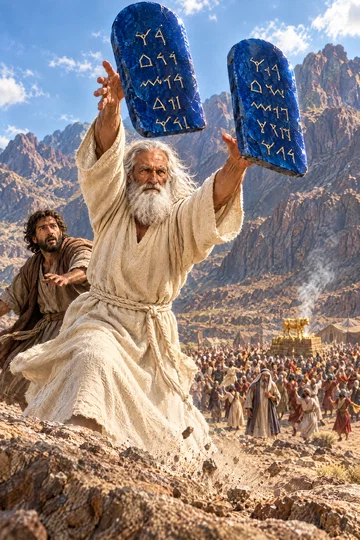
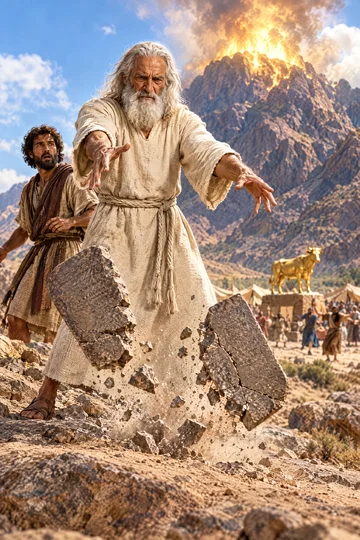
And I took the two tables, and cast them out of my two hands, and brake them before your eyes.
Translations
American King James Version, Webster Bible
And I took the two tables, and cast them out of my two hands, and broke them before your eyes.
King James Version, KJV Cambridge Paragraph Bible
And I took the two tables, and cast them out of my two hands, and brake them before your eyes.
Revised Version, American Standard Version
And I took hold of the two tables, and cast them out of my two hands, and brake them before your eyes.
'And I lay hold on the two tables, and cast them out of my two hands, and break them before your eyes,
And I seized the two tables, and cast them out of my two hands, and broke them before your eyes.
So I seized the two tables, and cast them from off my two hands,—and brake them in pieces before your eyes.
Berean Standard Bible, Majority Standard Bible
So I took the two tablets and threw them out of my hands, shattering them before your eyes.
I took hold of the two tablets, and threw them out of my two hands, and broke them before your eyes.
And I let the stones go from my hands, and they were broken before your eyes.
Therefore I tooke the two Tables, and cast them out of my two handes, and brake them before your eyes.
Douay-Rheims (Challoner revision)
I cast the tables out of my hands, and broke them in your sight.
Pictures
Cross-references
- Exodus 32:19
And it came to pass, as soon as he came nigh unto the camp, that he saw the calf, and the dancing: and Moses’ anger waxed hot, and he cast the tables out of his hands, and brake them beneath the mount.
Moses breaks the tablets after seeing Israel worship the calf.
- Deuteronomy 10:1-5
At that time the LORD said unto me, Hew thee two tables of stone like unto the first, and come up unto me into the mount, and make thee an ark of wood.
God replaces the tablets Moses broke and commands him to place them in the ark.
- Exodus 34:1-28
And the LORD said unto Moses, Hew thee two tables of stone like unto the first: and I will write upon these tables the words that were in the first tables, which thou brakest.
Moses returns to Sinai after Israel’s sin and receives the covenant anew.
Commentary
Each commentary is drawn from primary sources: the writings of Ellen G. White and Adventist pioneers and periodicals. Each commentary is separate. Its own words are not a quotation; follow the references to read the source passages.
Ellen G. White
1 source
Moses was rehearsing Israel's history to remind them that their repeated rebellion had moved the Lord on several occasions to purpose their destruction.SG4 53.4 He threw the breaking of the two tablets into that larger account of provocation and threatened judgment.SG4 53.4 He stressed that his own earnest intercession had prevailed so that God graciously spared the people instead of cutting them off.SG4 53.4 He set that sparing mercy alongside the mighty acts the Lord had performed against Pharaoh and all Egypt, deeds their own eyes had witnessed.SG4 53.4 He then made both that deliverance from deserved destruction and that eyewitness experience the ground of his appeal that they keep all the commandments.SG4 53.4 Obedience was the way they would be strong and go in and possess the promised land.SG4 53.4
Sources
Pioneers and periodicals
4 sources
Deuteronomy 9 recounts Moses's forty-day interview with God, which was spent in intercession that God would not destroy Israel for its sin.RH Dec 31, 1861 After coming down from the mountain to find Israel in transgression, worshiping the golden calf in rebellion against God's covenant, Moses cast the first two stone tablets from his hands and broke them before the people's eyes.ST Mar 3, 1909RH Apr 28, 1874ST Feb 27, 1896 He broke the tablets in righteous indignation at Israel's transgression.ST Mar 3, 1909 He acted under a divine impulse when he broke them.RH Apr 28, 1874 After the breaking, the law was given again on a second set of stone tablets.RH Apr 28, 1874
Sources