Exodus 32:19
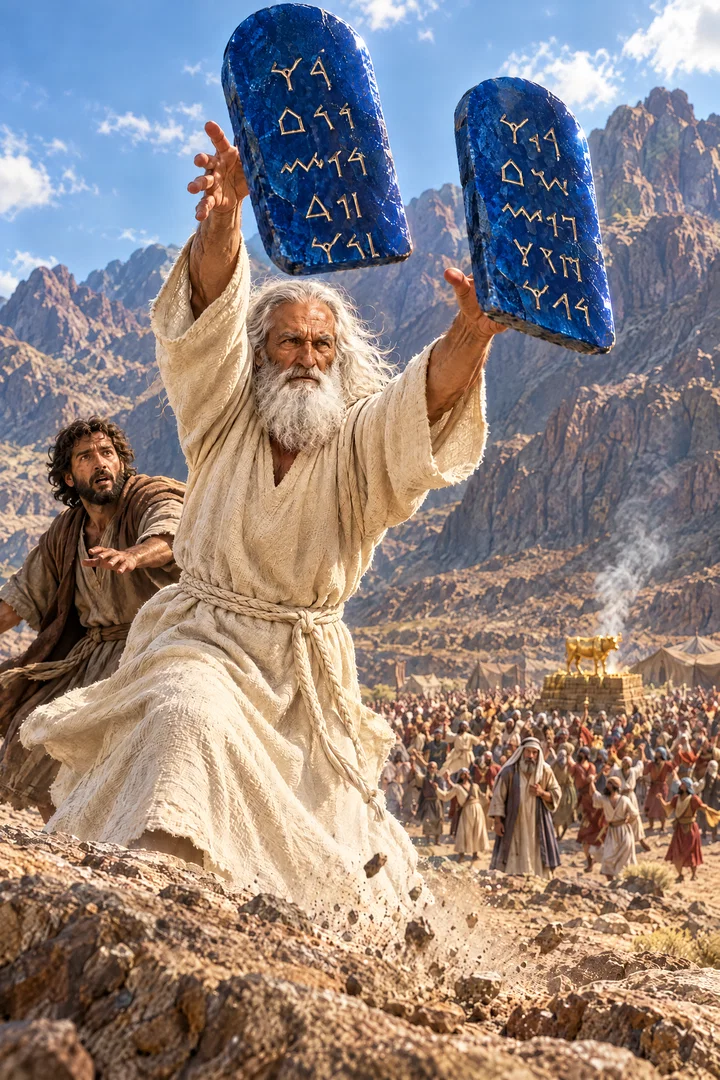
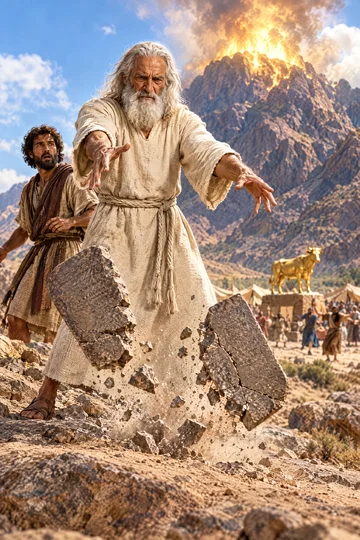
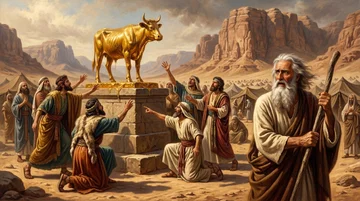
And it came to pass, as soon as he came nigh unto the camp, that he saw the calf, and the dancing: and Moses’ anger waxed hot, and he cast the tables out of his hands, and brake them beneath the mount.
Translations
And it came to pass, as soon as he came near to the camp, that he saw the calf, and the dancing: and Moses’ anger waxed hot, and he cast the tables out of his hands, and broke them beneath the mount.
King James Version, KJV Cambridge Paragraph Bible
And it came to pass, as soon as he came nigh unto the camp, that he saw the calf, and the dancing: and Moses’ anger waxed hot, and he cast the tables out of his hands, and brake them beneath the mount.
And it came to pass as soon as he came nigh to the camp, that he saw the calf, and the dancing: and Moses's anger waxed hot, and he cast the tables from his hands, and broke them beneath the mount.
Revised Version, American Standard Version
And it came to pass, as soon as he came nigh unto the camp, that he saw the calf and the dancing: and Moses’ anger waxed hot, and he cast the tables out of his hands, and brake them beneath the mount.
And it cometh to pass, when he hath drawn near unto the camp, that he seeth the calf, and the dancing, and the anger of Moses burneth, and he casteth out of his hands the tables, and breaketh them under the mount;
And it came to pass, when he came near the camp, and saw the calf and the dancing, that Moses' anger burned, and he cast the tables out of his hands, and shattered them beneath the mountain.
And it came to pass when he drew near unto the camp, and saw the calf, and the dancings, that the anger of Moses kindled, and he cast out of his hands the tables, and brake them in pieces at the foot of the mountain.
Berean Standard Bible, Majority Standard Bible
As Moses approached the camp and saw the calf and the dancing, he burned with anger and threw the tablets out of his hands, shattering them at the base of the mountain.
As soon as he came near to the camp, he saw the calf and the dancing. Then Moses’ anger grew hot, and he threw the tablets out of his hands, and broke them beneath the mountain.
And when he came near the tents he saw the image of the ox, and the people dancing; and in his wrath Moses let the stones go from his hands, and they were broken at the foot of the mountain.
Nowe, as soone as he came neere vnto the hoste, he sawe the calfe and the dancing: so Moses wrath waxed hote, and he cast the Tables out of his handes, and brake them in pieces beneath the mountaine.
Douay-Rheims (Challoner revision)
And when he came nigh to the camp, he saw the calf, and the dances: and being very angry, he threw the tables out of his hand, and broke them at the foot of the mount:
Pictures
Cross-references 20 of 46
- Exodus 32:1-6
And when the people saw that Moses delayed to come down out of the mount, the people gathered themselves together unto Aaron, and said unto him, Up, make us gods, which shall go before us; for as for this Moses, the man that brought us up out of the land of Egypt, we wot not what is become of him.
Israel makes and worships the calf Moses sees, leading him to break the tablets.
- Exodus 32:26-28
Then Moses stood in the gate of the camp, and said, Who is on the LORD’s side? let him come unto me. And all the sons of Levi gathered themselves together unto him.
Moses calls the faithful to take the Lord’s side, and the Levites execute judgment for calf worship.
- Exodus 34:1
And the LORD said unto Moses, Hew thee two tables of stone like unto the first: and I will write upon these tables the words that were in the first tables, which thou brakest.
God tells Moses to prepare replacement tablets.
- Deuteronomy 10:1-4
At that time the LORD said unto me, Hew thee two tables of stone like unto the first, and come up unto me into the mount, and make thee an ark of wood.
Moses recounts the replacement tablets and God writing the commandments again.
- Exodus 31:18
And he gave unto Moses, when he had made an end of communing with him upon mount Sinai, two tables of testimony, tables of stone, written with the finger of God.
God gives Moses the stone tablets that he later breaks.
- Exodus 32:11-14
And Moses besought the LORD his God, and said, LORD, why doth thy wrath wax hot against thy people, which thou hast brought forth out of the land of Egypt with great power, and with a mighty hand?
Moses intercedes for Israel after their sin, and God withholds the threatened judgment.
- Exodus 24:12
And the LORD said unto Moses, Come up to me into the mount, and be there: and I will give thee tables of stone, and a law, and commandments which I have written; that thou mayest teach them.
The Lord promises Moses the stone tables he later breaks.
- Exodus 20:3-5
Thou shalt have no other gods before me.
The calf worship violates the commands against other gods and graven images.
- Deuteronomy 9:17
And I took the two tables, and cast them out of my two hands, and brake them before your eyes.
Moses recounts breaking the tablets after seeing Israel’s idolatry.
- Deuteronomy 9:20
And the LORD was very angry with Aaron to have destroyed him: and I prayed for Aaron also the same time.
Moses prayed for Aaron when God was angry with him over the idolatry.
- Exodus 24:3-8
And Moses came and told the people all the words of the LORD, and all the judgments: and all the people answered with one voice, and said, All the words which the LORD hath said will we do.
Israel’s promise to obey at Sinai is broken by the later apostasy.
- Exodus 19:3-9
And Moses went up unto God, and the LORD called unto him out of the mountain, saying, Thus shalt thou say to the house of Jacob, and tell the children of Israel;
Israel pledges obedience to God’s covenant at Sinai before rebelling in Exodus 32.
- Psalms 106:19-23
They made a calf in Horeb, and worshipped the molten image.
Recounts Israel’s calf worship and Moses’ intercession that averted destruction.
- Deuteronomy 5:22
These words the LORD spake unto all your assembly in the mount out of the midst of the fire, of the cloud, and of the thick darkness, with a great voice: and he added no more. And he wrote them in two tables of stone, and delivered them unto me.
God spoke the commandments and wrote them on two stone tablets.
- Exodus 24:18
And Moses went into the midst of the cloud, and gat him up into the mount: and Moses was in the mount forty days and forty nights.
Moses spends forty days on the mountain before descending to find the calf.
- Exodus 32:28
And the children of Levi did according to the word of Moses: and there fell of the people that day about three thousand men.
Levites slay three thousand after the golden calf worship.
- Exodus 33:1-3
And the LORD said unto Moses, Depart, and go up hence, thou and the people which thou hast brought up out of the land of Egypt, unto the land which I sware unto Abraham, to Isaac, and to Jacob, saying, Unto thy seed will I give it:
After the calf, God promises an angel but refuses to go with Israel.
- 1 Corinthians 10:11
Now all these things happened unto them for ensamples: and they are written for our admonition, upon whom the ends of the world are come.
Israel’s experience serves as an example and warning for later generations.
- Deuteronomy 10:1-2
At that time the LORD said unto me, Hew thee two tables of stone like unto the first, and come up unto me into the mount, and make thee an ark of wood.
The broken first tablets are replaced with new tablets bearing the same words.
- Exodus 32:8
They have turned aside quickly out of the way which I commanded them: they have made them a molten calf, and have worshipped it, and have sacrificed thereunto, and said, These be thy gods, O Israel, which have brought thee up out of the land of Egypt.
Israel’s worship of the calf prompts Moses’ anger.
Commentary
Each commentary is drawn from primary sources: the writings of Ellen G. White and Adventist pioneers and periodicals. Each commentary is separate. Its own words are not a quotation; follow the references to read the source passages.
Ellen G. White
31 sources
Coming down from God's glory with Joshua bearing the tables of the testimony, Moses heard revelry that Joshua mistook for war and then saw the calf with the people shouting and dancing around it in heathen riot.SG3 278.2–279.1PP 335.1–2PP 319.3–320.4ST May 20, 1880 The tables in his hands were God's own work bearing His writing of the Ten Commandments, His precious pledge to humanity on condition of obedience.Ms 13, 1906, par. 21–243T 341.1RH Jul 29, 1873 In hot wrath and utter discouragement at their great idolatry, he cast the tables out of his hands and broke them beneath the mount purposely in the sight of all to show abhorrence of the crime.1SP 247.1–248.1SG3 278.2–279.1Ms 13, 1906, par. 21–24 The shattered tablets represented that Israel had broken its newly made covenant by breaking God's law, and signified that God had broken His covenant with them.1SP 247.1–248.1SPBC 156.13T 341.13T 298.1PP 319.3–320.4 His anger was righteous indignation from grief and fidelity for God's glory, not self-love or wounded ambition and not a sin for which God rebuked him, while those who held the other view taught that rashness and indiscretion were joined to his zeal which God pardoned.SPBC 156.13T 341.13T 298.13T 341.23T 341.3
Seeing the Camp's Idolatry
Moses came down from the awful presence of God's glory with Joshua, bearing the tables of the testimony with the precepts of the law Israel had pledged to obey, and as they descended they heard wild shouting that Joshua mistook for the noise of war but Moses knew to be singing and revelry.PP 335.1–2PP 319.3–320.4ST May 20, 1880 Though God had warned him that the people had corrupted themselves, sacrificed to an idol, demanded gods of gold, bowed in adoration before a golden image, and denied loyalty to Jehovah, Moses was still in a measure unprepared for their dreadful degradation and was overwhelmed after coming from God's glory.SG3 278.2–279.1PP 319.3–320.4ST May 20, 1880 As he came nigh unto the camp he saw the calf and the people shouting and dancing around it in excited heathen riot imitating the idolatrous feasts and idol-worshipers of Egypt, utterly unlike solemn, reverent worship of God.SG3 278.2–279.1PP 319.3–320.4ST May 20, 1880
The calf-worship came when the people saw that Moses delayed coming down from the mount, and they became discontented, careless, inattentive, and lawless, with unbelief revealing itself in a marked manner.PP 315.2–3Ms 58, 1900, par. 23–25 It was a waiting period when they should have meditated on the law they had heard and prepared their hearts for further revelation, but the mixed multitude were first in murmuring and impatience to be on the way to the land flowing with milk and honey promised only on condition of obedience.PP 315.2–3 Feeling helpless without Moses, they desired some image to represent God and go before them in his place, so that at the suggestion of those who had practiced Egyptian worship of the ox or calf a calf was made and worshiped.PP 315.2–3 This was done though God had given no manner of similitude of himself and had prohibited any material representation, though the mighty miracles in Egypt and at the Red Sea were designed to establish faith in him as the invisible, all-powerful Helper and only true God, and though desire for visible manifestation had been granted in the pillar of cloud and of fire and in the revealing of his glory upon Sinai with the cloud still before them; with the cloud still in view they turned back in heart to Egypt and represented the glory of the invisible God by the similitude of an ox.PP 315.2–3
The moment was Satan's work at the very foot of Sinai during the forty days Moses was in the mount to overthrow God's law and carry forward his rebellion begun in heaven by exciting doubt, apostasy, and rebellion.PP 335.1–2 By leading Israel into daring insult and blasphemy to Jehovah, Satan planned to make them appear so utterly degraded and lost to God's privileges and blessings and to their own solemn and repeated pledges that God would divorce them from himself and devote them to destruction, thereby securing the extinction of the seed of Abraham that was to preserve the knowledge of the living God and through whom he was to come, the true Seed that was to conquer Satan, and thus thwart God's purposes.PP 335.1–2 Satan was defeated there, for sinful Israel was not destroyed; while those who stubbornly ranged themselves on Satan's side were cut off, the humbled and repentant were mercifully pardoned, and the history stands as a perpetual testimony to the guilt and punishment of idolatry and to the justice and long-suffering mercy of God.PP 335.1–2 God allowed the evil to develop until the apostasy reached its full expression in plain sight at Sinai, where the hearts beneath outward conduct could be seen, so that the hidden intentions of the leading men would be exposed and still greater evils prevented.Ms 13, 1906, par. 15
The verse belongs to the time when God proved Moses by offering to make a great nation of him, which Moses refused while pleading for Israel, showing God would not arbitrarily destroy the people but would give them a chance to return and place themselves on the Lord's side.Ms 117, 1909, par. 15–22 In sequence the anger and breaking follow Israel's transgression in making the calf and come before Moses pleads with God for the people.GW92 33.1–34.3 He reached the camp and saw the idolatry only after he had remained on the mountain until God granted his plea for Israel's pardon.3T 340.2
Anger and Broken Tablets
Coming near the camp and seeing the calf and the dancing, Moses was overwhelmed in utter discouragement and hot wrath because of Israel's great sin and fearful idolatry before God, and he cast the tables out of his hands and broke them beneath the mount.1SP 247.1–248.1SG3 278.2–279.1Ms 13, 1906, par. 21–243T 298.1 He broke them purposely in the sight of all the people by divine direction to show abhorrence of the crime.PP 319.3–320.4 What he cast down were God's own work bearing God's writing, the tables of the testimony bearing the law of the Ten Commandments.Ms 13, 1906, par. 21–24RH Jul 29, 18733T 340.2 They were God's precious pledge to humanity on condition of obedience.3T 341.13T 340.2
The broken tablets represented to Israel that they had broken the covenant they had so recently made with God by breaking His law.1SP 247.1–248.1SPBC 156.13T 341.1PP 319.3–320.4RH Jul 29, 1873 He broke them because he saw that Israel had broken God's law, and he cast them down as he acted to deface the idol.3T 341.1 The act also signified that, because Israel had broken its covenant with God, God had broken His covenant with them.3T 298.1PP 319.3–320.4RH Jul 29, 1873ST Jul 29, 1897ST Sep 16, 1913
His anger was righteous indignation and honest zeal for God's glory, arising from grief and fidelity against apostasy and shameful forgetfulness of God.SPBC 156.13T 341.13T 298.13T 301.1 It was not anger driven by self-love or wounded ambition, and it was not a sin.SPBC 156.1EW 133.2 God did not rebuke him, condemn his ardor and indignation, or reprove him for breaking the tables of stone, even though the people regarded him as rash and Aaron as gentle.SPBC 156.13T 301.1SG3 279.2–281.1 His later sin that barred him from Canaan was taking to himself honor due to God, not this breaking.EW 133.2
His anger and breaking also involved rashness joined to zeal and indiscretion from fidelity, disappointment, and grief at the apostasy.3T 341.2 God pardoned his indiscretion.3T 341.23T 341.3 That pardoned indiscretion stands in contrast to Aaron's sinful weakness under pressure, which led to the death of thousands.3T 341.3
Leadership Failure and Judgment
When Moses was absent on the mount, Aaron was left in charge and failed to hold the people faithful through temptation, for when they demanded gods he yielded to them, joined their plans, made the molten calf, and carried out their plans with calm assurance.RP 45.1Ms 92, 1900, par. 22–25SG4 19.2 By contrast Moses felt the burden of his work deeply, and God was always his counselor.SG4 19.2 The apostasy of the calf and the dancing in the camp could have been prevented if Aaron had stood unswervingly for the right irrespective of consequences.RH Feb 4, 1909CT 351.2 If he had maintained his own allegiance to God, exercised his authority to hold the congregation back from wrongdoing, cited the people to the perils of Sinai, and reminded them of their solemn covenant to obey God's law, the evil would have been checked.RH Feb 4, 1909CT 351.2
Instead his compliance emboldened them to go to greater lengths in sin than had before entered their minds.RH Feb 4, 1909 He allowed the first beginning of wrong by permitting a spirit of reveling and commonness and one departure from right, and that small permission opened the way for the spirit of idolatry.RP 45.1CT 351.2 His failure came from weakness and desire to please the people even at the sacrifice of principle, the same defective administration he showed with his children at home, and he lost his power of command at the very first permission to go contrary to God's commands in the least particular.CT 351.2 The current of wrong set in motion by that first concession could not be stayed until stern and decisive measures were taken.RP 45.1CT 351.2
God was angry with Aaron for his sin, and he would have been slain and destroyed had Moses not interceded for him.Ms 92, 1900, par. 22–25ST May 20, 1880 He was spared through Moses' intercession and his own repentance. The verse belongs to Israel's rebellion at Sinai against the God whose authority they had pledged to obey.PP 335.1–2Ms 156, 1905
The judgment that followed shows God maintained His law while allowing opportunity to repent, for the humbled and repentant were mercifully pardoned while only those who stubbornly ranged themselves on Satan's side and persisted in rebellion were cut off.PP 335.1–2 Prompt punishment protected Israel and others from the greater ruin unchecked rebellion would bring, as a lesson that sin must be dealt with. The golden-calf experience should have left Israel a lasting lesson, but God's displeasure over their repeated offenses against the Angel who led them, shown in broken ranks and missing people, failed to teach them to make up for past failure through faithful obedience.3T 342.1
Sources
Pioneers and periodicals
87 sources
As soon as Moses came near the camp beneath the mount bearing the God-written tables, he saw the calf and the dancing and in hot anger cast the tables from his hands and broke them in the sight of the people.ST May 20, 1880RH Aug 19, 1852ST Apr 11, 1906ST Apr 15, 1886RH Jun 13, 1854 Within forty days of pledging obedience at Sinai, Israel had turned to an Egyptian calf-god with gluttonous feasting and naked, lewd revelry called a feast to Jehovah.ST May 20, 1880ST Jul 16, 1902ST Aug 16, 1910ST Jul 10, 1901ST Jan 29, 1908 His anger was righteous holy indignation, not sin, and the breaking signified that Israel had broken its newly made covenant with God.RH Jul 29, 1873ST Jan 31, 1911ST Oct 8, 1885RH Apr 28, 1874ST Apr 17, 1907 The shattered stones did not end the law, which remained binding, and the Lord afterward had Moses hew new stones and wrote again the same words.ST Apr 15, 1886ST Apr 1, 1886RH Sep 30, 1902 Swift judgment fell on three thousand impenitent leaders, yet on Moses' intercession God spared those who repented, forgave, and renewed the tables and the covenant.ST Sep 9, 1880ST Aug 16, 1910RH Nov 13, 1856ST Jan 10, 1906
Setting and Circumstances
The breaking took place less than forty days after God gave His law in written form, within forty days of His speaking at Sinai and while Israel was still surrounded by signs of His presence.RH Aug 19, 1852ST Jan 27, 1909ST Jul 10, 1901 It came within weeks of their solemn promise of obedience, showing how quickly they disobeyed and transgressed, in swift apostasy and backsliding so soon after the awful and glorious display at Sinai.RH Aug 19, 1852ST Jul 10, 1901ST Jan 29, 1908 The calf Moses saw was the representative of the Egyptian sun-god Apis, and the breaking stands just before the revelation of divine anger and the plea for Israel.ST Jul 10, 1901ST Jan 29, 1908
Moses had been gone scarce forty days in the mount receiving the tables of the law and instruction about the sanctuary and its services.ST Jun 16, 1914ST Aug 16, 1910ST Sep 30, 1886 During those forty days he was instructed in the complete system of pardon and atonement for sin and its final removal, and pardon was offered to Israel on the day of transgression as it had been offered to Adam in Eden, reestablishing the kingdom of grace in the nation.ST Jun 16, 1914ST Aug 16, 1910 There he was given the divine pattern for the marvelously beautiful sanctuary and told to ask the children for free-will offerings of all things used in building, that they might make a sanctuary that God might dwell among them, with workmen specially endowed to build it.ST Aug 16, 1910 The golden calf was a religious form borrowed from the Egyptians.ST Aug 16, 1910ST Sep 30, 1886
The book of Exodus means going out, for the departure of Israel from Egypt, and the verse stands in the worship section running from chapters 25 to 50, after the history in chapters 1 to 18 and the laws in chapters 20 to 24.ST Jun 19, 1907RH Jan 20, 1916 It falls within Exodus 20-40, where the law given through Moses is especially set forth, including the Ten Commandments and other statutes and judgments, as well as laws about sacrifices, offerings, conduct, health, and ceremonies.RH Jan 20, 1916 The laws of offerings and sacrifices reveal types whose substance belongs to the new dispensation. It belongs to the detailed story of great deliverance and becoming a nation with thorough organization, efficient leadership under Moses as chosen leader, a complete code of laws, and an established form of worship.RH Jan 20, 1916 It stands within the story of the building of the inner tabernacle erected in the wilderness at God's command, afterward replaced by Solomon's temple, in both of which worship centered with all service revolving around the holy of holies where the law rested beneath the mercy-seat.ST Jun 19, 1907
Moses came down from the presence of glory bearing the tables in serious converse with Joshua, coming within hearing of the tumult of the multitude.ST May 20, 1880RH Jun 13, 1854 Joshua mistook the noise for fighting in the camp, but Moses knew by practiced ear that it was not the shout of victors or the shriek of the vanquished but the noise of singing.ST May 20, 1880RH Jun 13, 1854 On drawing near beneath the mount at the foot where a month before the people had heard thunders and trumpet and seen lightning and glory, he saw shouting and dancing around the calf in excited heathenism imitating Egyptian idol feasts, with naked, bacchanalian revelry wholly unlike solemn reverent worship.ST May 20, 1880RH Jun 13, 1854 Though warned that the people had corrupted themselves and made an idol and sacrificed to it, he was still in a measure unprepared for the degradation and was overwhelmed.ST May 20, 1880 When he saw the revelry and blasphemous worship his anger waxed hot and he cast the tables from his hands at his feet beneath the mount and broke them purposely in sight of the people by divine direction, to signify that they had broken the covenant so recently made, then rushed into the camp with wrathful brow so that the throng fell before him and dancing and song and shouts were suddenly hushed for judgment.ST May 20, 1880RH Jun 13, 1854
The tables were God's work with God's writing, and after the breaking God told Moses to prepare two replacement tables and Moses spent another forty days on the mount, even another forty-day fast on the holy mountain, after which God gave a new copy of the law.RH Jun 26, 1900ST Apr 27, 1904 By that sequence Israel received a written copy of the Ten Commandments at least eighty days after the covenant had been ratified, the commandments being not themselves the first covenant but its basis.RH Jun 26, 1900 One reckoning places the going up to receive the two tables on the second day of the week and the coming down on account of the calf idolatry on the fifth day of the week, and those two weekdays were kept for public fasts and for private fasting.ST Apr 27, 1882
Nature of Israel's Sin
The calf Moses saw was the Egyptian sun-god Apis, the representative of Egyptian sun worship and of the worship of the elements of reproduction.ST Aug 16, 1910ST Jul 10, 1901ST Jan 29, 1908 It was a religious form borrowed from Egypt, and its swift adoption less than forty days after the covenant promise showed how deep-rooted Egyptian idolatry still was in Israel after long slavery had left them inclined to it.ST Aug 16, 1910ST Jul 10, 1901ST Sep 30, 1886 The backsliding came so soon after the awful and glorious display at Sinai that the breaking of the tables stands immediately before the revelation of divine anger.ST Jan 29, 1908
The calf was a human religious invention that turned the people from God despite their witness of His power after deliverance from Egypt while Moses was receiving the law.RH Oct 8, 1872ST Jun 6, 1916 It was a sinful substitute for the God of Israel that could not take the place of worshiping Him.RH May 25, 1876 In contrast to what God appoints, it brought idolatry, disaster, and death, whereas the brazen serpent appointed by God brought healing and life.ST Jun 6, 1916
What Israel did was to substitute something else for the worship of God while calling it God, not a devout conception of God as a person but worship of the carnality of the human heart.ST Jul 16, 1902 They deified lust and put that false god in the place of Jehovah while calling its worship the worship of the true God, for their carnality longed for the old nature worship of Apis with its sensuousness and licentiousness, and the golden calf was the apotheosis of low, lustful nature worship.ST Jul 16, 1902 To call this sensuous sun-god feast a feast to Jehovah was awful backsliding and awful blasphemy.ST Jul 16, 1902 Their shouting and singing around it did not make it good religion or acceptable worship to God.RH Mar 24, 1859
They sat down to eat and drink in gluttony and rose up to wanton, naked, lewd orgies, singing and dancing with idolatrous glee and undraped bodies.ST Jul 16, 1902ST Aug 16, 1910 Coming down from the presence of God's glory bearing the tables, Moses heard singing and then saw Israel shouting and dancing around the calf in excited heathenism imitating Egyptian idol feasts, wholly unlike solemn reverent worship of God.ST May 20, 1880 Within hearing of the tumult of the naked multitude in bacchanalian revelry right at the foot of the mountain where a month before they had heard thunders and trumpet and seen lightning and glory, the noise proved by practiced ear to be not war but singing, and on drawing near the revelry and blasphemous worship was seen in sharp contrast to communion between Jehovah and Moses on the top.RH Jun 13, 1854
Despite deliverance by God's own power and witness of His presence, they quickly forgot His voice and turned to an idol even before Moses came down with the tables of the covenant, breaking the first precept by worshiping the works of their own hands.RH Nov 13, 1856RH Jan 1, 1867 They proved stiff-necked and disobedient, and their dancing around the calf with sanction given to it proved ingratitude for deliverance under God's own right arm and defection from God.RH Nov 13, 1856RH Nov 14, 1854 Their idolatry and dancing reveal the blindness and stubbornness of unbelief after witnessing God's deliverance and power.RH Nov 6, 1866 They praised Jehovah yet turned to a golden calf, illustrating the instability of those who waver between serving God and following other loyalties, and their rejection of God's deliverance filled the returning Moses with indignation.RH Apr 28, 1863RH Apr 15, 1873 The calf worship was idolatry in the form of covetousness stealing upon the hearts of God's people, with readiness in yielding to the seductions of neighboring idolaters, complaints of the weariness of the way and the absence of Egyptian luxuries, and reluctance to go forward at God's command to take possession of the promised land, revealing a desire to return to Egypt to bondage and darkness rather than go forward.RH Nov 14, 1854
Moses' Anger and Action
As soon as he came near the camp he saw the calf and the dancing, and his anger waxed hot, and he cast the tables out of his hands and broke them beneath the mount.RH Aug 19, 1852ST Apr 11, 1906ST Apr 15, 1886ST Apr 9, 1902 He came down bearing the tables in converse with Joshua, hearing tumult and singing, and on drawing near he saw shouting and dancing around the calf in excited heathenism imitating Egyptian feasts, wholly unlike solemn reverent worship.ST May 20, 1880 Though warned that the people had corrupted themselves and made an idol and sacrificed to it, he was still in a measure unprepared for their degradation and was overwhelmed.ST May 20, 1880 He broke them purposely in the sight of the people, even at his feet, by divine direction.ST May 20, 1880 This happened less than forty days after God gave His law in written form, showing how quickly the people disobeyed and transgressed.RH Aug 19, 1852
His anger was righteous anger and just holy wrath showing the gravity of the idolatry and the evil the calf represented.ST Apr 11, 1906ST Jan 31, 1911ST Oct 8, 1885 He had just come from forty days communion with the Lord and from the presence of God's glory, imbued with the highest sense of the pure worship God required, in greatest contrast to the apostasy he beheld.ST May 20, 1880ST Jan 31, 1911 He acted in distress under apparent divine impulse, in utter discouragement and wrath because of their great sin.ST May 20, 1880RH Apr 28, 1874
His anger and breaking did not constitute sin, and the record does not show that God reproved him for it.ST May 20, 1880RH Oct 7, 1862RH Oct 28, 1873 Though the meekest man, he was warm and zealous when God's honor and glory were concerned, a lamb in his own cause but a lion in God's cause, and displeasure at sin as sin is fully consistent with reigning meekness.RH Jul 29, 1873RH Oct 28, 1873RH Apr 10, 1866 His ardor against this apostasy was not condemned by God, even though the blind idolatrous people mistook his forceful response for rash impetuosity and a bad spirit and regarded Aaron's calm yielding to popular opinion as the better and gentler example.RH Jul 29, 1873RH Oct 7, 1862RH Oct 28, 1873 One teaching holds the breaking was a hasty act that destroyed sacred writing and ruined God's gift, which Moses as far as possible had to restore by providing new stones because he could not restore God's finger-writing.RH Jan 7, 1915
The breaking expressed just indignation and symbolized Israel's transgression, signifying in the sight of the people that Israel had broken God's law and broken its covenant so recently made.RH Jul 29, 1873ST May 20, 1880ST Jan 31, 1911ST Apr 17, 1907ST Jan 2, 1893 It signified that God had broken His covenant with them, dissolving it.RH Jul 29, 1873ST Jul 29, 1897 The tables he broke were the tables of testimony bearing God's voice expressed in Ten Words on stone, the Ten Commandments, later placed in the ark, and they were later replaced with tables like the first bearing the same words written by God.ST Apr 15, 1886ST Jan 31, 1911ST Oct 8, 1885ST Jan 2, 1893 The breaking explains why Moses had to prepare the second tables himself, in doing so learning valuable lessons, and the revelations in Exodus 32-34 contain lessons for people.ST Apr 9, 1902
Covenant and Law Doctrine
Israel broke the conditional covenant made at Horeb within forty days by worshiping the golden calf, violating the pledge to do all the Lord commanded and forfeiting the conditional claim.RH Nov 13, 1856RH Jan 8, 1857ST Sep 23, 1913 Even before Moses came down with the tables of the covenant they broke the first precept by worshiping the works of their own hands, proving stiff-necked and disobedient.RH Nov 13, 1856RH Jan 8, 1857 God's dealing with them was to bless when obedient and punish when disobedient, so that at that time He thought to disinherit them.RH Nov 13, 1856 The breaking of the tablets was a divine object lesson that Israel had broken the law and then broken its promise to obey it, signifying that God had broken His covenant with them and dissolved it.RH Jul 31, 1900RH Jul 31, 1900ST Apr 17, 1907 Approached through human effort and self-righteousness, the first covenant displayed only the broken law, remaining as a warning that men cannot obey God's commandments in their own strength and need the Gospel.RH Jul 31, 1900RH Jul 31, 1900ST Apr 17, 1907 Their failure showed they could not establish their own righteousness or rely on themselves to keep the covenant, and because it offered no forgiveness they could claim no favor of God through it.RH Jan 12, 1911RH Jul 31, 1900ST Apr 17, 1907
Their failure brought them to recognize sin and need of pardon and a Saviour, leading them to trust God's everlasting covenant with Abraham.RH Jan 12, 1911RH Jul 31, 1900 That Saviour was revealed in the Abrahamic covenant and represented in the sacrifices, and by faith and love bound to God as deliverer from sin they could receive the blessings of the new covenant.RH Jul 31, 1900 Thus the law served as a schoolmaster to bring them to Christ and justification by faith, and God forgave them through the provisions of the new covenant.RH Jan 12, 1911RH Jul 31, 1900 The tables Moses cast down were literal stone, tables of testimony bearing the Ten Words or Ten Commandments, the work of God with the writing of God graven upon them on both sides, later placed in the ark of the testimony.ST Jan 31, 1911ST Oct 8, 1885RH Dec 31, 1861ST Jan 14, 1886ST The plain narrative of throwing them down and breaking them beneath the mount leaves no room to make them merely something in Moses' mind in a spiritual sense.ST Jan 14, 1886ST His breaking of them beneath the mount expressed just indignation and symbolized Israel's transgression in turning the glory of God into the likeness of a four-footed beast in shameless idolatry.ST Jan 31, 1911ST Oct 8, 1885RH Dec 31, 1861
Breaking the stone tablets did not make God's law or its truth cease to exist, but the law remained as steadfast as before with its claims still binding.ST Apr 1, 1886RH Sep 30, 1902 As erasing the record of sin cannot remove sin from the sinner, so the people's breaking of God's law does not end its demand for obedience, and the tablets were written again by God.ST Apr 1, 1886RH Sep 30, 1902 The Lord told Moses to hew two tables like the first and promised to write again the same words that were on the broken stones, and fulfilled that promise in rewriting the law.ST Apr 15, 1886ST Jan 2, 1893ST Jan 14, 1886 The broken tablets were the first tables of the Ten Commandments, and the Lord later wrote the same words on the second set, showing the law was not changed.ST Apr 15, 1886ST Sep 9, 1913ST Jan 2, 1893ST Oct 8, 1896 Although Israel had openly violated the Sinaitic covenant in which they had agreed to obey that law, even before Moses departed from the immediate presence of the Lord, the Lord did not cast them off.RH Nov 13, 1856ST Jan 2, 1893
The dishonor done to the law was repaired in a way that exhibits the law as more glorious and more highly valued than before, to forcibly impress this on the minds of men.RH Dec 18, 1855 The strict and minute precautions for promulgation, preservation, and careful deposit for preservation of the two tables given afterward demonstrate the permanent, everlasting and universal obligation of the whole law and of the fourth commandment as part of it, which the Redeemer fulfilled for justification and by which His people are justified and bound in all its parts to obey, so the ten do not belong only to Israel and cannot be reduced to nine by separating out the fourth.RH Dec 18, 1855 The episode came within forty days of God speaking at Sinai while Israel was still surrounded by signs of His presence, showing that fear or compulsion does not produce faithful service.ST Jan 27, 1909 God's law must be received into the heart through love, for the tablets represent the law set out in written form, and studying that form and trying to put its principles into the mind produces only a broken copy.ST Jan 27, 1909ST Jan 2, 1893 During the forty days Moses was in the mount God had instructed him in the complete system of pardon and atonement for sin and its final removal from the universe.ST Jun 16, 1914 On Moses' pleading in Exodus 32:11-35 pardon was offered that day of transgression at Sinai through the new-covenant kingdom of grace, as pardon was offered to Adam in Eden on the day of his transgression, and the kingdom of grace originally established on the day of Adam's fall was reestablished in Israel so that pardon was offered to all Israel that day.ST Jun 16, 1914
Judgment Mercy and Restoration
The breaking of the tables belongs to the immediate punishment that fell for abominable idolatry, and the violation of the law written on stone brought certain punishment.ST Mar 11, 1889ST Jan 2, 1907ST Jan 2, 1907 The summary punishment under the theocracy shows God no less merciful then than now, and sin was punished as surely then as in the present age.ST Jan 2, 1901
Three thousand of the impenitent and defiant were slain by the sword at God's command, the leaders in the rebellion being destroyed.ST Aug 16, 1910ST Jan 10, 1906 Israel had received great light at Sinai, so this crisis of singing and dancing with idolatrous glee was treated more sternly than the sins of a people still in Egypt's spiritual darkness.ST Aug 16, 1910ST Jan 10, 1906 The swift, signal punishment of discontented Israel should have left a lasting warning against ingratitude and disobedience, yet they soon failed to learn from it.ST Sep 9, 1880ST May 23, 1911
Their sin put God's purpose to dwell among them in the sanctuary in doubt.ST Aug 16, 1910 The Lord at first refused to go farther among them into the land promised to Abraham, Isaac, and Jacob, and the tabernacle of meeting where God met Moses was removed from the midst of the camp.ST Aug 16, 1910ST Nov 4, 1886RH Mar 3, 1853 That tabernacle afterward pitched without the camp was not the sanctuary just shown on the mount, because that sanctuary was not yet built.RH Aug 21, 1856 God cannot live in the midst of sin nor in a camp of practicing sinners, for to sin is a consuming fire that must consume both sin and sinner, while to the one who hates sin and desires separation God consumes the sin and converts the sinner.ST Aug 16, 1910
The Lord thought to disinherit them for breaking the first precept by worshiping the works of their own hands even before Moses came down, but when Moses pleaded for them He repented of the evil He thought to do and saved all that repented.RH Nov 13, 1856 Through wonderful intercession the people were spared from threatened judgment, and through intercession and repentance and humbling God forgave Israel so His plan for the sanctuary could again be carried out.ST Aug 16, 1910RH Jan 7, 1862 The stone tables were later renewed under God's direction, with God a second time writing His holy law, and the covenant was confirmed again, while the chapters that follow are revelations of His mercy and His righteous name and character.ST Aug 16, 1910ST Jan 29, 1908
In the judgment that followed God maintained His law while allowing opportunity to repent, and only those who persisted in rebellion were cut off. Prompt punishment protected Israel and others from the greater ruin that unchecked rebellion would bring, and served as a lesson that sin must be dealt with.
Aaron helped the apostasy while Moses was absent, yielding when the people demanded gods to replace their Creator as leader and provider on the journey.ST Mar 31, 1909RH Mar 5, 1908 If he had unswervingly maintained allegiance to God, cited the perils of Sinai, reminded them of their solemn covenant to obey, and opposed their godless plans as high priest and Moses' representative, the evil would have been checked.RH Feb 4, 1909ST Aug 31, 1882 Instead his compliance with their desires and the calm assurance with which he carried out their plans emboldened them to go to greater lengths in sin than had before entered their minds, and his evasive fear of bearing blame led him to offer excuse.RH Feb 4, 1909ST Nov 30, 1904
His excuse did not remove his guilt, and God was angry with Aaron and would have destroyed him had Moses not interceded for him.ST Aug 31, 1882ST May 20, 1880 He escaped death only by humbling himself before God in true repentance, being spared through Moses' intercession and his own repentance.ST Aug 31, 1882 The broken tablets represented Israel's recent breaking of its covenant, for which God did not reprove Moses, and the episode shows the fearful sin of idolatry, the need for leaders to uphold duty rather than join in sin, and the importance of a God-appointed leader.ST May 20, 1880RH Mar 7, 1907
Warnings for Later Times
The dancing seen on coming near the camp belongs to idolatrous worship of the calf, and as such it was harmful and degrading worship stirred by idolatry.ST Sep 15, 1909ST Jun 3, 1880ST Apr 11, 1906 That dance around the calf is the model for dances treated as dissipation rather than innocent amusement.RH Aug 15, 1871 It gives no sanction to promiscuous dancing for amusement.ST Jun 3, 1880
The calf worship with its dancing is a pattern for later bearers of the Master's name who turn from God and trample His commandments.RH Sep 3, 1908 It proved ingratitude for deliverance, defection from God, and desire to return to bondage and darkness rather than go forward to take the promised land at His command.RH Nov 14, 1854 It was idolatry in the form of covetousness stealing upon the hearts of God's people, readiness in yielding to neighboring idolaters, complaints of the weariness of the way and the absence of former luxuries, and reluctance to advance.RH Nov 14, 1854 The same worldly, covetous, complaining spirit now appears in the churches as tokens of defection.RH Nov 14, 1854 As Moses called for those on the Lord's side to take their stand, God now calls the sincere to come out and stand for Him and His truth.RH Sep 3, 1908
Though the error was widespread and headed even by the high priest, Moses and the few with him were right, proving a majority does not make religious error right.ST Jun 25, 1912 Moses' anger at the idolatry and his breaking of the tables on seeing the calf and the dancing was righteous indignation against apostasy, not failure of leadership.RH Mar 5, 1908 His open response when encountering the apostasy supports confronting wrongdoing rather than remaining silent.RH Jun 14, 1906 The episode warns against following weak leadership into apostasy and calls for decisive action on God's side.RH Mar 5, 1908
The calf represents making wealth, pleasure, or personal appearance into objects of worship through misuse of possessions and devotion.ST Sep 2, 1880 Its worship is the worship of gold and money-getting, the only religion still having real vitality, with faith and self-sacrifice dead and gold the mainspring of human energy.RH Aug 25, 1874 In it a thing is valued only by what it will fetch in the market, art and business and learning and social standing are measured by money, the rising generation are taught to revere only what leads to money-getting, and beneath glittering prosperity society is rotten at the core with poverty and vice.RH Aug 25, 1874 That same worship returns when people serve the money power, the spirit of conquest and the lust for empire, treating monopolizing trusts and colonial expansion for profit as good. In that worship greed makes a new commandment, changing Thou shalt not steal to forbid stealing only on a small scale while enthroning grand larceny by nations and the rich.
The apostasy after the giving of the law from Sinai warns against becoming careless or indifferent about exactly fulfilling God's requirements.RH Dec 2, 1909 It makes a great difference whether the Sabbath day God plainly specified is observed or a day of man's invention is substituted.RH Dec 2, 1909 In the Judgment all will be judged by the standard of God's Word.RH Dec 2, 1909
The dancing around the calf means idle, lukewarm, nominal indifference and frivolous activity by God's people at a time demanding great earnestness and activity in saving lost souls.RH Apr 22, 1915 There is no time for circling the calf while souls ready to perish are left unwarned, but it is time to spring to work and take a firm stand on the Lord's side.RH Apr 22, 1915 Abandoning sin involves sacrificing what has been invested in it, as shown in destroying the calf and its associated business without regard for cost.ST Jun 12, 1884 Going up into the mount in meekness and coming down in indignation to break the tables shows that time in the mount teaches just as time in affliction teaches, so afflictions are as needful as consolations. Meeting no opposition, troubles, scorn, and afflictions is being asleep, and troubles must now arouse sleeping energies in these last days.
Sources