Exodus 23:5
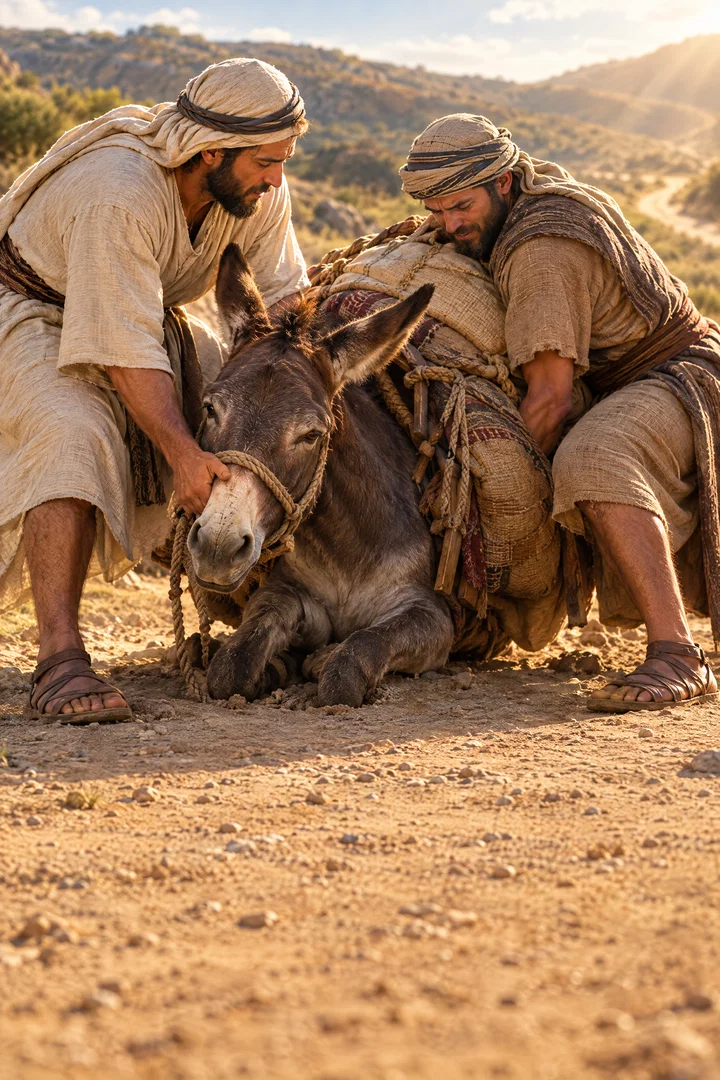
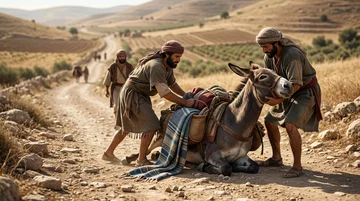
If thou see the ass of him that hateth thee lying under his burden, and wouldest forbear to help him, thou shalt surely help with him.
Translations
If you see the ass of him that hates you lying under his burden, and would forbear to help him, you shall surely help with him.
King James Version, KJV Cambridge Paragraph Bible, Revised Version
If thou see the ass of him that hateth thee lying under his burden, and wouldest forbear to help him, thou shalt surely help with him.
If thou shalt see the ass of him that hateth thee lying under his burden, and wouldest forbear to help him, thou shalt surely help with him.
If thou see the ass of him that hateth thee lying under his burden, thou shalt forbear to leave him, thou shalt surely release it with him.
when thou seest the ass of him who is hating thee crouching under its burden, then thou hast ceased from leaving [it] to it — thou dost certainly leave [it] with him.
If thou see the ass of him that hateth thee lying under its burden, beware of leaving [ it] to him: thou shalt certainly loosen [ it] with him.
When thou seest the ass of him that hateth thee sinking down under his burden, and mightest have foreborne to unload him, thou shalt surely help him to unload,
Berean Standard Bible, Majority Standard Bible
If you see the donkey of one who hates you fallen under its load, do not leave it there; you must help him with it.
If you see the donkey of him who hates you fallen down under his burden, don’t leave him. You shall surely help him with it.
If you see the ass of one who has no love for you bent down to the earth under the weight which is put on it, you are to come to its help, even against your desire.
If thou see thine enemies asse lying vnder his burden, wilt thou cease to helpe him? thou shalt helpe him vp againe with it.
Douay-Rheims (Challoner revision)
If thou see the ass of him that hateth thee lie underneath his burden, thou shalt not pass by, but shalt lift him up with him.
Pictures
Cross-references
- Matthew 5:44
But I say unto you, Love your enemies, bless them that curse you, do good to them that hate you, and pray for them which despitefully use you, and persecute you;
Both command kindness toward those who hate you.
- Romans 12:20
Therefore if thine enemy hunger, feed him; if he thirst, give him drink: for in so doing thou shalt heap coals of fire on his head.
It is cited alongside the command to do good to an enemy.
- Proverbs 25:21-22
If thine enemy be hungry, give him bread to eat; and if he be thirsty, give him water to drink:
It is cited as teaching kindness toward an enemy.
- Luke 10:33-37
But a certain Samaritan, as he journeyed, came where he was: and when he saw him, he had compassion on him,
The Samaritan shows mercy by helping the wounded traveler.
Commentary
Each commentary is drawn from primary sources: the writings of Ellen G. White and Adventist pioneers and periodicals. Each commentary is separate. Its own words are not a quotation; follow the references to read the source passages.
Ellen G. White
5 sources
Exodus 23:5 was part of the instruction given to Moses on the mount, given by Christ Himself, among the statutes and directions given to Israel.Lt 160, 1906, par. 3–9Ms 126, 1901, par. 46–47 It was meant to guard against doing injustice and to guard the interests of the people, to guide their dealings with one another, and it showed the impartiality and high standard of God's requirements.Lt 160, 1906, par. 3–9Ms 126, 1901, par. 46–47 It is to be obeyed and taught today just as verily as by Israel then.Lt 160, 1906, par. 3–9 Practical obedience to its principles is the condition for receiving God's promised reward and for living in communication with Him.Ms 185, 1907, par. 13–16
If the donkey of one who hates you is seen lying, fallen, or crushed beneath its burden, help must surely be given to relieve it, and help must not be forborne or withheld because of hostility or reluctance.DA 499.2–500.2Ms 185, 1907, par. 13–16PP 311.1 The verse requires kindness even to personal enemies.PP 311.1 All contention is to cease, with brotherly love and with softened and subdued hearts.Lt 160, 1906, par. 3–9
Its mercy extends even to animals that cannot voice their need.DA 499.2–500.2 The duty to help a suffering human being is all the stronger.DA 499.2–500.2
Sources
Pioneers and periodicals
22 sources
If the donkey of one who hates you is seen lying fallen under its load, you must surely help him lift and relieve it even when you would be inclined to hold back and leave it alone.RH Oct 22, 1861ST Apr 15, 1886 The duty holds despite hostility and natural reluctance, requiring practical kindness, mercy and justice toward an adversary in need, as part of God's moral law and not a new teaching first introduced by Jesus.RH Oct 22, 1861ST Jun 15, 1915RH Jan 27, 1916 It belongs to the statutes and judgments of Exodus 21 to 23, which reveal, apply and grow out of the principles of the Ten Commandments and must be understood consistently with them.ST May 16, 1878ST Feb 6, 1879ST Apr 17, 1907 It is not one of the Ten Words spoken directly to the assembly and written on stone, but one of the additional judgments given through Moses and written in the book of the covenant.ST Dec 10, 1896ST Apr 15, 1886 Since even an animal's need under a burden calls for help, a person's need calls for still greater care, so an enemy fallen into distress must be helped when he needs assistance.ST Jul 16, 1894ST Oct 20, 1909
Setting in the Law
The instruction was spoken privately to Moses alone when he drew near the thick darkness where God was, after the people withdrew and stood afar off and asked that God not speak to them directly but that Moses speak to them instead.ST Feb 6, 1879ST Apr 17, 1907ST Feb 11, 1913 This followed the speaking of the Ten Words with divine majesty that shook the earth.ST May 16, 1878ST Feb 6, 1879 Moses then told the words to the people who promised to do them, and wrote them in the book of the covenant.ST Apr 17, 1907 They were practical lessons on the journey for the children of Israel, coming after the holy law itself in Exodus 20 and leading toward preliminary instruction for the building of the sanctuary.ST May 16, 1878ST Feb 11, 1913
The instruction belongs to the latter part of Exodus 20 and all of Exodus 21, 22, and 23, especially the statutes and judgments of Exodus 21 to 23.ST May 16, 1878ST Feb 6, 1879ST Apr 17, 1907 These statutes reveal, apply, develop, and grow out of the principles of the Ten Commandments and must be understood consistently with their moral principles.ST Apr 17, 1907ST Aug 5, 1889ST Apr 15, 1886ST Dec 10, 1896 They were given so the moral connections could be more clearly apprehended because Israel, blinded and corrupted through slavery and heathenism, could not comprehend what was spoken from Sinai.ST Apr 17, 1907 They did not change or diminish those principles, and Israel's failure to keep them did not affect the law's enduring authority, justice, or goodness.ST Dec 10, 1896
In content it regulates conduct between people, stating duties toward one another and principles of justice among men, with directions for civil and religious matters under that arrangement.ST May 16, 1878ST Feb 6, 1879 It is a judicial precept for the civil government of Israel, for life in Canaan and the Jewish theocracy, concerning what should be done from person to person and what ought to be enforced judicially to rectify or check evil when the law is violated.RH Oct 22, 1861RH Dec 31, 1861ST Apr 15, 1886 It partly defines duty toward God and includes precepts of moral, civil, and ceremonial character.ST Feb 6, 1879ST Dec 16, 1897 It is an epitome with the surrounding chapters of the civil and ceremonial laws given to Israel.ST May 16, 1878
It is not one of the Ten Commandments spoken directly by God to the assembly and written on stone, which alone are the terms of the covenant.ST Apr 15, 1886RH Jul 9, 1901 It is one of the judgments and additional instructions given through Moses to teach the people and make known to Israel as part of the old covenant.RH Jul 9, 1901 These instructions extending through Exodus 23 were recorded by Moses in a book, the book of the covenant that recorded the agreement between God and Israel, formed the basis of national law and the terms they agreed to perform, and was ratified when the people answered that they would do it in Exodus 24.ST Dec 10, 1896ST Apr 15, 1886ST Dec 16, 1897 The laws God gave through Moses at Sinai, including this instruction, were given in love to be written on the heart and to bring the people into close, fatherly fellowship with him, not to drive them away from him.ST Jan 27, 1909
Exodus 23 belongs to a shadowy, typical system designed especially for dwellers in Canaan, including three yearly feasts and seven annual sabbaths on certain days of certain months, which pointed forward to Christ and the remedy for sin.RH Oct 14, 1873 That system stood as a partition against Gentiles and a yoke they could not bear, and was abolished by Christ and nailed to the cross.RH Oct 14, 1873 That system is altogether different from the seventh-day Sabbath made for man at creation before the fall and before a remedy was needed, a memorial pointing back to creation that will exist in the new earth when types and shadows have vanished.RH Oct 14, 1873
Kindness to Enemies
The verse lays down a legal command for a practical case: when the burdened donkey of one who hates you is seen lying fallen and collapsed or trapped under its load, you must surely help him raise and relieve it, even when you would be inclined to forbear and leave it unaided.ST Jul 16, 1894RH Oct 22, 1861ST Apr 15, 1886ST Jan 27, 1909 It belongs among the judgments given for life in Canaan, forming part of the covenant's required obedience to God and a practical regulation within the body of statutes built on the Ten Commandments, to be understood consistently with their moral principles.RH Oct 22, 1861ST Apr 15, 1886 It teaches practical kindness and assistance toward an adversary in need, requiring help in lifting the burdened animal rather than refusing assistance.ST Jan 27, 1909ST Mar 10, 1909
The duty holds despite hostility and natural reluctance, showing that love extends even to an enemy.RH Oct 22, 1861ST Jun 15, 1915ST Nov 27, 1893 It calls for practical kindness, mercy, assistance, justice, and humanity toward an adversary in need, rejecting narrow or exclusive concern.ST Jul 16, 1894RH Jan 27, 1916ST Jan 27, 1909 This requirement is part of God's law and the moral law, not a new teaching introduced by Jesus.ST Jul 16, 1894ST Jun 15, 1915RH Jan 27, 1916
Since even an animal's need under a burden calls for help, a person's need calls for still greater care.ST Jul 16, 1894 The principle extends beyond the donkey itself: even when someone is your enemy, you must help him when he has fallen into distress and needs assistance.ST Oct 20, 1909 Neighborliness likewise includes low-cost, prompt help with a neighbor's livestock, so that when his stock is seen in his grain fields the duty is to tell him at once or take time to drive them out, and doing this can win the neighbor.RH Nov 9, 1916
Sources