Exodus 26:5
Fifty loops shalt thou make in the one curtain, and fifty loops shalt thou make in the edge of the curtain that is in the coupling of the second; that the loops may take hold one of another.
Translations
Fifty loops shall you make in the one curtain, and fifty loops shall you make in the edge of the curtain that is in the coupling of the second; that the loops may take hold one of another.
King James Version, KJV Cambridge Paragraph Bible, Webster Bible
Fifty loops shalt thou make in the one curtain, and fifty loops shalt thou make in the edge of the curtain that is in the coupling of the second; that the loops may take hold one of another.
Revised Version, American Standard Version
Fifty loops shalt thou make in the one curtain, and fifty loops shalt thou make in the edge of the curtain that is in the second coupling; the loops shall be opposite one to another.
fifty loops thou dost make in the one curtain, and fifty loops thou dost make in the edge of the curtain which [is] in the joining of the second, causing the loops to take hold one unto another;
Fifty loops shalt thou make in the one curtain, and fifty loops shalt thou make at the end of the curtain in the other coupling: the loops shall be opposite to one another.
fifty loops, shalt thou make, in the one curtain, and fifty loops, shalt thou make in the edge of the curtain which is in the second set, the loops being opposite, one to another.
Berean Standard Bible, Majority Standard Bible
Make fifty loops on one curtain and fifty loops on the end curtain of the second set, so that the loops line up opposite one another.
You shall make fifty loops in the one curtain, and you shall make fifty loops in the edge of the curtain that is in the second coupling. The loops shall be opposite one another.
Fifty twists on one curtain and fifty on the other, the twists to be opposite one another.
Fiftie strings shalt thou make in one curtaine, and fiftie stringes shalt thou make in the edge of the curtaine, which is in the second coupling: ye stringes shalbe one right against another.
Douay-Rheims (Challoner revision)
Every curtain shall have fifty loops on both sides, so set on, that one loop may be against another loop, and one may be fitted to the other.
Pictures
Cross-references
- Hebrews 8:5
Who serve unto the example and shadow of heavenly things, as Moses was admonished of God when he was about to make the tabernacle: for, See, saith he, that thou make all things according to the pattern shewed to thee in the mount.
The earthly tabernacle was made as a pattern of the heavenly sanctuary.
- Exodus 36:8
And every wise hearted man among them that wrought the work of the tabernacle made ten curtains of fine twined linen, and blue, and purple, and scarlet: with cherubims of cunning work made he them.
Records the making of the tabernacle curtains.
- Acts 7:44
Our fathers had the tabernacle of witness in the wilderness, as he had appointed, speaking unto Moses, that he should make it according to the fashion that he had seen.
The wilderness tabernacle was made according to the pattern shown to Moses.
- Exodus 26:1
Moreover thou shalt make the tabernacle with ten curtains of fine twined linen, and blue, and purple, and scarlet: with cherubims of cunning work shalt thou make them.
Both describe the coupled tabernacle curtains.
- Exodus 25:9
According to all that I shew thee, after the pattern of the tabernacle, and the pattern of all the instruments thereof, even so shall ye make it.
The tabernacle’s loops follow the pattern shown to Moses.
- Exodus 36:14-19
And he made curtains of goats’ hair for the tent over the tabernacle: eleven curtains he made them.
same coverings actually made
- Exodus 26:9
And thou shalt couple five curtains by themselves, and six curtains by themselves, and shalt double the sixth curtain in the forefront of the tabernacle.
same tent roof curtains joined
- Exodus 25:40
And look that thou make them after their pattern, which was shewed thee in the mount.
Moses is told to make the sanctuary according to the pattern.
Commentary
Each commentary is drawn from primary sources: the writings of Ellen G. White and Adventist pioneers and periodicals. Each commentary is separate. Its own words are not a quotation; follow the references to read the source passages.
Ellen G. White
2 sources
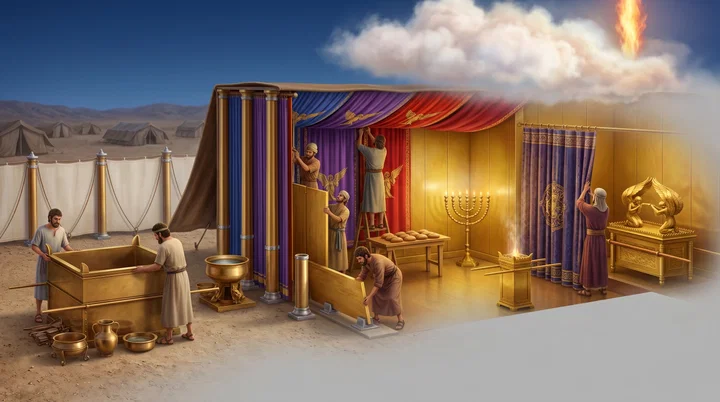
Fifty loops on each curtain edge to catch one to another belongs to God's detailed instructions to Moses for building the tabernacle and for coupling together its curtains.Ms 97, 1899, par. 3–4ST Mar 4, 1903 The minuteness of such specifications shows that the skill and wisdom employed in the tabernacle's construction were given by God and were to be used for His glory.Ms 97, 1899, par. 3–4 The tabernacle was so constructed that it could be taken apart and borne with Israel in all their journeyings, yet it was a structure of extraordinary magnificence.ST Mar 4, 1903 Its walls were upright boards heavily plated, overlaid, with the purest gold.ST Mar 4, 1903
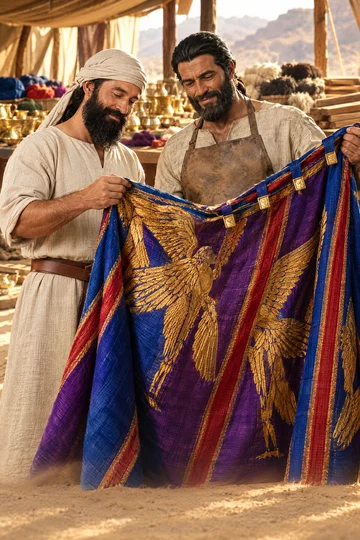
The sacred building was composed of two apartments, two rooms, separated by a rich and beautiful curtain or veil.ST Mar 4, 1903 A similar veil closed the entrance of the first apartment, the entrance to the first room.ST Mar 4, 1903 Those veils, together with the curtain that formed the ceiling of the tabernacle and was joined by the loops, were of a variety of colors most beautifully arranged.ST Mar 4, 1903 They were inwrought, woven, with threads of gold and silver and with figures of cherubim.ST Mar 4, 1903 The cherubim represented the angelic host who are connected with the work of the heavenly sanctuary and who are ministering angels to God's people, to the saints, upon the earth.ST Mar 4, 1903
Sources
Pioneers and periodicals
39 sources
Fifty loops were to be set on the edge of one set of curtains and fifty opposite them on the edge of the second set, so that the loops taking hold of one another joined the curtains into one covering.ST Jun 10, 1908ST May 16, 1878RH Dec 31, 1861 They belonged to the innermost covering of ten curtains of fine-twined linen with blue and purple and scarlet and cherubim, each twenty-eight cubits long and four cubits wide, coupled five and five with fifty clasps of gold.ST Apr 24, 1901RH Aug 4, 1863 The direction was part of the detailed instructions for the tabernacle and its furniture given by God to Moses during his forty days and nights in Mount Sinai, made according to the heavenly pattern shown to him.ST Mar 25, 1889ST May 16, 1878RH Dec 31, 1861RH Jan 4, 1870 That linen ceiling is a symbol of the fine linen which is the righteousness of saints obtained by faith in Christ, and its curtains joined by loops picture the members of the church with their different gifts bound together in brotherly love.ST Apr 24, 1901RH Aug 6, 1908 Apart from placing the instruction among the directions for the earthly sanctuary as a pattern of the heavenly, no further meaning is given to the loops themselves.ST Jun 19, 1907ST Jun 19, 1907
Curtains and Loops Described
The instruction calls for fifty loops on the one curtain and fifty loops on the edge of the curtain in the second coupling, set opposite one to another so that the loops take hold one of another and fasten the two sections into one covering.ST Jun 10, 1908RH Dec 31, 1861RH Mar 28, 1854ST Jun 26, 1907 The loops run along the joining edges of the curtains, joining them together into the tabernacle's covering.ST May 16, 1878ST Apr 1, 1889ST Oct 29, 1894 The curtains so joined formed part of the sanctuary covering made according to direction.ST Jun 26, 1907
The loops belong to the first, innermost of the four coverings that formed the covering of the tabernacle.ST Nov 14, 1892 That innermost covering was ten curtains of fine-twined linen with blue and purple and scarlet and cherubim of skillful work, each twenty-eight cubits long and four cubits wide, coupled five and five with fifty loops of blue on each coupling edge opposite one to another and fifty clasps of gold, so that the tabernacle shall be one.ST Apr 24, 1901RH Aug 4, 1863RH Feb 11, 1858 The linen was embroidered with cherubim and the second covering was made of goats' hair.RH Aug 4, 1863RH Feb 11, 1858
That linen covering rested directly on the tabernacle, thrown over the top of the building and over the gold-overlaid walls to form a ceiling of surpassing beauty for both the holy place and the most holy place.ST Apr 1, 1889ST Apr 24, 1901RH Aug 4, 1863ST Nov 14, 1892 Its ends hung down on the outside of the boards on the sides to within three feet of the ground.ST Apr 1, 1889 The covering hung down over the boards with its linen curtains beautifully worked with cherubim.ST Oct 29, 1894
Above the linen were distinct outer coverings forming a tent over the tabernacle for shelter and protection against water, season and climate.ST Apr 1, 1889ST Feb 17, 1890ST Nov 14, 1892 Those were a curtain of goats' hair, red-dyed ram skins, and seal skins, also called badgers' skins.ST Apr 1, 1889ST Feb 17, 1890ST Nov 14, 1892 The roof erected over the gold-overlaid walls was thus covered with goats' hair, red ram-skins, and seal skins.ST Feb 17, 1890
The building so covered had sides and one end made of upright boards joined closely, set in silver sockets and held by bars passing through rings.ST Mar 10, 1898RH Jul 19, 1870ST Aug 30, 1877 It had an entrance hanging at the east end, with linen hangings closing the east end, and a second veil or curtain dividing it into two apartments, the holy place and the holiest of all, the outer one twice the size of the inner.ST Mar 4, 1903RH Jan 6, 1853ST Mar 10, 1898 The portable sanctuary with its two apartments separated by a curtain was surrounded by a court.ST Jul 8, 1930
The covering of joined curtains, with its boards, hooks, loops and sockets, was fashioned of movable parts, the coverings made in separate strips fastened together with gold clasps and coupled together.RH Jul 19, 1870ST Aug 30, 1877 Because journeying was a necessity and removals were frequent on entering forty years of wandering in the wilderness, it was so made that it could be readily taken down, conveniently transported, and easily erected at each successive stage of the journey.RH Jul 19, 1870ST Aug 30, 1877 So constructed it could be taken apart and borne with Israel in all their journeyings, yet it was a structure of extraordinary magnificence with walls of upright boards heavily plated with purest gold.ST Mar 21, 1911ST Mar 4, 1903ST Jan 29, 1908
Setting and History Stated
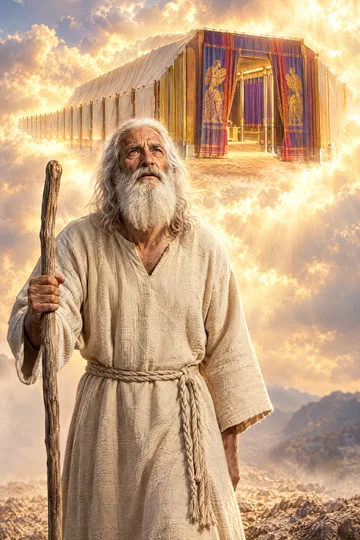
Exodus 26:5 is part of the detailed instructions for the construction of the tabernacle and its furniture given by God to Moses during his forty days and nights in the mountain on Sinai, specifying the loops that joined the curtains of the sanctuary together, with the tabernacle to be made according to the pattern shown to Moses on the mount.ST Mar 25, 1889RH Dec 31, 1861RH Mar 1, 1870ST Dec 10, 1896 Those instructions were afterward carried out just as directed in the preparation, fitting and setting up of the tabernacle with all its furniture and equipment, as described in Exodus 33-40.ST Jan 27, 1909ST Dec 10, 1896 God placed His Spirit upon the builders Bezalel and Oholiab together with other devoted men and women so the building might be properly erected and the work properly done, and wonderful blessing and glory came down upon the congregation and the building when it was completed.ST Jan 27, 1909 The directions show how particular God was about what pertained to His worship, with the sacred character of the sanctuary and its size and form not left to man's fancy.ST Mar 25, 1889ST Feb 17, 1890
The tabernacle so built was God's dwelling-place and habitation among Israel in the wilderness and through the time of the judges, Samuel, Saul and David, set up in their midst as the earthly center of worship.ST Jun 19, 1907ST Jun 4, 1885RH Mar 1, 1870RH Jul 19, 1870ST Aug 30, 1877 Its worship focused on the Most Holy Place, the holy of holies where the ark of the covenant containing God's holy law written on tables of stone rested beneath the mercy seat.ST Jun 19, 1907ST Jan 27, 1909 It was a movable building suited to Israel as they entered forty years of wandering in the wilderness, fashioned of movable parts with sides composed of upright boards and covering consisting of curtains of linen and dyed skins coupled together, so it could be readily taken down, conveniently transported, and easily erected at each successive stage of the journey.RH Jul 19, 1870ST Aug 30, 1877
After entering the promised land this temporary portable structure in time gave place to the magnificent temple of Solomon built after the same pattern, whose general outline was alike in Solomon's temple and the second temple.ST Jun 4, 1885RH Dec 24, 1908RH Jul 19, 1870 That temple was made in the wilderness pattern shown to Moses in Mount Sinai when God said to make a sanctuary to dwell among them, a worldly sanctuary made with two apartments, the holy and the most holy place.RH Dec 24, 1908 From its dedication when the glory of the Lord filled the house of the Lord it continued as God's dwelling-place among Israel, which in more permanent form as Solomon's temple with the second temple existed, saving only the time it lay in ruins in Daniel's day, till its final destruction by the Romans in A.D. 70.ST Jun 4, 1885RH Jul 19, 1870ST Aug 30, 1877
Heavenly Pattern Typified
The tabernacle with its two holy places, the holy and the most holy place, was made according to the pattern shown to Moses on the mountain at Sinai, and therefore serves as a pattern and object lesson of the heavenly temple and Christ's priestly work.ST May 16, 1878RH Jan 4, 1870ST Jun 26, 1907ST Jun 19, 1907RH Mar 1, 1870 The directions for making the wilderness sanctuary, including the joining of its curtains with fifty loops on each of two curtains so they could be coupled together, followed what was shown to Moses, and the earthly sanctuary and its service were types pointing to the heavenly sanctuary and to Christ's work.ST May 16, 1878ST Jun 26, 1907ST Jun 19, 1907 That earthly sanctuary built in the wilderness, whose general outline was alike in Solomon's temple and the second temple, was the sanctuary made to dwell among the people, a worldly sanctuary with its building and all its furniture and vessels.RH Dec 24, 1908 Apart from placing the instruction among the directions for the earthly sanctuary as a pattern of the heavenly, no further meaning is given to the loops themselves.ST Jun 19, 1907ST Jun 19, 1907
The explicit instructions for building the sanctuary present the earthly object lesson of God's plan of government and salvation from sin. Through that sanctuary God would dwell among His people and carry out His work through Christ, and God's people had a part in preparing it. The sanctuary where sacrifices and offerings were ministered was a type that passed away when Christ died, and it typified the heavenly temple where Jesus now ministers.ST Jan 24, 1911
The boards, coverings, loops, hooks and sockets of Exodus 26:1-37 are material details that must not be mistaken for the heavenly truth they represent or treated as its limit.RH May 25, 1905 The sanctuary truth is a glorious, harmonizing part of the gospel message, and its meaning reaches beyond measuring or counting its earthly furnishings.RH May 25, 1905 The top of the sanctuary was covered by four curtains, the first made of fine linen and embroidered with cherubim, with fifty loops to be made along the edge of each of two adjoining curtains so they could be joined, yet the loops themselves are not further explained.ST Jun 19, 1907ST Jun 19, 1907
Symbols in Coverings Seen
The inner roof over the dwelling was formed of ten curtains of fine-twined linen with blue and purple and scarlet and cherubim, each twenty-eight cubits long and four cubits wide, coupled five and five with fifty loops of blue on each joining edge set opposite one to another and fifty clasps of gold so that the whole became one.ST Apr 24, 1901 That linen curtain making the ceiling was a beautiful symbol of the fine linen which is the righteousness of the saints, obtained by faith in Christ.ST Apr 24, 1901 The cherubim skillfully worked into those curtains in varied colors with threads of gold and silver represent angels connected with the heavenly sanctuary, surrounding God's throne and ministering as ministering angels to God's people and to the saints upon the earth.ST Mar 21, 1911ST Mar 4, 1903ST Oct 29, 1894 The richly colored and beautifully arranged curtains so joined by the loops formed the ceiling and the veils, while the portable structure that could be taken apart and borne with Israel in all their journeyings had walls of upright boards heavily plated with purest gold and was divided into two apartments by a rich and beautiful curtain or veil, with a similar veil closing the entrance of the first apartment.ST Mar 21, 1911ST Mar 4, 1903 The linen curtains hung down over the boards and were beautifully worked with cherubim emblematic of the heavenly angels surrounding God's throne.ST Oct 29, 1894
The surrounding imagery of the sanctuary shows God's dwelling to be glorious within, with rich colors and embroidered veil-folds, even though the tent has no outward beauty.RH Nov 27, 1913 The curtains joined by loops picture the members of the church with their different gifts bound together.RH Aug 6, 1908 The blue loops represent the bonds of brotherly love by which they are united.RH Aug 6, 1908 The gold clasps and bars represent the sustaining graces of love and abiding faith.RH Aug 6, 1908
Law and Covenant Placed
The fifty loops belong to the complete description of the worldly sanctuary given in Exodus 25-31 and 35-40 and summarized in Hebrews 9:1-5.ST Jun 4, 1885ST Aug 5, 1889 That sanctuary was God's dwelling-place among Israel in the wilderness and through the time of the judges, Samuel, Saul, and David, until Solomon built the temple after the same pattern.ST Jun 4, 1885 From its dedication, when the glory of the Lord filled the house of the Lord, that temple continued as God's dwelling-place among Israel.ST Jun 4, 1885 The description to which the loops belong is connected with the first covenant.ST Aug 5, 1889
The loops are part of the law of Moses commanded through Moses in Horeb, included under the statutes and judgments to be remembered, especially in the last days. They stand with all the laws in Exodus 20 to 40 and Leviticus, not the Ten Commandments alone as the rule of conduct, but also the laws in which offerings, sacrifices and types were revealed. In those types the substance of the new dispensation may be traced from the shadows of the old.
These sanctuary instructions, including the joining of curtains by loops in Exodus 26, were part of the ceremonies and ordinances given through Moses, distinct from the Ten Commandments spoken by God at Sinai.ST Apr 15, 1886ST May 6, 1875 They belong to the written law of ordinances, set out immediately after the moral law in Exodus as part of the detailed instructions recorded for Moses' time.ST Apr 15, 1886ST May 6, 1875
Practical Lessons Drawn
The direction for the fifty loops is one of God's explicit directions for every part of the sanctuary He told Israel to build, whose center was the holy of holies where the ark of the covenant holding God's holy law written on tables of stone was placed.ST Jan 27, 1909 God placed His Spirit upon the builders Bezalel and Oholiab together with other devoted men and women, so that the building might be properly erected and the work properly done.ST Jan 27, 1909 This shows God is just as willing to bless consecrated workers in material things as workers in spiritual things.ST Jan 27, 1909 The directions were afterward carried out just as God directed in building the ark with all its furniture and equipment, and wonderful blessing and glory came down upon the congregation and the building when it was completed.ST Jan 27, 1909 The passage belongs to the Exodus 23 to 26 reading, which presses the question whether one's life conforms to the requirements of justice and humanity required by the moral law.RH Jan 27, 1916
Sources