Exodus 26:6
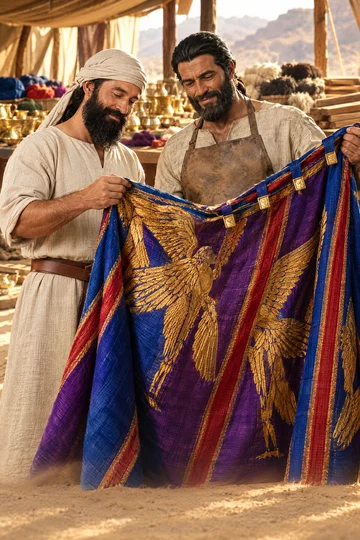
And thou shalt make fifty taches of gold, and couple the curtains together with the taches: and it shall be one tabernacle.
Translations
And you shall make fifty clasps of gold, and couple the curtains together with the clasps: and it shall be one tabernacle.
King James Version, KJV Cambridge Paragraph Bible
And thou shalt make fifty taches of gold, and couple the curtains together with the taches: and it shall be one tabernacle.
And thou shalt make fifty buttons of gold, and couple the curtains together with the buttons: and it shall be one tabernacle.
And thou shalt make fifty clasps of gold, and couple the curtains one to another with the clasps: and the tabernacle shall be one.
And thou shalt make fifty clasps of gold, and couple the curtains one to another with the clasps: and the tabernacle shall be one whole.
and thou hast made fifty hooks of gold, and hast joined the curtains one to another by the hooks, and the tabernacle hath been one.
And thou shalt make fifty clasps of gold, and couple the curtains together with the clasps, that the tabernacle may be one [whole].
And thou shalt make fifty clasps of gold,—so shalt thou join the curtains one to another, with the clasps, and thus shall the habitation be one.
Berean Standard Bible, Majority Standard Bible
Make fifty gold clasps as well, and join the curtains together with the clasps, so that the tabernacle will be a unit.
You shall make fifty clasps of gold, and couple the curtains to one another with the clasps. The tabernacle shall be a unit.
Then make fifty gold hooks, joining the curtains together by the hooks, and in this way the House will be made.
Thou shalt make also fiftie taches of gold, and couple the curtaines one to another with the taches, and it shalbe one tabernacle.
Douay-Rheims (Challoner revision)
Thou shalt make also fifty rings of gold wherewith the veils of the curtains are to be joined, that it may be made one tabernacle.
Pictures
Cross-references
- Exodus 25:8
And let them make me a sanctuary; that I may dwell among them.
The tabernacle is made as a dwelling place for God among Israel.
- Hebrews 8:5
Who serve unto the example and shadow of heavenly things, as Moses was admonished of God when he was about to make the tabernacle: for, See, saith he, that thou make all things according to the pattern shewed to thee in the mount.
The earthly tabernacle follows the pattern shown to Moses and shadows heavenly things.
- Hebrews 9:1-5
Then verily the first covenant had also ordinances of divine service, and a worldly sanctuary.
Describes the tabernacle’s two rooms and their furnishings.
- Hebrews 9:11
But Christ being come an high priest of good things to come, by a greater and more perfect tabernacle, not made with hands, that is to say, not of this building;
Christ ministers as High Priest in the greater, true sanctuary foreshadowed by the earthly tabernacle.
- Exodus 26:31-33
And thou shalt make a vail of blue, and purple, and scarlet, and fine twined linen of cunning work: with cherubims shall it be made:
Describes the veil dividing the tabernacle’s two apartments.
- Exodus 36:14-19
And he made curtains of goats’ hair for the tent over the tabernacle: eleven curtains he made them.
Records making the curtains and coverings of the tabernacle.
- Acts 7:44
Our fathers had the tabernacle of witness in the wilderness, as he had appointed, speaking unto Moses, that he should make it according to the fashion that he had seen.
The wilderness tabernacle was made according to the pattern God showed Moses.
- Hebrews 8:2
A minister of the sanctuary, and of the true tabernacle, which the Lord pitched, and not man.
Christ ministers in the true heavenly tabernacle, represented by the earthly sanctuary.
- Exodus 26:30
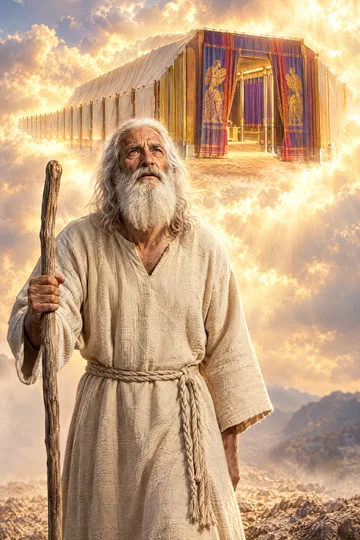
And thou shalt rear up the tabernacle according to the fashion thereof which was shewed thee in the mount.
The tabernacle is erected according to the pattern shown on the mount.
- Hebrews 9:23-24
It was therefore necessary that the patterns of things in the heavens should be purified with these; but the heavenly things themselves with better sacrifices than these.
The earthly sanctuary is a pattern of the heavenly holy places.
- Exodus 25:9
According to all that I shew thee, after the pattern of the tabernacle, and the pattern of all the instruments thereof, even so shall ye make it.
The sanctuary was to be made according to the pattern shown to Moses.
- Exodus 25:40
And look that thou make them after their pattern, which was shewed thee in the mount.
Moses is told to make the sanctuary according to the pattern shown on the mountain.
- Exodus 36:1-7
Then wrought Bezaleel and Aholiab, and every wise hearted man, in whom the LORD put wisdom and understanding to know how to work all manner of work for the service of the sanctuary, according to all that the LORD had commanded.
Skilled workers carry out the tabernacle instructions.
- Exodus 40:1-3
And the LORD spake unto Moses, saying,
Describes the tabernacle being set up.
- Exodus 40:34
Then a cloud covered the tent of the congregation, and the glory of the LORD filled the tabernacle.
God’s glory fills the completed tabernacle.
- Exodus 35:30-35
And Moses said unto the children of Israel, See, the LORD hath called by name Bezaleel the son of Uri, the son of Hur, of the tribe of Judah;
God gives skill for the tabernacle’s construction.
- Leviticus 16:33
And he shall make an atonement for the holy sanctuary, and he shall make an atonement for the tabernacle of the congregation, and for the altar, and he shall make an atonement for the priests, and for all the people of the congregation.
Both texts identify the tabernacle as a holy sanctuary.
Commentary
Each commentary is drawn from primary sources: the writings of Ellen G. White and Adventist pioneers and periodicals. Each commentary is separate. Its own words are not a quotation; follow the references to read the source passages.
Ellen G. White
2 sources
Exodus 26 provides the specifications for constructing the tabernacle.Ms 97, 1899, par. 3–4 The skill, genius, and wisdom employed in that work came from God and were to be used for His glory, and these building instructions were taught alongside the work of tentmaking.Ms 97, 1899, par. 3–4
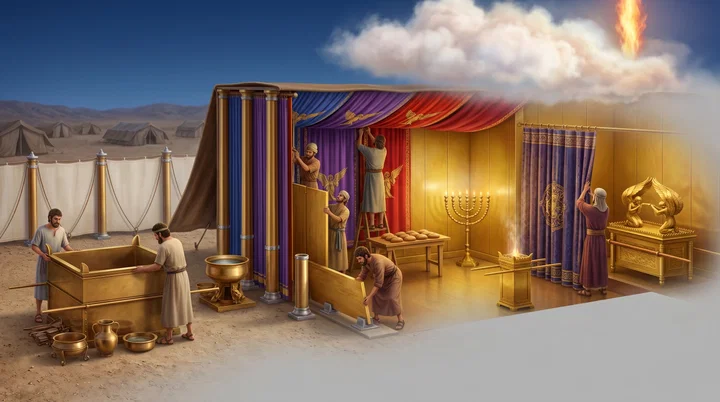
The coupling of the curtains together with the golden taches made the tabernacle so that it could be taken apart and carried with Israel on all their journeyings, yet it was a structure of extraordinary magnificence.ST Mar 4, 1903 Its walls were upright boards heavily plated with purest gold, and the building had two apartments separated by a rich and beautiful veil, with a similar veil closing the entrance of the first apartment.ST Mar 4, 1903 The veils and the curtain forming the ceiling were of varied colors beautifully arranged, and the cherubim worked in with threads of gold and silver represented the angelic host connected with the work of the heavenly sanctuary as ministering angels to the saints on earth.ST Mar 4, 1903
Sources
Pioneers and periodicals
38 sources
Fifty clasps of gold fastened to fifty loops of blue join the two sets of linen curtains together so that the separate sections become one tabernacle ceiling over both apartments.ST Apr 1, 1889ST May 20, 1880ST Apr 24, 1901RH Aug 4, 1863ST Feb 17, 1890 The direction was part of the exact pattern for the tabernacle and its furniture given to Moses on Mount Sinai, to be followed precisely in every detail and carried out by Spirit-filled builders.ST Mar 25, 1889ST Feb 17, 1890RH Dec 31, 1861ST Jun 4, 1885 That earthly building with its two holy places was made after the pattern of the heavenly temple, serving as God's object lesson of His plan of salvation and government in dealing with sinners.ST Oct 29, 1894ST May 16, 1878RH Jan 4, 1870ST Jun 19, 1907 Its beautiful inner linen is the righteousness of saints by faith in Christ, and its inwrought cherubim represent the angels connected with the heavenly sanctuary as ministering spirits to those on earth.ST Mar 4, 1903ST Apr 24, 1901ST Mar 10, 1898RH Nov 27, 1913ST Apr 1, 1913 The loops and golden clasps joining the curtains into one dwelling picture the members of the church bound together by brotherly love and sustaining faith, while the sacrificial ministry housed within passed away when Christ died once for all and entered the heavenly sanctuary where He now ministers.ST Jan 24, 1911RH Mar 28, 1854ST Jul 8, 1930RH Aug 6, 1908
Words and Construction
The word taches means clasps, and fifty taches of gold couple the curtains together so that the separate sections become one tabernacle.ST Apr 24, 1901RH Aug 4, 1863ST Nov 14, 1892ST Apr 1, 1889 Fifty loops of blue are set on each joining edge opposite one another, and the fifty clasps join through them to make the dwelling one.ST Apr 24, 1901ST Feb 17, 1890ST Nov 14, 1892ST Apr 1, 1889 The joined curtains make a beautiful ceiling over both apartments.ST Apr 24, 1901ST Nov 14, 1892ST Apr 1, 1889
That inner curtain resting directly on the tabernacle is ten curtains of fine-twined linen with blue and purple and scarlet and cherubim worked in.ST Apr 1, 1889ST May 20, 1880ST Apr 24, 1901ST Oct 29, 1894 Each curtain is twenty-eight cubits long and four cubits wide by one measure, joined as two sets of five.ST Apr 24, 1901 The ends hang down the sides, reaching to within three feet of the ground, and hang over the framework down along its outside.ST Apr 1, 1889ST Oct 29, 1894 This linen covering is distinct from the outer coverings, which form a tent over the sanctuary.ST Apr 1, 1889ST May 20, 1880
Together there are four layers over the sanctuary: fine linen on the inside embroidered with cherubim, then goat's hair, then red-dyed rams' skins, and badgers' skins or seal skins outside.ST May 20, 1880RH Jan 6, 1853RH Aug 4, 1863ST Mar 11, 1886 The fine-linen embroidered covering is the innermost, with several outer coverings together forming its roof and covering.ST May 20, 1880RH Jan 6, 1853RH Aug 4, 1863 Over the linen ceiling is erected a tent roof covered with a curtain of goat's hair, red ram-skins, and seal skins.ST Feb 17, 1890
Its sides and west end are upright acacia-wood boards overlaid with gold, thirty cubits long, ten cubits wide and ten cubits high.ST Oct 29, 1894ST Feb 17, 1890 They are secured below by tenons fitted into silver bases and held firmly at the top by bars passing through rings attached to the boards.ST Oct 29, 1894 The east end is closed by a veil called the door of the tent or tabernacle, and the interior is divided by a second veil into two parts called the holy place and the holiest of all.RH Jan 6, 1853ST May 16, 1878RH Jan 4, 1870RH Dec 24, 1908 The sanctuary is thus built in two apartments, the holy and the most holy place, with the outer apartment twice the size of the inner.ST Oct 29, 1894RH Jan 6, 1853RH Dec 24, 1908
Giving and Later History
The fifty gold clasps belong to the detailed instructions for the tabernacle and its furniture given to Moses during his forty days on Mount Sinai along with the tables of stone, before the law written by God was placed into his hands.RH Dec 31, 1861ST Jan 31, 1911 They form part of the sanctuary instructions in Exodus 25-31, summarized in Hebrews 9:1-5, which were afterward carried out in the preparation and fitting described in Exodus 36-40.ST Jun 4, 1885ST Jan 31, 1911ST Dec 10, 1896 The finished tabernacle was set up on the first day of the first month of the second year from the Exodus.
The directions gave explicit instruction regarding every part and were not left to human fancy but were to be followed exactly according to the pattern shown, showing how particular God was about what pertained to His worship.ST Mar 25, 1889ST Feb 17, 1890ST Jan 27, 1909 By them the curtains were to be coupled together with fifty taches of gold so that the tabernacle would be one, forming the surpassingly beautiful ceiling of fine-twined linen wrought with needlework and figures of angels spread over walls of upright acacia boards overlaid with gold, thirty cubits long, ten cubits wide and ten cubits high, over which was erected a tent roof covered with a curtain of goat's hair, red ram-skins, and seal skins.ST Feb 17, 1890ST Oct 25, 1905 The center of that sanctuary was the holy of holies, where the ark of the covenant was placed containing God's holy law written on tables of stone.ST Jan 27, 1909 In order for the building to be properly erected and the work properly done, God placed His Spirit upon the builders Bezalel and Oholiab together with other devoted men and women, showing that He is just as willing to bless workers in material things who are consecrated to Him as workers in spiritual things.ST Jan 27, 1909
The tabernacle was made to be taken apart and carried with Israel on all their journeyings, set up in their midst as the habitation of God and the center of religious worship as they entered forty years of wandering in the wilderness.ST Mar 21, 1911ST Mar 4, 1903RH Jul 19, 1870 Its sides of upright boards heavily plated with purest gold and its covering of curtains of linen and dyed skins joined with gold taches made it movable so it could be readily taken down, conveniently transported, and easily erected at each stage of the journey.RH Jul 19, 1870ST Aug 30, 1877 It was composed of two apartments separated by a rich and beautiful curtain or veil, with a similar veil closing the entrance of the first apartment, and these veils with the curtain forming the ceiling were of a variety of colors most beautifully arranged.ST Mar 4, 1903 Yet it was a structure of extraordinary magnificence.ST Mar 21, 1911ST Mar 4, 1903
That portable tabernacle whose story is told in Exodus 25 to 40 was later replaced by Solomon's temple, and in both buildings the worship of God upon the earth centered, with all earthly worship and service revolving around the holy of holies where the law of God rested with the mercy-seat over it.ST Jun 19, 1907RH Dec 24, 1908 That sanctuary was the one great central point of Jewish worship for some fifteen centuries, embracing the tabernacle in the wilderness, the temple of Solomon, and the second temple built after the return from Babylon until its destruction in A.D. 70.RH Dec 24, 1908 Its pattern was shown to Moses in Mount Sinai so God might dwell among His people, and it was built in two apartments, the holy and the most holy place, alike in general outline with the same furniture in each form.RH Dec 24, 1908 Except for the time it lay in ruins in Daniel's day, it continued in that more permanent temple form until its final destruction by the Romans in A.D. 70.RH Jul 19, 1870ST Aug 30, 1877
The clasps belong to the third part of Exodus concerning established worship after deliverance from bitter bondage in Egypt, by which the family grown more and mightier than the Egyptians became a nation with thorough organization, efficient leadership, a complete code of laws, and an established worship, in the book named for the going out from Egypt.RH Jan 20, 1916 They stand among the laws of Moses commanded in Horeb with statutes and judgments, including civil regulations, laws of sacrifices and offerings, laws of conduct, health laws, ceremonial laws, and moral laws, not the Ten-Commandment law alone. It belongs among the laws in which offerings, sacrifices, and types were revealed, in which the substance of the new dispensation is traced from the shadows of the old, to which attention is called in the last days, especially as set forth in Exodus 20 to 40 and also in Leviticus. They belong also to the instruction in Exodus 23 to 26 about justice and humanity required by the moral law and press the question whether life conforms to those requirements.RH Jan 27, 1916
Heavenly Pattern and Symbols
The tabernacle was constructed as a sacred building with two holy places, the holy place and the most holy place divided by a veil, according to the pattern shown to Moses on the mount.ST Oct 29, 1894ST May 16, 1878RH Jan 4, 1870 It was the true sanctuary of the old dispensation, the earthly dwelling where God manifested His presence among Israel.ST Oct 29, 1894ST May 16, 1878ST Aug 30, 1877 In this it served as a pattern of the heavenly temple, which also has two holy places.ST Oct 29, 1894ST May 16, 1878RH Jan 4, 1870 Its boards, coverings, rings, hooks and sockets are not mere measurements and materials but an earthly form pointing to heavenly truth.ST Jun 19, 1907ST Aug 30, 1877RH May 25, 1905 Yet as an earthly form it is not a perfect exact representation, because earthly things cannot fully portray heavenly things.ST Jun 19, 1907RH May 25, 1905
It is God's detailed earthly object lesson of His plan of salvation and government.ST Jun 19, 1907 It shows how God as king and priest deals with sinners, and its work involves cooperation between God and His people. Its essential features teach God's way in the sanctuary.ST Jun 19, 1907
The linen curtain forming the ceiling was a beautiful symbol of the fine linen that is the righteousness of saints, which is obtained by faith in Christ.ST Apr 24, 1901RH Nov 27, 1913ST Apr 1, 1913 The finished sanctuary's beauty and richness are within, where God dwells.RH Nov 27, 1913ST Apr 1, 1913 That inward richness and embroidered beauty reflects the glory of God's heavenly temple.ST Apr 24, 1901RH Nov 27, 1913ST Apr 1, 1913 The cherubim inwrought in blue and purple and scarlet with threads of gold and silver represent the angels of heaven who wait upon God's bidding.ST Mar 4, 1903ST Mar 10, 1898ST Jun 19, 1907 They represent the angelic host connected with the work of the heavenly sanctuary as ministering angels to the saints upon the earth.ST Mar 4, 1903ST Mar 10, 1898ST Jun 19, 1907
Worship Doctrine and Application
The ancient tabernacle described in Exodus 26 was constructed for the ministry of sacrifices and offerings as God's dwelling among Israel.ST Jan 24, 1911RH Mar 28, 1854ST Jul 8, 1930 It was the dwelling place God asked Israel to make so that He could dwell among them and reveal His love, with its parts made according to the pattern shown to Moses.RH Mar 28, 1854ST Jul 8, 1930 Those services passed away when Christ came and died once for all, while the sanctuary they typified is in heaven where Jesus now ministers.ST Jan 24, 1911 The fifty clasps of gold joined the separate curtains so that they formed one tabernacle.RH Mar 28, 1854
Its many exact specifications for construction, furnishings, and priestly garments offer lessons and encouragement, though their full meaning and the reasons for the costly materials and precise details are not all fathomed.ST Jun 10, 1908 The loops and golden taches joining the curtains into one dwelling picture the members of the church, each with a proper gift, bound together.RH Aug 6, 1908 The blue loops represent true brotherly love, while the taches represent the sustaining graces of love and abiding faith.RH Aug 6, 1908 That joining also calls to mind being girded with truth.RH Aug 6, 1908
Sources