Exodus 28:7
It shall have the two shoulderpieces thereof joined at the two edges thereof; and so it shall be joined together.
Translations
It shall have the two shoulder pieces thereof joined at the two edges thereof; and so it shall be joined together.
King James Version, KJV Cambridge Paragraph Bible
It shall have the two shoulderpieces thereof joined at the two edges thereof; and so it shall be joined together.
It shall have the two shoulder-pieces thereof joined at the two edges thereof; and so it shall be joined together.
It shall have two shoulderpieces joined to the two ends thereof; that it may be joined together.
It shall have two shoulder-pieces joined to the two ends thereof, that it may be joined together.
it hath two shoulders joining at its two ends, and it is joined.
It shall have two shoulder-pieces joined at the two ends thereof, where it is joined together.
Two joining shoulderpieces, shall there be to it upon the two extremities thereof that it may be joined together,
Berean Standard Bible, Majority Standard Bible
It shall have two shoulder pieces attached at two of its corners, so it can be fastened.
It shall have two shoulder straps joined to the two ends of it, that it may be joined together.
It is to have two bands stitched to it at the top of the arms, joining it together.
The two shoulders thereof shalbe ioyned together by their two edges: so shall it be closed.
Douay-Rheims (Challoner revision)
It shall have the two edges joined in the top on both sides, that they may be closed together.
Pictures
Cross-references
- Hebrews 8:5
Who serve unto the example and shadow of heavenly things, as Moses was admonished of God when he was about to make the tabernacle: for, See, saith he, that thou make all things according to the pattern shewed to thee in the mount.
The tabernacle was made according to a divine pattern and served as a shadow of heavenly things.
- Acts 7:44
Our fathers had the tabernacle of witness in the wilderness, as he had appointed, speaking unto Moses, that he should make it according to the fashion that he had seen.
The wilderness tabernacle was made according to the pattern shown to Moses.
- Exodus 28:15-30
And thou shalt make the breastplate of judgment with cunning work; after the work of the ephod thou shalt make it; of gold, of blue, and of purple, and of scarlet, and of fine twined linen, shalt thou make it.
Describes the breastplate worn with the ephod.
- Leviticus 16:4
He shall put on the holy linen coat, and he shall have the linen breeches upon his flesh, and shall be girded with a linen girdle, and with the linen mitre shall he be attired: these are holy garments; therefore shall he wash his flesh in water, and so put them on.
Describes garments worn for the atonement service.
Commentary
Each commentary is drawn from primary sources: the writings of Ellen G. White and Adventist pioneers and periodicals. Each commentary is separate. Its own words are not a quotation; follow the references to read the source passages.
Ellen G. White
7 sources
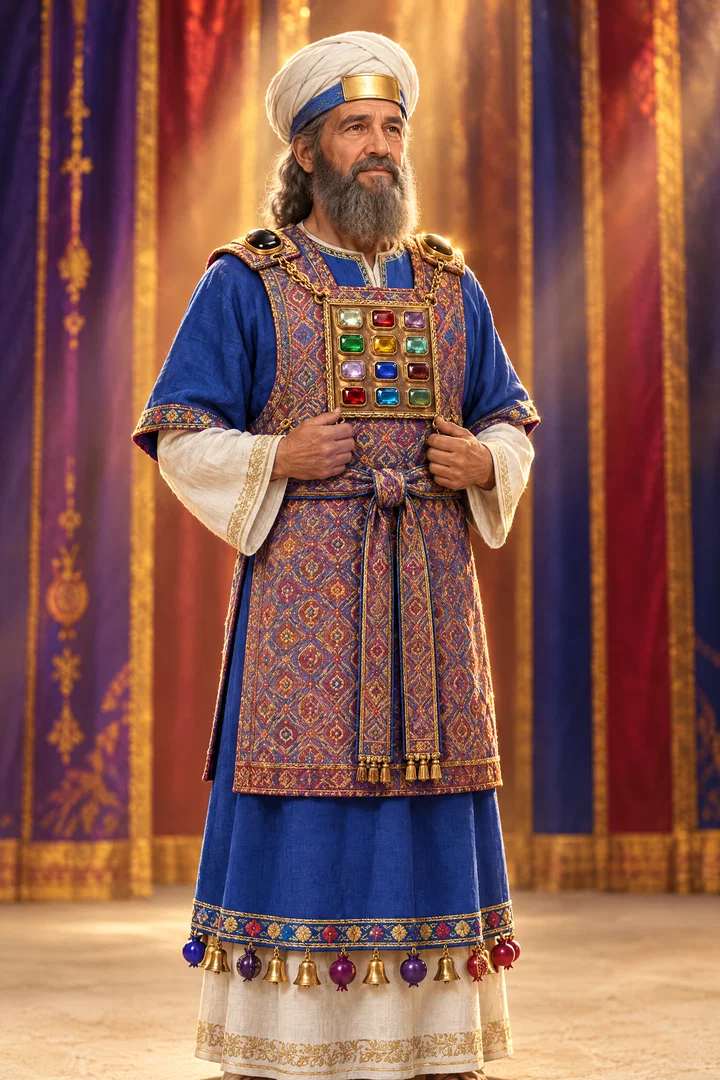
The verse is part of God's detailed directions through Moses for the garments Aaron and the priests were to wear when ministering before Him in service in the holy place.GW92 162.2GW92 161.12T 610.3–612.1Ms 56, 1900, par. 11–12 That instruction was given by Christ when enshrouded in the pillar of cloud to educate His church in the wilderness.Ms 92, 1899, par. 10–12 It describes the ephod's two shoulderpieces joined at their two edges so that the garment was held together.GW92 162.2EW 213.1PP 350.32T 610.3–612.1
The ephod was a shorter, sleeveless outer garment worn over the blue robe, made of costly material and beautiful workmanship befitting its exalted station.PP 350.3 It was woven of gold, blue, purple, scarlet, and white and confined by a beautifully wrought girdle of the same colors.PP 350.3 Its gold-embroidered shoulderpieces held two onyx stones bearing the names of the twelve tribes of Israel.PP 350.3 The description belongs to the sacred garments reflected in Jesus' priestly clothing, with a breastplate suspended from His shoulders, a robe with bells and pomegranates, and a crownlike headpiece.EW 213.1
The priestly garments were to be made in a particular, orderly, prescribed style suited to their sacred work.GW92 162.22T 610.3–612.1 Those garments were symbolic, showing that the clothing of people who serve God should represent Him.Ms 56, 1900, par. 11–12 The God who moves the world and sustains life and health may be honored or dishonored by the apparel of those who officiate before Him, and those ministers were to maintain order in everything and especially to preserve cleanliness.GW92 161.1 Such care in the priests' dress and service taught the people reverence for God and showed that His work was holy and must be free from impurity and uncleanness.2T 610.3–612.1
The verse is part of the outline of God's expressed will for present and eternal good, showing His covenant with the people He is seeking to save and the terms of salvation.Ms 92, 1899, par. 10–12 It holds the education of most value today, the highest knowledge after the divine similitude, teaching the laws of God's kingdom and how to conduct life as a citizen of heaven.Ms 92, 1899, par. 10–12 That education is for the mental, physical, and moral improvement of the whole being, for the formation of right sentiments, and for the development of practical usefulness.Ms 92, 1899, par. 10–12
Sources
Pioneers and periodicals
27 sources
It prescribes that the ephod have its two shoulderpieces joined at their two edges so the garment is held together as one.RH Aug 4, 1863ST Jun 4, 1885 The ephod was a sleeveless outer garment worn over the blue robe, made of gold, blue, purple, scarlet and white and bound by a girdle of the same work, with its gold-embroidered shoulderpieces set with two onyx stones bearing the names of the twelve tribes, six on each, to carry them on the shoulders in care for all Israel.RH Dec 15, 1910ST Nov 12, 1894RH Dec 15, 1910 It belongs to the minute instructions for the tabernacle and the clothing of Aaron and his sons given to Moses in the mount, to be made exactly according to the pattern shown him.ST Nov 12, 1894ST Jun 10, 1908ST Oct 29, 1894 It appoints a special dress suited to sacred office, teaching that God's work is holy and to be done with care and reverence, with nothing too small to escape His notice.ST Nov 12, 1894ST Jun 10, 1908RH Jul 26, 1864RH Oct 30, 1913ST Mar 15, 1883 It is part of the earthly sanctuary that was the pattern and shadow of the heavenly sanctuary and of Christ's more excellent ministry, which passed away when Christ died once for all and now ministers on high.ST Jan 24, 1911ST Jun 26, 1907 Its splendid dress was worn for ordinary ministration but was laid aside on the Day of Atonement for the plainest dress, showing the earthly high priest was high priest only in a typical sense, and it belongs to the Levitical law of ceremonies and ordinances imposed until the reformation, distinct from the Ten Commandments spoken by God Himself from Sinai.RH Jan 11, 1870ST Apr 15, 1886ST Mar 22, 1883ST Jun 6, 1878
Ephod Joining and Context
The two shoulderpieces of the ephod were to be joined at the two edges thereof, so that the garment was held together as one joined garment.RH Aug 4, 1863ST Jun 4, 1885ST Mar 22, 1883RH Dec 15, 1910 This splendid dress, including the ephod joined at its shoulderpieces, was for ordinary ministration on other occasions in the holy places, whereas on the Day of Atonement it was laid aside for the plainest and humblest dress.ST Jun 6, 1878 The ephod was a sleeveless, shorter outer garment, a linen cape worn over the high priest's blue robe or coat, made of gold and blue and purple and scarlet and white and confined by a beautifully wrought girdle of the same colors, befitting an exalted station.ST Nov 12, 1894 It was counted among the white garments that could have colored pieces or borders at their ends, and was described as a many-colored robe.RH Dec 15, 1910ST Oct 4, 1899 Its gold-embroidered shoulderpieces were set with two onyx stones in gold settings bearing the names of the twelve tribes of Israel, six tribes on each.ST Nov 12, 1894RH Dec 15, 1910RH Feb 2, 1911 They were borne on the shoulders to signify carrying concern for the welfare of all Israel, with gold chains connecting the settings to the breastplate worn before the chest which bore the tribal names and the inscription Holiness to the Lord.RH Dec 15, 1910
It belongs to the wonderfully itemized instructions in Exodus 25 to 31 and Exodus 25 to 40 for the tabernacle and its furniture and services and for the priestly clothing of Aaron and his sons.ST Nov 12, 1894ST Jun 10, 1908ST Oct 29, 1894 They were given by God to Moses in the mount during his forty days stay there along with the tables of stone, to be made exactly according to the pattern shown to Moses in the mount.ST Oct 29, 1894 They are to be studied together with the account of the priests' consecration in the next chapter, and they share in extreme exactness and minute detail.ST Nov 12, 1894ST Jun 10, 1908 Their full depths and reasons and motive for the profuse use of gold and silver and costly gems and fine linen cannot be seen or fathomed or appreciated, but careful, slow, thoughtful study of them with the mental microscope brings to the surface a multitude of invigorating and instructive ideas, suggestions and lessons, giving vitalizing food to strengthen famishing hearts and water of life to refresh worn spirits through long days.ST Jun 10, 1908
It was given after God redeemed Israel from Egyptian bondage with a mighty hand and commanded free-will offerings to make Him a sanctuary that He might dwell among them as His dwelling place where the priests might minister in His presence.RH Jan 4, 1870 The earthly worship and service centered on the holy of holies, where the law of God rested beneath the mercy seat.ST Jun 19, 1907 The marvelously beautiful sanctuary was a great multiple object-lesson by various forms and rites teaching the great plan of salvation and the character God required, needed because hundreds of years of slavery had unfitted Israel to comprehend God's great salvation, with a divine pattern given in the mount and with workmen specially endowed by God to build it. It belongs to the instructions for making the sanctuary, which was God's dwelling place among His people.ST Jun 4, 1885
Priesthood Type and Obligation
A special dress was appointed for the priests in accordance with their office, as an example of sanctification meaning setting someone or something apart for sacred use.ST Nov 12, 1894RH Jul 26, 1864 That clothing was to follow God's specified design and suit the sacred work, so that care and reverence in it would give the people an exalted view of God and show that His work is holy.RH Oct 30, 1913 The description of the garments prepared for the priests is to be carefully studied together with the account of the services connected with their consecration in the next chapter.ST Nov 12, 1894
God ordered the service of His sanctuary down to the smallest detail, telling what the priests should wear and how they should appear before Him, with nothing too trifling to escape His notice.ST Mar 15, 1883 His work is sacred and important, and He is the same now as then and will not accept carelessness or negligence now any more than then.ST Mar 15, 1883 The wonderfully itemized instructions in Exodus 25 to 31 for the tabernacle and for the priestly clothing of Aaron and his sons share in extreme exactness and minute detail, whose full depths, reasons, and motive for the profuse use of gold, silver, costly gems, and fine linen cannot be seen, fathomed, or appreciated.ST Jun 10, 1908 Careful, slow, thoughtful study of it brings to the surface a multitude of invigorating and instructive ideas, suggestions, and lessons, giving vitalizing food to strengthen famishing hearts and water of life to refresh worn spirits.ST Jun 10, 1908
The priesthood was committed to Aaron and his sons, so that after that appointment no one else was to perform the rites of a priest unless especially directed by the Lord.ST Mar 3, 1914 Saul's burnt offerings without waiting for Samuel at Gilgal were therefore presumptuous disobedience by one not ordained for priestly service.ST Mar 3, 1914 The splendid dress of the earthly high priest, including the ephod joined together at its two shoulderpieces, was prescribed for ordinary ministration on other occasions in the two holy places.RH Jan 11, 1870ST Jun 6, 1878 On the great Day of Atonement this splendid dress was laid aside for the plainest and humblest dress, solemnly admonishing that he was high priest only in a typical sense and not in reality.RH Jan 11, 1870ST Jun 6, 1878 That laying aside marked his infirmity and sinfulness in contrast to Christ, so that part has no counterpart in the work of Christ.ST Jun 6, 1878
The earthly sanctuary served as a pattern of the heavenly sanctuary and true tabernacle and pointed to Christ and His work, its ministration in the two holy places under the Levitical order being the example and shadow of Christ's more excellent ministry in the true tabernacle.ST Jun 26, 1907RH Mar 8, 1870 It belongs to the object-lesson let down upon earth that sets forth God's plan of government and how He deals with sin and those who sought to dethrone Him by sin. It sets forth the provision He devised from eternity for salvation from sin as priest upon the throne, still King while executing the office of priest in dealing with sinners. God's people are so intimately related to this sanctuary question that they cooperate with God in His work through Christ in the sanctuary, the divine and the human cooperating at every step. The ancient tabernacle was constructed for ministration in sacrifices and offerings, has no likeness to modern churches, and all passed away when Christ came and suffered and died once for all, while the great temple which it typified is on high where Jesus now ministers.ST Jan 24, 1911
It belongs to the law of Moses commanded through Moses in Horeb with the statutes and judgments, in the body of law set forth in Exodus 20 to 40 and Leviticus covering moral, civil, health, ceremonial, sacrificial and offering regulations. It is among the laws in which offerings, sacrifices and types were revealed as shadows from which the substance of the new dispensation is traced, and which God calls His people to remember in the last days. It is distinct from the Ten Commandments which God spoke directly with a great voice to the people and assembly from Sinai and wrote on the tables of stone with nothing added.ST Apr 15, 1886ST Jul 8, 1886ST Feb 20, 1879 It belongs with the additional instruction given later by the hand of Moses, recorded chiefly in Exodus 25 to 30 and in Leviticus, marking the appointment of the Levitical priesthood after the commandments.ST Apr 15, 1886ST Mar 22, 1883ST Mar 22, 1883ST Jul 8, 1886ST Feb 20, 1879 That later priestly setting consisted of burdensome ceremonies and carnal ordinances including required pilgrimages, circumcision, and diverse washings, imposed until the time of reformation, a yoke which neither the fathers nor their children were able to bear.ST Apr 15, 1886 This order of time proves the law received under the Levitical priesthood spoken of in Hebrews 7:11 is not the Ten Commandments but the Levitical law, distinguishing the moral law from the covenant made concerning it and from the law associated with the priesthood.ST Mar 22, 1883ST Mar 22, 1883ST Feb 20, 1879
Exodus 28 is linked to the position of the anointed cherub that covered, which was one of the two positions nearest the throne of God.ST Aug 8, 1900
Sources