Exodus 29:7
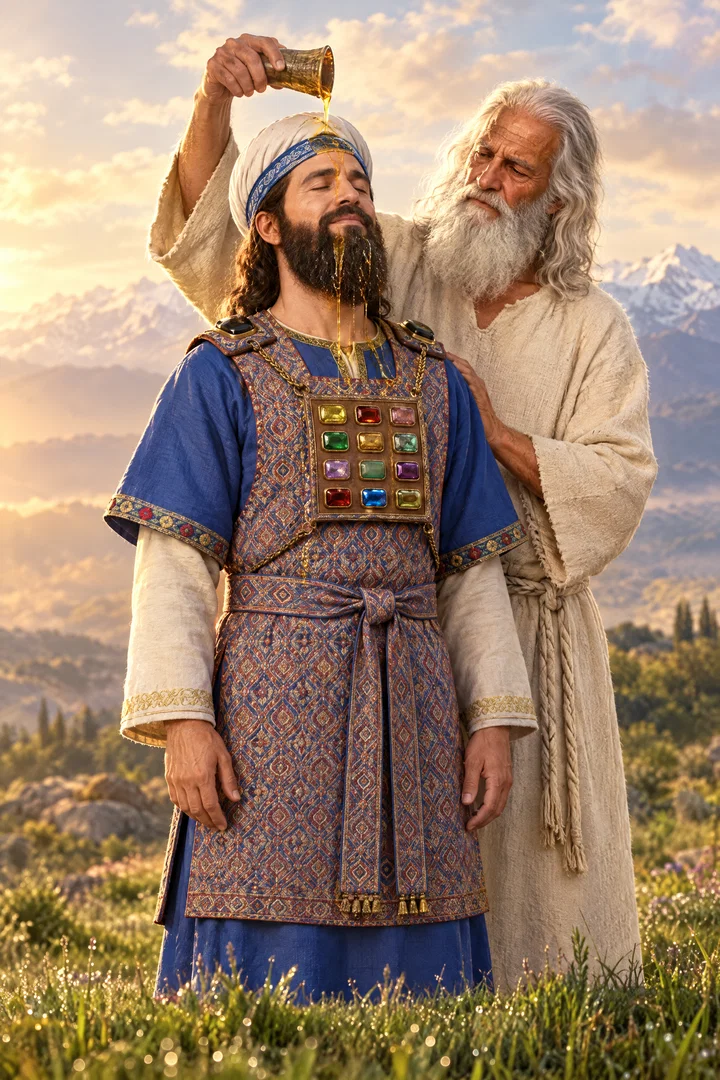
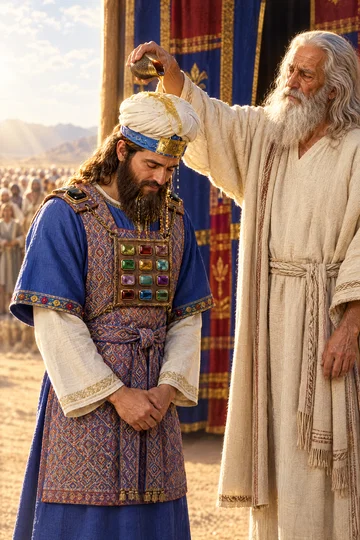
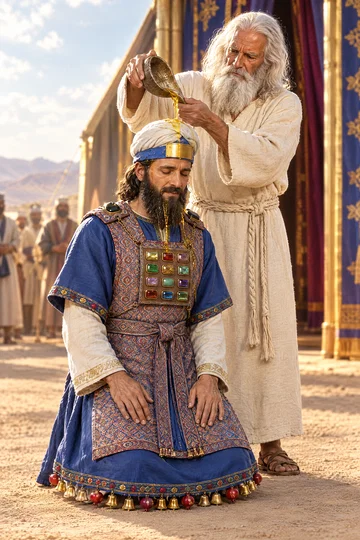
Then shalt thou take the anointing oil, and pour it upon his head, and anoint him.
Translations
Then shall you take the anointing oil, and pour it on his head, and anoint him.
King James Version, KJV Cambridge Paragraph Bible, Webster Bible, Revised Version, American Standard Version
Then shalt thou take the anointing oil, and pour it upon his head, and anoint him.
and hast taken the anointing oil, and hast poured [it] on his head, and hast anointed him.
and shalt take the anointing oil, and pour [ it] on his head, and anoint him.
Then shalt thou take the anointing oil, and pour upon his head,—so shalt thou anoint him.
Berean Standard Bible, Majority Standard Bible
Then take the anointing oil and anoint him by pouring it on his head.
Then you shall take the anointing oil, and pour it on his head, and anoint him.
Then take the oil and put it on his head.
And thou shalt take the anoynting oyle, and shalt powre vpon his head, and anoynt him.
Douay-Rheims (Challoner revision)
And thou shalt pour the oil of unction upon his head: and by this rite shall he be consecrated.
Pictures
Cross-references
- Exodus 28:41
And thou shalt put them upon Aaron thy brother, and his sons with him; and shalt anoint them, and consecrate them, and sanctify them, that they may minister unto me in the priest’s office.
Both texts describe anointing and consecrating priests for sacred service.
- Leviticus 8:12
And he poured of the anointing oil upon Aaron’s head, and anointed him, to sanctify him.
Aaron is anointed with oil during his priestly consecration.
- Leviticus 9
And it came to pass on the eighth day, that Moses called Aaron and his sons, and the elders of Israel;
Records Aaron’s first offering and the beginning of the priests’ sanctuary ministry.
- Exodus 29:20
Then shalt thou kill the ram, and take of his blood, and put it upon the tip of the right ear of Aaron, and upon the tip of the right ear of his sons, and upon the thumb of their right hand, and upon the great toe of their right foot, and sprinkle the blood upon the altar round about.
same consecration ritual explained
- Exodus 28:1
And take thou unto thee Aaron thy brother, and his sons with him, from among the children of Israel, that he may minister unto me in the priest’s office, even Aaron, Nadab and Abihu, Eleazar and Ithamar, Aaron’s sons.
Aaron and his sons are chosen for priestly service.
- Hebrews 3:2
Who was faithful to him that appointed him, as also Moses was faithful in all his house.
Both texts describe a divinely appointed priest or leader.
- Numbers 3:1-13
These also are the generations of Aaron and Moses in the day that the LORD spake with Moses in mount Sinai.
Identifies Aaron’s tribe as set apart for priestly service.
- Hebrews 9:11
But Christ being come an high priest of good things to come, by a greater and more perfect tabernacle, not made with hands, that is to say, not of this building;
The ancient sanctuary pointed to Christ’s ministry in the greater sanctuary.
- Hebrews 8:1-2
Now of the things which we have spoken this is the sum: We have such an high priest, who is set on the right hand of the throne of the Majesty in the heavens;
Christ ministers as High Priest in the true sanctuary in heaven.
Commentary
Each commentary is drawn from primary sources: the writings of Ellen G. White and Adventist pioneers and periodicals. Each commentary is separate. Its own words are not a quotation; follow the references to read the source passages.
Ellen G. White
1 source
The instruction to pour anointing oil upon the head fell from the lips of Jesus Christ Himself as He educated His church in the wilderness.Ms 92, 1899, par. 10–12 In that setting Christ was outlining God's expressed will for His people.Ms 92, 1899, par. 10–12 That outline was not confined to that generation, for it holds God's covenant with the people He is seeking to save today.Ms 92, 1899, par. 10–12 It states the terms of salvation for those living now.Ms 92, 1899, par. 10–12
It therefore provides the education of most value today.Ms 92, 1899, par. 10–12 It gives correct lessons from Christ as the greatest of all Teachers.Ms 92, 1899, par. 10–12 It is to be kept as one definite object before students.Ms 92, 1899, par. 10–12 It is to be learned by practical working out for present and eternal good.Ms 92, 1899, par. 10–12
Sources
Pioneers and periodicals
21 sources
God commanded that Aaron be consecrated as high priest by pouring sacred anointing oil upon his head after he was washed with water and clothed in his distinctive high-priestly garments, as part of a seven-day installation for sanctuary service.ST May 20, 1880ST Oct 29, 1894ST Nov 12, 1894ST Jul 8, 1930RH Dec 8, 1910 It belongs to the divine pattern for the wilderness sanctuary given on Mount Sinai, by which God would dwell among His people and set forth in forms and rites His plan of salvation through Christ.ST Mar 25, 1889ST Jun 26, 1907 The pouring of the oil set him apart and sanctified him to holy use, representing the presence of the Holy Spirit in cleansing and consecration with the blood of Christ, which alone could qualify him for priestly office and to which every child of God is likewise to be devoted.ST Dec 10, 1912RH Jul 26, 1864 That earthly priestly ministry with its sacrifices was a pattern and shadow of Christ's ministry as great High Priest in the heavenly sanctuary, belonging to the ministration of condemnation that could only point forward to the great Sacrifice while Christ now ministers pardon, life and salvation.ST Jan 24, 1911RH Mar 8, 1870RH Dec 12, 1854 It stands not among the ten commandments spoken by God and written on the tables of stone, but among the ceremonial directions for worship given by the hand of Moses, a burdensome yoke of carnal ordinances imposed until the time of reformation and distinct from civil government.ST Apr 15, 1886ST May 6, 1875ST Sep 3, 1896
Setting and Consecration Rite
God spoke these words to Moses on Mount Sinai during his forty days and nights stay in the mountain with the tables of stone, after Israel's covenant was ratified, as part of the instructions about building the sanctuary and its worship.ST Mar 25, 1889ST Jan 31, 1911 They belong to the chiefly legislative second division of Exodus in chapters 19-40. They fall within the instructions about building the sanctuary and its services that Moses received from God on the mount, Exodus 29 being part of those instructions.ST Mar 25, 1889ST Jan 31, 1911
They are part of the explicit directions given to Moses in the mount in Exodus 25 to 31 for the wilderness sanctuary after God brought Israel out from under Pharaoh and from Egyptian bondage across the Red Sea.ST Jun 26, 1907 The movable dwelling-place in the wilderness, a marvelously beautiful structure, was constructed with its dimensions, material, furnishings, and all exactly according to those directions so that God might dwell among His people.ST Jun 26, 1907 The directions for building and the services connected with preparing them set out God's plan for salvation from sin and His work through Christ by a multiple object-lesson of forms and rites, the pattern being divine, given of God to Moses in the mount.
In narrative order the command falls within the Exodus 19, 20, and 24-34 account of God's personal descent upon Sinai with His angels.RH Dec 24, 1861 It stands in the sequence in which He gave the Sabbath in Exodus 16, gave Himself to Israel as a holy nation in Exodus 19, and gave His law to Israel in Exodus 20.RH Dec 24, 1861 Chronologically it comes after the events of Exodus 19 to 32 and before the building and setting up of the sanctuary in Exodus 33 to 40.ST Dec 10, 1896 The word sanctuary is generally used of that wilderness inner tabernacle erected by Israel at the command of God, which was later replaced as the center of earthly worship by Solomon's portable temple, and in both buildings all earthly worship and service revolved around the holy of holies where rested the law of God under the mercy-seat.ST Jun 19, 1907
By the Lord's command it describes the consecration and installation of a priest for sanctuary service, with sacred anointing oil poured upon his head to anoint him.ST May 20, 1880ST Oct 29, 1894ST Sep 30, 1889 It is part of the account in Exodus 29 of the services connected with the consecration of the priests, which belongs with the description of the priestly garments in Exodus 28 and should be carefully studied.ST Nov 12, 1894 It records part of Aaron's consecration as high priest as he was set apart for holy priestly service.ST Jul 8, 1930RH Dec 8, 1910 The priests were first cleansed with water and dressed in their special garments, Aaron wearing distinctive high-priestly garments including a breastplate with the Urim and Thummim and a miter that the other priests did not wear.RH Dec 8, 1910 His consecration lasted seven days, after which God publicly accepted Aaron and his sons for their ministry.ST Jul 8, 1930
Typical Meaning and Application
The anointing commanded here does not belong to the ten commandments spoken directly to the people from Sinai and written on the two tables of stone with nothing added, but to what was given by the hand of Moses during the forty days in the mount.ST Apr 15, 1886ST May 6, 1875 It is part of what was written out in full after the moral law, recorded chiefly in Exodus 25-30 and Leviticus, among the ceremonial directions for anointing the priest.ST Apr 15, 1886ST May 6, 1875 It stands among the burdensome ceremonies and carnal ordinances with diverse washings imposed until the time of reformation, a yoke which neither the fathers nor their children were able to bear.ST Apr 15, 1886
It belongs to the set of laws given for the regulation of worship in Israel found in Exodus 29-31 and 40, distinct from the laws given for civil government in Exodus 21-23.ST Sep 3, 1896 It thus helps plainly designate the religious system and the position of those who execute it, separate from civil rulers.ST Sep 3, 1896 Civil government is a temporary arrangement of force to control men and regulate their relations to each other in this life only, while religion is to persuade men and bring them back to God.ST Sep 3, 1896 The two must go side by side on entirely separate lines of operation without commingling, since any commingling produces discord detrimental to both.ST Sep 3, 1896
The priesthood was committed to Aaron and his sons, and priestly rites were not for others to perform unless the Lord specially directed them, so that offering sacrifices without ordination for priestly service, as Saul did, was presumptuous.ST Mar 3, 1914 The anointing with oil set the priest apart for sacred service, sanctifying him in the sense of consecrating him to a religious use.RH Jul 26, 1864
The earthly sanctuary's priestly ministry established through this priesthood, with its offering of sacrifices, was a pattern and shadow of Christ's ministry in the heavenly sanctuary.ST Jan 24, 1911RH Mar 8, 1870 That ancient tabernacle service with its sacrifices passed away when Christ died once for all, and it typified the heavenly sanctuary where Jesus now ministers.ST Jan 24, 1911 Moses thus set apart the Levitical order to minister before the ark containing the law in the Most Holy Place of the typical sanctuary through the entire Old Testament period while it continued.RH Dec 12, 1854 That service belonged to the ministration of condemnation and death, which could only exhibit human guilt and just condemnation with in itself no promise of pardon.RH Dec 12, 1854 Its sacrifices could take away no sin but could only point penitent sinners forward to the great Sacrifice to be offered for the sins of men, in contrast to the heavenly sanctuary where Christ as great High Priest ministers before the ark of God's testament to offer life, pardon and salvation.RH Dec 12, 1854
The anointing oil poured on the head, together with the blood sprinkled on Aaron and his sons, represented the Holy Spirit and the blood of Christ, which alone could fully qualify them for priestly office.ST Dec 10, 1912 The oil represents the presence of the Holy Spirit in cleansing and consecration.ST Dec 10, 1912 The consecration required of the high priest was also required of the cleansed leper, so every child of God is to be devoted to God as Christ was.
Sources