Exodus 29:6
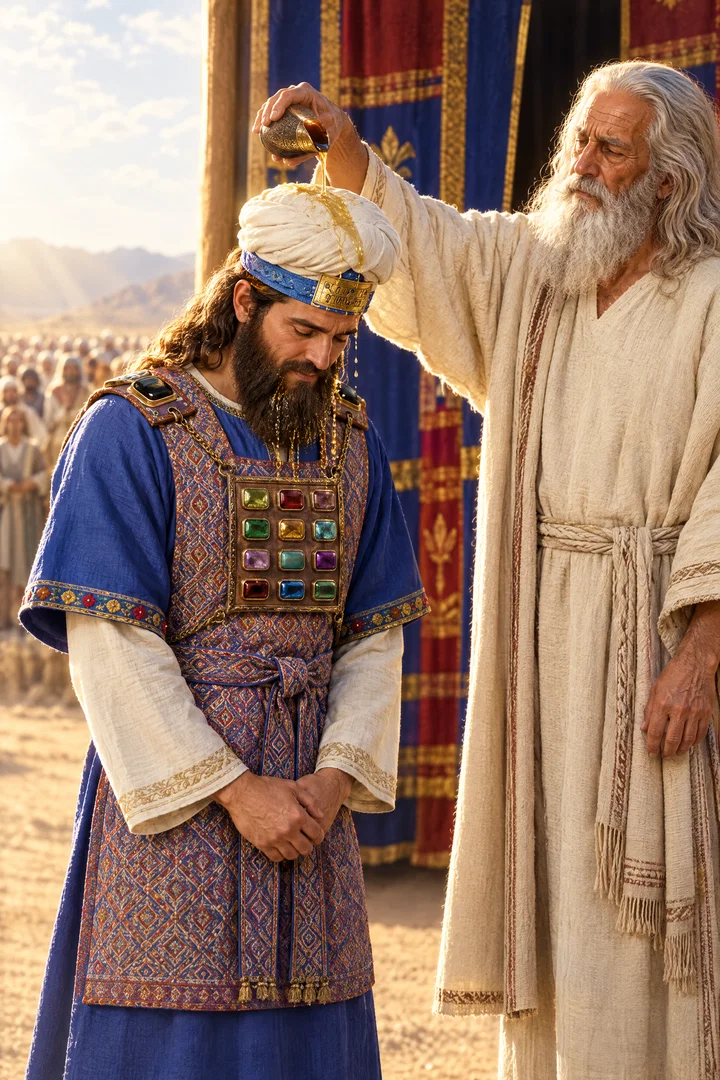
And thou shalt put the mitre upon his head, and put the holy crown upon the mitre.
Translations
And you shall put the turban on his head, and put the holy crown on the turban.
And thou shalt put the mitre upon his head, and put the holy crown upon the mitre.
and thou shalt put the mitre upon his head, and put the holy crown upon the mitre.
And thou shalt put the miter upon his head, and put the holy crown upon the miter.
Revised Version, American Standard Version
and thou shalt set the mitre upon his head, and put the holy crown upon the mitre.
and hast set the mitre on his head, and hast put the holy crown on the mitre,
And thou shalt put the turban upon his head, and fasten the holy diadem to the turban,
and shalt put the turban upon his head,—and place the holy crown upon the turban.
Berean Standard Bible, Majority Standard Bible
Put the turban on his head and attach the holy diadem to the turban.
You shall set the turban on his head, and put the holy crown on the turban.
And let the head-dress be placed on his head and the holy crown on the head-dress.
Then thou shalt put the miter vpon his head, and shalt put the holy crowne vpon ye miter.
Douay-Rheims (Challoner revision)
And thou shalt put the mitre upon his head, and the holy plate upon the mitre,
Pictures
Cross-references
- Exodus 28:1-3
And take thou unto thee Aaron thy brother, and his sons with him, from among the children of Israel, that he may minister unto me in the priest’s office, even Aaron, Nadab and Abihu, Eleazar and Ithamar, Aaron’s sons.
God appoints Aaron and his sons for priestly service and directs the making of the priestly garments.
- Leviticus 8
And the LORD spake unto Moses, saying,
Describes the consecration and setting apart of Aaron and his sons for priestly service.
- Leviticus 9
And it came to pass on the eighth day, that Moses called Aaron and his sons, and the elders of Israel;
Aaron’s first offering marks his priestly ministry, and God accepts it.
- Hebrews 8:1-2
Now of the things which we have spoken this is the sum: We have such an high priest, who is set on the right hand of the throne of the Majesty in the heavens;
Christ ministers as High Priest in the true heavenly sanctuary.
- Exodus 28:36-38
And thou shalt make a plate of pure gold, and grave upon it, like the engravings of a signet, HOLINESS TO THE LORD.
Related instructions for the high priest’s sacred headwear.
- Exodus 28:39
And thou shalt embroider the coat of fine linen, and thou shalt make the mitre of fine linen, and thou shalt make the girdle of needlework.
Describes the linen mitre as priestly dress.
- Exodus 28:4
And these are the garments which they shall make; a breastplate, and an ephod, and a robe, and a broidered coat, a mitre, and a girdle: and they shall make holy garments for Aaron thy brother, and his sons, that he may minister unto me in the priest’s office.
Lists the garments made for Aaron, including the mitre and holy crown.
- Exodus 29:29
And the holy garments of Aaron shall be his sons’ after him, to be anointed therein, and to be consecrated in them.
The priestly garments and office pass to Aaron’s successor.
- Hebrews 7:26
For such an high priest became us, who is holy, harmless, undefiled, separate from sinners, and made higher than the heavens;
Christ’s holiness contrasts with the earthly high priest’s consecrated crown.
- Exodus 28:41
And thou shalt put them upon Aaron thy brother, and his sons with him; and shalt anoint them, and consecrate them, and sanctify them, that they may minister unto me in the priest’s office.
Commands their anointing and consecration to serve as priests.
- Hebrews 9:7
But into the second went the high priest alone once every year, not without blood, which he offered for himself, and for the errors of the people:
The high priest alone enters the most holy place.
- Exodus 29:20
Then shalt thou kill the ram, and take of his blood, and put it upon the tip of the right ear of Aaron, and upon the tip of the right ear of his sons, and upon the thumb of their right hand, and upon the great toe of their right foot, and sprinkle the blood upon the altar round about.
both parts of same consecration ceremony
Commentary
Each commentary is drawn from primary sources: the writings of Ellen G. White and Adventist pioneers and periodicals. Each commentary is separate. Its own words are not a quotation; follow the references to read the source passages.
Pioneers and periodicals
23 sources
The verse commands placing the linen turban on Aaron's head with the holy crown fastened upon it as the finishing prescribed garments of his high-priestly attire, marking him out from the under-priests by dress suited to his office.ST Jun 10, 1908ST Nov 12, 1894ST Oct 25, 1905 It stands in the solemn seven-day ceremony by which Aaron and his sons were appointed and consecrated to the priesthood under God's direction as his earthly mediators, whose rites belonged to them alone.ST Dec 10, 1912ST Mar 3, 1914ST Jul 8, 1930 It belongs to the minute detailed instructions given to Moses on Mount Sinai for the wilderness sanctuary to be made exactly according to the pattern shown in the mount, centered on the ark holding God's law that he might dwell among his redeemed people.ST Oct 29, 1894ST Jan 27, 1909ST Jun 26, 1907ST Dec 10, 1896 As part of that typical system it served unto the shadow of the heavenly temple where Jesus now ministers, its rites and consecration being object lessons pointing penitent sinners forward to the coming Messiah and his sacrifice that takes away sin, sanctifying or setting apart for sacred service those who minister in harmony with God's holy law.ST Jun 10, 1908ST Jan 24, 1911ST Mar 25, 1889ST Jun 26, 1907RH Mar 8, 1870
Words and Historical Setting
Exodus 29:6 belongs to the very minute description in Exodus 25 to the end of the book for the sanctuary built in the days of Moses, given before the sanctuary was built and set up to be made exactly according to the pattern shown in the mount in dimensions, material, and furnishings.ST Oct 29, 1894ST Jun 26, 1907ST Dec 10, 1896 That full description sets out the sanctuary and its furnishings, including upright boards in silver sockets held by outside bars, roof curtains reaching to the ground, linen hangings at the east end, and a curtain dividing the building into two apartments with the outer apartment twice as large as the inner.ST Mar 10, 1898 The directions were given to Moses in the mount on Sinai for the worldly sanctuary pitched in the wilderness after deliverance from Pharaoh across the Red Sea.ST Jun 26, 1907
The instructions were given to Moses during his forty days and nights on Mount Sinai on the mountain, together with the tables of stone, after the Ten Commandments were proclaimed and ratified over the book of the covenant.ST Mar 25, 1889RH Dec 31, 1861 They were part of the system of legal ordinances given for the guidance of the ransomed people bound to Jehovah by solemn covenant as a peculiar treasure, a kingdom of priests, and a holy nation. The pattern for the sanctuary and its service was provided there before the ark containing the law, and the worship service was meant to bring people into harmony with God's holy law.ST Mar 25, 1889RH Dec 31, 1861
The sanctuary was commanded after God redeemed Israel from Egyptian bondage with a mighty hand, because hundreds of years of slavery had unfitted Israel to comprehend God's great salvation and the character He required.ST Jun 26, 1907 God therefore gave a great multiple object-lesson by various forms and rites comprehending the great plan of salvation, commanding free-will offerings of all things used in building that He might dwell among them, with the pattern divine and the workmen specially endowed by God to build it. The work was centered on the ark of the covenant holding God's law written on stone, and on its completion God brought His glory upon the congregation and the building.ST Jan 27, 1909 True worship centered in this worldly sanctuary until it was succeeded by Solomon's temple.ST Jun 26, 1907
As law the verse is part of the ceremonial requirements given through Moses and recorded among the regulations in Exodus 25-30, distinct from the Ten Commandments spoken by God and written on stone.ST Apr 15, 1886 With moral, civil, and health laws it belongs to the body of instruction through which types and shadows reveal the substance of the new dispensation. Exodus 29:1-31 sets out regulations for worship distinct from the civil laws in Exodus 21-23, showing that religious service had its own rules and appointed roles separate from civil government.ST Sep 3, 1896
In wording the verse commands putting the linen turban mitre on the head and the holy crown upon the mitre as prescribed parts of Aaron's priestly attire in preparation for service.ST Jun 10, 1908ST Nov 12, 1894ST Oct 25, 1905 The mitre was a linen turban appointed as special dress in keeping with the priestly office, completing the outward costume.ST Nov 12, 1894 Cited in Exodus 29:5-7 as part of the command to anoint, the instruction belongs to the consecration of Aaron as high priest.ST Sep 30, 1889 It distinguishes the high priest from the under-priests by special garments marking his office, while the priests' white linen signifies the purity of their character and work.RH Dec 8, 1910
In its immediate context the chapter gives the solemn ceremony under God's direction appointing Aaron and his sons to the priestly office and consecrating them, with the head covering and holy crown within the garments made for Aaron's consecration.ST Dec 10, 1912 Exodus 29 describes their seven-day consecration for priestly service.ST Jul 8, 1930 The priesthood was committed to Aaron and his sons, and its rites were not for others to perform unless God specially directed.ST Mar 3, 1914 After their consecration God publicly accepted them by sending fire to consume Aaron's first offering for the people, and Aaron served as God's appointed earthly mediator.ST Jul 8, 1930
Type and Consecration Lessons
The mitre and holy crown belong to the typical system that served unto the shadow of heavenly things.ST Jun 26, 1907RH Mar 8, 1870RH Feb 3, 1853 The worldly sanctuary pitched in the wilderness, with its two holy places, was the example and pattern of the true tabernacle which the Lord pitched and not man.ST Jun 26, 1907RH Mar 8, 1870RH Feb 3, 1853 The ancient tabernacle with its ministry of sacrifices and offerings typified the heavenly temple where Jesus now ministers.ST Jan 24, 1911ST Jun 26, 1907 Its explicit directions were given to Moses in the mount on Sinai after deliverance from Pharaoh across the Red Sea, to be carried out exactly in dimensions, material, furnishings and all.ST Jun 26, 1907
All its rites and ceremonies were object lessons pointing to the coming Messiah, the Lamb of God that takes away the sins of the world, and to His power to forgive sin, transform the character, and deliver from heavy burdens.ST Jun 26, 1907 The consecration of Aaron and his sons was part of the solemn ceremony appointing them to the priestly office, and their consecration and service typified Christ.ST Dec 10, 1912 The anointing oil and blood signified the Holy Spirit and Christ's blood as what qualified them for that holy work.ST Dec 10, 1912 That consecration set apart the Levitical order of priesthood to minister before the ark containing the law in the Most Holy Place of the typical sanctuary while that sanctuary continued, carrying forward through the entire Old Testament period the ministration Moses began when he brought the law down.RH Dec 12, 1854 That ministration could only exhibit guilt, condemnation and death, and its priesthood offered no sacrifice that could take away sin but could only point penitent sinners forward to the great Sacrifice to come.RH Dec 12, 1854 True worship centered in this worldly sanctuary, afterward succeeded by Solomon's temple, until Christ's sacrifice and offering at Calvary, when the veil of the temple was rent in twain and the earthly sanctuary with its typical and shadowy service passed away entirely and forever.ST Jan 24, 1911ST Jun 26, 1907
The mitre and holy crown were prescribed parts of Aaron's priestly attire in the detailed instructions for making the tabernacle and the priestly garments, and the chapter's exact instructions invite careful study for their instructive lessons.ST Jun 10, 1908 The verse specifies the high priest's mitre and holy crown without drawing a separate lesson from those items, placing the sanctuary instructions within God's plan for salvation from sin in which divine and human work together. Sanctification here means consecration to a religious use, shown in the priests being set apart for sacred service.RH Jul 26, 1864 Those instructions for consecrating the high priest, connected with the offerings and consecration required of a cleansed leper, teach that even the humblest child of God must be as devoted and consecrated as Christ, giving no further explanation of the mitre or holy crown.
The high priest was crowned with a holy crown placed upon his mitre, paralleled by the fair mitre marking Joshua as God's anointed high priest.ST Aug 16, 1910 That worship service was meant to bring people into harmony with God's holy law.ST Mar 25, 1889
Sources