Exodus 35:26
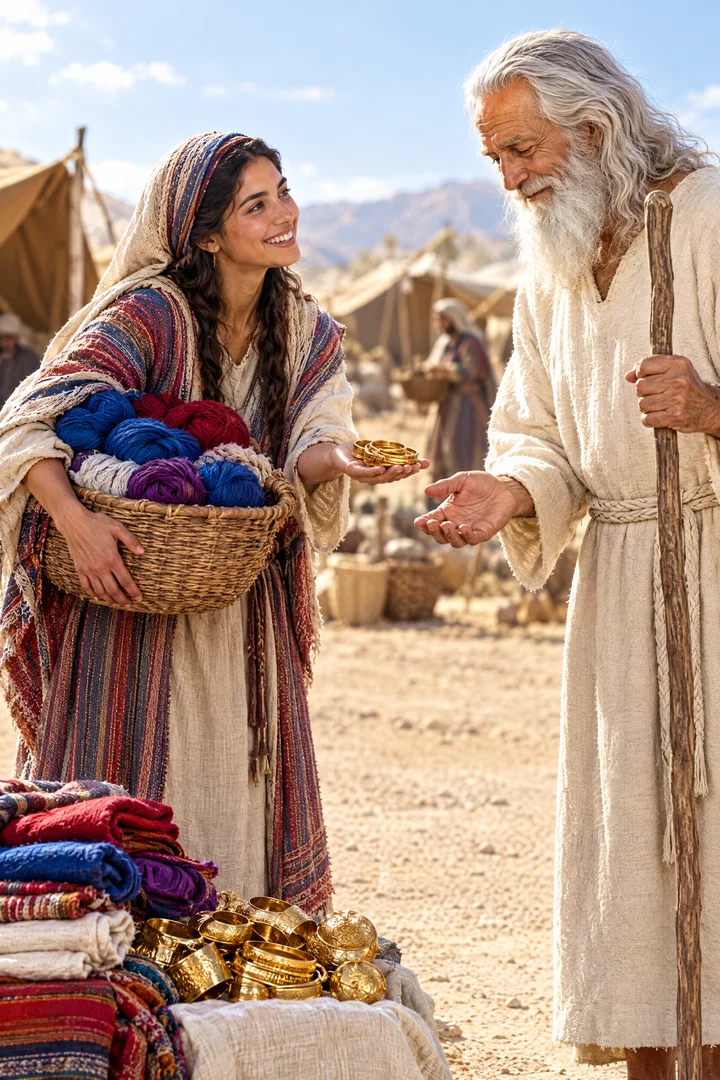
And all the women whose heart stirred them up in wisdom spun goats’ hair.
Translations
American King James Version, King James Version, KJV Cambridge Paragraph Bible
And all the women whose heart stirred them up in wisdom spun goats’ hair.
And all the women whose heart moved them in wisdom spun goats' hair.
Revised Version, American Standard Version
And all the women whose heart stirred them up in wisdom spun the goats’ hair.
and all the women whose heart hath lifted them up in wisdom, have spun the goats' [hair].
And all the women whose heart moved them in wisdom spun goats' [hair].
And, all the women whose hearts lifted them up with wisdom, span the goat’s-hair.
Berean Standard Bible, Majority Standard Bible
And all the skilled women whose hearts were stirred spun the goat hair.
All the women whose heart stirred them up in wisdom spun the goats’ hair.
And those women who had the knowledge, made the goats' hair into cloth.
Likewise al the women, whose hearts were moued with knowledge, spun goates heare.
Douay-Rheims (Challoner revision)
And goats’ hair, giving all of their own accord.
Pictures
Cross-references
- Exodus 36:5-7
And they spake unto Moses, saying, The people bring much more than enough for the service of the work, which the LORD commanded to make.
The people bring more than enough for the sanctuary, so further offerings are stopped.
- Exodus 35:21
And they came, every one whose heart stirred him up, and every one whom his spirit made willing, and they brought the LORD’s offering to the work of the tabernacle of the congregation, and for all his service, and for the holy garments.
The people whose hearts moved them brought willing offerings for the tabernacle work.
- Exodus 25:2-8
Speak unto the children of Israel, that they bring me an offering: of every man that giveth it willingly with his heart ye shall take my offering.
Willing offerings, including goats’ hair, provide materials for the sanctuary.
- Exodus 36:14
And he made curtains of goats’ hair for the tent over the tabernacle: eleven curtains he made them.
Records the making of the goats’ hair curtains.
- Exodus 26:7
And thou shalt make curtains of goats’ hair to be a covering upon the tabernacle: eleven curtains shalt thou make.
Describes the goats’ hair curtains made for the sanctuary.
- Exodus 36:7
For the stuff they had was sufficient for all the work to make it, and too much.
The materials offered were sufficient for the work, with more than enough.
- Exodus 36:2
And Moses called Bezaleel and Aholiab, and every wise hearted man, in whose heart the LORD had put wisdom, even every one whose heart stirred him up to come unto the work to do it:
Both describe willing, skilled workers serving in the tabernacle work.
- Hebrews 8:5
Who serve unto the example and shadow of heavenly things, as Moses was admonished of God when he was about to make the tabernacle: for, See, saith he, that thou make all things according to the pattern shewed to thee in the mount.
The tabernacle was made according to the heavenly pattern shown to Moses.
- Exodus 31:6
And I, behold, I have given with him Aholiab, the son of Ahisamach, of the tribe of Dan: and in the hearts of all that are wise hearted I have put wisdom, that they may make all that I have commanded thee;
God gives wisdom to those skilled in making the tabernacle.
- Exodus 35:22
And they came, both men and women, as many as were willing hearted, and brought bracelets, and earrings, and rings, and tablets, all jewels of gold: and every man that offered offered an offering of gold unto the LORD.
Willing-hearted men and women brought jewelry and spun materials for the tabernacle.
Commentary
Each commentary is drawn from primary sources: the writings of Ellen G. White and Adventist pioneers and periodicals. Each commentary is separate. Its own words are not a quotation; follow the references to read the source passages.
Ellen G. White
14 sources
All the women whose hearts stirred them used their God-given wisdom and skill to spin goats' hair for the tabernacle, giving willing and skillful labor to provide materials for its construction.ST Mar 4, 1903Ms 97, 1899, par. 3–4ST Sep 11, 1884Ms 100, 1899, par. 9–11 Their spinning was part of the people's freewill offerings for God's house, brought willingly from the heart and showing that His work calls for both generous giving and skilled workmanship.ST Sep 11, 1884PP 529.1ST Mar 4, 1903 Each person was anxious to have a part and brought cheerful gifts and labor in such abundance that more than was needed came in, until Moses had to proclaim that they must stop because all could not be used.ST Aug 5, 1875LC1 175.31SP 270.1 God required exactitude, skill, tact, wisdom and perfection in building the earthly tabernacle, and He requires the same perfection in every line of work done in His service according to the pattern shown to Moses in the mount.Ms 109, 1899, par. 1–4 The record stands as an example of devotion, energy, generosity and liberality in preparing a house where God could meet with His people, calling for giving now to be equally free, willing, anxious and abundant once the need and God's call are known.ST Aug 5, 18751SP 270.1ST Mar 4, 19031MR 337.2–338.2
Words and Historical Setting
All the women whose hearts stirred them up in wisdom used their skill to spin goats' hair for the sanctuary or tabernacle, providing materials for its construction as willing, skilled labor.ST Mar 4, 1903Ms 97, 1899, par. 3–4ST Sep 11, 1884SG4 154.3LC1 175.3 Their wisdom and skill were abilities provided by God, put to work for His glory and service.Ms 97, 1899, par. 3–4Ms 100, 1899, par. 9–11 Women also applied great ingenuity to embroidery and ornaments for the tabernacle.SG4 154.3
This took place just after leaving Egypt, when freedom could still turn back to slavery and means were scanty.ST Aug 5, 1875 Even then building God's house came before enlarging their own small tents.ST Aug 5, 1875 The work followed the design God gave.ST Aug 5, 1875
The contributions included jewelry taken from their persons, with gold, silver, brass, and ornamental work.ST Aug 5, 1875 Together they amounted to more than a million dollars.ST Aug 5, 1875
Freewill Offerings and Application
The spinning of goats' hair was part of the people's freewill offerings for God's house, brought willingly from the heart.ST Sep 11, 1884PP 529.1 The women's willing, skilled work belonged to the preparation of the sanctuary, a house where God could meet with His people.ST Mar 4, 19031MR 337.2–338.2 God's work in this called for both willing giving and skilled labor, with each person sharing in the blessing of supporting it through cooperation and the use of ability.1MR 337.2–338.2ST Nov 2, 1915
The call for these offerings was special, beyond all systematic and regular donations for religious purposes and the poor.4T 467.1–2 It was given by God for the people's own good as well as to sustain His service.4T 467.1–2 Like the later call for the temple at Jerusalem, it rested not on one class but on all, with the amount required proportioned to what each possessed.4T 467.1–2
The people needed no urging, but each soul was anxious to have a part in the work for God.ST Aug 5, 1875 They brought cheerful gifts and willing labor, including skilled work in spinning goats' hair, as a cheerful preparation of materials and freewill gifts for the construction of the tabernacle.ST Aug 5, 1875LC1 175.31SP 270.1 The gifts came in such abundance that more than was needed was brought in, until Moses had to proclaim that they had enough and must stop because all could not be used.ST Aug 5, 1875LC1 175.3PP 529.1
God required exactitude, skill, tact, wisdom, and perfection in building the earthly tabernacle.Ms 109, 1899, par. 1–4 He requires the same perfection to be brought into every line of work done in His service.Ms 109, 1899, par. 1–4 Workers in their different appointed occupations are to train their minds for the highest service and to desire mental strength to do everything according to the pattern shown to Moses in the mount.Ms 109, 1899, par. 1–4
The record stands as an example of devotion, energy, generosity, and liberality in supporting a place of worship and the worship of God.1SP 270.1ST Mar 4, 1903 It shows willing work in preparing a house where God could meet with His people, and that each person may share in the blessing of supporting God's work.ST Mar 4, 19031MR 337.2–338.2 Giving to God's work now must be equally free, willing, anxious, and abundant, with means and hearty cooperation given without urging once the need and God's call are known.ST Aug 5, 1875
Sources
Pioneers and periodicals
38 sources
All the women whose hearts moved them in skill willingly spun goats' hair with their hands and brought it in for the coverings of the wilderness tabernacle among the other precious materials for God's dwelling place.ST Mar 17, 1914RH May 27, 1902RH Jun 23, 1910ST Feb 17, 1890ST Jun 4, 1885
The work was a freewill offering given willingly from the heart from love to God, with no compulsion, urging or profane inducement.RH May 27, 1902RH Mar 4, 1873RH Nov 15, 1870
The people gave in prompt, abundant liberality until there was much more than enough and Moses had to command them to cease, and in this they showed their sincerity, devotion and self-sacrifice in preparing a place for the Lord to dwell among them.ST Aug 5, 1875ST Dec 31, 1874RH Mar 4, 1873RH Aug 21, 1856ST Jun 10, 1908
The building of the tabernacle by such freewill offering is the pattern for present mission work, in which each gives according to what is possessed and all bring voluntary offerings, tithe and personal abilities sufficient for the work to go forward as the Lord directs.ST Jun 24, 1880RH Feb 16, 1905RH Jun 30, 1904ST May 20, 1880
Such willing giving comes from real heart communion with God, and today builds no material temple but dedicates a temple in the heart adorned with the beauty of holiness.RH Jan 27, 1916RH Jun 2, 1859
Words and Sanctuary Setting
All the women whose heart stirred them up in wisdom willingly used their skill to spin goats' hair for the construction of the sanctuary or tabernacle.ST Mar 4, 1903ST Mar 17, 1914RH May 27, 1902RH Jun 23, 1910ST Mar 25, 1889 Their service was willing and arose from an inward desire to contribute, and their work was a willing offering to the Lord.RH May 27, 1902RH Jun 23, 1910ST Mar 25, 1889 Those who had wisdom for the work and the needed skill spun for the tabernacle service, and their willing, heart-moved work helped make its construction possible.ST Mar 4, 1903ST Mar 25, 1889
The spinning was done with their hands and what was spun was brought in.ST Jun 10, 1908RH Oct 3, 1907 The goats' hair was used for the sanctuary coverings among the varied precious materials for God's dwelling place among the people.ST Feb 17, 1890ST Jun 4, 1885 The offering included blue, purple, scarlet, fine linen, jewelry, silver, brass, skins, acacia wood, onyx stones and oil, given as Israel's varied, bountiful offering to build God a dwelling-place among them at Sinai.ST Jun 10, 1908 The sanctuary was built by the children of Israel, with the wise-hearted women spinning goats' hair as part of the work, helping build a sanctuary so the Lord might dwell among them as the great center of truth from which light would go to all the world.RH Oct 3, 1907
The verse belongs to the very minute account of building the worldly wilderness sanctuary in Exodus 33 to 40, which immediately followed the instruction in Exodus 25 to 31 according to the pattern shown to Moses in the mount.ST Oct 29, 1894ST Dec 10, 1896 It is part of the very minute description of the worldly sanctuary built in the days of Moses in Exodus 25 to 40, which was to be made exactly according to the pattern shown to Moses in the mount, with materials and workmanship following the directions given.ST Oct 29, 1894ST Jun 26, 1907 It is part of the account of Israel's wilderness tabernacle, the earthly sanctuary whose worship centered on the holy of holies, where the law of God rested beneath the mercy seat.ST Jun 19, 1907 It is part of the account of making the sanctuary and its furnishings, setting it up, consecrating it, and its being filled with God's presence.ST Jan 29, 1908
The work belongs to the time after Israel's release from Egypt, in the third month of that year after coming out of the wilderness of Sin between Elim and Sinai and encamping at Sinai.ST Jun 10, 1908 That mountain became a schoolhouse of flame where God spoke lessons of life if received and obeyed and death if disobeyed.ST Jun 10, 1908 The tabernacle was built just after leaving Egypt, when freedom could still turn back to slavery and means were scanty with only small tents, yet made possible because God had brought them out with great substance as promised to Abraham though they had few possessions and uncertain prospects.ST Aug 5, 1875ST Jun 10, 1908ST Aug 23, 1883
The verse stands within the law of Moses commanded in Horeb, among the statutes and judgments together with the Ten Commandments and all other precepts through Moses in Exodus 20 to 40 and Leviticus. It belongs to the whole body of moral, civil, health, ceremonial and sacrificial law whose offerings, sacrifices and types as shadows reveal the substance of the new dispensation to which God's people are called in the last days. The Spirit's blessing for consecrated labor extended to practical, material tasks, and God's work called for both willing giving and skilled labor through the people's cooperation.ST Nov 2, 1915ST Jan 27, 1909
Willing Freewill Offering
The sanctuary was built through voluntary freewill offerings given willingly from the heart from an inward desire to contribute, with the people giving what they had and contributing as they were moved to do so.RH Mar 4, 1873RH Nov 15, 1870RH Jun 23, 1874 There was no compulsion and no urging necessary, no grand feast, no invitation to scenes of gaiety, dancing and general amusement, and no lotteries or anything of this profane order.ST Aug 5, 1875ST Sep 17, 1874 The motive impelling was love to God and neighbor and no other, for anything done from selfish feeling will not do.ST Aug 5, 1875ST Sep 17, 1874RH Mar 4, 1873
The people gave gifts and willing labor in prompt, willing, free abundance without grudge or stint, each soul anxious to have a part in the work for God.ST Aug 5, 1875ST Jun 10, 1908RH Jun 2, 1859 They brought ornaments and jewelry from their persons into the treasury to beautify and enrich God's house, with gold, silver, brass, ornamental work and spun goats' hair, spending more than a million dollars.ST Aug 5, 1875ST Jun 10, 1908RH Jun 2, 1859 Their gifts were so abundant that there was much more than enough and too much for the work the Lord had commanded, more than could be used, so Moses had to proclaim they had enough and command them to cease their presents because all could not be used.ST Aug 5, 1875ST Sep 17, 1874RH Aug 21, 1856ST Jun 10, 1908 The zeal with which they engaged in the work and the readiness with which they sacrificed their treasures stands as the example from which the present church has in great measure departed, though there is no reason the spirit of sacrifice should depart any more than the gifts of the Holy Ghost.RH Aug 21, 1856
These offerings tested and showed the sincerity, love, devotion, energy, liberality and self-sacrifice of the people in consecrating possessions, skill and labor.ST Jun 24, 1880ST Dec 31, 1874RH Mar 4, 1873RH Jan 29, 1914 The wise-hearted women spinning goats' hair with their hands and bringing what they had spun was part of that devoted, heart-given contribution, an example of devotion and liberality in preparing a place for worship.ST Mar 21, 1911ST Jun 24, 1880ST Dec 31, 1874RH Jan 29, 1914 Their work helped prepare a dwelling place so the Lord might dwell among them and meet with them, which was to be the great center of truth from which light would go to all the world.RH Oct 3, 1907
The materials and skilled work were provided before construction, so the tabernacle could be completed without debt.RH Jul 17, 1913 When God directs a work, willing people provide materials and contribute their abilities to accomplish it.RH Jul 17, 1913RH Dec 30, 1915 Skilled labor freely given was itself a contribution to sacred work, showing that giving is closely connected with God's work and its blessings.RH May 27, 1902RH Dec 1, 1904 Such willing service provides the model for sacred work offered from a desire to help, rather than from wages as an inducement.RH May 27, 1902RH Dec 1, 1904
Pattern for Present Giving
Exodus 35 belongs to the plan for providing a place set apart for holding services, in which those interested bring voluntary offerings and donations sufficient to purchase the building so the work goes on as the Lord directs, together with every member paying tithe.RH Feb 16, 1905 The wise-hearted women spinning goats' hair with their hands and bringing what they had spun were part of Israel's willing offerings of personal possessions and skilled abilities for building the tabernacle.ST Jun 24, 1880RH Jun 30, 1904 That willing work was an example of devotion, energy, and liberality in preparing a house where God could meet with His people.ST Jun 24, 1880ST Mar 4, 1903
The building of the tabernacle in the wilderness by freewill offering, like the building of Solomon's temple, is the pattern for present mission work.ST May 20, 1880 Each person is moved to give or withhold such talents as are at disposal just as the importance of the work is felt.ST May 20, 1880 What is offered is accepted according to what is had, for no one is responsible for talents not possessed but only for what is possessed, and the Lord holds each answerable for what can be done with His divine aid and no more.ST May 20, 1880 Those who can do seemingly but little may receive the greatest reward.ST May 20, 1880 The work must be impelled by love to God and to neighbor and by no other motive power, for anything done from selfish feeling will not do, and when the genuine motive power is obtained and the work humbly carried forward, even the gates of hell cannot prevail against it.ST May 20, 1880
The spinning helped build a sanctuary so the Lord might dwell among them, which was to be the great center of truth from which light would go to all the world.RH Oct 3, 1907 All are called to help just as truly now by circulating Christ's Object Lessons.RH Oct 3, 1907 Leaving thousands of the books unsold stands as unfaithfulness while the last atoning work is being done for each person, bringing responsibility for souls that might have been saved by faithfully placing the soul-inspiring book in their hands.RH Oct 3, 1907 What is needed now is earnest united effort, with no more favorable time.RH Oct 3, 1907
Giving to God's work now must be free, willing, anxious, and abundant just as then, with means and hearty cooperation given without urging once the need and God's call are known.ST Aug 5, 1875 God's house had to be built first, before enlarging their own small tents, following the design God gave, just after leaving Egypt when freedom could still turn back to slavery and means were scanty.ST Aug 5, 1875 The people brought ornaments and jewelry from their persons into the treasury to beautify and enrich God's house, with gold, silver, brass, ornamental work, and spun goats' hair, spending more than a million dollars, until Moses had to proclaim they had enough and their cheerful offerings must cease because all could not be used.ST Aug 5, 1875RH Aug 21, 1856 The present church of God is far from this example of zeal and readiness to sacrifice treasures, for the spirit of sacrifice has in great measure disappeared, though there is no reason it should depart any more than the gifts of the Holy Ghost.ST Aug 5, 1875RH Aug 21, 1856
Heart Service Today
Willing giving for God's sanctuary springs from real communion of heart with God, and the verse searches each reader whether he enters into such communion and is such a willing giver.RH Jan 27, 1916
When Israel built the tabernacle under the direction of Jehovah each person brought offerings from the most precious possessions, gold and jewels and skilful handiwork and pure vessels and pictures and whatever was costly or beautiful, into the treasury of the Lord.RH Jun 2, 1859 Today God's people build no material temple or tabernacle of costly wood and rare and gorgeous workmanship, but each dedicates a temple in the heart to the God of the prophets, a temple adorned with the beauty of holiness.RH Jun 2, 1859 Whoever performs the most acceptable service to God and humanity most beautifies his heart temple.RH Jun 2, 1859 Standing firm in the hour of temptation brings granite from the quarry of trial and suffering to form its beautiful proportions, and a heart throbbing in continual sympathy with humanity, with a hand supporting the falling and a voice speaking as a brother to the degraded, hangs up daily pictures that Christ looks upon with delight.RH Jun 2, 1859 Offering the prayer of faith with a broken and contrite spirit breaks bottles of exquisite perfume whose delicate odors fill the outer court and penetrate even to the holy of holies.RH Jun 2, 1859
Sources