Exodus 36:5
And they spake unto Moses, saying, The people bring much more than enough for the service of the work, which the LORD commanded to make.
Translations
American King James Version, Webster Bible
And they spoke to Moses, saying, The people bring much more than enough for the service of the work, which the LORD commanded to make.
And they spake unto Moses, saying, The people bring much more than enough for the service of the work, which the LORD commanded to make.
and they spake unto Moses, saying, The people bring much more than enough for the service of the work, which the Lord commanded to make.
and they spake unto Moses, saying, The people bring much more than enough for the service of the work, which the LORD commanded to make.
and they spake unto Moses, saying, The people bring much more than enough for the service of the work which Jehovah commanded to make.
and speak unto Moses, saying, 'The people are multiplying to bring in more than sufficient for the service of the work which Jehovah commanded to make.'
and spoke to Moses, saying, The people bring much more than enough for the service of the work that Jehovah commanded to be done.
and spake unto Moses, saying, More than enough, are the people bringing in,—[more] than is needed for the service pertaining to the work; which Yahweh hath commanded to be done.
Berean Standard Bible, Majority Standard Bible
and said to Moses, “ The people are bringing more than enough for doing the work the LORD has commanded us to do.”
They spoke to Moses, saying, “ The people have brought much more than enough for the service of the work which the LORD commanded to make.”
And said to Moses, The people are giving much more than is needed for the work which the Lord has given us orders to do.
And spake to Moses, saying, The people bring too much, and more then ynough for the vse of the worke, which the Lord hath commanded to be made.
Douay-Rheims (Challoner revision)
Said to Moses: The people offereth more than is necessary.
Pictures
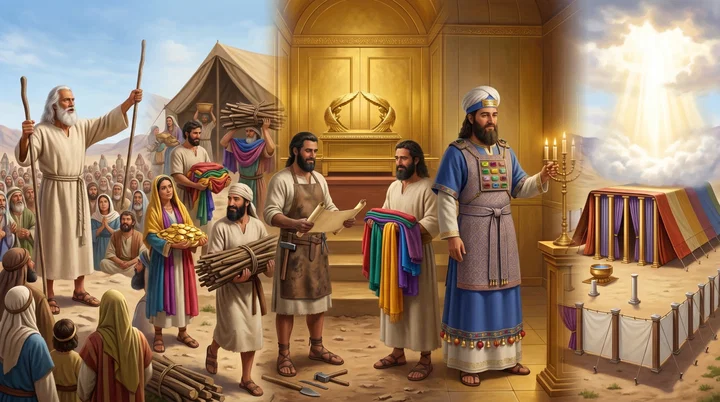
Cross-references
- Exodus 25:2
Speak unto the children of Israel, that they bring me an offering: of every man that giveth it willingly with his heart ye shall take my offering.
God asks Israel for willing gifts to build the sanctuary.
- Exodus 35:21-29
And they came, every one whose heart stirred him up, and every one whom his spirit made willing, and they brought the LORD’s offering to the work of the tabernacle of the congregation, and for all his service, and for the holy garments.
The people willingly bring gifts and materials for the sanctuary’s construction.
- Exodus 25:8
And let them make me a sanctuary; that I may dwell among them.
The offerings supplied the sanctuary God commanded Israel to make for his dwelling among them.
- Exodus 35:5
Take ye from among you an offering unto the LORD: whosoever is of a willing heart, let him bring it, an offering of the LORD; gold, and silver, and brass,
Moses invites willing gifts for the tabernacle’s construction.
- Exodus 25:9
According to all that I shew thee, after the pattern of the tabernacle, and the pattern of all the instruments thereof, even so shall ye make it.
The sanctuary is built according to the pattern God shows Moses.
- Exodus 12:35-36
And the children of Israel did according to the word of Moses; and they borrowed of the Egyptians jewels of silver, and jewels of gold, and raiment:
The Israelites received the Egyptians’ goods that they later offered for the work.
- Exodus 31:1-6
And the LORD spake unto Moses, saying,
God equips skilled workers with wisdom for the commanded work.
- Exodus 35:23-28
And every man, with whom was found blue, and purple, and scarlet, and fine linen, and goats’ hair, and red skins of rams, and badgers’ skins, brought them.
The people freely brought materials and skilled work for the tabernacle.
- Exodus 40:34
Then a cloud covered the tent of the congregation, and the glory of the LORD filled the tabernacle.
The completed tabernacle is filled with the Lord’s glory.
- Exodus 35:22
And they came, both men and women, as many as were willing hearted, and brought bracelets, and earrings, and rings, and tablets, all jewels of gold: and every man that offered offered an offering of gold unto the LORD.
Willing-hearted people bring gold and jewelry for the tabernacle work.
- Exodus 35:27-28
And the rulers brought onyx stones, and stones to be set, for the ephod, and for the breastplate;
Rulers supplied stones, oil, and incense for the tabernacle.
- Leviticus 22:18-19
Speak unto Aaron, and to his sons, and unto all the children of Israel, and say unto them, Whatsoever he be of the house of Israel, or of the strangers in Israel, that will offer his oblation for all his vows, and for all his freewill offerings, which they will offer unto the LORD for a burnt offering;
defines the willing gift Exodus 36:5 reports
- 1 Chronicles 22:14
Now, behold, in my trouble I have prepared for the house of the LORD an hundred thousand talents of gold, and a thousand thousand talents of silver; and of brass and iron without weight; for it is in abundance: timber also and stone have I prepared; and thou mayest add thereto.
Shows the scale of gifts prepared for temple construction.
- Acts 7:44
Our fathers had the tabernacle of witness in the wilderness, as he had appointed, speaking unto Moses, that he should make it according to the fashion that he had seen.
confirms pattern for building
- Acts 4:34-35
Neither was there any among them that lacked: for as many as were possessors of lands or houses sold them, and brought the prices of the things that were sold,
Believers bring proceeds from sold property for distribution among the community.
- Hebrews 8:5
Who serve unto the example and shadow of heavenly things, as Moses was admonished of God when he was about to make the tabernacle: for, See, saith he, that thou make all things according to the pattern shewed to thee in the mount.
The earthly sanctuary and its service are a shadow of heavenly things.
- 1 Chronicles 29:9-14
Then the people rejoiced, for that they offered willingly, because with perfect heart they offered willingly to the LORD: and David the king also rejoiced with great joy.
The people give willingly for the temple, acknowledging that all things come from God.
- Exodus 26
Moreover thou shalt make the tabernacle with ten curtains of fine twined linen, and blue, and purple, and scarlet: with cherubims of cunning work shalt thou make them.
Details the tabernacle’s construction.
Commentary
Each commentary is drawn from primary sources: the writings of Ellen G. White and Adventist pioneers and periodicals. Each commentary is separate. Its own words are not a quotation; follow the references to read the source passages.
Ellen G. White
16 sources
The people freely brought willing offerings every morning for building the wilderness tabernacle, until the gifts exceeded what was needed for every part of the commanded work and the workers reported to Moses that much more than enough had been brought.RH Apr 22, 19026T 468.1–2ST Sep 11, 1884 Because what had been brought could not all be used, Moses proclaimed that enough had been received and commanded the people to stop bringing gifts.ST Aug 5, 18751SP 269.3ST Sep 11, 1884 The means were raised simply by inviting every willing heart to give, with no compulsion and no resort to feasting, amusement, or entertainment to obtain them.ST Sep 11, 1884RH Oct 13, 1874PP 529.1 This devotion and cheerful liberality was recorded as an example for God's people afterward, teaching that offerings for a house where God meets with His people must be willing, earnest, of the very best, and sufficient to complete the work well without leaving it in debt.SG4 6.1–7.11SP 270.1ST Mar 4, 1903Ms 100, 1899, par. 16–18 Such generous-hearted service was pleasing to God, who signified His acceptance when the completed tabernacle was covered by the cloud and filled with His glory, and He rewards all who freely return to Him what He has given.RH Apr 22, 1902ST Mar 4, 1903
Wilderness Tabernacle Offering
The verse belongs to the building of the wilderness tabernacle or sanctuary for the work the Lord commanded to make, according to the pattern shown to Moses on the mountain.Ms 97, 1899, par. 3–4Ms 109, 1899, par. 1–4 The skill, wisdom, and ability employed in that work came from God to be used for His glory, and its construction demanded exactness, skill, wisdom, and perfection, a standard that applies to every work done in God's service.Ms 97, 1899, par. 3–4Ms 109, 1899, par. 1–4
Every willing-hearted man and woman whose heart was stirred brought the Lord's offering as free offerings every morning.RH Apr 22, 1902ST Sep 11, 1884 They brought gold, silver, brass, choice fabrics and spun work, valuable wood, precious stones, spices, oil, and ornamental materials, taking ornaments and jewelry from their persons into the treasury to beautify and enrich it, at a cost of more than a million dollars.RH Apr 22, 1902ST Sep 11, 1884 This was just after leaving Egypt, when freedom was new and return to slavery was still near, when means were scanty and their own tents were small, yet they did not ask to enlarge their own dwellings first but put God's house first according to the design God gave.ST Sep 11, 1884 They needed no urging, but gave gifts in abundance with cheerful, willing labor, each person anxious to have a part in the house being erected for God.RH Apr 22, 1902ST Sep 11, 1884
The willing offerings freely and generously given exceeded what was needed, proving sufficient for every part of the commanded work.RH Apr 22, 19026T 468.1–2ST Aug 5, 18755T 268.1–2 The workers examined the gifts and found there was more than enough, and reported to Moses that the people were bringing much more than enough.RH Apr 22, 19021SP 269.35T 268.1–2 Because all that had been brought could not be used, Moses proclaimed that enough had been brought and commanded the people to stop bringing gifts and to stop the work of bringing.ST Aug 5, 18751SP 269.3ST Sep 11, 1884RH Oct 13, 1874LC1 175.3 He simply accepted gifts from every man who gave willingly from his heart, and those free-will offerings came in so great abundance that they had given abundantly, more than could be used.RH Oct 13, 1874PP 529.1
This generous-hearted, willing service was pleasing to God.RH Apr 22, 1902 He signified His acceptance of it when the completed tabernacle was covered by the cloud and filled with His glory.RH Apr 22, 1902
Pattern for Willing Generosity
The means for the work were raised by simply inviting the people to bring an offering from every willing heart, with no compulsion and no need for urging.ST Sep 11, 1884RH Oct 13, 1874PP 529.1 No grand feast was made, no invitation was given to scenes of gaiety, dancing and general amusement, and no lottery or anything of profane order was instituted to obtain them.RH Oct 13, 1874PP 529.1 The free-will offerings came in so great abundance that there was more than could be used, and Moses proclaimed that enough had been brought and they must cease their presents.ST Sep 11, 1884RH Oct 13, 1874PP 529.1
The devotion, energy, liberality and cheerfulness shown in bringing the free-will offerings was recorded in sacred history for the benefit of God's people who would live afterward.1SP 270.1ST Mar 4, 1903 It stands as an example for all who truly love the worship of God, especially for those living near the close of time.1SP 270.1ST Mar 4, 1903 The same free, willing, anxious readiness to give means and hearty cooperation is found now wherever people are assured that a work is to be done and God calls for their help, and they too need no urging.6T 468.1–2ST Sep 11, 1884 They give freely and generously until there is more than enough for the commanded work, and they may share in the blessing of giving freely to support a school and its missionary work.6T 468.1–21MR 337.2–338.2
Offerings for a house where God may meet with His people must be willing, earnest, and of the very best, not bestowed grudgingly, stingily, or stinted to cost the least.SG4 6.1–7.1ST Mar 4, 1903 They are to be freely given in amount sufficient to accomplish the work well, so that the workmen can say, Bring no more offerings.SG4 6.1–7.1ST Mar 4, 1903Ms 100, 1899, par. 16–18 A building prepared expressly for divine service is to be arranged with care, made comfortable, neat and convenient, and dedicated to God, and a house built for God must never be left in debt, for He would thereby be dishonored.SG4 6.1–7.1ST Mar 4, 1903 Even a small offering is wholly acceptable to the Lord, who can make it go a long way.Ms 100, 1899, par. 16–18
Those who prize the blessing of God's sacred presence will manifest zeal and liberality in preparing such a house, with interest as much greater than that shown in preparing dwellings for themselves as heavenly blessings are valued above earthly comforts.1SP 270.1ST Mar 4, 1903 Those who value sacred privileges by such works will have prosperity and spiritual strength according to their works, blessed in proportion to their estimate of sacred things, while God will not cause His blessing to rest on those who have little appreciation of divine things.ST Mar 4, 1903 God knows every heart and will reward all who freely return to Him what He has given when He requires it, but those who withhold what belongs to God and rob Him will be afflicted in their families and decreased in possessions according to their disposition to rob Him.ST Mar 4, 1903
Sources
Pioneers and periodicals
53 sources
The verse records that Israel brought far more material than was needed for building the tabernacle, so much that the supply was sufficient and too much and had to be restrained.ST Oct 29, 1894RH Jun 23, 1910 Every willing-hearted man and woman whose heart was stirred brought freely every morning without urging, and the workmen left their tasks to report the surplus to Moses, who then proclaimed that no more offerings be made.RH Apr 22, 1902ST Mar 21, 1911RH Jun 23, 1910ST Aug 23, 1883RH Nov 19, 1903 That liberality was true sacrifice, for a homeless people journeying to a promised land gave a large part of their principal wealth received from Egypt, not merely increase, rather than enlarging their own small dwellings first.ST Sep 11, 1884ST Oct 18, 1877ST Dec 20, 1883RH Dec 20, 1870ST Aug 23, 1883 God required only such willing devotion from the heart, and He showed His pleasure in it when His glory filled the completed dwelling-place.RH Apr 22, 1902ST Mar 21, 1911ST Jun 24, 1880ST Jan 31, 1911 The same willing and prompt free-will giving beyond tithes is the appointed means for His work, to be gathered beforehand without borrowing, compulsion, feasting or lottery, and when His people are thus consecrated they count giving a privilege that brings material and spiritual prosperity and hastens His kingdom.ST Jan 21, 1889RH Apr 7, 1903RH Feb 9, 1905RH Jul 30, 1901RH Mar 16, 1911
Setting in Exodus
Exodus 36:5 belongs to Exodus 35-40, which records Israel carrying out the instructions for the sanctuary given in Exodus 25-30 and Exodus 25-31, building the ark with all its furniture and equipment just as directed after God instructed Moses in the mount.ST Feb 17, 1890ST Jan 27, 1909ST Dec 10, 1896 It stands in the account of building and setting up the sanctuary with the details of that work, showing those directions explicitly carried out in Exodus 35-39 in preparation for the dedication of the sanctuary and its filling with God's glory at the end of Exodus 40.ST Dec 10, 1896ST Oct 25, 1905ST Feb 13, 1912 Those who held the directions to be those given in Exodus 29-34 taught the same explicit carrying out and preparation for dedication.ST Feb 13, 1912
The sanctuary is a sacred or holy place made so God might dwell among Israel, where His glory remained and their worship centered, and it is the Bible sanctuary.ST Feb 17, 1890RH Apr 30, 1857 It belongs to the worship portion of Exodus, chapters 25 to 50, which sets forth Israel's established form of worship as part of how the people delivered from bitter bondage in Egypt in the going out that gives the book its name became a nation with thorough organization, efficient leadership under Moses as chosen leader, a complete code of laws, and an established worship.RH Jan 20, 1916 It is the dwelling place God commanded the people to make so He could dwell among them, connected with offerings given willingly from the heart.ST Jul 8, 1930
The construction was not left to human fancy as to size or manner, but was built by explicit instruction after a shown pattern by men endowed with wisdom to carry it out, made from the materials and according to the directions God had given Moses.ST Feb 17, 1890ST Jun 26, 1907 Exodus 36 describes that construction, including the tent roof erected over the gold-overlaid acacia building with its coverings of goat's hair, red ram-skins, and seal skins.ST Feb 17, 1890 The full description of the sanctuary and its furnishings is found in Exodus 25 through the end of Exodus.ST Mar 10, 1898
That structure had sides and one end of closely joined upright boards set in silver sockets in the ground and held by outside bars through rings, a roof of curtains reaching to the ground on both sides, and an east end closed by hangings of fine-twined linen for entrance.ST Mar 10, 1898 A curtain divided the whole into two apartments with twice as much space in the first, outer apartment as in the other.ST Mar 10, 1898 Its inner walls were overlaid with fine gold representing the reflected light of God's glory in the New Jerusalem, and its ceiling of finest pure linen was wrought with many angels in needlework representing the angels of heaven waiting on Jehovah's bidding.ST Mar 10, 1898
The building and inauguration of the sanctuary and its services in Exodus 36-40 came after Israel's idolatry, punishment, intercession, and the second writing of the commandments, and God's glory manifested in that completed work showed His acceptance of the people's repentance.ST Jan 31, 1911 It came after Moses returned from the mountain with reflected glory blazing from his brow so brightly that the terror-stricken people fled, bowed afar, and dared not look toward him until he put a veil upon his face. When with reverence and chastened fear they then heard the words Jehovah bade him speak about the work God commanded, a thousand thousand willing hands poured rich, gorgeous offerings at his feet as a fitting tribute to the King of kings, the obedient yet weak response of a guilty people spared from deserved vengeance when their mediator's prayer was heard and their deadly fear was changed to hope.
The sanctuary built by the willing offerings of the people was the dwelling-place of God among Israel in the wilderness and through the time of the judges, Samuel, Saul, and David, until Solomon built the temple after the same pattern and the glory of the Lord filled it as God's dwelling-place among Israel.ST Jun 4, 1885 The complete description of this worldly sanctuary given in Exodus 25-31 and 35-40 is summed up in Hebrews 9:1-5.ST Jun 4, 1885 The offerings supplied the materials for building the sanctuary God commanded, a teaching structure meant to illustrate the plan of salvation, whose service pointed forward to Christ and His work of forgiveness.ST Jun 26, 1907 When the ark was built with all its furniture and equipment just as God directed and the building was completed and dedicated, wonderful blessing and glory came down upon the congregation and the building, with the sanctuary filled with God's glory.ST Jan 27, 1909ST Feb 13, 1912
Abundant Willing Offering
The verse reports that the people brought much more than enough materials for the service of the work the Lord commanded to make for the tabernacle, so that the supply exceeded what was needed and was sufficient and too much.ST Oct 29, 1894RH Jun 23, 1910ST Jan 9, 1907ST Jun 19, 1907 Their liberality in giving offerings for God's work is shown in that the sanctuary was built from gifts freely supplied by the people in an amount greater than the work required.ST Jun 19, 1907ST Dec 24, 1894
Every willing-hearted man and woman whose heart was stirred brought the Lord's offering every morning while the building went on.RH Apr 22, 1902 Gold, silver, brass, choice fabrics, blue, purple, scarlet, fine linen, goats' hair, skins, valuable acacia wood, precious stones, cut and uncut jewels, spices, oil and spun work were brought promptly, willingly and freely without grudge or stint or objection from treasured things.RH Apr 22, 1902ST Jun 10, 1908 Old and young, men, women and children kept bringing while the building went on, with bracelets, earrings, rings, tablets and jewels of gold, wise-hearted women spinning and bringing blue, purple, scarlet and fine linen, and rulers bringing onyx and setting stones, oil and incense, until those in charge decided that enough and even more than could be used had been brought.ST Mar 21, 1911ST Jun 24, 1880ST Jun 10, 1908 They were able to give in such varied, affluent and continuing measure because they had come out of Egypt with great substance as promised to Abraham.ST Jun 10, 1908
Only what was offered willingly with the heart was to be taken.ST Oct 18, 1877ST Dec 20, 1883RH Dec 20, 1870 The giving was willing, cheerful, devoted, energetic and liberal, done with a stirred and earnest heart without urging and from hearts moved to give.ST Sep 11, 1884ST Aug 23, 1883ST Jan 7, 1886 Gifts came in abundance with cheerful, willing labor, each person anxious to have a part in the house being erected for God.ST Sep 11, 1884
The skilled workmen and those overseeing the construction left their tasks to tell Moses about the surplus, reporting that the people bring much more than enough.ST Aug 23, 1883RH Mar 25, 1915ST Mar 25, 1889RH Jun 11, 1914 Israel's response to the command to build was so willing and generous that the gifts exceeded what the work required before the sanctuary was finished.RH May 26, 1904 Their willing offerings were so abundant that further offerings had to be stopped.RH Jun 11, 1914
Moses then proclaimed throughout the camp to let neither man nor woman make any more work for the offering of the sanctuary, so bringing had to be restrained and the people were restrained from bringing because all that had been brought could not be used.ST Aug 5, 1875ST Sep 17, 1874RH Jun 23, 1910RH Nov 19, 1903 The workers had more material than the work required, and they were told to stop bringing more.RH Jul 30, 1901RH Jun 11, 1914
Sacrifice Behind Generosity
The generosity came while Israel was homeless and journeying to a land known only by promise, with entire uncertainty over the length and hardships of the journey entered upon.ST Oct 18, 1877ST Dec 20, 1883RH Dec 20, 1870 There was no means of gain and no dependable income to depend on for the future, and as wanderers in the wilderness they had only modest possessions with little prospect of increasing them.ST Oct 18, 1877ST Dec 20, 1883RH Dec 20, 1870ST Aug 23, 1883 The gold, silver and other precious articles they gave were what had been received from the Egyptians on leaving Egypt, all that was had for lifelong cruel bondage.ST Oct 18, 1877ST Dec 20, 1883RH Dec 20, 1870 They had come out with great substance as promised to Abraham, yet those same articles would likely be greatly needed when taking possession of new homes in Canaan.ST Oct 18, 1877ST Dec 20, 1883RH Dec 20, 1870ST Jun 10, 1908
Though their means were scanty and their own tents were small, they did not ask to enlarge their own dwellings first.ST Sep 11, 1884 God's house had to be built first, just after Israel left Egypt when freedom was new and return to slavery was still near.ST Sep 11, 1884 They gave willingly and gladly a large part of their principal wealth, not merely a tenth of their increase, thereby returning to God what was already His.ST Sep 11, 1884ST Aug 23, 1883 They took ornaments and jewelry from their persons into the treasury to beautify and enrich it, gladly giving gold, silver, brass and ornamental materials at a cost of more than a million dollars.ST Sep 11, 1884
Each person was anxious to have a part in the house being erected for God, giving promptly, freely, without grudge or stint or objection from treasured things and with cheerful, willing labor needing no urging.ST Sep 11, 1884ST Jun 10, 1908 When with reverence and chastened fear they heard the words about the work God commanded, a thousand thousand willing hands poured rich, gorgeous offerings as a fitting tribute to the King of kings. It was the obedient yet weak response of a guilty people spared from deserved vengeance when their mediator's prayer was heard and deadly fear was changed to hope.
Divine Acceptance Required
The dwelling place for God among Israel was to be prepared only by willing devotion and sacrifice from the heart, with devotion to His work required first.ST Mar 21, 1911ST Jun 24, 1880 Only free-will offerings were accepted for His sanctuary, although great and expensive preparations with precious and costly materials were necessary.ST Mar 21, 1911ST Jun 24, 1880 Old and young, men, women, and children kept bringing their offerings while the building went on, until those in charge of the work decided that enough and even more than could be used had been brought.ST Mar 21, 1911ST Jun 24, 1880 The excess proved the fullness of that willing liberality.ST Jun 24, 1880 Then Moses proclaimed throughout the camp that neither man nor woman should make any more work for the offering of the sanctuary, so the people were restrained from bringing.ST Mar 21, 1911ST Jun 24, 1880
Every willing-hearted man and woman whose heart was stirred brought the Lord's offering of gold, silver, choice fabrics, valuable wood, precious stones, spices, oil, and spun work as free offerings every morning, until the supply exceeded what was needed for the commanded work and the fact was reported to Moses.RH Apr 22, 1902 This generous-hearted, willing service was pleasing to God.RH Apr 22, 1902 He signified His acceptance of it when the completed tabernacle was covered by the cloud and filled with His glory.RH Apr 22, 1902 That building and inauguration of the sanctuary and its services came after Israel's idolatry, punishment, intercession, and the second writing of the commandments, and God's glory manifested in that completed work showed His acceptance of the people's repentance.ST Jan 31, 1911
Israel's response to the call for sanctuary materials was willing and overflowing generosity, with the people bringing free offerings from hearts moved to give until there was far more than needed to do the work the Lord commanded.ST Jan 7, 1886 That same willing and cheerful spirit in giving is what God loves and accepts in the present time.ST Jan 7, 1886 Their generous giving is presented as an example of willing service.
Principles for Financing Work
The gifts brought for the tabernacle were free-will offerings given willingly from an earnest, stirred heart to meet the needs of the Lord's cause beyond tithes and first-fruits.RH Apr 7, 1903 Such willingness grew so great that much more than enough was brought for the commanded work, so that the material was sufficient and too much and bringing had to be restrained.RH Apr 7, 1903 That willing and prompt giving stands as the example for supporting God's work and His ministers.RH Jul 30, 1901
Means for God's work are to be secured without borrowing, by first inviting all the people to contribute.RH Feb 9, 1905 Building is to be made conditional on raising the necessary funds before the work is begun, and is to proceed only with means already in hand.RH Feb 9, 1905RH Dec 30, 1915 Borrowing first and then asking people willingly to pay off a debt is not the way, and this course is to avoid debt in the future.RH Feb 9, 1905RH Dec 30, 1915
The successful plan used no compulsion to obtain means.ST Jan 21, 1889RH Oct 13, 1874 It made no grand feast, invited the people to no scenes of gaiety, dancing and general amusement, and instituted no lotteries or anything profane or of profane order.ST Jan 21, 1889RH Oct 13, 1874 By God's command the invitation was simply to bring offerings and to accept gifts of every man who gave willingly from his heart.ST Jan 21, 1889RH Oct 13, 1874 Those free-will offerings came in so great abundance that proclamation was made that it was enough and presents must cease, because abundantly more than could be used had been given.ST Jan 21, 1889RH Oct 13, 1874
When the Lord by providence commands His people to arise and build, He is willing to supply the means to do the work, as He did for the wilderness tabernacle.RH Dec 30, 1915 The first step in obeying the command to build is to go to the people and solicit funds for the work, believing that the same Spirit which leads to build will open hearts to provide the means for the building.RH Dec 30, 1915 Generous giving to God's work is response to the Lord's prompting, and at that point the needed resources can become sufficient, with more than enough material for the commanded work so that the people are told to stop giving.RH Sep 3, 1901
God's people are to give Him their best time, strength, treasure and service.RH Jun 21, 1870 His cause is never to go begging, but every need is to be supplied on the first call with more than is asked so the work is fully provided for.RH Jun 21, 1870 When the stuff is sufficient for all the work to make it and too much, bringing is restrained by the call to let neither man nor woman make any more work for the offering of the sanctuary.RH Nov 19, 1903 The surplus can then be turned toward other needed work, and donors may direct generosity to another area of service, as in funding the distribution of religious books until those responsible can say there is more than enough for that part of the work.RH Nov 19, 1903RH Apr 7, 1868
Present Application and Blessing
The energy, devotion and liberality with which free-will offerings were brought, much more than enough for the service, stands recorded as an example for all who truly love the worship of God, more especially for those living near the close of time.ST Jun 24, 1880ST Mar 4, 1903RH Mar 16, 1911 When God's people are consecrated and willingly serve with Him they give of material things abundantly, and such giving is a privilege rather than a stern duty.RH Mar 16, 1911 The same more-than-enough giving is repeated now in supplying funds to advance His cause, with an overflow beyond the amount called for.RH Feb 14, 1907 Such willingness to give is evidence of being in the day of the Lord's power and hastens His kingdom and His coming in glory, and every God-sanctioned call for funds to push the message to every part of the world should be increasingly successful.RH Feb 14, 1907
When God stirs His people with willing hearts to finish His commanded work they bring more than is needed so that further bringing must be stopped. This willingness proves the day of God's power has come and reveals the move of headquarters to Washington as the beginning of the end and the closing of God's great work in the earth. The upper chamber is thereby being erected for the soon-expected outpouring of the latter rain, when the golden morning is near. The word is soon to be fulfilled in Washington in freeing the Memorial church from debt and building other institutions free from debt by transferring future contributions to a denominational sanitarium and training school, the surplus being turned toward other needed work when the stuff is sufficient for all the work and too much.RH Nov 19, 1903
The hope is that willing hearts will give and pledge for the Washington work until there is more than enough, and that people will likewise give generously toward building a meeting-house in Atlanta.RH Aug 22, 1907RH Jul 21, 1904 The contributions of the Ohio Conference are compared with this abundant giving for the tabernacle.RH Aug 29, 1907 Giving for distribution of religious books should continue until those responsible can say there is more than enough for that part of the work, and then donors may direct generosity to another area of service.RH Apr 7, 1868 When the Lord by providence commands His people to arise and build, as at Paradise Valley Sanitarium, He is willing to supply the means as He did for the tabernacle in the wilderness, and the first step in obeying is to go to the people and solicit funds believing the same Spirit which leads to build will open hearts to provide them, making the building conditional on raising necessary funds before beginning in order to avoid debt in the future.RH Dec 30, 1915
In Chile the verse means willing and overflowing giving for God's cause, with people telling one by one what valuables they had at home and taking off jewelry they still wore to be gathered, sold and put in the treasury.RH Jun 30, 1904 Such surrender of kept treasures when God's cause needs them is evidence of the working of the Spirit of God.RH Jun 30, 1904 If God's people prize the blessing of His sacred presence they will manifest zeal and liberality in preparing a house where He may meet with them, with interest as much greater than that shown in preparing dwellings for themselves as heavenly blessings are of more value than earthly comforts.ST Sep 11, 1884ST Jun 24, 1880ST Mar 4, 1903 God's house had to be built first according to the design He gave, and though means were scanty and their own tents were small they did not ask to enlarge their own dwellings first.ST Sep 11, 1884
The same free, willing, anxious readiness to give means and hearty cooperation for advancement of the work exists now wherever people are assured a work is to be done and God calls for help, and they too need no urging, each person anxious to have a part in the house erected for God, taking ornaments and jewelry from their persons into the treasury to beautify and enrich it and gladly giving gold, silver, brass and ornamental materials at a cost of more than a million dollars until proclamation had to be made that enough had been brought and giving and work must stop because all brought could not be used.ST Sep 11, 1884 It rebukes expending means freely for comfortable houses for themselves or barns for cattle while bestowing offerings for a place to receive the presence of the high and holy One grudgingly and studying to make the house of worship cost the least, for such works show how sacred privileges are valued.ST Jun 24, 1880ST Mar 4, 1903 A building prepared expressly for divine service is to be arranged with care, made comfortable, neat and convenient, dedicated to God that He may abide there and make it sacred by His holy presence, with an amount freely given sufficient to accomplish the work so workmen can say bring no more offerings.ST Mar 4, 1903 A house built for God must never be left in debt, for He would thereby be dishonored.ST Mar 4, 1903
Such willing liberality blesses the cause and brings great joy of heart with material as well as spiritual prosperity.RH Apr 7, 1903 Prosperity and spiritual strength will be according to works, and those who manifest earnestness to bring acceptable offerings of the very best, as Israel did, will be blessed in proportion to their estimate of the value of sacred things.ST Jun 24, 1880ST Mar 4, 1903 God knows every heart and will reward all who freely return to Him what He has given when He requires it.ST Mar 4, 1903 Unwilling and stinted offerings are not accepted, God will not cause His blessing to rest upon those who have so little appreciation of divine things, and those who withhold what belongs to God and rob Him will be afflicted in families and decreased in possessions according to their disposition to rob Him.ST Jun 24, 1880ST Mar 4, 1903 The willing and abundant giving for building and furnishing God's sanctuary means the believer should examine how his own soul temple is adorned for God's indwelling.RH Jan 27, 1916
Sources