Exodus 38:6
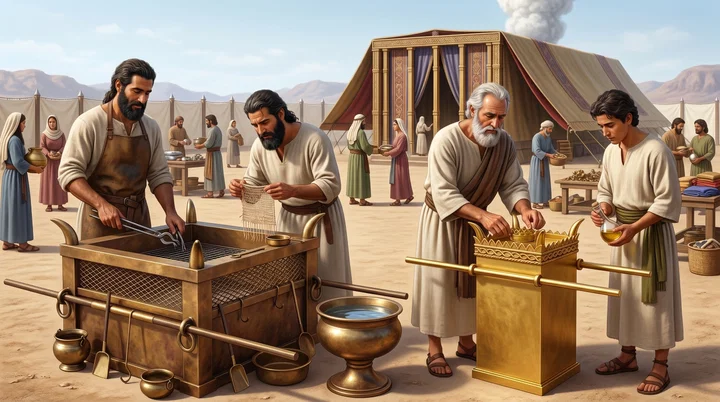
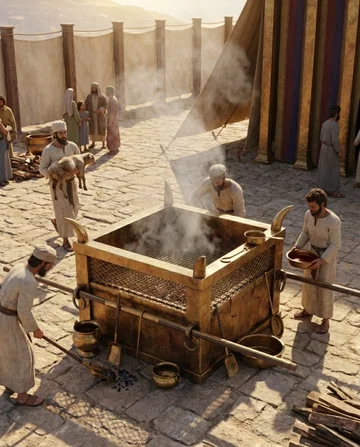
And he made the staves of shittim wood, and overlaid them with brass.
Translations
American King James Version, King James Version, KJV Cambridge Paragraph Bible
And he made the staves of shittim wood, and overlaid them with brass.
And he made the staffs of shittim wood, and overlaid them with brass.
Revised Version, American Standard Version
And he made the staves of acacia wood, and overlaid them with brass.
and he maketh the staves of shittim wood, and overlayeth them with brass;
And he made the staves of acacia-wood, and overlaid them with copper.
And he made the staves of acacia wood,—and overlaid them with bronze.
Berean Standard Bible, Majority Standard Bible
And he made the poles of acacia wood and overlaid them with bronze.
He made the poles of acacia wood, and overlaid them with bronze.
The rods he made of hard wood plated with brass.
And he made the barres of Shittim wood, and couered them with brasse.
Douay-Rheims (Challoner revision)
And he made the bars of setim wood, and overlaid them with plates of brass:
Pictures
Cross-references
- Hebrews 8:5
Who serve unto the example and shadow of heavenly things, as Moses was admonished of God when he was about to make the tabernacle: for, See, saith he, that thou make all things according to the pattern shewed to thee in the mount.
The earthly sanctuary was built according to the pattern shown on the mount.
- Exodus 25:3-5
And this is the offering which ye shall take of them; gold, and silver, and brass,
The listed brass and shittim wood are materials used in the sanctuary’s construction.
- Exodus 25:13
And thou shalt make staves of shittim wood, and overlay them with gold.
Gives the earlier instructions for making the ark’s poles.
- Exodus 27:6
And thou shalt make staves for the altar, staves of shittim wood, and overlay them with brass.
Both describe the altar’s wooden staves overlaid with brass.
- Exodus 26:19-23
And thou shalt make forty sockets of silver under the twenty boards; two sockets under one board for his two tenons, and two sockets under another board for his two tenons.
same boards, sockets, and fastening
Commentary
Each commentary is drawn from primary sources: the writings of Ellen G. White and Adventist pioneers and periodicals. Each commentary is separate. Its own words are not a quotation; follow the references to read the source passages.
Pioneers and periodicals
8 sources
Exodus 38:6 is one construction detail in the minute account in Exodus 25-40 of the worldly, wilderness, portable sanctuary built by Israel at God's command in the days of Moses, exactly according to the pattern and explicit directions shown and given to Moses in the mount on Sinai.ST Oct 29, 1894ST Jun 19, 1907ST Jun 26, 1907 It belongs to the description of the worldly sanctuary constructed in the wilderness after Israel was brought out from Egypt and through the Red Sea.ST Jun 26, 1907 The building and setting up in Exodus 33-40 came immediately after the instruction about the sanctuary in Exodus 25-31, in order after the events of Exodus 19-32.ST Dec 10, 1896
The tabernacle it describes had two apartments separated by a veil, the holy place twenty cubits long, ten cubits wide, and ten cubits high, and the most holy place ten cubits in each dimension.ST Oct 29, 1894 Its sides and west end were made of acacia boards overlaid with gold set by tenons into silver sockets weighing a talent each and held at the top by bars through rings on the boards.ST Oct 29, 1894
The verse records that the staves were made of shittim wood and overlaid or covered with brass.RH Jan 6, 1853RH Mar 1, 1870 They are the staves of the altar of burnt offering, and the altar itself was brass-covered and used for offering sacrifices to God.RH Jan 6, 1853RH Mar 1, 1870 Those who held it otherwise understood the verse as recording part of the construction of the ark's equipment, made according to the directions given earlier.ST Jan 27, 1909
The sanctuary God instructed Israel to build was a movable dwelling-place so that He might dwell among His people.ST Oct 25, 1905ST Jun 26, 1907 It was the portable sanctuary built by Israel at God's command and the center of earthly worship, which centered on the holy of holies, where the law of God rested beneath the mercy seat.ST Jun 19, 1907 Its construction was part of the object lesson God gave Israel to teach the plan of salvation.
The verse is part of the laws and instructions given through Moses, including the ceremonial and sacrificial system whose types and offerings reveal the substance of the new dispensation, and it belongs among the laws that are to be remembered alongside the Ten Commandments. The worldly sanctuary answered every purpose for which it was constructed yet was always typical of and foreshadowed the true tabernacle which the Lord pitched and not man, serving unto the shadow of heavenly things as an object lesson pointing to the Lamb of God and His power to forgive sin, transform character and deliver.ST Jun 26, 1907 With the death of Christ and the rending of the veil it passed away entirely and forever.ST Jun 26, 1907
Sources