Exodus 9:6
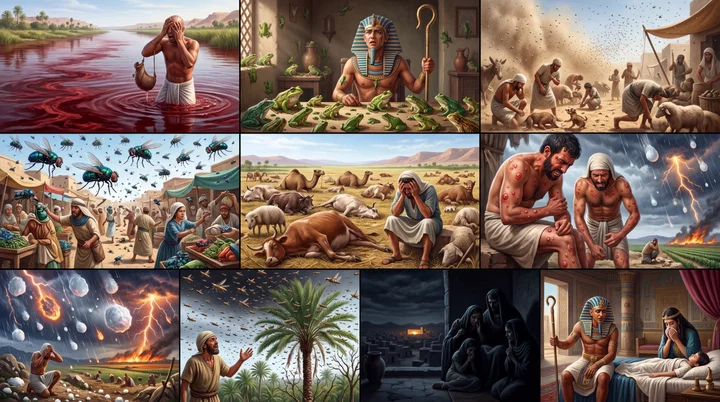
And the LORD did that thing on the morrow, and all the cattle of Egypt died: but of the cattle of the children of Israel died not one.
Translations
American King James Version, King James Version, Webster Bible, Revised Version
And the LORD did that thing on the morrow, and all the cattle of Egypt died: but of the cattle of the children of Israel died not one.
And the Lord did that thing on the morrow, and all the cattle of Egypt died: but of the cattle of the children of Israel died not one.
And Jehovah did that thing on the morrow; and all the cattle of Egypt died; but of the cattle of the children of Israel died not one.
And Jehovah doth this thing on the morrow, and all the cattle of Egypt die, and of the cattle of the sons of Israel not one hath died;
And Jehovah did this thing on the following day, and all the cattle of Egypt died; but of the cattle of the children of Israel died not one.
So Yahweh did this thing, on the morrow, and all the cattle of the Egyptians died,—but of the cattle of the sons of Israel, died not one.
Berean Standard Bible, Majority Standard Bible
And the next day the LORD did just that. All the livestock of the Egyptians died, but not one animal belonging to the Israelites died.
The LORD did that thing on the next day; and all the livestock of Egypt died, but of the livestock of the children of Israel, not one died.
And on the day after, the Lord did as he had said, causing the death of all the cattle of Egypt, but there was no loss of any of the cattle of Israel.
So the Lord did this thing on the morow, and all the cattel of Egypt dyed: but of the cattell of the children of Israel dyed not one.
Douay-Rheims (Challoner revision)
The Lord therefore did this thing the next day: and all the beasts of the Egyptians died, but of the beasts of the children of Israel there died not one.
Pictures
Cross-references
- Exodus 7:20
And Moses and Aaron did so, as the LORD commanded; and he lifted up the rod, and smote the waters that were in the river, in the sight of Pharaoh, and in the sight of his servants; and all the waters that were in the river were turned to blood.
Egypt’s waters turned to blood in a parallel plague.
- Exodus 12:29-30
And it came to pass, that at midnight the LORD smote all the firstborn in the land of Egypt, from the firstborn of Pharaoh that sat on his throne unto the firstborn of the captive that was in the dungeon; and all the firstborn of cattle.
Both describe a plague killing Egypt’s cattle or firstborn while sparing Israel.
- Exodus 9:19-21
Send therefore now, and gather thy cattle, and all that thou hast in the field; for upon every man and beast which shall be found in the field, and shall not be brought home, the hail shall come down upon them, and they shall die.
The warning about the hail distinguishes those who heed the Lord’s word from those who disregard it.
- Exodus 7:3-5
And I will harden Pharaoh’s heart, and multiply my signs and my wonders in the land of Egypt.
The plagues reveal God’s power to Egypt.
- 1 Samuel 4:7-8
And the Philistines were afraid, for they said, God is come into the camp. And they said, Woe unto us! for there hath not been such a thing heretofore.
Philistines remembered literal plagues
- Psalms 105
O give thanks unto the LORD; call upon his name: make known his deeds among the people.
recounts deliverance showing God's right to rule
- Exodus 9:23-25
And Moses stretched forth his rod toward heaven: and the LORD sent thunder and hail, and the fire ran along upon the ground; and the LORD rained hail upon the land of Egypt.
The hail plague follows the forewarned judgment at God’s command.
- Revelation 16
And I heard a great voice out of the temple saying to the seven angels, Go your ways, and pour out the vials of the wrath of God upon the earth.
The last plagues echo the plagues of Egypt.
- Exodus 9:27
And Pharaoh sent, and called for Moses and Aaron, and said unto them, I have sinned this time: the LORD is righteous, and I and my people are wicked.
Pharaoh confesses his wickedness under the plagues.
Commentary
Each commentary is drawn from primary sources: the writings of Ellen G. White and Adventist pioneers and periodicals. Each commentary is separate. Its own words are not a quotation; follow the references to read the source passages.
Ellen G. White
6 sources
God warned Pharaoh through Moses and Aaron to let His people go to serve Him, declaring that if he refused and still held them a plague would fall on the livestock and foretelling that Israel would be exempt from the evil.1SP 189.2ST Mar 18, 1880 The plague was murrain upon the cattle that were out in the field, brought on the morrow at the time announced beforehand.PP 267.11SP 217.1ST Mar 18, 1880 Its coming exactly as predicted, on the day foretold, showed it was not chance.1SP 217.1ST Mar 18, 1880 All the Egyptian cattle struck by it died, including beasts of burden such as oxen, sheep, horses, camels and donkeys.SG3 211.31SP 189.2PP 267.1ST Mar 18, 1880
Not one of the cattle of the children of Israel died or was even afflicted, marking a complete division between the cattle of Israel and the cattle of Egypt and God's protection of Israel.SG3 211.31SP 189.2PP 267.11SP 217.1ST Mar 18, 1880 That sparing of Israel's cattle while Egypt's were destroyed confirmed that the warning given through Moses had come true.SG3 211.3PP 267.1 Together with the other plagues it demonstrated to the Egyptians that the whole earth is under the command of the God of the Hebrews.1SP 217.1 The destruction was aimed at Egypt's worship of animals, striking sacred animals including sacred bulls, rams, heifers and goats, and by this act the Lord showed His supremacy and exposed the powerlessness of the animal idols.PP 267.1PP 758.3–760.1
Pharaoh tested the division by sending messengers to the homes of the Israelites to inquire.1SP 189.2ST Mar 18, 1880 They reported back that Israel had entirely escaped, that not one of their cattle had died.SG3 211.31SP 189.2ST Mar 18, 1880 Yet his heart was hardened and he remained obstinate in persistency, encouraged by the priests and magicians, and refused to let the people go.SG3 211.31SP 189.2ST Mar 18, 1880
Sources
Pioneers and periodicals
45 sources
The Lord fulfilled His warning on the next day by sending death upon the livestock of Egypt while not one animal belonging to Israel in Goshen died.ST Jan 25, 1910ST Jan 14, 1889ST Jan 28, 1889 It was the fifth plague, a murrain upon beasts in the field, forming with boils the pair of plagues that brought disease.ST Apr 13, 1904RH Oct 31, 1912ST Dec 4, 1901 The stroke fell upon the very cattle, sheep and beasts of burden the Egyptians valued and worshiped as gods, exposing their worthlessness and displaying Jehovah as all-powerful above them.RH Jan 6, 1903ST Jan 25, 1910ST Jan 20, 1909ST Jan 14, 1889RH Mar 11, 1915 The sharp distinction between Egypt and Israel displayed His merciful care and power to deliver His children while breaking the oppressor who denied them worship and rest.RH Jan 6, 1903RH Mar 25, 1909ST Jan 14, 1889ST Mar 7, 1906RH Nov 3, 1868 Though Pharaoh sent to verify that Israel had escaped untouched, he hardened his own stubborn heart and refused to release them until God at last left him hardened.ST Mar 18, 1880RH Jan 6, 1903ST Jan 28, 1889ST Jan 20, 1909RH Apr 1, 1862 As with all the plagues of Egypt, it stands as a literal pattern of the seven last plagues, showing that God will leave His people in the land through the time of trouble yet set them apart and keep them safe.RH Dec 23, 1851STST Jul 18, 1878
Words and Historical Setting
The Lord did the threatened thing on the morrow, sending the cattle plague on Egypt the next day so that all the cattle of Egypt died while not one animal belonging to Israel died.ST Jan 25, 1910ST Jan 14, 1889ST Jan 28, 1889ST Jan 30, 1912 Of the cattle of the children of Israel in the land of Goshen died not one, for Israel's animals there were entirely spared.ST Jan 25, 1910ST Jan 14, 1889RH Jan 6, 1903 This fulfilled the announced distinction between Egypt and Israel and displayed God's care for His people and His power in distinguishing them from the Egyptians.ST Jan 14, 1889ST Jan 30, 1912 The plague on cattle was what Moses and Aaron had threatened if Pharaoh refused to let the people go to hold a feast, and Pharaoh gave some thought to what was said about the cattle in Goshen.RH Jan 6, 1903
It belongs to the history part of Exodus, chapters 1 to 18, which tells the story of Israel's great deliverance from bitter bondage and oppression in Egypt.RH Jan 20, 1916 That deliverance shows how Israel went out from Egypt and became a nation with thorough organization, efficient leadership, a complete code of laws, and an established form of worship.RH Jan 20, 1916 This going out is what gives the book of Exodus its name, meaning going out.RH Jan 20, 1916 During that deliverance God sent plagues and storm, marking the departure from bondage with manifestations of divine power.ST Sep 28, 1904
Its background is Egypt three and one-half millenniums ago when it ruled the world as the greatest kingdom, acknowledged for might and power and skill and wisdom in statecraft.ST Nov 14, 1906 It deified its annually overflowing fertilizing river as a god and worshiped the sun that with the river produced food, with its kings titled as representatives of the sun-god upon the throne of men.ST Nov 14, 1906 It had supplied the descendants of Abraham from its granaries through Joseph the captive slave who taught Pharaoh to store grain in plenteous years and gave Egypt a land-law of easy rental and taxes.ST Nov 14, 1906 Under that system the country flourished and the people knew no oppression while his memory was honored among the rulers.ST Nov 14, 1906
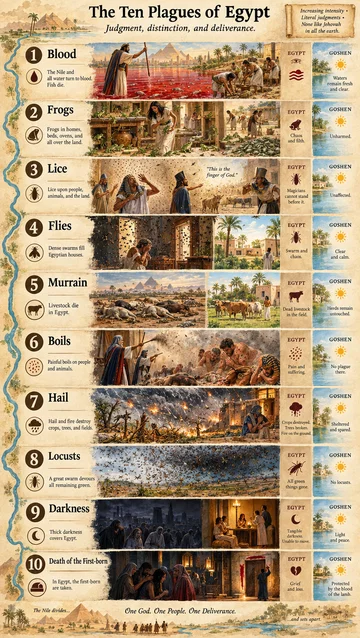
It is the fifth plague, a murrain on livestock that killed Egypt's cattle while Israel's cattle were spared.ST Apr 13, 1904RH Oct 31, 1912ST Dec 4, 1901 With boils it forms the third pair of plagues, both being diseases, with murrain affecting beasts and boils affecting people.ST Apr 13, 1904 Like the other first eight plagues it affects man in a material or physical way, unlike darkness and death which cause intense mental anguish.ST Apr 13, 1904 The loss struck especially hard because Egyptians held the affected animals in great reverence, and Israelite sacrifice of such an animal could endanger the people.RH Oct 31, 1912 One teaching calls it the sixth plague that killed Egypt's cattle while sparing the cattle of the Israelites.ST Jan 22, 1885
The murrain struck Egyptian livestock at the appointed time after Pharaoh was forewarned that the Hebrews would be exempted from the evil, coming as predicted on the morrow.ST Mar 18, 1880ST Nov 23, 1904 It struck cattle out in the field, afflicting cattle, horses, asses, camels, sheep, and beasts of burden across the land.ST Mar 18, 1880ST Nov 23, 1904ST Dec 4, 1901 The cattle, horses, and camels were both valuable property and sacred to the Egyptians, so their deaths were a blow to wealth and worship while Israel was distinguished by exemption.ST Nov 23, 1904 It was a deadly disease raging through flocks and herds, greatly resembling outbreaks of smallpox among sheep and pulmonary disease among cattle that rapidly thin herds, leave skeletons of thousands and thousands covering the ground, and kill thirty percent of horses and horned cattle across entire pastoral regions.ST Jun 17, 1875 The livestock disease later reported ravaging Turkey was said to resemble this biblical murrain described in Exodus 9:3-6.RH May 27, 1875
“All the cattle of Egypt” means all the cattle afflicted by the plague, since the plague was directed at cattle in the field and other cattle may not have been exposed.ST Jun 7, 1910 Israel's surviving cattle also provide a possible source from which Egyptians later obtained animals.ST Jun 7, 1910 By the time the hail was warned of, some Egyptian animals remained, and those who trusted the warning brought them indoors while those who did not believe left them in the fields.ST Nov 23, 1904
It stands as an example of God's public dealings with Israel in connection with His law and covenant, without explaining the cattle plague itself.ST Jun 12, 1879
Judgment Against Egyptian Gods
The miracles in Exodus 7 to 12 set God's religious system against Egypt's religious system, with miracles on both sides.RH Mar 11, 1915ST May 4, 1882 God's acts aimed to convince Pharaoh and the Egyptians to obey Him, while the magicians' acts served to deceive Pharaoh and harden him against the message.RH Mar 11, 1915ST May 4, 1882 The plagues came largely against Egyptian idolatry to show that Egypt's gods were worthless and that the Lord was above them.ST Jan 24, 1911ST Feb 4, 1913ST Jan 20, 1909 They demonstrated step by step, beginning in kindness, that those gods were powerless and utterly unworthy of trust.ST Feb 4, 1913ST Jan 20, 1909 The name LORD in capitals means Jehovah, whom Pharaoh rejected when he said he knew Him not.ST Jan 20, 1909
The cattle plague was not brought at first against human beings but against the gods the Egyptians worshiped, being connected with their worship to expose them.RH Jan 6, 1903ST Jan 25, 1910ST Jan 20, 1909 It struck Egypt's sacred animals and beasts of burden while not one animal belonging to Israel died, a distinction foretold beforehand.RH Jan 6, 1903ST Jan 25, 1910ST Jan 20, 1909 That sparing exposed the folly of worshiping animals as gods and showed the plague was directed against Egyptian cattle worship.RH Jan 6, 1903ST Jan 25, 1910 The demand behind it, Let My people go that they may serve Me, was reasonable, showing merciful deliverance to God's children and mercy even to Pharaoh and the Egyptians.ST Jan 20, 1909
The destruction fell on the sacred bull, ram, heifer, goat and many other sacred animals.ST Jan 14, 1889RH Mar 11, 1915ST Jan 22, 1885 The ox and cow symbolized Osiris and Isis, and the sheep symbolized Amon.ST Dec 4, 1901 Egyptians held the affected animals in great reverence, so that Israelite sacrifice of such an animal could endanger the people.RH Oct 31, 1912ST Dec 4, 1901 The plague afflicted cattle, horses, asses, camels and sheep across the land.RH Oct 31, 1912ST Dec 4, 1901 By this Jehovah displayed His supremacy over the animal idols.ST Jan 14, 1889ST Jan 22, 1885
That judgment was directed against the debasing system of brute worship.RH Mar 11, 1915ST Jan 22, 1885 It dismantled the brute idols and revealed the power of the living God in contrast to the impotence of dead brute deities.RH Mar 11, 1915ST Jan 22, 1885 It was an appropriate and merciful plague.ST Feb 4, 1913ST Nov 1, 1899 God's dealings were step by step, beginning in kindness.ST Feb 4, 1913
The Egyptians had no knowledge of the one all-powerful and all-wise God, believing instead in a multitude of gods each having his own field and function in nature, worshiped by king and peasant alike.ST Nov 1, 1899 The plague proved the one God of Israel to be all-embracing, all-efficient, all-powerful and all-wise.ST Nov 1, 1899 He was above the Egyptian gods wherein they dealt proudly.ST Nov 1, 1899 Through the ten plagues He humbled Egypt and brought its supposed gods to nothing, giving opportunity to know God personally.ST Nov 1, 1899ST Nov 27, 1901
Israel's Deliverance and Protection
The verse displays the wonderful deliverance of Israel from Egypt with a mighty hand, showing wisdom, love and power and the right and ability to rule, and laying waste the land until the power of the Egyptian oppressor was broken.RH Mar 25, 1909ST Mar 7, 1906 That oppression was not only physical bondage but denial of the right to worship the true Creator and keep His commandments, especially the Sabbath, for hindering the people from their works meant teaching them Sabbath rest.RH Mar 25, 1909 Because Pharaoh knew not the Lord, despised Him and His law as vain words, increased burdens and stubbornly refused to let the people go to hold a feast to God in the wilderness, direct miraculous judgments intervened, including the death of Egypt's cattle while Israel's were spared.RH Mar 25, 1909
A distinction between Egypt and Israel had been foretold, and on the morrow it was fulfilled when the threatened plague killed Egypt's cattle while not one belonging to Israel died, without loss.RH Jan 6, 1903ST Jan 14, 1889RH Nov 3, 1868ST Jan 30, 1912RH Apr 1, 1862 This keeping alive of Israel's livestock displayed care for His people, merciful deliverance to His children, and power in distinguishing them from the Egyptians and sparing them from the plagues that fell on Egypt.ST Jan 14, 1889RH Nov 3, 1868ST Jan 30, 1912ST Jan 20, 1909 Pharaoh sent messengers to Goshen and to the homes of the Israelites to verify the matter, and they found that Israel had entirely escaped.ST Mar 18, 1880RH Jan 6, 1903RH Apr 1, 1862
The deaths struck cattle, horses, asses, camels and beasts of burden across the land, and because those animals were both valuable property and sacred, the blow fell at once on wealth and worship.ST Nov 23, 1904 The murrain came upon the Egyptian cattle out in the field after forewarning that the Hebrews would be exempted from the evil, and it arrived as predicted while Israel's animals in Goshen remained unharmed.ST Mar 18, 1880ST Nov 23, 1904ST Nov 23, 1904 Israel thus escaped in Goshen by heeding the word of God.ST Nov 24, 1898
That going out belongs to the history of Exodus 1-18, the story of great deliverance from bitter bondage and oppression by which Israel became a nation with thorough organization, efficient leadership, a complete code of laws and an established worship, a going out that gives Exodus its name meaning going out.RH Jan 20, 1916 Yet hundreds of years of slavery had unfitted the redeemed people to comprehend the great salvation and the character required, so they were given a great multiple object-lesson of the plan of salvation in various forms and rites. Moses was therefore instructed to have the children of Israel bring free-will offerings to make a sanctuary that He might dwell among them.
Pharaoh's Investigation and Hardening
Moses and Aaron had warned that the cattle would be struck if Pharaoh refused to let the people go to hold a feast to God in the wilderness, and Pharaoh gave some thought to what had been said about the cattle in Goshen.RH Jan 6, 1903 When the blow fell on the morrow he sent messengers to Goshen and to the homes of the Israelites to check and verify whether Israel had suffered with the Egyptians.ST Mar 18, 1880RH Jan 6, 1903ST Nov 23, 1904RH Apr 1, 1862 They found that Israel had entirely escaped, with not one animal dead and the livestock in Goshen remaining unharmed, while all the exposed cattle of Egypt had died.ST Mar 18, 1880RH Jan 6, 1903ST Jan 28, 1889ST Nov 23, 1904RH Apr 1, 1862
When he was told of this distinction and learned that Israel's cattle were untouched, he still hardened his heart and refused to let the people go.RH Jan 6, 1903ST Jan 28, 1889ST Nov 23, 1904 He remained obstinate in persistency, encouraged by the priests and magicians.ST Mar 18, 1880 The judgment did not soften him but only made him want relief from the plagues, while he despised God and His law as vain words, increased the burdens, and stubbornly continued to withhold permission for the wilderness feast.RH Mar 25, 1909ST Dec 4, 1901
The hardening did not come first from God, for Pharaoh made his own heart hard and stubborn while God pleaded with him.ST Jan 20, 1909 Only after he utterly rejected every appeal did God withdraw His Spirit and leave his heart remaining hardened when there was no hope of saving him.ST Jan 20, 1909 In this way the discrimination of mercy shown to Israel and not to Egypt became the occasion for hardening through Pharaoh's own proud, jealous, rebellious heart, as sinners are often hardened when they see more mercy shown to others than to themselves, with no direct hardening power from God.RH Apr 1, 1862
Foreshadowing the Last Plagues
The plagues on Egypt were literal, real, historical, physical and tangible judgments that Egypt knew and that Philistia did not doubt.STST May 31, 1910 The death of all the cattle of Egypt while not one of the cattle of Israel died was a real physical affliction, a grievous murrain that struck livestock, and like the other plagues upon Egypt it supports the expectation that the judgments described in Revelation 16 are literal.ST May 31, 1910RH Mar 23, 1852 Like the other plagues it is a type, pattern and illustration of the seven last plagues in Revelation 16.RH Dec 23, 1851STRH Mar 23, 1852ST Oct 28, 1930 Those seven terrible plagues will sweep over the world just before the final deliverance of God's people at the close of probation, just as the ten plagues fell just before the deliverance of ancient Israel.RH Dec 23, 1851ST Oct 28, 1930 The going out of Egypt into Canaan is a type of the deliverance of God's people from the dark Egypt of earth.ST
It demonstrates the power of God's two witnesses to smite the earth with plagues as often as they will.ST Apr 13, 1904ST Apr 4, 1911RH Jan 14, 1862 The death of all the cattle of Egypt while none of the cattle of Israel died stands with the whole series of plagues on Egypt in Exodus 7-9, and with the same plagues to come again under the seven last plagues.ST Apr 13, 1904RH Jan 14, 1862 It forms the third pair of plagues with boils, both being diseases, with murrain affecting beasts and boils affecting people.ST Apr 13, 1904 Like the other first eight plagues it affects man in a material or physical way, unlike darkness and death which cause intense mental anguish.ST Apr 13, 1904 The great power was not in Moses himself but in the Word, the message God spoke through him, lying in the message borne and in how it is received or rejected.ST Apr 4, 1911
It means God leaves His people in the land through the plagues yet puts a difference between them and the wicked, destroying what belongs to Egypt while preserving what belongs to Israel untouched.ST Jul 18, 1878 So the end-time saints will likewise not be removed from the earth until after six of the seven last plagues are poured out, but must witness the fearful scenes of the time of trouble.ST Jul 18, 1878 They will be kept safe by the seal of the living God so that death falling all around them does not come near them.ST Jul 18, 1878
Doctrine and Obedient Response
The power broken by the death of all the cattle of Egypt was not physical bondage alone but denial of the right to worship the true Creator and keep His commandments, especially the Sabbath.RH Mar 25, 1909 Moses and Aaron hindering the people from their works meant teaching them to rest on the Sabbath.RH Mar 25, 1909 Because Pharaoh knew not the Lord, despised God and His law as vain words, increased the burdens, and stubbornly refused to let Israel go to hold a feast to God in the wilderness, God directly intervened with miraculous judgments.RH Mar 25, 1909 One of those terrible plagues was the death of the cattle of Egypt while the cattle of Israel were spared, and the judgments continued until the land was laid waste and deliverance came.RH Mar 25, 1909
The stroke shows terrible judgment sent upon Egyptian slaveholders because they refused to release Israel at once.RH Oct 1, 1861 Israel had been allowed to remain for a time in a servile condition as serfs, but even that modified form of slavery was not sanctioned.RH Oct 1, 1861 The displeasure against oppression led to bringing Israel out as an army of fugitive slaves and drowning their pursuers in the Red Sea.RH Oct 1, 1861
The demand behind the plague is reasonable, Let My people go that they may serve Me.ST Jan 20, 1909 The death of Egypt's cattle with not one of Israel's cattle dying shows merciful deliverance to His children and mercy to Pharaoh and the Egyptians.ST Jan 20, 1909 He would have left them in Egypt had they the privilege of serving Him there.ST Jan 20, 1909 Such wonderful deliverance from Egypt demonstrates wisdom, love, and power and ability and right to rule, and lays upon Israel the obligation to obey.ST Mar 7, 1906 Through the ten plagues God humbled Egypt and brought its supposed gods to nothing, giving opportunity to know God personally.ST Nov 27, 1901
Sources