Exodus 12:29
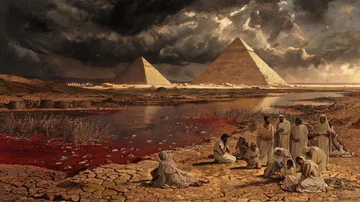
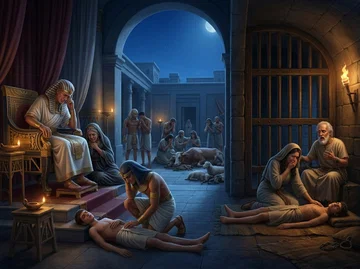
And it came to pass, that at midnight the LORD smote all the firstborn in the land of Egypt, from the firstborn of Pharaoh that sat on his throne unto the firstborn of the captive that was in the dungeon; and all the firstborn of cattle.
Translations
And it came to pass, that at midnight the LORD smote all the firstborn in the land of Egypt, from the firstborn of Pharaoh that sat on his throne to the firstborn of the captive that was in the dungeon; and all the firstborn of cattle.
And it came to pass, that at midnight the LORD smote all the firstborn in the land of Egypt, from the firstborn of Pharaoh that sat on his throne unto the firstborn of the captive that was in the dungeon; and all the firstborn of cattle.
And it came to pass, that at midnight the Lord smote all the firstborn in the land of Egypt, from the firstborn of Pharaoh that sat on his throne unto the firstborn of the captive that was in the dungeon; and all the firstborn of cattle.
And it came to pass, that at midnight the LORD smote all the first-born in the land of Egypt, from the first-born of Pharaoh that sat on his throne, to the first-born of the captive that was in the dungeon; and all the first-born of cattle.
And it came to pass at midnight, that the LORD smote all the firstborn in the land of Egypt, from the firstborn of Pharaoh that sat on his throne unto the firstborn of the captive that was in the dungeon; and all the firstborn of cattle.
And it came to pass at midnight, that Jehovah smote all the first-born in the land of Egypt, from the first-born of Pharaoh that sat on his throne unto the first-born of the captive that was in the dungeon; and all the first-born of cattle.
And it cometh to pass, at midnight, that Jehovah hath smitten every first-born in the land of Egypt, from the first-born of Pharaoh who is sitting on his throne, unto the first-born of the captive who [is] in the prison-house, and every first-born of beasts.
And it came to pass that at midnight Jehovah smote all the firstborn in the land of Egypt, from the firstborn of Pharaoh who sat on his throne to the firstborn of the captive that was in the dungeon, and all the firstborn of cattle.
And it came to pass, at midnight, that Yahweh, smote every firstborn in the land of Egypt, from the firstborn of Pharaoh who sat upon his throne, unto the firstborn of the captive who was in the pit of his prison,—and every firstborn of beasts.
Berean Standard Bible, Majority Standard Bible
Now at midnight the LORD struck down every firstborn male in the land of Egypt, from the firstborn of Pharaoh, who sat on his throne, to the firstborn of the prisoner in the dungeon, as well as all the firstborn among the livestock.
At midnight, the LORD struck all the firstborn in the land of Egypt, from the firstborn of Pharaoh who sat on his throne to the firstborn of the captive who was in the dungeon, and all the firstborn of livestock.
And in the middle of the night the Lord sent death on every first male child in the land of Egypt, from the child of Pharaoh on his seat of power to the child of the prisoner in the prison; and the first births of all the cattle.
Nowe at midnight, the Lord smote all the first borne in the lande of Egypt, from the first borne of Pharaoh that sate on his throne, vnto the first borne of the captiue that was in prison, and all the first borne of beastes.
Douay-Rheims (Challoner revision)
And it came to pass at midnight, the Lord slew every firstborn in the land of Egypt, from the firstborn of Pharao, who sat on his throne, unto the firstborn of the captive woman that was in the prison, and all the firstborn of cattle.
Pictures
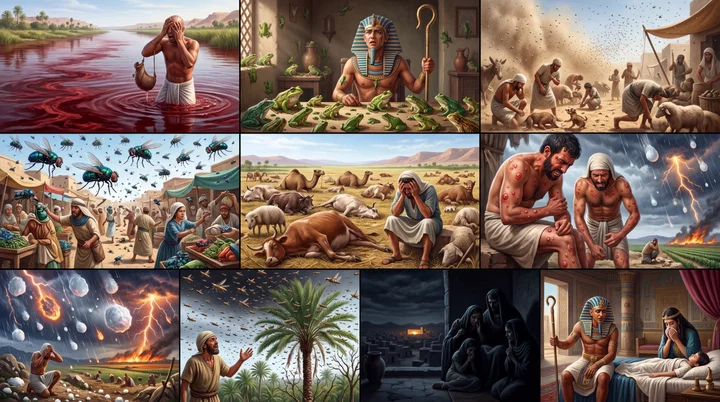
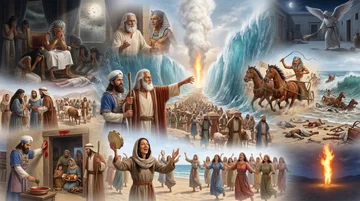
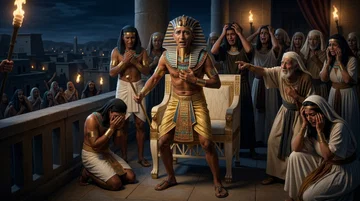
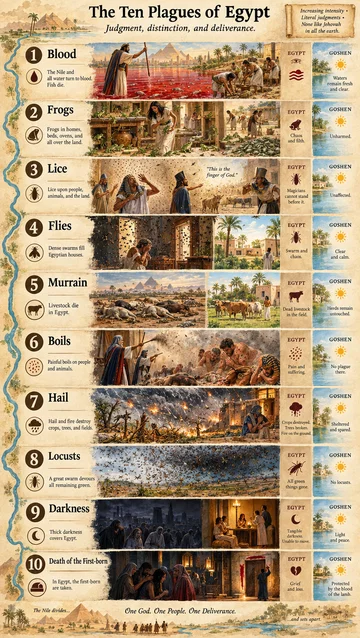
Cross-references 20 of 64
- Exodus 12:13
And the blood shall be to you for a token upon the houses where ye are: and when I see the blood, I will pass over you, and the plague shall not be upon you to destroy you, when I smite the land of Egypt.
The blood marked Israelite homes for protection when God struck Egypt’s firstborn.
- Exodus 12:7
And they shall take of the blood, and strike it on the two side posts and on the upper door post of the houses, wherein they shall eat it.
blood sprinkled on doorposts kept destroyer out
- 1 Corinthians 5:7
Purge out therefore the old leaven, that ye may be a new lump, as ye are unleavened. For even Christ our passover is sacrificed for us:
Christ is identified as the Passover sacrifice foreshadowed in Exodus.
- Exodus 12:22-23
And ye shall take a bunch of hyssop, and dip it in the blood that is in the bason, and strike the lintel and the two side posts with the blood that is in the bason; and none of you shall go out at the door of his house until the morning.
sprinkled blood linked to death angel story
- Exodus 4:23
And I say unto thee, Let my son go, that he may serve me: and if thou refuse to let him go, behold, I will slay thy son, even thy firstborn.
The threatened death of Egypt’s firstborn is fulfilled at midnight.
- Exodus 12:12
For I will pass through the land of Egypt this night, and will smite all the firstborn in the land of Egypt, both man and beast; and against all the gods of Egypt I will execute judgment: I am the LORD.
The firstborn plague carries out God’s judgment against Egypt and its gods.
- Exodus 12:42
It is a night to be much observed unto the LORD for bringing them out from the land of Egypt: this is that night of the LORD to be observed of all the children of Israel in their generations.
The night of Israel’s deliverance from Egypt is to be observed to the Lord.
- Exodus 12:11
And thus shall ye eat it; with your loins girded, your shoes on your feet, and your staff in your hand; and ye shall eat it in haste: it is the LORD’s passover.
The Israelites ate the Passover dressed and equipped for a hurried departure.
- Revelation 16
And I heard a great voice out of the temple saying to the seven angels, Go your ways, and pour out the vials of the wrath of God upon the earth.
Egypt’s plagues foreshadow the seven last plagues.
- Exodus 5:2
And Pharaoh said, Who is the LORD, that I should obey his voice to let Israel go? I know not the LORD, neither will I let Israel go.
Pharaoh’s boast of refusing the LORD is humbled by the death of Egypt’s firstborn.
- Exodus 11:4-5
And Moses said, Thus saith the LORD, About midnight will I go out into the midst of Egypt:
Moses announces the coming judgment on Egypt’s firstborn.
- Exodus 12:14
And this day shall be unto you for a memorial; and ye shall keep it a feast to the LORD throughout your generations; ye shall keep it a feast by an ordinance for ever.
The Passover memorializes Israel’s deliverance from Egypt.
- Numbers 3:13
Because all the firstborn are mine; for on the day that I smote all the firstborn in the land of Egypt I hallowed unto me all the firstborn in Israel, both man and beast: mine shall they be: I am the LORD.
Israel’s firstborn were set apart to God after Egypt’s firstborn perished.
- Exodus 12:23
For the LORD will pass through to smite the Egyptians; and when he seeth the blood upon the lintel, and on the two side posts, the LORD will pass over the door, and will not suffer the destroyer to come in unto your houses to smite you.
The Lord passes over blood-marked doors during the judgment.
- Deuteronomy 16:1-6
Observe the month of Abib, and keep the passover unto the LORD thy God: for in the month of Abib the LORD thy God brought thee forth out of Egypt by night.
Gives instructions for the Passover offering and its observance.
- Genesis 15:14
And also that nation, whom they shall serve, will I judge: and afterward shall they come out with great substance.
God judges Egypt and brings Israel out with great substance.
- Exodus 13:3-10
And Moses said unto the people, Remember this day, in which ye came out from Egypt, out of the house of bondage; for by strength of hand the LORD brought you out from this place: there shall no leavened bread be eaten.
Israel is commanded to remember the deliverance from Egypt through the feast of unleavened bread.
- Exodus 12:33
And the Egyptians were urgent upon the people, that they might send them out of the land in haste; for they said, We be all dead men.
After the firstborn died, the Egyptians feared death and urged Israel to leave.
- Exodus 13:2
Sanctify unto me all the firstborn, whatsoever openeth the womb among the children of Israel, both of man and of beast: it is mine.
The firstborn were set apart as the Lord’s after their deliverance from Egypt.
- Numbers 33:3
And they departed from Rameses in the first month, on the fifteenth day of the first month; on the morrow after the passover the children of Israel went out with an high hand in the sight of all the Egyptians.
Both date Israel’s departure from Egypt to the fifteenth day, after the Passover.
Commentary
Each commentary is drawn from primary sources: the writings of Ellen G. White and Adventist pioneers and periodicals. Each commentary is separate. Its own words are not a quotation; follow the references to read the source passages.
Ellen G. White
42 sources
At midnight the Lord struck every firstborn in Egypt, from Pharaoh on his throne to the captive in the dungeon and the lowliest servant, with all the firstborn of cattle, bringing a great cry with not a house without one dead.SG3 228.21SP 204.1ST Apr 1, 1880PP 279.4 The stroke was the last and most dreadful plague, carried out by the destroyer passing from house to house, by a single angel acting under command, and by God himself with a high hand.SG3 228.21SP 204.1ST Apr 1, 18804SP 441.1 That same night Israel was preserved behind the blood sprinkled on the doorposts, with families gathered inside eating the lamb in haste, so the destroyer did not enter and not one behind the blood was slain.SG3 228.2ST Apr 1, 188017MR 350.2–351.1DA 76.1PP 279.3 It was the foretold final judgment that broke Pharaoh's pride and forced Egypt to release Israel from cruel servitude after persistent refusal to obey, reaping the harvest of his own obstinacy.4T 20.5–21.1COL 84.4SG3 245.18MR 2.3–3.3Ms 126, 1901, par. 20–22 The night is kept as the yearly Passover memorial of passing over Israel when Egypt was smitten, and its sheltering blood foreshadows how the blood of Christ shelters believers from the wrath to come, to be repeated at midnight in the final deliverance of the saints.ED 42.2DA 76.1SG3 223.1LC1 29.2–30.1SG1 205.1
The Midnight Stroke
At midnight the LORD smote every firstborn throughout the land of Egypt, from the firstborn of Pharaoh that sat upon his throne to the firstborn of the captive that was in the dungeon, from the heir of the king to the eldest-born of the lowliest servant, and all the firstborn of cattle were slain also by the mandate of the Lord.SG3 228.21SP 204.1ST Apr 1, 1880PP 279.44T 20.5–21.1 The avenging angel entered every Egyptian house and put to death the firstborn of every family, so that none escaped.SG3 228.21SP 204.1ST Apr 1, 18804T 20.5–21.11SP 219.1 At that same time Israel had followed the directions given for deliverance and stood ready for the journey, with the token of blood upon the doorposts, waiting for the rebellious king and his great men to bid them go.SG3 228.2ST Apr 1, 18804T 20.5–21.1
The stroke was the work of the destroyer, the death-dealing angel of death passing from house to house among the Egyptians.SG3 228.2ST Apr 1, 1880DA 51.2–3 It was carried out by a single angel acting under God's command, bidden on his mission of death to slay the firstborn of man and beast.ST Apr 1, 18804SP 441.1GC88 614.1–2DA 51.2–3GC 613.2–614.2 It was God Himself working for His people with signs and wonders and with a high hand.4SP 441.1GC88 614.1–2DA 51.2–3
It was the last of the plagues, coming closer and more severe and more dreadful than any before it, falling in one dreadful night.SG3 246.11SP 219.1DA 51.2–3 There was a great cry throughout all Egypt, with wailing and mourning and grief throughout the land, for there was not a house where there was not one dead.1SP 204.1ST Apr 1, 1880PP 279.4SG3 246.11SP 219.1
Israel's Protection and Deliverance
That same night Israel had followed the directions given for deliverance and stood ready for the journey, with families gathered inside their dwellings, the paschal lamb slain and its flesh roasted with fire, unleavened bread and bitter herbs prepared, blood sprinkled by the father upon the doorpost, and the lamb eaten in haste and silence while the people prayed and watched in awe.SG3 228.2ST Apr 1, 1880PP 279.3DA 51.2–3 Every house was marked with the blood of the slain lamb so that when the angel came he might pass over the homes of the Israelites and they might be spared.ST Apr 1, 1880PP 279.3DA 51.2–3 The token of blood was upon their doorposts as they waited for the rebellious king and his great men to bid them go.SG3 228.2ST Apr 1, 1880
The blood on the doorways marked them as God's people, and those homes were passed over so the destroyer did not enter there.ST Apr 1, 188017MR 350.2–351.1DA 76.1SG3 223.1PP 279.3 Not one Hebrew behind the blood was slain, for the sign of blood on their doors was the sign of a Saviour's protection.COS 103.1–4SG3 223.1PP 279.3 On the last night of bondage, when no token of deliverance appeared for Egypt, the Hebrews were gathered in their dwellings under the blood while God struck down Egypt's firstborn from Pharaoh's household to the captive's household as well as the firstborn of the cattle.DA 76.1COS 103.1–4
Even in Israel the heart of every firstborn from the strong man down to the little child throbbed with dread that night, as fathers and mothers clasped their loved firstborn thinking of the fearful stroke to fall.PP 279.3 Israel's firstborn had been exposed to the same doom as Egypt's, and their preservation through the Passover sacrifice was an act of mercy.PP 279.3PP 275 No dwelling of Israel was visited by the death-dealing angel.PP 279.3PP 275
Escape required faith shown by works, in putting the blood where it could be seen, separating from the Egyptians, and gathering families and children into their own houses.Ms 54, 1903, par. 3–717MR 350.2–351.1SG3 223.1 No judgment fell on the children of parents who were faithful in gathering their little ones with them into the house and remaining there until the destroying angel had passed.Ms 54, 1903, par. 3–717MR 350.2–351.18MR 2.3–3.3 Any Israelite found in an Egyptian house would fall by the destroying angel, and anyone who failed to obey could not be spared but suffered with the Egyptians.17MR 350.2–351.1SG3 223.1
The signs and wonders led many Egyptians to acknowledge the God of the Hebrews as the only true God and their own gods as without knowledge and without power to save or destroy.SG3 223.1 That fearful night they entreated shelter in Israelite houses, chose the God of Israel as their God, and were welcomed in.SG3 223.1 They left Egypt with Israel to worship Him.SG3 223.1
The blow broke Pharaoh's pride and answered his boast that he did not know the Lord and would not let Israel go.ST Apr 1, 1880SG3 246.11SP 219.1 That same night he in haste with his counselors and rulers went to Goshen, bowed before Moses and Aaron, and called them before him to order Israel out without delay to serve the Lord with flocks and herds and all they possessed as they had requested.ST Apr 1, 1880PP 279.44T 20.5–21.1SG3 246.11SP 219.1 He entreated Moses to bless him in hope that a blessing from God's servant would protect him from further effects of the plague.ST Apr 1, 1880SG3 246.1 His officers and people implored Israel to be gone quickly, saying they were all dead men and fearing that unless God's curse was removed the land would become a vast burial-ground.1SP 204.1ST Apr 1, 18804T 20.5–21.1SG3 246.1 The deaths brought a great cry throughout Egypt, and Israel then marched out in glad triumph as an independent nation.1SP 204.1PP 279.44T 20.5–21.1
After this death of the firstborn Pharaoh consented to let the Israelites start on their journey, for the final judgment compelled him to release Israel after repeated plagues and hardened resistance, bringing mourning from the king to the lowliest people.1T 264.4–266.1RH Apr 23, 1901Lt 102, 1906, par. 11–13 But hardness of heart came upon him and he soon pursued them with an army.RH Apr 23, 1901Lt 102, 1906, par. 11–13 The Egyptians still refused to acknowledge the judgment as God's work and pursued Israel after letting them go.1T 264.4–266.1
Judgment After Defiance
The midnight stroke was foretold as the final judgment that at last forced Egypt to release Israel from long and cruel servitude and accomplished the deliverance from captivity.4T 20.5–21.1SG3 245.11T 264.4–266.1DA 51.2–31SP 205.2 It came after repeated plagues and Pharaoh's persistent refusal to obey the command to let Israel go, more dreadful than all the judgments before it, bringing wailing throughout Egypt and mourning from the king to the lowliest people.SG3 245.18MR 2.3–3.31T 264.4–266.1DA 51.2–31SP 205.2 The avenging angel entered every Egyptian house and put to death the firstborn of every family, with none escaping from the heir of Pharaoh to the eldest-born of the captive in the dungeon, and the firstborn of cattle were also slain by the mandate of the Lord, while the angel of death passed over the homes of the children of Israel and did not enter there.4T 20.5–21.1SG3 245.18MR 2.3–3.3 Horror-stricken, Pharaoh called Moses and Aaron in the night and ordered them to leave Egypt without delay with all they possessed, fearing with his people that unless God's curse was removed the land would become a vast burial-ground, and Israel then marched out in glad triumph, though the Egyptians still refused to acknowledge the judgment as God's work and pursued Israel with an army after letting them start the journey.4T 20.5–21.11T 264.4–266.11SP 205.2
Pharaoh's questioning grew after he rejected the first miracle, his heart grew harder through unbelief and resistance to light, and he was brought at last to face the death of the firstborn in his own house.5T 274.2COL 84.4Ms 126, 1901, par. 20–22Lt 31, 1891, par. 4–6 He looked upon his devastated land and the dead firstborn in his own house and in every family of his kingdom, upon his own son and kindred and the pride of every household throughout the vast realm of Egypt laid low at midnight.5T 274.2COL 84.4Ms 126, 1901, par. 20–22Lt 31, 1891, par. 4–6 He had sowed infidelity when he refused the evidence of the first miracle and went on from one step to another of unbelief until he would not be convinced by any working of God's power.COL 84.4Ms 126, 1901, par. 20–22 When strong and convincing light making known the great I AM came he was compelled to yield, but as soon as the pressure was removed his unbelief returned and counteracted the light.Ms 126, 1901, par. 20–22
He reaped the harvest of his own sowing, for God destroys no man and did not compel him to disbelieve.COL 84.4Ms 126, 1901, par. 20–22Ms 56, 1898, par. 51–52 By rejecting God's first warning and stifling conscience and resisting light he sowed unbelief, obstinacy and infidelity, and God left the seed to germinate and bring forth fruit after its kind without new interference.COL 84.4Ms 126, 1901, par. 20–22Ms 56, 1898, par. 51–52 There was no more need for God by some new power to interfere with its growth than to interfere with the growth of a grain of corn; all that was required was that the seed be left to germinate and bring forth fruit after its kind, obstinacy reaping obstinacy.COL 84.4Ms 126, 1901, par. 20–22 His resistance continued through the devastation of the land and the death of the firstborn to his ruin when the sea closed over his army, proving that everyone who is destroyed has destroyed himself and that whatsoever a man sows he also reaps.COL 84.4Ms 126, 1901, par. 20–22Ms 56, 1898, par. 51–52
Israel had made great preparations that the Egyptians ridiculed, especially the token of blood upon their doorposts, but the stroke turned mocking into terror.ST Apr 1, 1880SG3 246.11SP 219.1 The judgment fell in one dreadful night, closer and more severe than any plague before it, striking every Egyptian household from the king upon his throne down to the lowliest servant and filling all Egypt with wailing.ST Apr 1, 1880SG3 246.11SP 219.1 God delayed this last and most dreadful scourge with three days of thick, oppressive darkness that stopped the busy activities of life to remove distractions and give the Egyptians time for reflection, repentance, and meditation.ST Mar 18, 1880 The delay gives new evidence of His compassion and unwillingness to destroy.ST Mar 18, 1880
The escalating plagues following repeated rejection of the evidence of God's power made clear whom God favored and who were His people.Ms 56, 1898, par. 51–52Lt 31, 1891, par. 4–6 In the death of the firstborn He gave Egypt for Israel.Ms 56, 1898, par. 51–52
Divine Power Revealed
The final plague made clear that Jehovah is the God who executes judgment on the earth.PP 758.3–760.1 In it He displayed mighty power to deliver His people from Egypt despite Pharaoh's opposition, so that they might keep the law given in Eden.8T 197.4–198.1 He brought them to Sinai to hear Him proclaim the ten commandments with His own voice, in awful grandeur revealing His majesty and authority as Ruler of the world and the sacredness and importance of obeying His law.8T 197.4–198.1
The stroke that brought mourning throughout the land was carried out by a single angel acting under God's command.4SP 441.1GC88 614.1–2GC 613.2–614.2 It illustrates the destructive power that holy angels exercise when God commands.4SP 441.1GC88 614.1–2GC 613.2–614.214MR 1.3–3.1 That same destructive power evil angels may exercise when He permits, so calamities that follow the withdrawal of divine protection occur under His permission, though Satan's power is at work in them.GC 613.2–614.214MR 1.3–3.1
The rescue when the destroying angel slew Egypt's firstborn was a powerful display of God's care for Israel's children.PP 292.1–3 He Himself slew the firstborn of all the families of Egypt with a high hand to accomplish their deliverance from captivity.Lt 24, 1896, par. 4–6RH Apr 7, 1903 Joined with feeding them with angels' food and covenanting to bring them into the promised land, it was one of His repeated manifestations of Himself meant to give them reason to trust Him.RH Apr 7, 1903 That great act should have reminded them of His power and care when later brought into lack and testing at Rephidim and into hardship, instead of rebelling and complaining that they had been brought out only to die.PP 292.1–3Lt 24, 1896, par. 4–6RH Apr 7, 1903
Memorial and Future Deliverance
That night of judgment when at midnight the death-dealing angel struck the firstborn of man and beast in Egypt became the feast of the Passover, kept as a lasting ordinance and yearly memorial of passing over the houses of Israel when the Egyptians were smitten.ED 42.2DA 76.1SG3 223.1LC1 29.2–30.1 It was the final judgment warned to Pharaoh on the last night of bondage, when no token of deliverance appeared for Egypt while the Hebrews were gathered in their dwellings under the blood of the slain lamb, and the blow moved the king to send word for Israel to rise up, leave his people and serve the Lord, so they went out as an independent nation.ED 42.2DA 76.1 Escape that night required faith shown by works in putting the blood where it could be seen and in separating to gather families and children into their own houses, for not one Hebrew behind the blood was slain but any Israelite found in an Egyptian house would fall.SG3 223.1 The memorial rehearses in solemn silence the night assembly, the men with girded loins, shoes on feet and staff in hand, the hasty meal, the lamb, the unleavened bread and the bitter herbs, the sprinkled blood and the grand march from the land of bondage, with parents telling children of their preservation.ED 42.2SG3 223.1ST Nov 2, 1915 Its retelling is of a nature to stir the imagination and impress the heart, and bound up with kindly human association to fix God's past dealings forever in the memory of children and youth.ST Nov 2, 1915 By its observance minds are turned from world-loving interests and cares and anxieties about temporal concerns to review His works, miracles, mercies and loving-kindness, that love and reverence for Him might increase and lead ever to look to Him and trust in Him in trial and not turn to other gods.LC1 29.2–30.1
The wrath that fell upon the Egyptians in the death of the firstborn foreshadows the wrath of God to come upon the impenitent and unbelieving world.LC1 29.2–30.1 From that coming wrath the blood of Christ shelters and cleanses the believing sinner from sin, as the blood marking the doorposts sheltered Israel.LC1 29.2–30.1 Yet none is benefited by God's provision for salvation unless by his own acts he manifests faith in it.LC1 29.2–30.1
Midnight is the hour God chose for delivering His people.SG1 205.1 That same midnight deliverance will be repeated in the final deliverance of the saints while the wicked are mocking around them.SG1 205.1 Then suddenly the sun appears shining in his strength and the moon stands still, with signs and wonders following in quick succession and everything turned out of its natural course, tokens the saints behold with solemn joy.SG1 205.1
Lesson for Families Today
At midnight the threatened judgment was fulfilled when every firstborn in the land of Egypt was struck, from the firstborn of Pharaoh on the throne to the firstborn of the captive in the dungeon, together with all the firstborn of cattle.Ms 54, 1903, par. 3–78MR 2.3–3.3Ms 28, 1895, par. 10–11 The homes of the Israelites were passed over, and no judgment fell on the children of parents who were faithful in gathering their little ones with them into the house and remaining there until the destroying angel had passed.Ms 54, 1903, par. 3–78MR 2.3–3.3 Before the terrible blow fell, the command required gathering the children into their own homes in obedience to the Lord's instructions, where the blood-marked doorposts signified protection.8MR 2.3–3.3ST Nov 24, 1914Ms 28, 1895, par. 10–11 God-fearing parents today are therefore to understand God's will for themselves and their children, keeping their children within the protective circle of the home and under sacred influences made possible through Christ's redeeming blood.Ms 54, 1903, par. 3–7ST Nov 24, 1914 Home teaching shapes them for life and protects them from influences that turn them from God, so their education is to be based on a scriptural foundation, because it is not safe now to send them to public schools.Ms 54, 1903, par. 3–7ST Nov 24, 1914Ms 28, 1895, par. 10–11
Sources
Pioneers and periodicals
114 sources
At midnight the Lord struck dead every firstborn in Egypt, from Pharaoh on the throne to the captive in the dungeon with all the firstborn of cattle, while Israel waited ready with blood on the doorposts and a great cry arose because no house was without its dead.ST Apr 1, 1880RH Apr 7, 1874ST Jan 21, 1889 Houses marked with covenant blood were passed over and spared through faith, while every household without the blood suffered sudden death, and if Israel had refused the blood they would have died the same death.ST May 28, 1894ST Nov 4, 1897ST Dec 14, 1904 The blood on lintel and sideposts pointed to Christ our Passover, the Lamb slain on the fourteenth day of the first month, whose freely shed blood causes the Lord to pass over transgression so His people are not cut off.ST Apr 13, 1904ST May 28, 1894 The stroke was righteous retribution because Egypt enslaved its benefactors and slew their children at birth, and since Israel was esteemed as God's son, even His firstborn, Pharaoh's refusal to release God's son brought the slaying of his own firstborn.RH Mar 11, 1915ST Jan 22, 1885RH Mar 11, 1915 As the literal plagues just before Israel's freedom came, so the ten plagues shadow the seven last plagues just before the saints' final deliverance, with God's people remaining on earth protected as Israel was through Egypt's plagues.STRH Dec 23, 1851ST Jul 18, 1878
Midnight Stroke Described
At midnight the Lord struck every firstborn in the land of Egypt, from the firstborn of Pharaoh who sat on the throne, even his eldest son, to the firstborn of the captive in the dungeon, together with all the firstborn of cattle.ST Apr 1, 1880RH Apr 7, 1874ST Jan 21, 1889ST May 28, 1894RH Jan 14, 1862 The judgment reached every level of Egyptian society and every household, so that Pharaoh and all his servants and all the Egyptians rose in the night and there was a great cry throughout all Egypt because there was not a house without one dead.ST Apr 1, 1880RH Apr 7, 1874ST Jan 21, 1889ST May 28, 1894RH Nov 15, 1853 While the stroke fell, the children of Israel stood ready for their journey with the token of blood on their doorposts, and that blood is what shielded them, for if they had refused the instruction about the blood they would have suffered the same death of the firstborn.ST Apr 1, 1880ST May 28, 1894 The Egyptians' mocking of Israel's preparations and of the blood was turned into terror, and Pharaoh's proud boast, Who is the Lord that I should obey his voice, was humbled when he was forced that same night to call for Moses and Aaron and order Israel out to serve the Lord with flocks and herds, hoping their blessing would protect him from further plague, while his officers and people implored Israel to go, saying, We be all dead men.ST Apr 1, 1880 This event explains the name Passover, that the Lord's angel passed over the Hebrews' houses, and the feast with its memorial commemorated their deliverance from Egyptian bondage.RH Jan 14, 1862RH Nov 15, 1853
The stroke was executed by the destroyer, the angel of death passing from house to house, commissioned as one of Jehovah's angels to pass through the land.ST Apr 1, 1880ST Mar 25, 1880 It was completed by the direct power of the Lord alone without any agency by Moses or Aaron, a real event and not an illusion or deception, forming the culmination of the signs in Egypt.ST Jul 3, 1879 Scripture does not name the angel, and he was not Lucifer. In the mid-watches of the night the angel of pestilence was sent to the dwellings of Egypt and breathed in the face of all the firstborn, so that in the morning the hope of every family from palace to cottage was a corpse and an agonizing wail rose from all the parents of the nation, manifesting that Jehovah executes judgment in the earth as a God not only of power but of judgment, to be feared by evildoers.ST Mar 25, 1880ST Jan 22, 1885ST Jul 24, 1893 The Egyptians were punished because they had chosen sin and stood with oppression, while Satan was responsible for the destruction by inducing them to sin.
The threatened judgment was carried out exactly at midnight.ST May 28, 1894 The angel of Jehovah slew the firstborn without any indication of his approach, so that the judgment fell suddenly and without warning.ST Jul 24, 1893ST Sep 6, 1899
The word for cattle denotes all kinds of animals, not the stricter word used only of sheep and goats and neat cattle excluding beasts of burden.ST Feb 13, 1893 Its mention here after the murrain in Exodus 9, which says that all the cattle of Egypt died, is explained because all may mean all the cattle afflicted by the murrain, especially those in the field, cattle outside the field may have survived, time also passed between the plagues, and the Egyptians may have obtained cattle from the Israelites whose cattle were spared, without claiming which explanation is certain.ST Jun 7, 1910 Pharaoh himself was not killed at that time, distinct from the pestilence that God said could have cut him and his people off earlier.
The Hebrew word for day can refer to a period that includes nighttime, since Israel's deliverance began at midnight yet that night belongs to the same day, supporting the use of day for a full twenty-four-hour period rather than daylight alone.RH Dec 12, 1871
Historical Setting and Date
The stroke was the tenth, last and most severe plague, culminating the infliction of the plagues after the interviews with Pharaoh and the contest with his magicians and leading directly to the hurried departure.ST Apr 13, 1904ST May 14, 1894 It was the final terrible plague by which power was broken and merciful deliverance was brought, standing in close connection with the giving of the ordinance of the Passover, the claiming of the firstborn as the Lord's, and the gospel of forgiveness and mercy through blood on lintel and sideposts.ST Apr 13, 1904RH Mar 25, 1909ST Jan 20, 1909 At first the plagues struck not men but the gods Egypt worshiped, almost every plague being connected with their worship to show them unworthy of trust, and only after repeated opportunities were rejected and every appeal utterly refused was the last scourge sent.ST Jan 20, 1909ST May 14, 1894 It stands at the beginning of the chain of chief incidents leading through Exodus 12:29 to Exodus 15:21 up to the passage through the Red Sea.ST May 28, 1894
Israel was thrust out the same night, starting just after midnight in hurried flight, about three million people marching from Rameses to Succoth bearing what they could carry upon their shoulders and driving flocks and herds with them.ST Apr 1, 1880ST Jul 17, 1879 The fifteenth of Abib, the fifteenth day of the first month, was therefore a night of flight, burden-bearing, marching, driving animals and labor, followed by a great cry because there was not a house without one dead.ST Apr 1, 1880ST Jul 17, 1879RH Apr 18, 1854 The sudden expulsion explains the feast of unleavened bread, for they were thrust out at night with dough not yet leavened, which they baked after leaving Egypt.RH Apr 18, 1854 The plagues ended in March or April after a duration of several months.ST May 6, 1913
The deliverance came after the promised four hundred and thirty years, when at midnight the power of the oppressor was broken and departure made possible so that God might bring out His own people to give them His Sabbath, His law, and Himself in public covenant.RH Dec 17, 1861 It began the journey described in Exodus 12-20, from departure on the fifteenth day of the first month to coming to the wilderness of Sin on the fifteenth day of the second month, where God guarded the Sabbath by miracles in giving manna.RH Oct 21, 1851 There He reminded them of His Sabbath thirty days before they came to Sinai and thirty-two days before they heard the Ten Commandments, proving the Sabbath was known and kept before the law was given from Horeb and not first made there.RH Oct 21, 1851 The leaving of Egypt belongs to 1491 years before Christ.ST Jan 28, 1886
The call came about three and one-half millenniums ago when Egypt ruled the world as the greatest of all kingdoms, acknowledged for might and power and skill and wisdom in statecraft.ST Nov 14, 1906 Its river fertilized its land and its sun produced food, both of which it deified as gods, and its kings held their title as representatives of the sun-god upon the throne of men.ST Nov 14, 1906
The death of the king's son among the losses of that night is to be compared with Egyptian historical records.RH Apr 23, 1908 The judgment reached every level of society from Pharaoh's eldest son to the captive's, with the firstborn of cattle included, and is connected with the reported absence of any record of the Pharaoh's eldest son and the succession of his second son.RH Apr 7, 1874 The tomb prepared for the son of Meneptah II was left unfinished, matching that sudden death, and the inscriptions are said to indicate that Menephtah II's son died while still young in the last of the plagues.ST Dec 14, 1915RH Apr 23, 1908ST Aug 12, 1913 An Egyptian papyrus tells of a royal or noble youth's mysterious death followed by a royal order for a people to depart in haste, setting the historical background of the sudden death of the firstborn including a royal son.RH Mar 18, 1858 The deaths and the departure of six hundred thousand laborers weakened Egypt militarily, shook royal authority and encouraged rival claims to the throne, while checking the construction of great works, and this loss is presented as slight historical confirmation of the event.RH Apr 23, 1908
Justice Against Oppression
At midnight the final terrible plague broke Pharaoh's power and laid Egypt waste when the angel of death visited every Egyptian family and struck the firstborn.RH Mar 25, 1909 It came because Pharaoh refused to know the Lord and to let Israel go to hold a feast to Him in the wilderness.RH Mar 25, 1909 He despised God and His law, accused Moses and Aaron of hindering the people from their work by teaching them to rest on the Sabbath, and laid heavier work upon them instead, yielding only after this direct intervention and miraculous judgment.RH Mar 25, 1909
The judgment was righteous retribution in infinite justice because Egypt had long cruelly oppressed Israel and finally slain their offspring at birth.RH Mar 11, 1915ST Jan 22, 1885RH Mar 11, 1915 Though Egypt had been preserved by one of Israel's family, it enslaved its benefactors to whom it owed so much and then killed their children.RH Mar 11, 1915RH Mar 11, 1915RH Oct 31, 1912 Since Israel was esteemed as God's son, even His firstborn, Pharaoh's refusal to let God's son go to serve Him brought the slaying of his own firstborn.RH Oct 31, 1912RH Sep 3, 1908 In the mid-watches of the night the angel of pestilence was sent to the dwellings of Egypt and breathed in the face of all the firstborn, from the king's palace to the lowliest home and from Pharaoh's household to the captive's, with the firstborn of cattle also smitten, so that in the morning the hope of every family was a corpse and an agonizing wail rose from all the parents of the nation bringing grief and defeat without precedent.RH Mar 11, 1915ST Jan 22, 1885RH Oct 31, 1912RH Sep 3, 1908 This answered Egypt's injustice toward Israel including the killing of Israelite children, and showed both God's power and His justice, for though He bears long with those who abuse His people, retribution for injustice comes as divine punishment for effort to keep Israel in bondage and prevent departure.RH Mar 11, 1915RH Mar 11, 1915RH Oct 13, 1859
God dealt with Pharaoh step by step, first with kindness and then through mighty miracles showing that Egypt's gods were powerless.ST Feb 4, 1913 Pharaoh continued to harden his heart, reasoning away the miracles, suffering increasingly severe plagues through boils, hail, locusts and felt darkness, explaining them as natural causes with his mighty men and counsellors strengthening themselves against God.RH May 1, 1866RH Jan 7, 1915 He rejected the first miracle and every appeal with growing unbelief, agreeing to let Israel go under suffering only to harden his heart again when relief came, going in day by day before Moses and Aaron while hardening his heart more and more until there was no remedy.RH May 1, 1866RH Jan 7, 1915RH Jan 16, 1913 After Moses made his last visit to Pharaoh's court with his last warning rejected, the Spirit of God ceased its work for that king and left him alone, his heart remaining hardened with no hope of saving him and his host devoted to destruction with sudden destruction without remedy.ST Feb 4, 1913ST Jan 20, 1909RH Jan 16, 1913 It stands at the culmination of the plagues that Pharaoh resisted after rejecting repeated opportunities to yield, under which judgment Israel was released, with Pharaoh representing the wicked world and Israel in Egypt representing those persecuted by the world whom Christ remembers and delivers.ST May 14, 1894
The plagues at first were not brought against human beings but against the gods the Egyptians worshiped, almost every plague being connected with their worship to show those gods utterly unworthy of trust, revealing Israel's God alone as all-embracing, all-powerful and all-wise while their gods were nothing before Him.ST Jan 20, 1909ST Nov 1, 1899 The smiting of the firstborn was the eleventh and last miracle in Egypt, a judgment to manifest to all minds that Jehovah executes judgment in the earth.ST Jan 22, 1885ST Jan 14, 1889 The stroke taught the cruel taskmasters by means that entered their souls that the true God is a God not only of power but of judgment, to be feared by evildoers and reverenced by those that do well, humbling proud Egypt, forcing release, and displaying mercy by delivering His people from bondage.ST Jan 22, 1885ST Feb 26, 1885 God's punishment of the guilty thus protected His loyal subjects and expressed mercy toward them even while those who continued rebellion and oppression and refused to let Israel go were punished, giving personal knowledge of the King of kings beyond hearing of Abraham's God to prepare them for Sinai.ST Jan 20, 1909ST Feb 26, 1885
God delayed the last and most dreadful scourge with three days of thick oppressive darkness that stopped the busy activities of life.ST Mar 18, 1880 The delay removed distractions to give the Egyptians time for reflection, repentance and meditation, giving new evidence of His compassion and unwillingness to destroy.ST Mar 18, 1880
The Egyptians were punished because they had chosen sin and stood with oppression, while Satan was responsible for the destruction by inducing them to sin. The destroying angel was one of Jehovah's angels commissioned to pass through the land, whom Scripture does not name, and he was not Lucifer. The power working through Moses was not in Moses himself but in the Word, the message, that God spoke through him, which turned the rivers into blood and smote the land with plague culminating at midnight in the death of all the firstborn from Pharaoh to the captive with the firstborn of cattle.ST Apr 4, 1911 That same stroke was Christ striking Egypt's firstborn, leaving a corpse in every Egyptian home in one night to show Israel that their God was more powerful than false gods.RH Apr 9, 1901 The same law that was for Israel was for every other person of whatever race or nationality.ST Jun 13, 1906
Passover Blood and Deliverance
At midnight the threatened judgment was carried out exactly, when every firstborn in the land was struck from the firstborn of Pharaoh on the throne to the firstborn of the captive in the dungeon, along with all the firstborn of cattle, so that Pharaoh and all his servants and all the Egyptians rose in the night and there was a great cry because there was not a house without one dead.ST May 28, 1894ST Nov 4, 1897ST Dec 14, 1904 Houses marked with covenant blood were passed over and spared, for the blood on the houses shielded Israel from the stroke and represented faith in God, and those under its protection were saved while every household without blood on the doorposts suffered sudden death and deep grief.ST May 28, 1894ST Nov 4, 1897RH Apr 24, 1879RH Dec 10, 1867 If Israel had refused to follow the instruction about the blood they would have suffered the same death of the firstborn, for the Hebrew firstborn were spared because the blood was efficacious and the judgment fell while Israel kept the Passover under protection.ST May 28, 1894ST Dec 14, 1904RH Apr 24, 1879 The blood had to be applied to the door, and its presence was the sign that the destroying angel would pass over those homes, while judgments coming upon all Egypt from which Israelites were spared by the divine hand were enshrouded in darkness to Egyptians on the wrong side of the cloud though Israelites had light in their pathway.RH Apr 24, 1879RH Dec 10, 1867ST Jan 1, 1885 The night that brought sudden death and grief yet also offered salvation points to Jesus as our Passover, whose blood offers salvation, and refusing that salvation leaves no escape from just punishment.ST May 28, 1894ST Nov 4, 1897
The signs and wonders shown in Egypt had led quite a number of Egyptians to acknowledge that the gods they had worshiped were without knowledge and had no power to save or to destroy and that the God of the Hebrews was the only true God.ST Mar 25, 1880 These believing Egyptians with their families begged to be allowed into the houses of the Israelites that night to escape the slaying, and the Hebrews welcomed them into their homes.ST Mar 25, 1880 They pledged henceforth to choose the God of Israel as their God and to leave Egypt and go with the Israelites to worship the Lord.ST Mar 25, 1880 Conversely any Hebrew child found in an Egyptian habitation was destroyed, so deliverance required being gathered in the appointed place, and the Passover also signifies God's presence crossing the threshold into the homes of the faithful, bringing protection and consolation.RH Feb 7, 1907ST Sep 2, 1913
The event explains the name Passover, for the angel saw blood on the doorposts and passed over those houses instead of killing the oldest child, and the Lord's angel passed over the Hebrews' houses while smiting the Egyptians.ST May 22, 1907RH Jan 14, 1862RH Jan 7, 1862 The first Passover was kept at Rameses, Egypt, on the night Israel was led out of bondage, when the firstborn in every Egyptian family were slain from Pharaoh's household to the captive's along with the firstborn of the cattle.ST May 22, 1907RH Jan 14, 1862 The Passover was given as a memorial of this judgment and Israel's deliverance, when the destroying angel dark with wrath passed over Israel's dwellings on his fearful path, and the Passover observed again and again preserves this in strong remembrance, declaring that with mighty hand Jehovah brought Israel up from Egypt's land.RH Jan 7, 1862RH Nov 15, 1853ST Sep 13, 1877 The feast commemorated deliverance from Egyptian bondage and served as a shadow of something good to be done for the human race, with the feast of unleavened bread recalling the bread Israel ate when they fled Egypt.RH Jan 14, 1862ST Aug 13, 1885RH Jan 7, 1862 The Passover was eaten at night, and that night was to be observed in remembrance of the Lord bringing Israel out of Egypt, standing with the Feast of Unleavened Bread as one of two fit, plain yearly memorials of that work of Heaven, distinct from the weekly Sabbath rest, for a weekly rest cannot fitly keep in memory a day that could come round but once a year, and a rest cannot memorialize a rush.ST Aug 13, 1885ST Sep 13, 1877
The blood on the lintel and sideposts typified the blood of Christ our Passover, and the lamb eaten at the feast was a type of Christ, the true Passover.ST Apr 13, 1904ST May 28, 1894ST May 12, 1898 The slaying of the paschal lamb on the fourteenth day of the first month met its antitype in the death of the Lamb of God on that day, for that sacrifice was fulfilled in the death of Christ, the Lamb of God, on the same day.ST Aug 13, 1874RH Mar 31, 1874 The verse stands in close connection with the gospel of forgiveness and mercy in Israel's Passover experience, where the Lord passes by or passes over the transgressions of His people by virtue of that freely shed blood so they are not cut off, an experience the remnant living at the close of probation will share in thrilling measure.ST Apr 13, 1904 Approach and reconciliation depend on a victim's blood, and the deliverance from Egypt points to Christ, the Passover sacrifice, whose blood must be applied to secure entrance to the promised land.RH Apr 24, 1879 The last of the ten plagues, paired with darkness as the final two plagues bringing intense mental anguish through darkness and death, left every Egyptian home a house of mourning with the beloved firstborn a corpse after three days of darkness that could be felt when no one saw another as an apt symbol and shadow of death bringing gloomy foreboding, a day of just retribution to the Egyptians.ST Apr 13, 1904
Because the firstborn males of Israel were spared that night while Egypt mourned the loss of all its firstborn sons, God claimed every firstborn son in Israel for His special service, and this miraculous deliverance was remembered by consecrating Israel's firstborn to God.RH Dec 1, 1910ST Feb 10, 1914 The tenth plague, the death of the firstborn, culminates the infliction of the plagues on Egypt following the interviews with Pharaoh and the contest with his magicians, leads directly to the hurried departure of the Israelites, and stands in close connection with the giving of the ordinance for the Passover and with the claiming of the firstborn as the Lord's. The original design was not a special class or caste priesthood but a representative order to whom all the people would be related, though the tribe of Levi was afterward chosen to fill that place.RH Dec 1, 1910
The original Passover instituted for the Israelites in Egypt and then observed in the wilderness on the journey from Egypt to Palestine and for some time later is distinct from the later temple form, for later Scriptures added injunctions not found in the former and hardly possible to carry out in the wilderness.ST Feb 22, 1899 The original instructions did not enjoin the use of wine and did not require the closing song, the Hallel of Psalms 113-118, both of which belonged to later observance, and Exodus 12's directions do not mention wine.ST Feb 22, 1899ST Nov 22, 1883 Its rule is summed up in one statement that nothing leavened — fermented — was permitted there, and using anything leavened at that sacred memorial feast incurred the heaviest penalty known.ST Oct 8, 1894 The word eat implies both to eat and to drink, so drink was optional in the wording, but a seven-day festival made drink a necessity, with what that drink was to be left to circumstances and common sense except for the absolute that it could not be leavened.ST Oct 8, 1894 The chapter expressly gives the time of the Passover, and that fixed time contrasts with the Lord's Supper, whose frequency is not set by a fixed command, though Christ and His disciples kept the Passover festival as consistent Israelites when the Lord's Supper was instituted.ST Oct 8, 1894ST Apr 23, 1896
The Passover law directed roasting by each family on the evening after the fourteenth day of the first month, and its regular observance was intended for when Israel had entered the promised land.RH Jan 7, 1862 It was observed once in the wilderness, then omitted until Israel entered Canaan, and this timing is used to argue that the separate prohibition on kindling fires applied only during the wilderness years.RH Jan 7, 1862 Abib was identified as the first month of Israel's sacred year, though it was the seventh month of the civil year reckoned from creation, and the civil year held by the Jews began with the month Abib.ST Jun 18, 1912RH Nov 7, 1871 The passage distinguishes the Passover, which commemorated deliverance from Egypt, from the weekly Sabbath, and does not present the Exodus as a divine change of the Sabbath day.RH Nov 7, 1871
The warning of death for the firstborn applied to Heber and other firstborn prisoners as well as the king's people.ST Dec 7, 1904 Heber fears that they will perish, but the keeper, who believes the prophets and their God, has sworn to help them escape.ST Dec 7, 1904
Prophecy of Final Plagues
The going out of Egypt into Canaan is a type of the deliverance of God's people from the dark Egypt of this earth, and the literal plagues visited upon Egypt just before Israel went free shadow the seven last plagues of Revelation 16 poured out just before the final deliverance of the saints.STRH Dec 23, 1851ST Oct 28, 1930 The smiting of the firstborn came just prior to Israel going free, so the seven terrible plagues to sweep the world will be just as real and literal and will fall just before the saints are set free.RH Dec 23, 1851ST Oct 28, 1930RH Mar 23, 1852 God's people remain on earth during the judgments as Israel did during the Egyptian plagues, protected through them while calamities fall on the wicked, and during the destruction of the firstborn they were not harmed.ST Jul 18, 1878RH Mar 23, 1852 As Pharaoh and his host were deceived by the enchantments of the magicians who withstood Moses just before and in connection with the plagues of Egypt, so the worshippers of the beast will be deceived by the wonders and miracles of the two-horned beast prior to and in connection with the last plagues.RH Dec 23, 1851
God puts a distinguishing religious mark upon His servants by which they are exempted from the judgments falling on the wicked around them, patterned in the houses marked with the blood of the paschal lamb that were spared when the destroying angel passed at midnight to slay all the firstborn of Egypt.ST May 8, 1879 It is the pattern for the sealing of the servants of God before the four winds of war and trouble blow, where the seal of God in the fourth commandment marks Sabbathkeepers for protection, even the sealing of the 144,000.ST May 8, 1879 The midnight plague on the firstborn was the last sign before Israel went out from Egypt, and it types the true midnight cry of 1844.RH Aug 19, 1851 That night of midnight judgment and deliverance by which Israel could know God had led them and made them His people is the pattern for the last days, when God brings a people out of antitypical Egypt under the midnight cry and after they are freed from the churches gives them the Third Angel's Message containing the Ten Commandments as the way to the everlasting inheritance.RH Aug 19, 1851RH May 29, 1856
The angel of Jehovah slew the firstborn at midnight without any indication of his approach, and the judgment fell suddenly and without warning.ST Jul 24, 1893ST Sep 6, 1899 The same suddenness marks Christ's coming to reckon with His servants after the judgment closes, when the decree ending probation goes forth and priestly robes are exchanged for garments of vengeance.ST Jul 24, 1893ST Sep 6, 1899 That coming ends the day of salvation and begins the day of Jehovah's fierce anger, arriving without trumpet or shout of archangel, as a thief in the night.ST Jul 24, 1893ST Sep 6, 1899 The deaths brought death, grief and desolation filling every home from the ruler to the humblest subject, from Pharaoh's household to the captive's, with even the firstborn of cattle, and this is compared with the fifth vial's blow against the Beast when death and grief spread through its kingdom from the reigning pontiff to its least follower.RH Jan 8, 1901 The king's grief and frenzy over his firstborn led him to order his armies to pursue Israel to their own destruction, a pattern for the Beast's reaction to a devastating plague and for the conflicts prepared by the sixth angel at the Euphrates.RH Jan 8, 1901 The angel of death then went forth to slay the firstborn only, but that limited work foreshadows a greater day when the wicked have fully united with Satan and God vindicates the authority of His downtrodden law, and the same angel goes forth again with the wider command to slay utterly old and young, both maids and little children and women, beginning with those who professed to be spiritual leaders but proved false watchmen.ST Jul 24, 1893
The midnight smiting of all the firstborn was an orderly act of deliverance leading Israel with order out of the confusion of distracted Egyptian slavery, setting God's harmony against Egypt's confusion.ST Aug 18, 1881 It is like God bringing a world robed in beauty out of chaos in the six days of creation, and keeping order in saving Noah, his family, and the beasts and birds while confusion and destruction ruled outside the ark.ST Aug 18, 1881 It is like His giving Israel a grand yearly series of religious forms to bring them near Himself and make them mighty, where departure in the least particular was worthy of blame, proving He has not changed and is not the author of confusion.ST Aug 18, 1881
Sabbath Not Exodus Memorial
The Passover was appointed as the memorial of the deliverance from Egypt, expressly declared to be a memorial with its office described, so that deliverance already has its own appointed remembrance and does not make the Sabbath its memorial.RH Dec 17, 1857RH Nov 13, 1860ST May 31, 1905 The appropriate memorials of the flight and deliverance that reached its crisis when the firstborn were smitten are found in Exodus 12, and that chapter does not identify the Sabbath as a memorial of that deliverance nor give the deliverance as the reason for instituting the Sabbath.RH Nov 13, 1860RH Apr 30, 1872RH Nov 7, 1871 Rest on the seventh day fits the rest of the Creator after six days of making heaven and earth, and the Sabbath is and always has been a memorial of the Creator's rest, not a memorial of the flight from Egypt.ST May 31, 1905ST Sep 13, 1877 The Passover observed again and again preserves in strong remembrance that with mighty hand Jehovah brought Israel up from Egypt's land when the destroying angel passed over Israel's dwellings on his fearful path, and it stands with the Feast of Unleavened Bread as two fit, plain yearly memorials of that work of Heaven, distinct from the weekly Sabbath rest.RH Dec 17, 1857RH Apr 30, 1872ST Sep 13, 1877 A weekly rest cannot fitly keep in memory a day that could come round but once a year, and a rest cannot memorialize a rush, with resting having nothing to commemorate a midnight flight.ST May 31, 1905ST Sep 13, 1877
Abib is identified as the first month of Israel's sacred year, though it was the seventh month of the civil year reckoned from creation, distinguishing the Passover which commemorated deliverance from Egypt from the weekly Sabbath without presenting the Exodus as a divine change of the Sabbath day.RH Nov 7, 1871 The midnight smiting thrust Israel out the same night, and just after midnight about three million people started in the night marching from Rameses to Succoth carrying what they could bear upon their shoulders and driving their flocks and herds with them.ST Jul 17, 1879 The fifteenth of Abib was therefore a night of flight, burden-bearing, marching, and driving animals, wholly unlike the rest of the weekly Sabbath of the Lord.ST Jul 17, 1879 Its labor proves it did not lay the foundation of a new order of Sabbaths.ST Jul 17, 1879
Exodus 12 provides at most evidence about the calendar for that one year, and it does not prove that weeks began anew with each month or year. Its convocation days were fixed to particular days of the month and had no reference to the weekly Sabbath, and the Passover holy days were not necessarily on the weekly Sabbath.RH Apr 9, 1861 Changes in the month or year did not create a shortened week. The first day of unleavened bread in Egypt stands at the end of a span of years, days and weeks counted from the Creator's rest day in Eden in Genesis 1.ST Jun 12, 1879
The smiting at midnight belongs to the account of Israel's deliverance from oppression in Egypt after the promised four hundred and thirty years, breaking the oppressor's power and making departure possible, a deliverance that culminates in the song of triumph after crossing the Red Sea.ST Jan 30, 1912RH Dec 17, 1861 That mighty saving work is described as a new manifestation of creative power.ST Jan 30, 1912 God brought Israel out as His own people so that He might give them His Sabbath, His law, and Himself, and this public covenant relationship did not make the Sabbath or the law merely Jewish, since both already existed before the Exodus.RH Dec 17, 1861 The midnight smiting of all the firstborn is true history from God with divine origin and authority, forming part of Israel's deliverance and adoption as a peculiar people, recognized as verity through the other books of the Old Testament which proceed upon it, and ratified in the fullest manner as reality in the New Testament, with the work of redemption it reveals founded upon it and dependent on it for truth and propriety.ST May 8, 1879 Moses recorded the exodus under direct supervision and stated it no less positively than the history of creation, so that rejecting the truth of Moses' account of creation undermines confidence in the rest of his writings.ST Jul 28, 1881
Warning and Faithful Living
Deliverance from Egyptian bondage means deliverance from the heavier and more accursed bondage of sin, and the sprinkling of Passover blood avails nothing if sin is not repented of.ST Aug 20, 1912 Though Israel is called God's firstborn, the midnight smiting of Egypt's firstborn will be the fate of every Israelite who clings to sin, for the doom falls on all who identify themselves with sin.ST Aug 20, 1912
The deliverance was written for the instruction of those who live in the last days.RH Feb 7, 1907RH Mar 3, 1904 Before the overflowing scourge comes upon dwellers of the earth, all who are Israelites indeed must prepare, and parents must gather their children into their own houses away from those who disregard God's commandments and teach and practice evil.RH Feb 7, 1907 They are to get out of the large cities as fast as possible and establish church-schools, keeping children within the protection of sacred influences made possible through Christ's redeeming blood, as Israel gathered children behind blood-marked posts.ST Nov 24, 1914RH Feb 7, 1907 The Hebrew firstborn were saved by blood on the lintel of the door, which symbolized the blood of Christ who alone saved them, and any Hebrew child found in an Egyptian habitation was destroyed, so deliverance required being gathered in the appointed place.ST Nov 24, 1914RH Feb 7, 1907
Israel standing all night waiting for departure exemplifies the faith required to act on a testing message and to buy an individual experience and be ready to meet the Lord.RH Oct 6, 1904LDT 173.1–174.1RH Aug 27, 1914 It is the same faith that led Abraham to offer Isaac, Noah to build the ark, Lot to leave Sodom, Daniel to go into the lions' den, and the three Hebrews into the fiery furnace.LDT 173.1–174.1 That faith believes God's truth and ventures out upon it by strong faith that gives glory to God, with entire consecration to God and deadness to the world as if to die that day.LDT 173.1–174.1RH Aug 27, 1914 It endures a test that only those willing to be counted fools and madmen by antediluvians, Sodomites, a lukewarm church, and sleeping virgins will venture upon, heeding the cry to escape for life, look not behind, and remember Lot's wife.LDT 173.1–174.1 After long years of slavery the signs and great acts by which the Lord showed that He alone is God had established confidence in Moses as the leader chosen and directed by God, and at Passover midnight Israel was ready to leave Egypt.RH Jul 18, 1907
The death-dealing angel striking the firstborn, the sprinkled blood, the hasty meal with lamb, unleavened bread and bitter herbs, girded loins, shoes on feet and staff in hand, the night assembly and the grand march from bondage were rehearsed in solemn silence as part of the paschal service at Jerusalem.ST Nov 2, 1915 The retelling was of a nature to stir the imagination and impress the heart.ST Nov 2, 1915 Bound up with nature and kindly human association, it fixed God's past dealings forever in the memory of children and youth.ST Nov 2, 1915
The final and most severe judgment, when the firstborn were slain from the king upon the throne down to the most humble and lowly and wailing and mourning filled the land, came after Pharaoh hardened his heart, reasoned away miracles, explained plagues as natural causes, and agreed to let Israel go under suffering only to harden again when relief came.RH May 1, 1866 It illustrates the selfish love of slavery and the desperate lengths slaveholders will go before they yield, with seared and hardened consciences degrading slaves to brutes, yielding only under compulsion while principles remain unchanged and ready to oppress again if possible, so that only God can wrench the slave from the relentless oppressor.RH May 1, 1866 So the South in holding slaves with a firm Pharaoh-like grasp after temporary willingness to free them during defeat shows the same hardened character and faces a further judgment to come.RH May 1, 1866 God did not sanction bondage but demanded release from the servile condition and brought Israel out after judging oppressors.RH Oct 1, 1861 In civil-war America the death of the firstborn, cold and bloody in every house, with worse still the father and husband dead, joined with thick darkness that can be felt, means God's judgment on the nation for oppression, when darkness covers the country so no one can see a track, tell who he runs against, or find the way home, and can only stand still and feel it.RH May 10, 1864 The slaves are Israel under hard taskmasters, Lincoln is Moses the deliverer, and while the nation is dark the freed have light in dwellings that talks, sings, works, plays with children, warms, feeds, and promises to last till morning and never go out.RH May 10, 1864
The striking down in death of the firstborn of every household brought grief and sorrow all but universal, no ordinary calamity but one throwing impenetrable gloom over the whole nation.RH Apr 18, 1865 The midnight cry of weeping and wailing across the land was a terrible sound, one of the terrors of Scripture imaging the fear produced by divine warnings.RH Nov 20, 1856RH Aug 24, 1869 Yet the weeping and wailing of the lost is a still more terrible sound.RH Nov 20, 1856
The deliverance demonstrates God's wisdom, love, power, and right to rule, and His mighty power to act in saving work, striking Egypt's firstborn from Pharaoh's heir to the captive's child with the firstborn of livestock and bringing mourning throughout the land.ST Mar 7, 1906RH Jan 23, 1913 God struck down Egypt's firstborn as a mighty act of judgment to punish Pharaoh's host, hasten Israel's release, and deliver His people from captivity.ST Feb 27, 1896RH May 10, 1906 God Himself slew the firstborn of all Egypt's families with a high hand, joined with feeding Israel with angels' food and covenanting to bring them into the promised land, to give reason to trust Him when brought into lack and testing at Rephidim instead of rebelling and complaining of being brought out only to die.ST Dec 12, 1906RH Apr 7, 1903 With the Red Sea path and Pharaoh's overthrow it should establish faith as certain as sight, leaving murmuring over hard ways doubly strange and condemned by Israel's witness.RH Apr 7, 1903
The exodus must be understood in order to understand Jesus Christ, for the true Christ is the Christ of the prophets, the fulfillment of Moses and the embodiment of the written Word.RH Nov 8, 1906 The deliverance from Egypt is a theme of Bible history stretching from Adam to David that carries new significance and opens new beauties in the record. God accompanied it with darkness, plague, and storm, and the midnight judgment on the firstborn belongs to that nation's exodus marked by awe-inspiring signs.ST Sep 28, 1904
Sources