Ezekiel 23:15
Girded with girdles upon their loins, exceeding in dyed attire upon their heads, all of them princes to look to, after the manner of the Babylonians of Chaldea, the land of their nativity:
Translations
Girded with girdles on their loins, exceeding in dyed attire on their heads, all of them princes to look to, after the manner of the Babylonians of Chaldea, the land of their nativity:
King James Version, Webster Bible
Girded with girdles upon their loins, exceeding in dyed attire upon their heads, all of them princes to look to, after the manner of the Babylonians of Chaldea, the land of their nativity:
girded with girdles upon their loins, exceeding in dyed attire upon their heads, all of them princes to look to, after the manner of the Babylonians of Chaldea, the land of their nativity:
girded with girdles upon their loins, exceeding in dyed attire upon their heads, all of them princes to look upon, after the likeness of the Babylonians in Chaldea, the land of their nativity.
girded with girdles upon their loins, with flowing turbans upon their heads, all of them princes to look upon, after the likeness of the Babylonians in Chaldea, the land of their nativity.
Girded with a girdle on their loins, Dyed attire spread out on their heads, The appearance of rulers — all of them, The likeness of sons of Babylon, Chaldea is the land of their birth.
girded with girdles upon their loins, with flowing turbans on their heads, all of them captains in appearance, [ after] the likeness of the children of Babylon, of Chaldea, the land of their nativity.
Girded with waistcloths upon their loins With overhanging high turbans upon their heads, In appearance, knights all of them,-The likeness of the sons of Babylon of Chaldea, the land of their birth.
Berean Standard Bible, Majority Standard Bible
wearing belts on their waists and flowing turbans on their heads; all of them looked like officers of the Babylonians in Chaldea, the land of their birth.
dressed with belts on their waists, with flowing turbans on their heads, all of them looking like princes, after the likeness of the Babylonians in Chaldea, the land of their birth.
With bands round their bodies and with head-dresses hanging round their heads, all of them looking like rulers, like the Babylonians, the land of whose birth is Chaldaea.
And girded with girdles vpon their loynes, and with dyed attyre vpon their heads (looking all like princes after the maner of the Babylonians in Caldea, the land of their natiuitie)
Douay-Rheims (Challoner revision)
And girded with girdles about their reins, and with dyed turbans on their heads, the resemblance of all the captains, the likeness of the sons of Babylon, and of the land of the Chaldeans wherein they were born,
Pictures
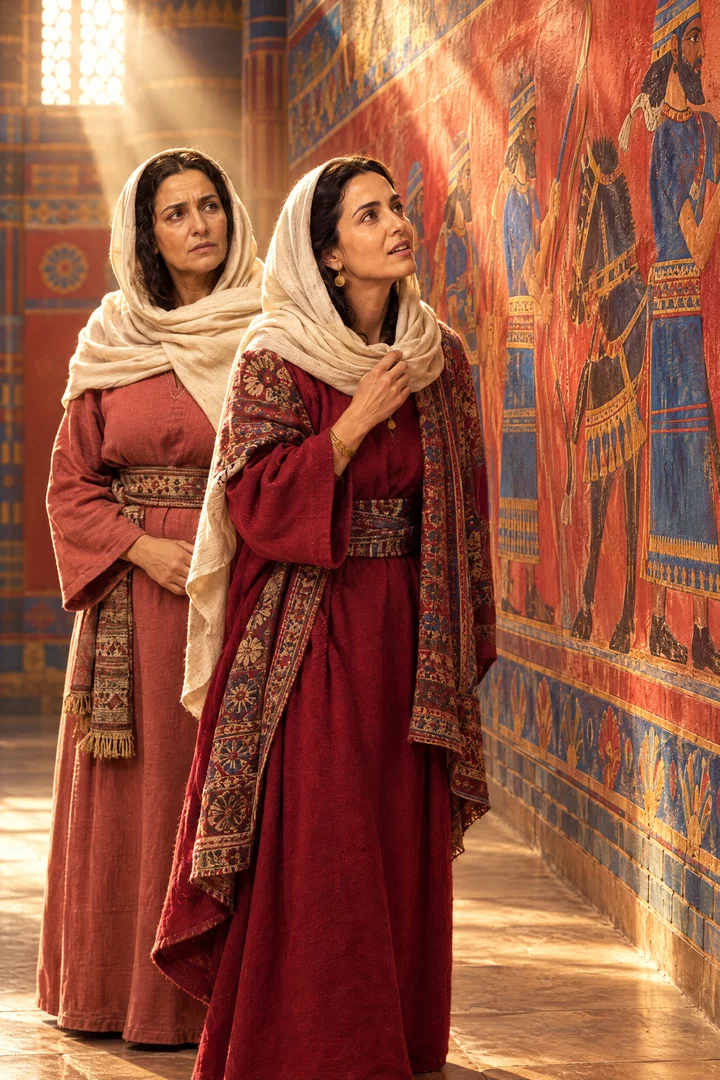
Cross-references
- Ezekiel 16:15
But thou didst trust in thine own beauty, and playedst the harlot because of thy renown, and pouredst out thy fornications on every one that passed by; his it was.
Both portray Israel’s apostasy as sexual unfaithfulness.
- Revelation 17:5
And upon her forehead was a name written, MYSTERY, BABYLON THE GREAT, THE MOTHER OF HARLOTS AND ABOMINATIONS OF THE EARTH.
Names Babylon as a harlot.
- Isaiah 47:1-3
Come down, and sit in the dust, O virgin daughter of Babylon, sit on the ground: there is no throne, O daughter of the Chaldeans: for thou shalt no more be called tender and delicate.
Both texts portray Babylon as a harlot.
- Jeremiah 3:1-14
They say, If a man put away his wife, and she go from him, and become another man’s, shall he return unto her again? shall not that land be greatly polluted? but thou hast played the harlot with many lovers; yet return again to me, saith the LORD.
Both portray Israel’s turning from God as harlotry.
- Habakkuk 1:6-8
For, lo, I raise up the Chaldeans, that bitter and hasty nation, which shall march through the breadth of the land, to possess the dwellingplaces that are not theirs.
Describes the invading nation as swift and fierce.
Commentary
Each commentary is drawn from primary sources: the writings of Ellen G. White and Adventist pioneers and periodicals. Each commentary is separate. Its own words are not a quotation; follow the references to read the source passages.
Pioneers and periodicals
10 sources
The verse depicts Babylonian princes as conspicuous and impressive to look at, girded with girdles upon their loins and clothed in richly dyed, brightly colored clothing with distinctive headwear.ST Jul 23, 1885RH Aug 10, 1916 The Hebrew word behind the dyed attire means dyeing or coloring, an act usually done by dipping the material into the dye.ST Oct 6, 1881 The appearance and manner of the Chaldeans is presented as the likeness or pattern characteristic of the Babylonians of Chaldea.RH Jan 5, 1860
The description fits the Babylon of Ezekiel's time and its splendor under Nebuchadnezzar.ST Jul 23, 1885 Unlike Assyria, Babylon used painted plaster and colored enameled brick for interior decoration because stone was scarce, and its walls were famed for brilliant coloring.ST Jul 23, 1885 That artistic custom ended with conquest by the Medes and Persians, so the detail places the book in its own time.ST Jul 23, 1885 Ancient palace reliefs and inscriptions illustrate the description of their splendid attire.RH Aug 10, 1916
The chapter portrays Samaria and Jerusalem as adulterous women because they turned from their covenant with God and sought relations with foreign nations.ST Jun 11, 1896 The verse shows their attraction to Babylonian power and appearance as part of portraying Judah as becoming like the surrounding heathen.ST Jun 11, 1896 That adultery is spiritual fornication meaning apostasy, turning from God's law and worship to an unlawful connection with idolatrous or false religious groups.RH Aug 28, 1860 The chapter's lesson is that Israel's unfaithfulness to God, in forsaking God and seeking help from Egypt, is rebellion, a pattern like churches seeking union with civil power.ST Jul 22, 1913
The corrupt woman presented in the chapter shows that a corrupt woman is a symbol of a corrupt church.ST Jul 15, 1913 The description is part of the portrayal of backsliding Israel and Judah, and Babylon and her daughters, as harlots who ensnared souls and corrupted the nations of the earth.ST Jul 27, 1904 The verse belongs to the prophecy of Babylon's coming against Jerusalem, connected with the removal of the diadem from Israel's profane wicked prince and the overturning of the kingdom until the one with the right to rule comes, dated to 593 BC.RH Oct 22, 1861
Sources