Ezekiel 33:5
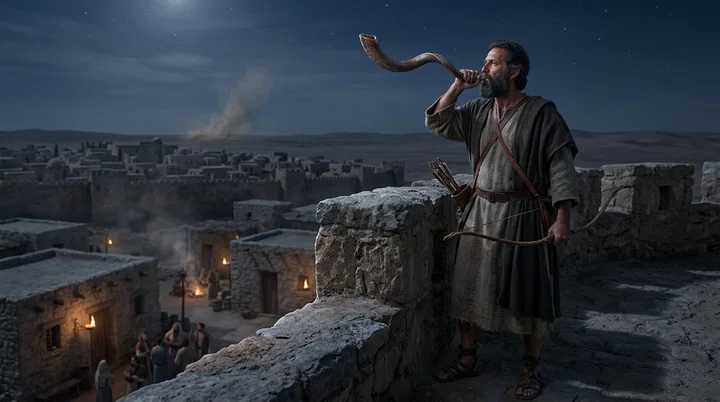
He heard the sound of the trumpet, and took not warning; his blood shall be upon him. But he that taketh warning shall deliver his soul.
Translations
He heard the sound of the trumpet, and took not warning; his blood shall be on him. But he that takes warning shall deliver his soul.
King James Version, KJV Cambridge Paragraph Bible, Webster Bible
He heard the sound of the trumpet, and took not warning; his blood shall be upon him. But he that taketh warning shall deliver his soul.
He heard the sound of the trumpet, and took not warning; his blood shall be upon him: whereas if he had taken warning he should have delivered his soul.
He heard the sound of the trumpet, and took not warning; his blood shall be upon him; whereas if he had taken warning, he would have delivered his soul.
The voice of the trumpet he heard, And he hath not taken warning, his blood is on him, And he who took warning his soul hath delivered.
He heard the sound of the trumpet, and took not warning; his blood is upon him: whereas had he taken warning, he would have delivered his soul.
The sound of the horn, he heard, but took not warning, His blood, upon himself shall remain,— Whereas had he taken warning, his own soul, he should have delivered.
Berean Standard Bible, Majority Standard Bible
Since he heard the sound of the horn but failed to heed the warning, his blood will be on his own head. If he had heeded the warning, he would have saved his life.
He heard the sound of the trumpet and didn’t take warning. His blood will be on him; whereas if he had heeded the warning, he would have delivered his soul.
On hearing the sound of the horn, he did not take note; his blood will be on him; for if he had taken note his life would have been safe.
For he heard the sound of the trumpet, and woulde not bee admonished: therefore his blood shall be vpon him: but he that receiueth warning, shall saue his life.
Douay-Rheims (Challoner revision)
He heard the sound of the trumpet and did not look to himself, his blood shall be upon him: but if he look to himself, he shall save his life.
Pictures


Cross-references
- 1 Corinthians 14:8
For if the trumpet give an uncertain sound, who shall prepare himself to the battle?
A trumpet must sound clearly to prompt a response.
- Joel 2:1
Blow ye the trumpet in Zion, and sound an alarm in my holy mountain: let all the inhabitants of the land tremble: for the day of the LORD cometh, for it is nigh at hand;
The trumpet alarm warns that the day of the Lord is near.
- Ezekiel 3:17-19
Son of man, I have made thee a watchman unto the house of Israel: therefore hear the word at my mouth, and give them warning from me.
The watchman must warn the wicked or answer for failing to do so.
- Isaiah 58:1
Cry aloud, spare not, lift up thy voice like a trumpet, and shew my people their transgression, and the house of Jacob their sins.
Commands a loud warning that exposes sin.
- Ezekiel 33:11
Say unto them, As I live, saith the Lord GOD, I have no pleasure in the death of the wicked; but that the wicked turn from his way and live: turn ye, turn ye from your evil ways; for why will ye die, O house of Israel?
Warns the wicked to turn from sin and live.
- Acts 20:26-27
Wherefore I take you to record this day, that I am pure from the blood of all men.
Paul is clear of others’ blood because he declared the whole counsel of God.
- Numbers 10:8
And the sons of Aaron, the priests, shall blow with the trumpets; and they shall be to you for an ordinance for ever throughout your generations.
Names the priests who were to sound the trumpets.
- Isaiah 21:6
For thus hath the Lord said unto me, Go, set a watchman, let him declare what he seeth.
Both use the watchman image to give a clear warning.
- Ezekiel 33:15-16
If the wicked restore the pledge, give again that he had robbed, walk in the statutes of life, without committing iniquity; he shall surely live, he shall not die.
Taking warning and turning brings life and forgiveness.
- Proverbs 1:23
Turn you at my reproof: behold, I will pour out my spirit unto you, I will make known my words unto you.
Both urge sinners to heed reproof and turn.
- Colossians 1:28
Whom we preach, warning every man, and teaching every man in all wisdom; that we may present every man perfect in Christ Jesus:
Defines the minister’s duty to warn and teach every person.
- Ezekiel 18:30
Therefore I will judge you, O house of Israel, every one according to his ways, saith the Lord GOD. Repent, and turn yourselves from all your transgressions; so iniquity shall not be your ruin.
Turning from sin averts judgment.
- Jeremiah 18:8
If that nation, against whom I have pronounced, turn from their evil, I will repent of the evil that I thought to do unto them.
God’s announced judgment may change when people turn from evil.
- Isaiah 21:11-12
The burden of Dumah. He calleth to me out of Seir, Watchman, what of the night? Watchman, what of the night?
Both use the watchman figure to convey a message.
- Habakkuk 2:1
I will stand upon my watch, and set me upon the tower, and will watch to see what he will say unto me, and what I shall answer when I am reproved.
Both describe a watchman’s alertness to his appointed message.
- Romans 14:12
So then every one of us shall give account of himself to God.
Both affirm that each person answers to God.
- 2 Timothy 4:2
Preach the word; be instant in season, out of season; reprove, rebuke, exhort with all longsuffering and doctrine.
Both texts affirm the duty to warn through faithful preaching.
Commentary
Each commentary is drawn from primary sources: the writings of Ellen G. White and Adventist pioneers and periodicals. Each commentary is separate. Its own words are not a quotation; follow the references to read the source passages.
Ellen G. White
30 sources
When the watchman sees danger coming and sounds the trumpet, each hearer decides his own fate: to ignore the sound and be lost leaves the guilt on himself, while to heed it saves his life.Ms 28, 1905, par. 3–8Ms 33, 1900, par. 19–21Ms 125, 1907, par. 1–4 No one can shift that choice to another, for each must search and obey for himself, and being misled by ministers or neighbors gives no excuse.Ms 33, 1900, par. 19–21Ms 33, 1900, par. 22–24Lt 162, 1900, par. 16–17 To heed is to return to obedience to God's plain word, open the heart to Christ and the Holy Spirit to cleanse it from sin and selfishness, and use and share every ray of light sent.Ms 33, 1900, par. 22–24Lt 30, 1895, par. 14–165T 718.1Ms 18, 1888, par. 18 Those set as watchmen today bear even greater responsibility than ancient watchmen, and if they warn faithfully they free themselves from guilt even when the wicked refuse to turn, but if they neglect or delay, the blood of the lost is required at their hand.Ms 125, 1907, par. 1–4Lt 26d, 1887, par. 27–295T 15.2–16.1STMW11 3.1–24T 402.2–403.1 That warning must be given at once, plainly and loudly with a certain sound of reproof rather than smooth words of peace.5T 715.2STBk 119.1ST2 10.2
Hearing Brings Personal Responsibility
When the watchman sees the sword coming and blows the trumpet to warn the people, the outcome rests on each hearer.Ms 28, 1905, par. 3–8Ms 33, 1900, par. 19–21Ms 125, 1907, par. 1–418MR 183.5–184.4STMW11 19.1 Whoever hears the sound and refuses to act, and is taken away, bears his own guilt, and his blood is upon his own head.Ms 28, 1905, par. 3–8Ms 33, 1900, par. 19–21Ms 125, 1907, par. 1–418MR 183.5–184.4Ms 33, 1900, par. 22–24 Whoever heeds the warning and acts on it saves his life and delivers his soul.Ms 28, 1905, par. 3–8Ms 33, 1900, par. 19–21Ms 125, 1907, par. 1–418MR 183.5–184.4STMW11 19.1 Individual responsibility decides the result, for each must choose for himself.Ms 33, 1900, par. 19–21Lt 162, 1900, par. 16–17 No one can obey for a neighbor, another's neglect does not excuse neglect, no other man can save the hearer or answer for him, and even a minister cannot pay the ransom for deceived souls, since Christ alone gave His life to save them and give another trial to return to loyalty.Ms 33, 1900, par. 19–21Ms 33, 1900, par. 22–24Lt 162, 1900, par. 16–17
Those who permit themselves to be deceived are not excused for neglecting to search the Word of God for themselves and committing their souls to a minister.Ms 33, 1900, par. 19–21Ms 33, 1900, par. 22–24 When God sends faithful messengers to warn church members, to feed them with pure truth and call them to search the Scriptures and obey for themselves, those who hear and refuse to examine and obey are left without excuse.Ms 33, 1900, par. 19–21Ms 33, 1900, par. 22–24 This holds even when ministers and shepherds mislead them, wrest the Scriptures, teach human commandments, oppose the messengers, warn the people against doing what God commands, and stand in the way of obedience.Ms 33, 1900, par. 19–21Ms 33, 1900, par. 22–24 Those who take Satan's side and work to justify sin must bear the penalty of sin, and their loss is their own fault, while those who listen and obey escape.Ms 33, 1900, par. 19–21Ms 33, 1900, par. 22–24
Taking warning means returning to loyalty and obedience to a plain Thus saith the Lord.Ms 33, 1900, par. 22–24 It means letting the Holy Spirit come into the heart and abide there, expelling Satan and selfishness and unholy lust from the soul temple.Ms 33, 1900, par. 22–24Lt 30, 1895, par. 14–16 It means opening the door of the heart to Jesus to receive richest blessing, purification, and fellowship with the Father and the Son.Lt 30, 1895, par. 14–16 It also means receiving whatever light God sends by His word, His ministers, and other agencies, putting it to the best use and passing it along to church and world so its full force is felt.5T 718.1 By so taking warning and using the light, hearers deliver their souls, are clothed with the righteousness of Christ and fortified by truth, are fitted to prepare for the coming conflict and the great issues ahead, to stand in the day of trouble and in the great crisis before them, and to reject Satan's delusions instead of being left to stumble in darkness unprepared and not knowing what is before them.5T 718.1Ms 18, 1888, par. 18
The trumpet warning that must give a certain sound, a clear alarm the people can hear so they realize their danger and do the work required at the present time, is sounded by a watchman appointed to alert the people, and is carried and passed along by God's human messengers with warning, reproof, and instruction to enlighten His people.Ms 125, 1907, par. 1–45T 718.1Ms 18, 1888, par. 18Lt 87, 1896, par. 14 If the watchman gives the warning and a wicked person does not turn from his way, the person remains answerable for his own iniquity and the watchman has fulfilled his duty.Ms 125, 1907, par. 1–4 Rejecting or working against their message of mercy repeats the Jews' rejection of Christ.Lt 87, 1896, par. 14
Watchmen Must Warn Faithfully
Ministers are watchmen unto the house of Israel today, as the ancient watchmen were upon the walls of Jerusalem, and upon the walls of Zion now the salvation of souls depends on their fidelity.5T 15.2–16.14T 402.2–403.1 Their solemn charge is rightly to understand and explain the word of God and to warn every man from God, teaching every man in all meekness and wisdom.5T 15.2–16.1 Their responsibility is even greater than in the prophet's day because their light is clearer and their privileges and opportunities are greater.5T 15.2–16.1 To meet it they must not conform to the practices of the world, must contend for the faith once delivered to the saints, must stay spiritually minded and closely connected with God, and must live very near to God to hear His word at His mouth and be impressed by His Spirit.5T 15.2–16.14T 402.2–403.1 They must not be sleepy sentinels with benumbed spiritual senses who see and realize no danger, but when they see the sword coming must sound the trumpet note of warning.4T 402.2–403.1
The watchman who sounds the warning has fulfilled his duty and delivered his own soul, even when the warning has no good effect.Ms 125, 1907, par. 1–4STMW11 3.1–22T 53.2 If the wicked person warned does not turn from his way but refuses to heed and dies in his iniquity, his guilt and loss are his own and he remains answerable for his own iniquity.Ms 125, 1907, par. 1–4STMW11 3.1–2 The one who gave the warning is then no longer partaker in that sin and is no longer answerable for that blood.2T 53.24T 402.2–403.1 He that takes warning preserves his life and delivers his soul, while he that hears and refuses bears responsibility for his own death.Ms 125, 1907, par. 1–44T 402.2–403.1
A watchman who fails to warn, delays, neglects, gives up his watch, or stands by at ease while people perish is accountable, and God will require their blood at his hand.5T 15.2–16.1STMW11 3.1–25T 715.24T 402.2–403.1 The charge requires discernment, firmness, and faithful correction of wrongdoing and evils rather than ease or neglect, with protest and prayer against harmful movements.Lt 26d, 1887, par. 27–295T 15.2–16.1 Faithful warning requires living very near to God to hear His word and be impressed by His Spirit, lest through unfaithfulness the watchman lose his own soul and the souls of those who hear him.5T 15.2–16.14T 402.2–403.1 Condemnation will be proportionate to misleading influence, and in the scene of the plagues those who were not warned will blame ministers for failing to warn them of the coming hour, while the unfaithful ministers suffer God's wrath.SG1 200.2
Those entrusted with sacred responsibility, especially ministers appointed as watchmen, must stay alert to dangers threatening the spiritual life, health, and prosperity of God's people and must speak out to warn others against dishonoring God.18MR 183.5–184.4Lt 26d, 1887, par. 27–29 They must watch over souls because those who watch must give an account.Ms 56, 1898, par. 53–55 This work belongs not only to ministers but to canvassers, who as watchmen are to warn people of danger and awaken those asleep to the message of salvation through Christ and obedience to God's law.MC 7.4 It belongs also to teachers and other workers whose conduct and influence affect the young, who must give faithful warning rather than sometimes serve the enemy's purposes, and to faithful God-fearing people who must warn the church and confront danger before it takes hold, since neglect can leave a damaging condition that years of work may not repair.Lt 26d, 1887, par. 27–29TBC1882 16.3Lt 26d, 1887, par. 42
The warning must be given immediately when danger threatens, and clearly, plainly, loudly, and with a certain sound that people can recognize and prepare by.5T 715.2STBk 119.1AAP 19.34T 402.2–403.1 When danger is seen, watchmen united in spiritual discernment must sound the trumpet more clearly and loudly so the people can be warned.ST2 10.2LSEGW 327.1 It means plain testimonies of reproof that show transgressions and sins rather than smooth things and cries of peace.4T 402.2–403.1 A leader's hesitation and uncertainty can prevent the warning from doing its work and leave souls unprepared, and confusion about what constitutes that certain sound leaves people unsure what warning to follow.5T 715.2
The chapter is to be studied in connection with Christ's command and commission to His followers, including medical missionary work as part of the work He commanded.STMW11 19.1Lt 54a, 1898, par. 13 Its warning principle calls for all to be alerted to the approaching day of the Lord so none are left without warning.6T 22.2–3 Ministers must stay focused on the third angel's message and not let side issues hinder the truth's work of converting souls.Lt 9, 1892, par. 19–24 The alarm for religious liberty is to be sounded and then the work left to God, and in places like Battle Creek faithful watchmen must not stand by while others face temptation but must actively warn and help young helpers, patients, believers, and unbelievers.STB 296.3–297.1
Sources
Pioneers and periodicals
45 sources
The trumpet is the alarm the watchman sounds when he sees the sword and danger coming upon the land, to give all who hear it a chance to escape and prepare.ST Oct 30, 1884RH May 23, 1871RH Sep 3, 1857 The one who hears that sound and takes no warning bears the blame for his own death and destruction, with his blood upon himself, but he who takes warning delivers his soul and preserves his life.RH Dec 10, 1867ST Feb 8, 1883ST Nov 3, 1914 The watchman is charged to warn the wicked from his way, and if he gives the warning he has done his duty even if the hearer still dies in iniquity, but if he sees the danger and fails to speak his blood is required at the watchman's hand.RH Dec 10, 1867RH Aug 3, 1911 That charge rests in every age on all Christ's servants, ministers and church members and publications alike, to lift up the voice like a trumpet whether men will hear or forbear.RH Dec 18, 1913ST Oct 28, 1908ST Jun 7, 1899 The warning is a final solemn call to repent, believe the gospel, turn to Christ as the sure refuge, and keep all God's commandments and covenant while mercy still pleads before judgment comes.ST Oct 28, 1908ST Jun 7, 1899RH Aug 14, 1856ST Jan 4, 1877
Trumpet, Watchman, and Alarm
The trumpet is the alarm sounded by the watchman when he sees the sword coming upon the land, giving all who hear it a chance to escape danger and prepare.ST Oct 30, 1884RH May 23, 1871RH Sep 3, 1857RH Mar 9, 1911RH Nov 29, 1906 If he sounds it he has discharged his duty, and anyone who hears it yet refuses to act bears the guilt of his own death when the sword takes him, while the one who heeds it preserves his life.ST Oct 30, 1884RH May 23, 1871RH Sep 3, 1857RH Mar 9, 1911RH Nov 29, 1906 That office is not limited to formal appointment, for any who see approaching peril are to warn, and the warning must be clear enough to make people ready for the coming King.ST Oct 30, 1884RH Sep 3, 1857RH Mar 9, 1911RH Nov 29, 1906RH Jan 19, 1905
The figure is taken from ancient watchmen stationed on city walls to give alarm of approaching danger and to mark the night and the coming day, who answered with their lives for failure to warn.ST Oct 30, 1884 God sets Ezekiel and His servants over the house of Israel in that same place, to hear the word at His mouth and warn the people from Him.ST Oct 30, 1884ST Jun 3, 1889ST Nov 28, 1900 The watchman's charge is therefore to look for danger and sound the alarm, while each hearer must respond.ST Oct 30, 1884ST Jun 3, 1889ST Nov 28, 1900
The trumpet must give a certain, clear sound that awakens from spiritual slumber, dispels the darkness of sin, keeps the light visible, and makes ready for the coming King.RH May 23, 1871RH Jul 4, 1912RH Jan 19, 1905ST Jan 18, 1899 A minister as watchman does this by plainly stating his reasons for the danger he sees and faithfully warning the brethren, laboring to help those he loves rather than leaving the sheep to the wolf like a hireling.RH Jul 4, 1912RH Jul 16, 1861 The same certain sounding belongs to speech and writing that remain alert at their post concerning dangers threatening church and government, calling for vigilance, spiritual readiness, deeper consecration and earnest faithfulness before crisis comes; a weak or absent sounding leaves the inactive complaining of weakness and unfit for action, and the people without alert, unprepared and exposed to error.RH May 23, 1871RH Jul 4, 1912RH Jul 16, 1861ST Jan 18, 1899
Hearer's Personal Accountability
The one who hears the trumpet sound and refuses to take warning carries the responsibility for his own death, loss and destruction, with his blood upon himself, while the one who takes warning delivers his soul and saves and preserves his life.RH Dec 10, 1867ST Feb 8, 1883ST Nov 3, 1914RH Aug 3, 1911 The warning belongs to the watchman's duty, but the hearer is accountable for responding to it, so faithful warning leaves those who refuse it accountable for their own deaths.RH Aug 3, 1911RH Aug 17, 1916 The chapter is an urgent appeal to return and live because God takes no pleasure in anyone's death.ST Nov 24, 1909 God's dealings are governed by the general principle that response to warning matters, and announced judgments or blessings depend on conduct, applying among all people even when not stated explicitly.ST Oct 1, 1896 This setting forth of the watchman's duty proves God is not cruel, showing His wonderful mercy with His pledge of life to those who turn standing for every single soul.ST Oct 14, 1908
Accountability is personal before God's judgment, for once danger is presented each person must act for himself and answer for heeding God's voice.ST Sep 1, 1898ST Aug 20, 1902 Warning others is therefore a serious duty to be done urgently even when hearers seem indifferent, and those who warn have done their duty when they have given the warning.RH May 23, 1871 This applies to the duty to warn against compromise with iniquity, after which those warned must choose their course once the danger is before them.ST Sep 1, 1898 Those who continue to violate God's law while the light of truth is available have their blood upon their own heads.RH Mar 2, 1852 Those who hear yet refuse warning because they feel satisfied, trusting their own inclinations, their church membership, and their living and hoping instead of testing faith and works by God's word, go on blindly in a course ending in destruction with responsibility for ruin resting on themselves, while he who is aroused from slumber and heeds escapes.ST Jul 4, 1878
Even a watchman or minister as a hearer who hears the trumpet warning but does not heed it bears responsibility for his own death, while the one who takes warning saves his life.ST Jan 18, 1905 This illustrates the responsibility of ministers as watchmen to warn sinners when they see danger: if they fail to warn they are accountable for the sinner's blood, but if they warn and the sinner refuses to turn the sinner dies in iniquity while the watchman has delivered himself. The same duty applies to leaders who see danger entering the church: they must sound the alarm, and silence when they recognize the threat leaves those who could have been warned without that warning.ST Jan 18, 1905
Watchman's Duty to Warn
The watchman is charged to warn the wicked to turn from his way, and when he gives that warning faithfully he has discharged his duty even if the hearer still dies in his iniquity.RH Dec 10, 1867RH Aug 3, 1911ST Oct 30, 1884ST Oct 28, 1908 If he sees the sword and danger coming and fails to speak and warn, the wicked man still dies in his iniquity, yet his blood is required at the watchman's hand and left upon his garments.RH Dec 10, 1867ST Oct 30, 1884ST Oct 28, 1908ST Feb 17, 1898 The one who hears the trumpet and refuses to heed it bears the guilt of his own death and loss, while the one who takes warning delivers his soul and saves his own life, for warning is the watchman's duty and response is the hearer's accountability.RH Dec 10, 1867RH Aug 3, 1911ST Oct 30, 1884ST Oct 28, 1908 This charge to reprove serious faults applies even when it touches influential friends, and must not be avoided to preserve favor.RH Dec 10, 1867
The spiritual watchman's duty holds in all ages and rests on all Christ's servants and ambassadors charged to teach the way of life and salvation, warn of certain ruin following transgression, proclaim Jesus Christ as the sure refuge and remedy, and exhort, beseech and persuade men to repent, believe the Gospel, turn to Christ and live.RH Dec 18, 1913ST Oct 28, 1908ST Jun 7, 1899ST Nov 28, 1900 It rests particularly on ministers, but church members also serve as watchmen to guard against the enemy's encroachments, and it binds those who recognize danger to warn others faithfully even without official appointment.RH Dec 18, 1913ST Oct 28, 1908RH Jun 6, 1907RH Jul 4, 1912 Christians as watchmen are called to warn through speech and writing, with publications alert at their post, so that faithful warning may help dispel the darkness of sin.RH Jun 6, 1907RH Jul 4, 1912 The watchman is responsible for looking for danger and giving a clear alarm, while each person must heed it for himself.RH Dec 18, 1913ST Nov 28, 1900
The warning must be given to all persons without exception, high and low, rich and poor, ruler and subject, in private life and in public conduct, because God desires to save men wherever they are.ST Jun 7, 1899 It must be lifted up like a trumpet to show the people their sins and dangers whether men will hear or forbear, sounding the alarm to a judgment-bound generation facing approaching doom.ST Jun 7, 1899ST Jul 22, 1875 This requires backbone and moral courage that cannot be bought or sold, swerved, bribed by smiles, wheedled by flatteries, or intimidated by frowns into putting truth in the background, with willingness to believe the whole truth and share the reproaches cast upon it.ST Jul 22, 1875 Faithful messengers must warn of dangers God has revealed rather than preach a false assurance of peace, and the true servant shuns not to speak the whole counsel of God.ST Feb 17, 1898ST Jun 18, 1894
The duty to warn remains even when prophecy says the evil will surely come, as Jeremiah warned Jerusalem though its destruction by Babylon was certain.ST Apr 12, 1905 The warning against union of church and state forming an image to the beast by Sunday laws is given to save souls and avert evil, and to save the lawmakers themselves from allying with the powers of evil and becoming persecutors, not to save the faithful from persecution, for God will care for His own.ST Apr 12, 1905 Petitioning, protesting, remonstrating, and pleading fulfills this duty, and failure to warn leaves the blood of souls upon the watchman's garments.ST Apr 12, 1905 In the approaching religious-liberty crisis God's people must therefore raise the alarm, defend religious liberty, act rather than remain inactive, and pray for the threatened calamity to be deferred, and must not assume that prophecy or divine protection makes action unnecessary.ST Apr 12, 1905RH Jan 27, 1910
Gospel Message to Proclaim
Christ's servants are set as watchmen charged to speak and warn the wicked from his way by teaching the way of life and salvation.ST Oct 28, 1908ST Jun 7, 1899 The warning tells of certain ruin and inevitable destruction that follows transgression and violation of the principles of righteousness and justice.ST Oct 28, 1908ST Jun 7, 1899 It proclaims Jesus Christ as the sure refuge and remedy, and exhorts, beseeches and persuades men to repent, believe the Gospel, turn to Christ and live.ST Oct 28, 1908ST Jun 7, 1899 If the wicked hears the sound of the trumpet and takes not warning he dies in his iniquity and his blood is upon himself, but he that takes warning delivers his soul, while if the watchman does not speak to warn the wicked from his way that wicked man still dies in his iniquity but his blood is required at the watchman's hand.ST Oct 28, 1908ST Jun 7, 1899 This charge to warn rests on all Christ's ambassadors and is to be given to all persons without exception, high and low, rich and poor, ruler and subject, in private life and in public conduct, because God desires to save men wherever they are.ST Jun 7, 1899
The trumpet is a solemn warning that must prompt action, for hearing without heeding leaves a person accountable for the announced danger and responsible for the consequences, while taking warning delivers the hearer and preserves life.RH Aug 14, 1856ST Jan 4, 1877 It is a final call to accept mercy and make peace with God by keeping all His commandments and escaping destruction for breaking the everlasting covenant, so as to inherit eternal life.RH Aug 14, 1856ST Jan 4, 1877 The call centers on God's law and the seventh-day Sabbath and is to be urged while mercy and the Saviour's pleading remain, before judgment comes when the warning is no longer heard.RH Aug 14, 1856ST Jan 4, 1877
Those who know the truth and understand God's law must earnestly teach it as God gave it and sound the warning so people can hear and respond.RH Mar 2, 1905RH Nov 11, 1873 They must warn the world against efforts to present the law as changed, as part of the message for the present generation that prepares the way for the coming King.RH Mar 2, 1905 Ministers standing watch must warn about threats to the Sabbath so that hearers who ignore the trumpet bear responsibility for their own death while the one who heeds it saves his life.RH Mar 2, 1905RH Nov 11, 1873
End-Time Warning Applied
In the last days the faithful watchman warns that the day of the Lord is at hand.ST Jun 4, 1874 That warning is the proclamation of the last message of warning to those who have not yet heard it, preparing the way for the coming King.RH Feb 25, 1904RH Mar 2, 1905 It is the third angel's message, to be proclaimed earnestly and supported in its spread, for those entrusted with the gospel must sound it or answer for blood left unwarned, while those who hear and refuse to heed bear responsibility for their own loss.RH Aug 28, 1856 The watchman's trumpet must give a clear sound so that people can be made ready for the coming King.RH Jan 19, 1905 Yet pulpits and the religious press hold up that faithful watchman as a fanatic and a teacher of dangerous heresies, setting forth in contrast a long period of peace and prosperity for the church that quiets the churches to sleep, so the scoffer keeps scoffing and the mocker keeps mocking until their day comes.ST Jun 4, 1874
The present warning concerns coming religious coercion and its consequences, with God's people as watchmen who must clearly warn others and give them a chance to avoid danger.RH Mar 9, 1911 The danger threatening the government is the union of church and state that forms an image to the beast by Sunday laws.ST Apr 12, 1905 God's people must raise the alarm, defend religious liberty, act rather than remain inactive, and pray for the threatened calamity to be deferred, never assuming that prophecy or divine protection makes action unnecessary.RH Jan 27, 1910 A publication that gives clear warning about dangers threatening the government and remains alert at its post is itself such a watchman's trumpet, where the hearer who ignores it bears responsibility and the one who takes warning preserves life.ST Jan 18, 1899 Even when prophecy says the evil will surely come the duty to warn remains, as Jeremiah warned Jerusalem though destruction by Babylon was certain, with petitioning, protesting, remonstrating and pleading given to save souls and avert evil and to save lawmakers themselves from allying with evil and becoming persecutors, not to save the faithful from persecution, for God will care for His own, and failure leaves blood upon the watchman's garments.ST Apr 12, 1905
Faithfulness requires that God's people be warned of coming danger, for the hearer who refuses warning bears responsibility while he who takes warning saves his life.RH Apr 2, 1867 The warning is urgent: people must be roused from complacency before destruction comes.RH Aug 31, 1911 Delaying a needed warning to a lukewarm church may prove fatal, while faithful warning discharges the watchman's duty even if hearers continue to ignore it.RH Sep 3, 1857 A minister is a watchman who when he sees the sword coming must give the trumpet a certain sound by plainly stating reasons for the danger he sees and faithfully warning the brethren, laboring to help those he loves rather than leaving them in error without warning, for to see the wolf coming and leave the sheep is the act of hirelings.RH Jul 16, 1861 That same duty requires ministers to reprove serious faults even in influential friends rather than avoiding the task to preserve favor, since failure to warn leaves their blood required at the watchman's hand.RH Dec 10, 1867 Failing to keep even a promised appointment to give needed spiritual help can make the minister answerable for the discouragement and loss that follow.RH Jun 14, 1870
The trumpet's certain sound can awaken people from spiritual slumber, though those long inactive may complain of weakness and be unfit for action.RH May 23, 1871 Christians as watchmen are called to warn through speech and writing, sounding a clear warning about danger so that those who heed may save their lives, and faithful warning through those means helps dispel the darkness of sin.RH Jul 4, 1912 Like a lighthouse watcher, the Christian must keep the light of warning visible, urge and persuade those in danger, since heeding preserves life while refusing leaves responsibility for the danger that follows upon the hearer.RH Dec 5, 1865
Sources