Ezekiel 4:2
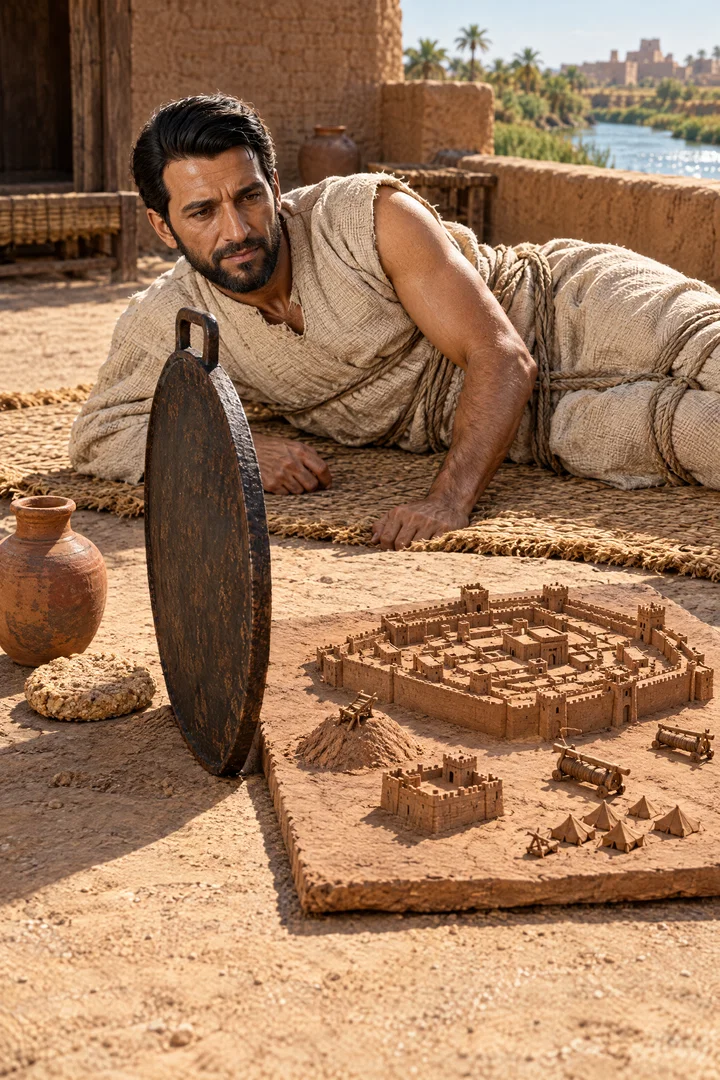
And lay siege against it, and build a fort against it, and cast a mount against it; set the camp also against it, and set battering rams against it round about.
Translations
American King James Version, King James Version
And lay siege against it, and build a fort against it, and cast a mount against it; set the camp also against it, and set battering rams against it round about.
and lay siege against it, and build a fort against it, and cast a mount against it; set the camp also against it, and set battering rams against it round about.
And lay siege against it, and build a fort against it, and cast a mount against it; set the camp also against it, and set battering rams against it on every side.
and lay siege against it, and build forts against it, and cast up a mount against it; set camps also against it, and plant battering rams against it round about.
and lay siege against it, and build forts against it, and cast up a mound against it; set camps also against it, and plant battering rams against it round about.
and hast placed against it a siege, and builded against it a fortification, and poured out against it a mount, and placed against it camps, yea, set thou against it battering-rams round about.
and lay siege against it, and build forts against it, and cast a mound against it, and set camps against it, and place battering-rams against it round about.
Then shalt thou lay siege against it And build up against it a siege-wall And cast up against it, a mound,— And set against it camps, And place against it battering-rams, round about.
Berean Standard Bible, Majority Standard Bible
Then lay siege against it: Construct a siege wall, build a ramp to it, set up camps against it, and place battering rams around it on all sides.
Lay siege against it, build forts against it, and cast up a mound against it. Also set camps against it and plant battering rams against it all around.
And make an attack on it, shutting it in, building strong places against it, and making high an earthwork against it; and put up tents against it, placing engines all round it for smashing down its walls.
And lay siege against it, and builde a fort against it, and cast a mount against it: set the campe also against it, and lay engins of warre against it rounde about.
Douay-Rheims (Challoner revision)
And lay siege against it, and build forts, and cast up a mount, and set a camp against it, and place battering rams round about it.
Pictures
Commentary
Each commentary is drawn from primary sources: the writings of Ellen G. White and Adventist pioneers and periodicals. Each commentary is separate. Its own words are not a quotation; follow the references to read the source passages.
Pioneers and periodicals
11 sources
Ezekiel 4:2 is part of a symbolic visual portrayal of Jerusalem under siege, with a fort, a mount, a camp, and battering rams set round about to illustrate the coming judgments and calamities that awaited the Jews and Judah.ST Jul 1, 1897RH May 23, 1907ST Jun 3, 1908RH Sep 30, 1873ST Aug 12, 1913 God directed the portrayal on a tile and its enactment in detail as a visual lesson, making Israel's condition clearer and the message more forceful.ST Nov 14, 1900 The portrayal was a message sent to Judah's captives, showing that pictures and other visual forms can legitimately communicate God's message when used for his glory.ST Jul 1, 1897 Its miniature realism of laying siege, building a fort, casting a mount, setting the camp, and setting battering rams portrays a real coming siege.RH May 23, 1907
God preaches in a most realistic way through terrible things seen in righteousness, as in the Jamaica earthquake disaster, and those who witness such a scene tell their message with new force, emphasis, positiveness and dispatch as those who know assuredly what they affirm.RH May 23, 1907 The chapter's other signs belong to the same symbolic portrayal in which sacred writers speak or act to represent the future experience of others: lying a number of days on the left side and then on the right side, and eating bread by weight and drinking water by measure, and eating defiled bread, typified the captivity and represented the food that the children of Israel would eat in their captivity among the Gentiles.RH Sep 30, 1873 The signs include lying on the left side for Israel 390 days and on the right side for Judah 40 days, with each day representing a year of captivity, covering Israel's captivity and the remainder of Judah's captivity through the restoration after seventy years.ST Aug 12, 1913
In its context of Ezekiel 4:1-6, also cited as 4:1-7, the verse gives God's established rule and key for reckoning symbolic prophetic time, that each day stands for a corresponding year and symbolic days refer to the same number of years as the number of days named.RH Aug 24, 1916RH Sep 28, 1905ST Mar 13, 1893ST Nov 10, 1909ST Feb 3, 1898 By that rule the 2,300 days signify 2,300 years.RH Sep 28, 1905 By that rule the 1,260 prophetic days of papal persecution yield 1,260 literal years.ST Mar 13, 1893ST Feb 3, 1898 Applied to the period of a time, times, and half a time, the 1,260 prophetic days become 1,260 years of papal persecution, ending in 1798.ST Feb 3, 1898 Applied to Daniel, 483 days extend to the appearing of Messiah as 483 years, reckoned from the commandment to restore Jerusalem in 457 B.C. to the anointing of Christ at His baptism in A.D. 27, which proves the rule works.RH Aug 24, 1916
Sources