Genesis 1:14
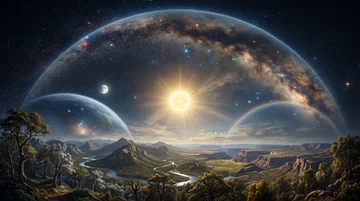
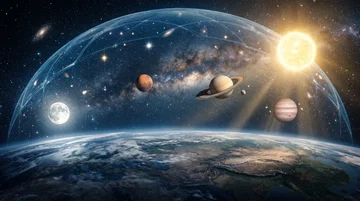
And God said, Let there be lights in the firmament of the heaven to divide the day from the night; and let them be for signs, and for seasons, and for days, and years:
Translations
American King James Version, King James Version, KJV Cambridge Paragraph Bible
And God said, Let there be lights in the firmament of the heaven to divide the day from the night; and let them be for signs, and for seasons, and for days, and years:
And God said, Let there be lights in the firmament of the heaven, to divide the day from the night: and let them be for signs, and for seasons, and for days, and years.
And God said, Let there be lights in the firmament of the heaven to divide the day from the night; and let them be for signs, and for seasons, and for days and years:
And God said, Let there be lights in the firmament of heaven to divide the day from the night; and let them be for signs, and for seasons, and for days and years:
And God saith, 'Let luminaries be in the expanse of the heavens, to make a separation between the day and the night, then they have been for signs, and for seasons, and for days and years,
And God said, Let there be lights in the expanse of the heavens, to divide between the day and the night; and let them be for signs, and for seasons, and for days and years;
And God said—Let there be luminaries in the expanse of the heavens, to divide between the day and the night,—and let them be for signs, and for seasons, and for days and years;
Berean Standard Bible, Majority Standard Bible
And God said, “ Let there be lights in the expanse of the sky to distinguish between the day and the night, and let them be signs to mark the seasons and days and years.
God said, “ Let there be lights in the expanse of the sky to divide the day from the night; and let them be for signs to mark seasons, days, and years;
And God said, Let there be lights in the arch of heaven, for a division between the day and the night, and let them be for signs, and for marking the changes of the year, and for days and for years:
And God said, Let there be lights in the firmament of the heauen, to separate the day from the night, and let them be for signes, and for seasons, and for dayes and yeeres.
Douay-Rheims (Challoner revision)
And God said: Let there be lights made in the firmament of heaven, to divide the day and the night, and let them be for signs, and for seasons, and for days and years:
Pictures


Cross-references 20 of 32
- Genesis 1:3-5
And God said, Let there be light: and there was light.
First-day light and the division of day and night precede the heavenly lights.
- Psalms 33:9
For he spake, and it was done; he commanded, and it stood fast.
God speaks, and creation comes into existence.
- Genesis 1:5
And God called the light Day, and the darkness he called Night. And the evening and the morning were the first day.
defines day and night as evening and morning measured by the lights
- Hebrews 11:3
Through faith we understand that the worlds were framed by the word of God, so that things which are seen were not made of things which do appear.
Both teach that God created the worlds by his word.
- John 1:3
All things were made by him; and without him was not any thing made that was made.
The Word is identified as the agent through whom all things were made.
- Genesis 1:6-8
And God said, Let there be a firmament in the midst of the waters, and let it divide the waters from the waters.
Both describe the firmament separating the waters during the second day of creation.
- Psalms 33:6
By the word of the LORD were the heavens made; and all the host of them by the breath of his mouth.
Both affirm that God made the heavens and their host by his word.
- 2 Corinthians 4:6
For God, who commanded the light to shine out of darkness, hath shined in our hearts, to give the light of the knowledge of the glory of God in the face of Jesus Christ.
Creation light commanded from darkness parallels God’s light shining in hearts.
- Psalms 19:1
The heavens declare the glory of God; and the firmament sheweth his handywork.
The heavens and firmament display God’s glory and handiwork.
- Luke 21:25
And there shall be signs in the sun, and in the moon, and in the stars; and upon the earth distress of nations, with perplexity; the sea and the waves roaring;
The sun, moon, and stars serve as signs, including signs of the end.
- Genesis 1:18
And to rule over the day and over the night, and to divide the light from the darkness: and God saw that it was good.
The lights divide light from darkness and rule over day and night.
- Revelation 21:23
And the city had no need of the sun, neither of the moon, to shine in it: for the glory of God did lighten it, and the Lamb is the light thereof.
The city needs no sun or moon because God’s glory and the Lamb provide its light.
- Deuteronomy 4:19
And lest thou lift up thine eyes unto heaven, and when thou seest the sun, and the moon, and the stars, even all the host of heaven, shouldest be driven to worship them, and serve them, which the LORD thy God hath divided unto all nations under the whole heaven.
Both texts identify the heavenly lights God appointed over the day and night.
- Genesis 1:19
And the evening and the morning were the fourth day.
Marks the completion of the fourth day containing the lights.
- Revelation 22:5
And there shall be no night there; and they need no candle, neither light of the sun; for the Lord God giveth them light: and they shall reign for ever and ever.
God’s light replaces the sun in the city.
- Colossians 1:16-17
For by him were all things created, that are in heaven, and that are in earth, visible and invisible, whether they be thrones, or dominions, or principalities, or powers: all things were created by him, and for him:
All things were created and are sustained through Christ.
- Hebrews 1:2
Hath in these last days spoken unto us by his Son, whom he hath appointed heir of all things, by whom also he made the worlds;
Christ is identified as the one through whom God made the worlds.
- Psalms 104:19
He appointed the moon for seasons: the sun knoweth his going down.
The moon marks seasons and the sun marks day.
- Psalms 74:16
The day is thine, the night also is thine: thou hast prepared the light and the sun.
Distinguishes the prepared light from the sun.
- Psalms 148:5
Let them praise the name of the LORD: for he commanded, and they were created.
also describes the creation
Commentary part 1 of 2
Each commentary is drawn from primary sources: the writings of Ellen G. White and Adventist pioneers and periodicals. Each commentary is separate. Its own words are not a quotation; follow the references to read the source passages.
Ellen G. White
24 sources
God Himself spoke the sun, moon and stars into the starry heaven to divide day from night and to serve for signs and seasons and days and years, setting the sun to mark day and night, ordering the stars in the firmament, and appointing sun and moon to give light and warmth and make vegetation flourish.WLF 6.7–9CT 387.28T 310.3–45T 312.1 This was done in one plain literal day about six thousand years ago as part of the six working days in which heaven and earth and all their host were made and called very good, followed by His rest and blessing and sanctifying of the seventh day, with that first week measured off as the sample for every week to the close of time.Lt 51, 1901, par. 5–7CE 190.1–21SP 87.1ED 128.21SP 85.1–86.1 To stretch that day into thousands or millions of years to accommodate geology and evolution makes obscure what was made very plain, strikes at the foundation of the Sabbath of the fourth commandment, and destroys the force of the command to keep seven literal days in commemoration of that week.CE 190.1–21SP 87.11SP 86.2 Just how God did this work in six literal days when He could have spoken it all into existence in one day has never been revealed to mortals and cannot be explained from natural causes, for His creative works are as incomprehensible as His existence.ST Mar 20, 18798MR 412.1ST Mar 20, 1879Lt 7a, 1878, par. 3–7PP 113.2 Though sin has marred that holy and beautiful work, the sunshine and moon and glory of the starry heavens still bear witness to the Creator and reveal His goodness and forbearance and love, so He is to be chosen and taught by as Teacher rather than worldly-wise men destitute of divine enlightenment, and His creative Word still accepted by the will brings the life of the Infinite One to transform the nature and recreate the soul in God's image.6T 358.1–359.1CT 387.28T 310.3–4ST Apr 11, 1906
Lights in Creation Week
The Father and the Son were engaged together in contemplating and then performing the mighty and wondrous work of creating the world.ST Jan 9, 1879 The earth that came forth from the Creator's hand was exceedingly beautiful, like a noble palace furnished with pure and healthful air.ST Jan 9, 1879 Its surface was not one extensive plain but was diversified with hills, mountains and plains, regular and beautiful in shape, not high and ragged as now, with no bare high rocks seen upon them, the rocks lying beneath the surface as bones to the earth.ST Jan 9, 1879 The waters, including rivers and other bodies, were regularly dispersed, while hills, mountains and very beautiful plains were adorned with plants and flowers and tall, majestic trees of every description, many times larger and much more beautiful than trees are now.ST Jan 9, 1879 Angels beheld these wonderful and beautiful works and rejoiced.ST Jan 9, 1879
Heaven in the verse means the starry region of the sun, moon and stars.WLF 6.7–9 That starry heaven is distinct from Paradise, distinct from the air around the earth where birds fly, and distinct from the church on earth.WLF 6.7–9 That starry heaven is not the heaven to be shaken and rolled together as a scroll.WLF 6.7–9 The heaven to be shaken is the air around the earth, to be shaken by the seventh vial and by the voice of God as the last literal sign just before the sign of the Son of man appears in heaven.WLF 6.7–9
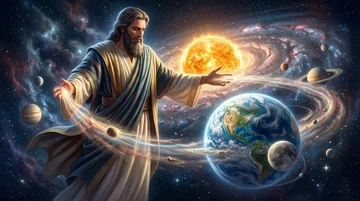
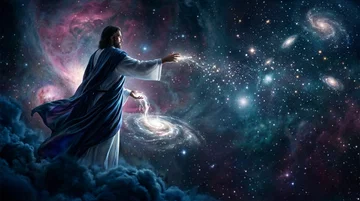
God Himself spoke and made the lights to divide the day from the night, to be for signs and for seasons and for days and years.ST Mar 20, 1879 He placed the sun in the heavens to mark the periods of day and night, set the stars in their order in the firmament, and appointed the sun and the moon to do their work.CT 387.28T 310.3–45T 312.1 The beams of the sun give the earth light and warmth and cause vegetation to flourish.5T 312.1 Just how God wrought that work He has never revealed to men.ST Mar 20, 1879
The lights with all creation form a reservoir of means made ready for instant employment to do His pleasure.6MR 30.2 Nothing He made is useless.6MR 30.2 Confusion did not come from Him, but the curse caused tares to be sown by the enemy, and rational beings alone cause confusion.6MR 30.2
This work was accomplished in six literal days, not in six vast indefinite periods.ST Mar 20, 1879 Just how God accomplished it in six literal days has never been revealed to mortals, and His creative works are as incomprehensible as His existence.ST Mar 20, 1879ST Mar 20, 1879 It cannot be explained from natural causes, and human science cannot search out the secrets of the God of heaven, for His ways are not as human ways and His thoughts are not as human thoughts.ST Mar 20, 1879 What is revealed belongs to men for faith, while secret things belong to the Lord, and God has given sufficient evidence so that men are left without excuse when they count His word unreliable and receive human reasoning and infidel fables in opposition to plain Scripture facts.ST Mar 20, 1879PP 113.2 The time of past conditions shown by relics in the earth, such as bones of much larger men and animals, instruments of warfare, and petrified wood, can be learned only from the inspired record, for without Bible history geology can prove nothing, though the relics do give evidence of a state of things differing in many respects from the present.ST Mar 20, 1879 That difference is explained by the greater size of men, animals and trees before the flood and by the great changes that took place in the earth at the flood.ST Mar 20, 1879 Conjecturing beyond the inspired record is innocent only when suppositions do not contradict the facts of Scripture, but to leave the word of God in order to account for His creative works upon natural principles puts men upon a boundless ocean of uncertainty.ST Mar 20, 1879PP 113.2
God took six days to make the world when He could have spoken it into existence in one day.8MR 412.1Lt 7a, 1878, par. 3–7
Sabbath and Scriptural Authority
Genesis 1:14 belongs to the six days in which heaven and earth and all their host were made and finished, with everything seen as very good and the evening and the morning marking the sixth day.Lt 51, 1901, par. 5–7 On the seventh day the work was ended, with rest from all that had been created and made, blessing and sanctifying of the seventh day, and refreshing.Lt 51, 1901, par. 5–7 By this the divine will was proclaimed to all the earth, making six-day creation the reason to keep the Sabbaths holy as a perpetual covenant and a sign forever that the people are sanctified, with death and cutting off for defiling work on the day of rest.Lt 51, 1901, par. 5–7 That first week originated at creation as the sample measured off for every successive week to the close of time, six literal days like every other week for labor because the same period was employed in creation, each day a generation producing a new portion, and the seventh day for rest in commemoration of rest after six days of work.CE 190.1–21SP 85.1–86.1
Its day was one plain literal day about six thousand years ago, not tens of thousands of years ago, and not a vast indefinite period of thousands or millions of years assumed to accommodate geology and evolution from chaos.1SP 87.1ED 128.2 The six days together with the rest day were not seven indefinite periods, for the days are literal like the days of every other week.1SP 87.11SP 86.2 To stretch the day into a long age makes obscure what was made very plain, strikes at the foundation of the Sabbath of the fourth commandment, and makes senseless and destroys the force of the command to observe seven literal days in commemoration of that week.1SP 87.11SP 86.2 Such a course charges the Commander with requiring a week of seven literal days in commemoration of seven indefinite periods, which is unlike His dealings with mortals and impeaches His wisdom.1SP 86.2 The law given from Sinai recognizes this week and points back to the six days of making heaven and earth, the sea and all in them, and rest on the seventh day, as the reason for keeping the Sabbath, a reason beautiful and forcible precisely because the days are literal.CE 190.1–2
The verse is part of the Mosaic record of plain Scripture facts to be accepted as stated in its literal sense, in opposition to human reasoning from natural causes and to suppositions contradicting it.PP 113.2 It belongs to the authentic account of creation found in God's Word alone, fresh from the fountain of eternal truth and preserved in purity through all ages by the divine Mind and Hand.TBC1882 6.4Lt 64, 1909, par. 5Lt 84, 1909, par. 10–11 Its bright rays shine into the far distant past where human research seeks vainly to penetrate, beholding the power that laid earth's foundation and stretched out the heavens, and furnishing a history of the race unsullied by human prejudice or pride.TBC1882 6.4 The supposed conflict of geology with that record comes from inferences erroneously drawn from observed facts, and the interpretations adopted to restore harmony undermine and destroy the force of the Word.ED 128.2 Without Bible history geology can prove nothing about relics such as bones of much larger men and animals, instruments of warfare, and petrified wood, though they evidence a state differing in many respects from the present, explained by greater size of men, animals and trees before the flood and by great changes at the flood; conjecturing beyond the inspired record is innocent only when suppositions do not contradict Scripture, while accounting for creative works upon natural principles apart from the Word puts men upon a boundless ocean of uncertainty.ST Mar 20, 1879
The verse states one of the great facts of creation standing with the fall, the atonement and the perpetuity of the law as pillars of faith.GC88 582.3 It belongs to the holy Word handed down at the cost of suffering and blood, to be accepted with implicit confidence as the guide of life.GC88 582.3 To cavil at it, spiritualize it and explain away its most important truths from pride in wisdom and independence is infidelity, a practical rejection wholly or in part of truth and its Author, prevailing to an alarming extent not in the world merely but in the church, taught by ministers to their people and by professors and teachers to their students.GC88 582.3
Divine Teacher and Daily Life
Because God as Creator ordered these lights, setting the stars in their order in the firmament and appointing the sun and the moon to do their work, He is the one to choose as teacher and to be taught by.CT 387.28T 310.3–4 The opinions of worldly-wise men destitute of divine enlightenment are not to be trusted or exalted or praised or glorified.8T 310.3–4 There is no need to go to infidel authors for wisdom about His plans and ways.8T 310.3–4
The creation record to which this dividing of day from night belongs shows that His plan in the beginning included equal use of the mental and physical powers.Lt 382, 1908, par. 6–8 By dividing day from night He set regular hours for work and for sleep.Lt 7a, 1878, par. 3–7 By deliberately taking six days to make the world when He could have spoken it into existence in one day, He taught the same lesson of measured labor and rest.Lt 7a, 1878, par. 3–7 Turning night into day and day into night by working day and night without rest is poor policy, and regular hours for sleep and work must be preserved without overwork and exhaustion.Lt 7a, 1878, par. 3–7
These lights were made as part of His great work when the earth came holy and beautiful from His hand, in the glad sunshine and the moon in its beauty and the glory of the starry heavens.6T 358.1–359.1 Though sin marred that perfect work, they still bear witness of the Creator and reveal His goodness.6T 358.1–359.1 Every ray of light shed on the unthankful world testifies to His forbearance and love.6T 358.1–359.1 Parents should point children to them on Sabbath afternoons in the fields and groves to explain the reason for the institution of the Sabbath.6T 358.1–359.1
The Word that alone gives this authentic account of the creation of the world, preserved in its purity through the ages by the divine Mind and Hand, is to be the chief study in schools.Lt 64, 1909, par. 5Lt 84, 1909, par. 10–11 It is given to carry the minds of students higher and to train the understanding to grasp the truths of divine revelation concerning eternal life.Lt 64, 1909, par. 5Lt 84, 1909, par. 10–11 Heart and mind are trained to preserve purity by receiving daily supplies from the fountain of eternal truth.Lt 64, 1909, par. 5Lt 84, 1909, par. 10–11 There converse is held with patriarchs and prophets.Lt 64, 1909, par. 5Lt 84, 1909, par. 10–11 There is learned what redemption cost the One who was equal with the Father from the beginning and sacrificed His life that a people might stand before Him redeemed from every common, earthly thing and renewed in the image of God.Lt 64, 1909, par. 5Lt 84, 1909, par. 10–11
The same creative energy of the Word that called the world into existence still imparts power and begets life now.ST Apr 11, 1906 Every command is a promise, and accepted by the will and received into the soul it brings with it the life of the Infinite One.ST Apr 11, 1906 It transforms the nature and recreates the soul in the image of God.ST Apr 11, 1906 The life thus imparted is sustained by every word proceeding from the mouth of God.ST Apr 11, 1906
Sources
Pioneers and periodicals
174 sources
On the fourth day God by His spoken word appointed the sun as the greater light to rule the day and the moon as the lesser light to rule the night with the stars, to divide day from night, give light upon the earth, and serve for signs and seasons and days and years, and it was good.ST Jan 13, 1914ST Dec 29, 1887RH Dec 28, 1916ST Jan 13, 1914 The lights are light-bearers appointed to carry and distribute light, not the source of light itself, for light was called into existence on the first day and the sun was made its bearer and ruler by appointment.RH Nov 7, 1865RH Mar 12, 1861ST Apr 15, 1903RH Dec 25, 1900RH Nov 7, 1865 The days are ordinary literal twenty-four-hour days of evening and morning, fixed as such by their numbered boundaries, by the seventh day of the same length, and by the Sabbath commandment.ST Nov 9, 1915RH Feb 19, 1901ST Jun 28, 1905ST Nov 19, 1912ST Feb 22, 1910 Six days of work followed by God's rest, blessing and sanctifying of the seventh originated the seven-day week and instituted the Sabbath as the memorial of six-day creation, expressly reaffirmed in the fourth commandment.ST Jan 20, 1881RH May 6, 1852RH Sep 2, 1852RH Aug 10, 1869RH May 11, 1911 It was the voice of Jesus that spoke the lights into place, and the same almighty power that commanded light out of darkness must recreate the sin-darkened heart anew.ST Sep 17, 1894ST Aug 4, 1914RH Mar 12, 1908RH Dec 31, 1901 The appointment for signs includes unusual events in sun, moon and stars warning that the end approaches, fulfilled after the papal tribulation in the Lisbon earthquake of 1755, the dark day of 1780, and the falling stars of 1833.RH Nov 22, 1906RH Sep 25, 1913ST Feb 10, 1898ST Apr 15, 1903
Words and Creation Setting
The word rendered lights means light-bearers or luminaries, bodies that give or excite light rather than sources of light in themselves.RH Nov 7, 1865ST Apr 15, 1903RH Nov 7, 1865 They carry light flowing from God who is light and in whom is no darkness at all, with sunlight imparted to the sun by His mandate whose entrance gives light.ST Apr 15, 1903 The light-substance was created on the first day and later put under their rule, with divine power producing its light until the sun was made by appointment as its bearer, distributor, and instrument that would excite or give light.RH Nov 7, 1865RH Nov 7, 1865RH Oct 23, 1900 Physical light can therefore exist apart from the sun, which answers ridicule against light existing on the first day, and solar time began as soon as the earth began to revolve around the sun and lunar time as soon as the moon began to revolve around the earth.ST Oct 21, 1930 Heat and light from burning wood, coal, and oil only reproduce sunlight stored up when they grew as plants and trees, and in the completed new creation the same glory of God will lighten the whole earth independent of sun, moon, stars, candle, or any other agency, when the moon shall be confounded and the sun ashamed before the Lord of hosts reigning gloriously in Mount Zion and in Jerusalem, and the Lamb is the light of the city.ST Apr 15, 1903 God made the sun, moon, and stars as light-bearers with distinct purposes to separate day from night and to mark signs, seasons, days, and years, so the sun serves the light God created earlier and is not the source of light or the primary focus of creation.ST Oct 7, 1930RH Oct 23, 1900 Creation and the continuing natural world depend on God's active will, not on powers inherent in nature or self-operating natural laws, and the fourth commandment points back through the first day to God as Creator of the light, making creation — not the sun — the focus of the Sabbath memorial.ST Oct 7, 1930RH Oct 23, 1900
Heaven in the verse is the starry heaven where sun, moon, and stars are, identified with Genesis 1:8-17 as one biblical use of the word heaven.ST Feb 16, 1915RH Aug 5, 1851 It is distinct from the atmospheric heaven of birds and clouds and from the third heaven where God dwells, and distinct from Paradise and from the air around the earth where birds fly.ST Feb 16, 1915RH Aug 5, 1851 The verse does not teach that the earth is the center of the solar system, and the creation account makes no such claim.ST Nov 11, 1930 The starry heaven is not the heaven to be shaken and rolled together as a scroll just before the Advent; that shaking is of the atmospheric heaven around the earth.RH Aug 5, 1851
The making of the lights stands after light, air, dry land and seas, and grass, herbs, and fruit trees, and before sea creatures, birds, land animals, and man, as one successive step fitting up the earth for man's abode toward completion within six literal days.RH Dec 31, 1861ST Jun 23, 1898ST Jul 23, 1894 It belongs to the work of the first four days, which comes before the fifth-day command for sea creatures and birds and the sixth-day creation of land animals and man.ST Jun 23, 1898ST Jun 16, 1898 On the fourth day God appointed the sun, moon, and stars to appear in the firmament to divide the day from the night, to give light upon the earth, to rule over the day and over the night, to divide the light from the darkness, and to be for signs and for seasons and for days and years.RH Dec 31, 1861ST Jun 16, 1898 This shows beauty, wisdom, goodness, and order in the way God works, where everything made has its own time, place, and function and without such order could not exist, continuing to speak and working wonderful transformation through the word of His power toward all things perfect in symmetry as a paradise of beauty.RH Dec 31, 1861ST Jul 23, 1894 It belongs to the account of the world before the Flood when the day began in Eden, when the waters were gathered together to one place so there was only one body of land and one body of water.ST God's six days of creation present His works in perfect order, completed before He rested on the seventh day and appointed the Sabbath.RH Jul 15, 1875
The account is written in common language of appearance like sunrise and sunset, not scientific terminology, and day and night, or evening and morning, is a common way of expressing simply the regular day, so three days and three nights does not necessarily mean exactly three days of twenty-four hours each or seventy-two hours.ST Mar 3, 1890ST Jan 9, 1901 Its days are counted with cardinal numbers, one day, two day, with the first day kept in the Septuagint as hemera mia, source of the New Testament phrase for the first day of the week.ST Apr 30, 1896 God's names for the days are numbers, and the New Testament continues that numbering with the name the first day of the week, so fifth-day means Thursday, while names like Thursday belong to Gentile mythology.ST Nov 10, 1881ST Apr 30, 1896 The days are named by number with Gentile planet names belonging to mythology, and the Mosaic account of creation called Berashith numbers the days.ST Nov 10, 1881 Elohim is used for God with singular verbs describing His actions, supporting reading Elohim as singular in meaning, not as the gods, and Elohim is the one who creates in Genesis 1 through Genesis 2:1-3, distinct from the next three or four chapters where the Creator is called Jehovah, or the Lord.RH Jun 24, 1873ST Jan 21, 1903 It is part of the true historical record of creation standing against the nebular theory, millions of years of earth history, and evolution by descent with survival of the fittest, showing order and masterly design.ST Jan 9, 1901 The facts found by the telescope and by astronomy, geology, and natural history confirm its truthfulness, theories drawn from bare facts must be rejected where they contradict it, and even true facts must be weighed in relation to the effects of sin upon the earth and upon the whole living creation.ST Jan 9, 1901
There is one creation in Genesis 1, not two, and Genesis 2 does not give a different creation but gives the same creation with added detail, so the making of the lights to divide day from night stands in full harmony with the forming of man from the dust in the image of God and the forming of woman from man.ST Aug 9, 1910 Genesis 1 through Genesis 2:4 is the brief complete first general history, finished in itself, giving a brief view of the works of the first week of time including the creation of man and the making of the Sabbath.ST Nov 30, 1882ST Sep 1, 1881 The fuller account that follows gives more particular facts about the creation of man, his location, probation, and related details, more fully giving the creation of the first pair, their temptation, fall, and reception of the penalty, as a more extended view of the creation of man and woman leading to the fall.ST Nov 30, 1882ST Sep 1, 1881 Both accounts speak of the same material man, not a separate spirit, immaterial and immortal man made in God's image distinct from the man formed of the dust of the ground in Genesis 2 to be infused into him at a later creation, so the image-bearing man of Genesis 1 is the man who transgressed, came under sentence, dies, and has interest in redemption through Christ.ST Nov 30, 1882 The distinction between the first record of the first creation in Genesis 1 and the account that follows in Genesis 2 bears on whether the first man was made spiritual.ST Dec 30, 1903
Manner of Fourth Day
Creation was performed by the spoken word of God, with God the Son speaking when there was no earth so that what He commanded stood fast, and the whole first chapter is summed up in God said and it was so.ST Jan 13, 1914RH Dec 28, 1916 The words let there be carried with them the power of being, so that which did not exist could not bring itself into existence but the thing required was in the words requiring its production, and the sun, moon and stars could not create themselves.ST Sep 5, 1895RH Aug 7, 1900ST Dec 19, 1878 God's words are life-giving and brought into existence what had not existed before through Spirit and Word working inseparably, laying down a cosmos and making this world and fitting it for man's dwelling place, for He spoke and it was.RH Dec 28, 1916RH Aug 7, 1900ST Dec 19, 1878 There was no delay, hands, tools, materials or human means, and not by evolution, but immediate fulfillment by the same creating power that is the power of the gospel by which God's commands are fulfilled in believers.ST Jan 13, 1914ST Sep 5, 1895
Light is a substance altogether distinct from the sun, called into existence on the first day, while the sun is a solid globe similar to earth and other planets whose splendor comes from an envelope of luminous clouds.RH Mar 12, 1861RH Dec 25, 1900 The sun is not itself the light but its vehicle or bearer or carrier, made on the fourth day the light-bearer to the earthly system, with the moon giving a lesser reflected light and the stars more distant.RH Mar 12, 1861RH Dec 25, 1900ST Jun 24, 1880 The wording is minutely accurate and the order of epochs precisely that deduced from geological observation, knowable only by revelation from the Maker.RH Mar 12, 1861 Day and night did not depend on the sun, for light and darkness were already separated to make day and night, and first-day light diffused through mist was sufficient for plants and fruit trees made on the third day to flourish and bear before the sun existed, since God is able to hold light in existence without its present bearer.RH Dec 25, 1900ST Jun 24, 1880ST Mar 8, 1883 The light created on the first day had been gathered near the surface and spread over the earth with light on one side and darkness on the other, then on the fourth day removed and placed in the sun and through the sun dispersed to revolving planets, relieving night of thick darkness and joining heavens and earth in beauty.RH Jan 8, 1875ST Mar 8, 1883 This was possible because God Himself is the light of the universe in whom is no darkness, dwelling in unapproachable light before whom the sun is ashamed, and by His own presence He sustained creation and caused grass, herbs, trees, living green and flowers to spring forth in a single day as He now uses the sun to cause growth for cattle and man.RH Dec 25, 1900ST Jun 16, 1898
The sun, moon and stars were created in the very beginning with the heavens and the earth but did not appear in the heavens until the fourth day, shut away by dense clouds, heavy mist and vapors surrounding the earth.ST Apr 11, 1906STST Sep 21, 1904 Their light reached earth on the first day when light was divided from darkness as diffused through the cloudbank, and on the second day an expansion divided waters above as clouds from waters on earth, which cloudy condition lasted until the fourth day.ST Apr 11, 1906ST Sep 21, 1904 On the fourth day much vapor having been deposited as water upon earth with the rest left as clouds or invisible moisture, God cleared the vapors and caused the bodies to appear so they would have been seen from earth for the first time as distinct lights to divide day from night.ST Apr 11, 1906ST The wording about making them is the language of appearances, as though newly created, describing a visible change preparing earth for habitation, with solar and lunar time then beginning.STST Sep 21, 1904 The work perfected and shaped the solar system, brought its parts to the light of this world and arranged their motions, though how much was done in that way is unknown and cannot be stated, and the heavenly bodies had been included in creation of the heavens on the first day and were made light-bearers when earth and heavens were ready.RH Apr 7, 1874ST Jan 20, 1898
On the fourth day God appointed and commissioned the lights to give light upon earth, to separate day from night and light from darkness, and to be for signs and seasons and days and years, and God saw it was good and the evening and morning were the fourth day.ST Dec 29, 1887ST Jan 13, 1914RH Dec 3, 1861 The chief greater light is the sun, a vast body in mid-heaven clothed with glory to pour radiance on earth and rule the day as king, and the second smaller nearer light is the moon streaming soft silvery light on the darker side to rule the night as queen, with the remaining lights a great host of stars sprinkled as sparkling gems to grace the night, so heavens declare glory.ST Dec 29, 1887RH Dec 3, 1861 The sun does not make the day but only rules it, so literal evening-and-morning days already existed before, whereas during the first three days the division into light called day and dark called night of about equal length was made by direct command and thereafter effected by the sun.ST Dec 29, 1887ST Jan 13, 1914ST Nov 9, 1915 They did not develop into light-bearers by any power in themselves but were made by God's word, disproving speculation that suns and systems developed from fire-balls coursing through space over unknown periods, and they continue to this day according to His ordinances as His servants.ST Jan 13, 1914RH Dec 3, 1861 Their rule over days confirms the creation days were ordinary twenty-four-hour periods rather than vast indefinite ages, with the fourth day falling on what is called Wednesday when sun, moon and stars appeared at least in visible form.RH Apr 7, 1874ST Apr 10, 1907
Literal Days and Time
The days of the creation week are ordinary days of twenty-four hours each, not long indefinite periods of millions or thousands of years and not immense ages of evolution, with each day made up of evening and morning, a dark part and a light part like all other days in the Bible.ST Nov 9, 1915RH Feb 19, 1901ST Nov 19, 1912RH Feb 5, 1867 To make day mean long periods transforms its manifest meaning by fancy, following the popular scientific opinion taught in public school textbooks and by many modern theologians, under which teaching the literal days is called unscientific and ministers risk reputation as scholar and scientist.ST Nov 9, 1915ST Nov 19, 1912 The seventh day is not an ongoing long age, and the first seven days were literal days of the same length as days now, running from sunset to sunset for about twenty-four hours measured by the sun rather than by hours.RH Feb 19, 1901ST Jul 26, 1910 The sun was installed on the fourth day as bearer of light to rule the day, and this does not make a different kind of day, for the same word for day is used before the sun and after the sun and all the days have evenings and mornings.ST Jun 28, 1905ST Nov 19, 1912 The fifth and sixth days after the sun are solar days, and their duration fixes the duration of the days before them and of the first Sabbath day and therefore of every Sabbath day afterward, with the falling of the manna in the wilderness proving that this same measure continued.ST Jun 28, 1905ST Nov 19, 1912
The days are made definite twenty-four-hour days by numeral adjectives, day one, day the second, day the third, day the fourth, and by their evening-morning boundaries and by the seventh day of the same length.ST Jun 28, 1905ST Nov 19, 1912 The work of these six days that fitted the earth for the home of man is made, distinct from the beginning when God created the heaven and the earth.ST Nov 19, 1912 The twenty-four-hour meaning is confirmed by the fall of manna and by the Sabbath commandment spoken from Mount Sinai, which is in harmony with the Sabbath institution.ST Jun 28, 1905ST Nov 19, 1912 It is further fixed by Adam living through part of the sixth and through the seventh within 930 years, and by vegetation made one day before the sun which could not wait unknown centuries without sun.ST Jun 28, 1905ST Nov 19, 1912 Under the rule of the great time-keepers, the greater light ruling the day and the lesser ruling the night, day and night and morning and evening have ever since come with utmost regularity to make up the day of twenty-four hours as given to Adam, so the seventh day begins and ends in the same manner as the first six began and ended.ST Feb 22, 1910RH Jun 2, 1851ST Nov 28, 1900ST
Each day begins with evening at sunset and runs sunset to sunset for about twenty-four hours, with evening as night the first half and morning as the light part.ST Jul 26, 1910ST Aug 9, 1899 The Sabbath therefore begins Friday evening at sunset and closes Saturday evening at sunset, not by midnight, noon, or sunrise reckoning.ST Jul 26, 1910ST Aug 9, 1899 Two evenings are recognized, with the sunset evening beginning the next day.ST Jul 26, 1910ST Aug 9, 1899 Days are counted from a fixed day line established at the creation of light where the western edge of light mingled with darkness, where alone apparent time was real time, with twelve hours of darkness before morning twilight and twelve hours of daylight after it to make the first twenty-four-hour day.RH Jun 20, 1871RH Jun 20, 1871 Morning is twilight giving place to daylight, and it could only be at that western twilight, not the eastern twilight and not in the middle of the light, because only there twelve hours of darkness are followed by twelve hours of daylight; the earth turns eastward carrying that western tract across the field of light while the eastern twilight at once enters darkness.RH Jun 20, 1871RH Jun 20, 1871
Time is measured by the phenomena of day passing that line: six hours after morning it is noon at the line, six hours later it is evening twilight when the day closes and the next day begins, and evening then carries the new day westward round the globe.RH Jun 20, 1871RH Jun 13, 1871 Each day requires forty-eight hours to come on and retire from the earth, and evening and morning are put for the two entire twelve-hour divisions of night and day counted as they pass the line.RH Jun 20, 1871 As evening follows sunset around the earth it must complete its circuit at a fixed point and there begin the next day, so the creation reckoning of days beginning with evening implies a fixed place from which days are counted.RH Jun 13, 1871 At the moment the sun first appeared its appearance depended on place, just setting from the most eastern point where it could be seen, in mid-heaven farther west, and just rising at the extreme western point; at the place in the east where the day begins the circuit, perhaps the garden of Eden, the sun at its creation was just setting.RH Dec 4, 1855 As it continued westward it carried sunset with it around the globe, so the day begins in the east and travels round the world and the Sabbath makes the circuit of the globe to be kept as it comes wherever people live.RH May 27, 1852RH Dec 4, 1855RH Oct 3, 1907
The line lies providentially in the Pacific touching no inhabited land, the Pacific west coast being a day ahead of its east coast, and the sun's exact order without mistake even at the 180th meridian lets the seventh day be kept on a round earth.RH May 27, 1852RH Oct 3, 1907 Time is to be regulated by the sun and the seventh day kept as it comes locally, not by reckoning from Palestine or Jerusalem, and keeping a definite day does not require observing the same hours as people in Palestine.RH May 27, 1852RH Oct 3, 1907RH May 26, 1853RH Apr 21, 1851 God divided and imparted the sun to all nations under the whole heaven to rule the day and to be for signs and for seasons and for days and years, so inhabitants scattered abroad receive divine instruction for time through the sun and must commence every day and especially the seventh-day Sabbath in its exact time as it comes to that part of the earth, even an hour later than at Jerusalem, as in Corinth.RH May 26, 1853RH Apr 21, 1851 Those favored with light of sun and moon as the earth revolves enjoy these time-keepers, while those beyond their light for a long period, as in polar regions with half a year of sunshine and half a year of darkness, do not enjoy this division, yet sun and moon marking day and night and stars marking earth's revolutions when sun and moon are not visible make it possible to reckon days in every place and identify beginnings and ends.RH May 27, 1852RH Aug 4, 1868 Even when the sun stood still and daylight lasted about a whole day longer, nearly sixty clock hours, the whole extended period still counted as one day in the order of the week, so added length does not change the count and does not move the seventh day.ST Apr 8, 1897
The heavenly lights divide day from night and reckon days, months, and years, giving a monthly cycle of about thirty days on the moon's revolution and a yearly cycle of about three hundred and sixty days on the earth's revolution round the sun, with further division into twelve months and four seasons so dates can be assigned and confusion avoided.ST Aug 25, 1909 But the seven-day week with six working days and the Sabbath has no natural cause in the sky and rests solely on God's fiat in the first week, derived from nothing in nature and coming only from the six days of creation and the rest of the Sabbath, marked only by the return of the sanctified rest-day.ST When the Sabbath was made the only computation of time was the seven-day week counted from creation, and the Sabbath stands related in time only to the six days that precede it, returning every seventh day.ST May 20, 1897 The Sabbath is not counted by sun or moon and is not the seventh of the month or year, not coming every thirtieth day or every three hundred and sixtieth day. God made the days and gave each its place in the cycle with corresponding duty for man to follow the Architect, and resting upon, blessing, and sanctifying the seventh day for man made it the Sabbath, the crowning day made by special divine act before a month had run its course, as real as earth and man.ST May 20, 1897STST Aug 4, 1914
The lights serve as a reliable universally available timepiece whose rising and setting mark days, unlike clock time unavailable in ancient times, with the sun's setting naturally marking when the Sabbath begins and ends and its exact regular return showing wisdom, power, system, and order with organization as heaven's first rule assuring regularity and precision.ST Dec 8, 1914RH Jun 19, 1860 The sun rules but does not make the day, so days existed before the sun and would remain the same length if the sun became dark.ST Dec 8, 1914ST Apr 8, 1897 The lights were made for signs and seasons but did not mark the return of the seventh day, and even if they did they could not make observance obligatory, for they cannot make any principle of right obligatory; only the law of God can, though nature may inspire devotion.RH Aug 6, 1857 Sun and moon are called signs in the ordinary sense of markers for seasons, days, and years, and being a sign does not mean being unreal or merely symbolic.ST Oct 30, 1884
Time began about six thousand years ago when darkness covered the chaotic earth, with the first revolution making the first day and six days before the seventh, when God by creative word spoke light and life and symmetry into darkness, death, and chaos.ST May 22, 1879ST The beginning is the commencement of measured duration marked by the creative word giving existence to heaven and earth, with time as measured duration distinguished from unmeasured eternity, and the six numbered, measured, recorded days belong to time with God's rest-day belonging to the same series.ST May 22, 1879 Adam and the animals were created on the sixth day, so the sixth day was Adam's first day of life, and the exact hour does not matter, just as a child born late June 12 still counts June 12 as birthday and not June 13.ST Jun 3, 1889ST Jun 12, 1884 God's seventh day was therefore not Adam's first day, and if Adam started his own count his seventh day would be God's fifth day; Adam was created quite early on the sixth day.ST Jun 3, 1889ST Jun 12, 1884 The moon placed on the fourth day gives no data for calculating Passover weekdays, and knowledge of the six days and sanctified rest-day could not be lost among the godly because Adam lived till Lamech was 56, Lamech till Shem was 93, and Shem till Abraham was 150.ST Jun 12, 1884RH Dec 10, 1861
Sources