Genesis 12:15
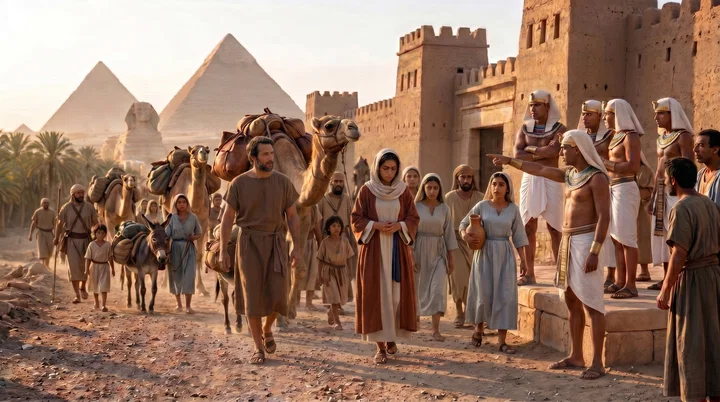
The princes also of Pharaoh saw her, and commended her before Pharaoh: and the woman was taken into Pharaoh’s house.
Translations
American King James Version, King James Version, KJV Cambridge Paragraph Bible
The princes also of Pharaoh saw her, and commended her before Pharaoh: and the woman was taken into Pharaoh’s house.
The princes also of Pharaoh saw her, and commended her before Pharaoh: and the woman was taken into Pharaoh's house.
Revised Version, American Standard Version
And the princes of Pharaoh saw her, and praised her to Pharaoh: and the woman was taken into Pharaoh’s house.
and princes of Pharaoh see her, and praise her unto Pharaoh, and the woman is taken [to] Pharaoh's house;
And the princes of Pharaoh saw her, and praised her to Pharaoh; and the woman was taken into Pharaoh's house.
And the princes of Pharaoh beheld her, and praised her unto Pharaoh,—so the woman was taken to the house of Pharaoh;
Berean Standard Bible, Majority Standard Bible
When Pharaoh’s officials saw Sarai, they commended her to him, and she was taken into the palace of Pharaoh.
The princes of Pharaoh saw her, and praised her to Pharaoh; and the woman was taken into Pharaoh’s house.
And Pharaoh's great men, having seen her, said words in praise of her to Pharaoh, and she was taken into Pharaoh's house.
And the Princes of Pharaoh sawe her, and commended her vnto Pharaoh: so the woman was taken into Pharaohs house:
Douay-Rheims (Challoner revision)
And the princes told Pharao, and praised her before him: and the woman was taken into the house of Pharao.
Pictures
Cross-references
- Genesis 20:2
And Abraham said of Sarah his wife, She is my sister: and Abimelech king of Gerar sent, and took Sarah.
Abraham again presented Sarah as his sister.
Commentary
Each commentary is drawn from primary sources: the writings of Ellen G. White and Adventist pioneers and periodicals. Each commentary is separate. Its own words are not a quotation; follow the references to read the source passages.
Ellen G. White
3 sources
This verse belongs to Abraham's trial during his sojourn in Egypt, where severe famine had driven him down from Canaan.Ms 19, 1886, par. 4PP 368.2 There Abraham acted as a representative through whom the God of heaven was revealed to the people.PP 368.2 In that setting God gave him favor with the Egyptians, so that he left Egypt with more than he had when he entered.Ms 19, 1886, par. 4 The episode records Abraham's sin in Egypt, where though favored by God he was overcome by temptation and sinned.ST May 31, 1910 His failure is recorded as a warning against wrongdoing and as encouragement that sinners can rise again through God's grace.ST May 31, 1910
Sources
Pioneers and periodicals
19 sources
The princes of Pharaoh saw Sarai, praised her beauty to Pharaoh, and she was taken into Pharaoh's house.ST Dec 29, 1909AUST Jun 14, 1920ST Mar 10, 1887 This happened when Abram had gone down to sojourn in Egypt because of famine and, in unbelief and failure to trust God's protecting care, called Sarah his sister to preserve himself.ST Jul 31, 1901AUST Jun 14, 1920ST Mar 10, 1887 God in overruling providence watched over His children and the promised Seed borne by Abraham, vindicating them by divine judgments that put fear upon the Egyptians until Pharaoh sent the household away enriched with great substance and goodwill.ST Jul 31, 1901ST Jan 2, 1912ST Dec 29, 1909ST Dec 20, 1910RH Mar 18, 1915 The wrong is recorded without approval as a stain on Abraham that brought reproach on the truth, warning that sin brings consequences, yet showing that though favored believers may be overcome they can rise again by God's grace while His cause remains pure.ST May 31, 1910AUST Jun 14, 1920RH Jan 2, 1913ST Jan 29, 1885ST Apr 7, 1881 It belongs to the covenant chapter in which God chose righteous Abraham and first promised him innumerable descendants, blessing to all nations through his seed, and the land forever.RH Nov 13, 1856ST Jan 21, 1913
Narrative Setting and Historicity
The princes of Pharaoh saw Sarai and praised her before Pharaoh, and she was taken into Pharaoh's house.ST Dec 29, 1909AUST Jun 14, 1920ST Mar 10, 1887ST Jan 29, 1885 It stands within God's care for the promised Seed and His providential dealing with His children.ST Dec 29, 1909 The taking occurred during Abram's sojourn in Egypt because of famine, after in unbelief and failure to trust God's protecting care he presented Sarah as his sister to preserve himself.ST Jul 31, 1901AUST Jun 14, 1920ST Mar 10, 1887ST Jan 29, 1885 His claim that she was his sister was a deception whose result was her removal into Pharaoh's house, and the wrongdoing is recorded without approval as a warning that sin brings consequences.AUST Jun 14, 1920ST Jan 29, 1885
The encounter ended with divine judgments manifested in Abraham's behalf, so that fear of him fell upon the Egyptians.ST Jul 31, 1901 Pharaoh then sent Abraham's household away on its journey with rich gifts and goodwill, and enriched by the gifts of the Egyptians he went out with great substance.ST Jul 31, 1901RH Mar 18, 1915
The verse belongs to the inspired, historically accurate record of the first fourteen chapters of Genesis, given by the Creator of the universe and not copied from Babylonian sources.ST Dec 7, 1915 Its truth is confirmed by voices out of ancient tombs and by the literatures and traditions of all civilized nations of antiquity, demolishing the criticism that this portion is impossible of truth and pure imagination.ST Dec 7, 1915 The similarities between Scripture and other ancient accounts exist because the early races of men took primeval traditions with them wherever they wandered, pointing to a time when the human race occupied a common home and held a common faith, of which the Genesis record is the purest, the least colored by extravagances, and the nearest to the original form.ST Dec 7, 1915 The account of Abraham's sojourn in Egypt reflects knowledge of Egypt and its customs, and its details accurately portray Egyptian customs and history.RH Nov 9, 1916
Covenant Providence and Prophecy
The taking of Sarai into Pharaoh's house belongs to Abram's sojourn and trials of faith, which are marked by repeated and remarkable evidence of God's overruling providence.ST Jan 2, 1912ST Dec 29, 1909ST Dec 20, 1910 It is part of God's providential dealing with His children and His care for the promised Seed.ST Dec 29, 1909ST Dec 20, 1910 It belongs to God's dealings with Abram from his call onward, set among repeated lessons in faith and examples of providential care.ST Jan 2, 1912ST Dec 20, 1910 It belongs to God's providential dealings with Abraham's family, whose chosen progenitor was the Seed.ST Dec 29, 1909ST
The chapter records the covenant God made with Abraham, who was chosen because he was righteous.RH Nov 13, 1856 God promised him innumerable descendants, that all nations would be blessed through his seed, and that they would inherit the land forever.RH Nov 13, 1856 It marks the first promise to Abraham.RH Nov 13, 1856ST Jan 21, 1913
God's call to Abraham in this chapter marks the beginning of the 430-year period of sojourning in Canaan and Egypt, dated to 1921 B.C.ST Aug 12, 1913ST Jan 21, 1913 The 430 years are counted from that promise to Israel's exodus from Egypt.ST Aug 12, 1913ST Jan 21, 1913 Adding 430 years to the year of Genesis 12 reaches the year of Exodus 20, fixing the time when the dispensation of law began.ST Aug 12, 1913RH Oct 8, 1857ST Jan 21, 1913
That chronology proves the law in Galatians 3 that commenced then and expired later in the midst of the seventieth week is not the moral law, because the moral law existed before Moses and continues after Christ.RH Oct 8, 1857 Coveting another man's wife already violated the tenth commandment before Sinai, as shown when Abraham's wife was taken into a foreign ruler's household.ST Jun 6, 1906RH Oct 8, 1857
Abraham went down into Egypt because of famine and sojourned there.ST Jul 31, 1901 Divine judgments were manifested in his behalf so that fear of him fell upon the Egyptians, and enriched by gifts of the Egyptians he went out with great substance.ST Jul 31, 1901 This matches the experience of his descendants centuries later, who also went down into Egypt because of famine, sojourned there, were vindicated by divine judgments that put fear upon the Egyptians, and went out enriched with great substance.ST Jul 31, 1901
Moral Warning and Witness
The taking of Sarai into Pharaoh's house after his princes saw her and commended her to him was the result of Abram's deception in calling her his sister, which came from his failure to trust God's protecting care to preserve him in Egypt.AUST Jun 14, 1920 It belongs to the record of his lack of faith and unbelief during his time in Egypt.AUST Jun 14, 1920RH Jan 2, 1913 His mistakes there left a stain on his character and brought reproach on the truth.ST Apr 7, 1881 His sin in Egypt shows that even one highly favored by God may be overcome by temptation and sin.ST May 31, 1910
The wrongdoing is set down without approval, as a warning that sin brings consequences.ST Jan 29, 1885 It stands as a warning against wrongdoing and at the same time as encouragement that sinners can rise again through God's grace.ST May 31, 1910 Though Abraham's course brought reproach, the cause of God itself remained in its native purity.ST Apr 7, 1881
Because of his lack of faith he was sent away from Egypt without extending the light of God to the Egyptians.RH Jan 2, 1913 Yet his sojourn, including the taking of his wife into Pharaoh's house, formed part of his witness to the living God in Egypt.
Sources