Genesis 12:16
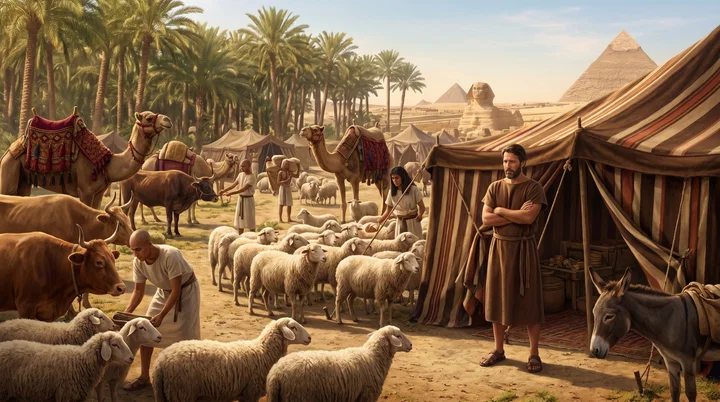
And he entreated Abram well for her sake: and he had sheep, and oxen, and he asses, and menservants, and maidservants, and she asses, and camels.
Translations
American King James Version, King James Version, KJV Cambridge Paragraph Bible
And he entreated Abram well for her sake: and he had sheep, and oxen, and he asses, and menservants, and maidservants, and she asses, and camels.
And he treated Abram well for her sake: and he had sheep, and oxen, and he-asses, and men-servants, and maid-servants, and she-asses, and camels.
And he entreated Abram well for her sake: and he had sheep, and oxen, and he-asses, and menservants, and maidservants, and she-asses, and camels.
And he dealt well with Abram for her sake: and he had sheep, and oxen, and he-asses, and men-servants, and maid-servants, and she-asses, and camels.
and to Abram he hath done good because of her, and he hath sheep and oxen, and he-asses, and men-servants, and handmaids, and she-asses, and camels.
And he treated Abram well on her account; and he had sheep, and oxen, and he-asses, and bondmen, and bondwomen, and she-asses, and camels.
and with Abram, dealt he well for her sake,—so that he came to have flocks and herds and he-asses, and men-servants, and maid-servants, and she-asses and camels.
Berean Standard Bible, Majority Standard Bible
He treated Abram well on her account, and Abram acquired sheep and cattle, male and female donkeys, menservants and maidservants, and camels.
He dealt well with Abram for her sake. He had sheep, cattle, male donkeys, male servants, female servants, female donkeys, and camels.
And because of her, he was good to Abram, and he had sheep and oxen and asses, and men-servants and women-servants, and camels.
Who intreated Abram well for her sake, and he had sheepe, and beeues, and hee asses, and men seruants and maide seruants, and shee asses, and camelles.
Douay-Rheims (Challoner revision)
And they used Abram well for her sake. And he had sheep and oxen, and he asses, and men servants and maid servants, and she asses, and camels.
Pictures
Cross-references
- Genesis 20
And Abraham journeyed from thence toward the south country, and dwelled between Kadesh and Shur, and sojourned in Gerar.
Abraham again passes Sarah off as his sister, and Abimelech gives him livestock and servants.
- Genesis 20:14
And Abimelech took sheep, and oxen, and menservants, and womenservants, and gave them unto Abraham, and restored him Sarah his wife.
Both describe a ruler giving servants to Abraham.
- Genesis 16:1
Now Sarai Abram’s wife bare him no children: and she had an handmaid, an Egyptian, whose name was Hagar.
Hagar is identified as an Egyptian handmaid.
Commentary
Each commentary is drawn from primary sources: the writings of Ellen G. White and Adventist pioneers and periodicals. Each commentary is separate. Its own words are not a quotation; follow the references to read the source passages.
Ellen G. White
3 sources
During the famine Abram went down into Egypt and was favored and treated well there for Sarai's sake.Ms 19, 1886, par. 4PP 368.2ST May 31, 1910 Pharaoh gave him sheep and oxen and he asses and menservants and maidservants and she asses and camels, livestock and servants added to his wealth.Ms 19, 1886, par. 4PP 368.2ST May 31, 1910 By those gifts he left Egypt with more possessions than he had brought in.Ms 19, 1886, par. 4
The episode placed Abraham among the peoples to whom God was revealed through his integrity and conduct.PP 368.2 It belongs to an account of deception and failure, honestly recorded to show how even a man favored by God could fall under temptation.ST May 31, 1910 That record stands to warn against sin and to encourage those who have fallen to rise again through God's grace.ST May 31, 1910
Sources
Pioneers and periodicals
20 sources
Pharaoh treated Abram well for Sarai's sake, enriching him with sheep, oxen, donkeys, camels, menservants and maidservants as he sent the household on its way.ST Dec 29, 1909RH Mar 10, 1863 This happened in Abram's first deception about Sarai, when from lack of trust in God's protecting care he said she was his sister, showing that even though he had obeyed God's call his faith was not yet perfect.AUST Jun 14, 1920ST Mar 10, 1887 The account belongs to God's providential care and favor toward Abram and his family as the chosen line through which the promised Seed would come.ST Dec 29, 1909ST Dec 20, 1910ST His lie was not approved by God but is recorded honestly as a stain on his character that brought reproach and consequences, warning against sin while encouraging those who have fallen to rise again by God's grace.ST May 31, 1910ST Apr 7, 1881ST Jan 29, 1885 Among those maidservants received in Egypt was perhaps Hagar the Egyptian, and Abram's departure enriched by gifts foreshadows how his descendants would later leave Egypt enriched by the Egyptians.ST Jul 31, 1901RH Oct 1, 1861
Words and Historical Setting
Pharaoh treated Abram well for Sarai's sake, enriching him with sheep and oxen and he-asses and menservants and maidservants and she-asses and camels.ST Dec 29, 1909RH Mar 10, 1863 The gifts made up great substance and added to the material wealth of Abraham's household.ST Jul 31, 1901RH Mar 18, 1915 They were sent with him as Pharaoh sent the household on its journey, given with goodwill.ST Jul 31, 1901RH Mar 18, 1915
The verse stands in the Abraham section of Genesis covering chapters 12-20.ST Aug 9, 1905 It stands at the beginning of the account of the covenant and promise made with Abraham, an account continuing onward through Genesis 26.RH Nov 13, 1856ST Jan 21, 1913 The chapter where it stands is where the promise to Abraham is found.ST Jan 21, 1913
It belongs to Abram's first deception about Sarai, when he said she was his sister.AUST Jun 14, 1920ST Mar 10, 1887 He did so from lack of trust in God's protecting care and from unbelief.AUST Jun 14, 1920ST Mar 10, 1887 Although he had obeyed God's call, his faith was not yet perfect, showing that even Abraham, the father of believers, did not always trust God.AUST Jun 14, 1920ST Mar 10, 1887
Among what Abram received in Egypt were menservants and maidservants, and Hagar the Egyptian handmaid was perhaps one of those maidservants given to him there.RH Oct 1, 1861 The details of the sojourn in Egypt are remarkably accurate and consistent with Egyptian customs and history.RH Nov 9, 1916 The objection that Pharaoh could not have given Abram sheep and oxen because Egyptians supposedly hated those animals is contradicted by evidence that sheep and oxen were present in Egypt.
Providence and Covenant Promise
Genesis 12:16 belongs to the account of God's providential dealings with Abram and His care and favor toward him and his family.ST Dec 29, 1909ST Dec 20, 1910ST That family was the chosen line through which the promised Seed would come.ST Dec 29, 1909ST The account forms part of repeated lessons in faith.ST Dec 20, 1910
Genesis 12:16 stands at the beginning of the account of the covenant God made with Abraham, an account continuing onward through Genesis 26.RH Nov 13, 1856 Abraham was chosen because he was righteous.RH Nov 13, 1856 The covenant promised him innumerable descendants, that through his descendants all nations shall be blessed, and that they shall inherit the land forever.RH Nov 13, 1856 The call and promise in this chapter mark the beginning of the 430-year sojourning of Abraham and his descendants in Canaan and Egypt, about 1921 B.C.ST Aug 12, 1913ST Jan 21, 1913 That period is counted as 215 years in Canaan and 215 years in Egypt.ST Aug 12, 1913
Pharaoh treated Abram well for Sarai's sake, giving him great substance with goodwill including livestock and servants, and sent the household on its journey.ST Jul 31, 1901ST Dec 29, 1909 Abram's departure from Egypt with these gifts recalls how his descendants would later leave Egypt enriched by gifts from the Egyptians after divine judgments caused the Egyptians to fear them.ST Jul 31, 1901 This was the time in Egypt when Abraham made the living God known to the Egyptians.
Doctrine and Moral Warning
The taking of Sarai described in Genesis 12:14-20 was coveting of another man's wife in violation of the tenth commandment, proving that the commandments were known and could be broken long before Sinai.ST Jun 6, 1906 When Genesis 12 is set beside Genesis 26:3-5, the charge that Abraham kept God's commandments and laws cannot be reduced to only three separate orders to leave his people, to walk through the land, and to offer Isaac, for such a limitation reverses cause and effect.RH Mar 25, 1858
The listing of male and female servants among sheep, oxen, donkeys, and camels shows that servants formed part of Abram's household possessions in Egypt, and the text is therefore evidence to be weighed in asking whether Abraham was a slaveholder.RH Mar 10, 1863RH Oct 1, 1861 Yet the word servants by itself does not mean enslaved persons and does not settle what kind of servitude they experienced, since that meaning must be established by context or by the usage of the time.RH Mar 10, 1863RH Oct 1, 1861
The enrichment belongs to Abram's lie and failure in Egypt, when Pharaoh treated him well for Sarai's sake with livestock and servants, and that wrongdoing was not approved by God.ST Apr 7, 1881ST Jan 29, 1885 It is recorded impartially and honestly, leaving a stain upon his character and bringing reproach upon the truth, while the cause of God itself remained pure, showing that sin brings consequences.ST Apr 7, 1881ST Jan 29, 1885 That failure stands in the Bible's honest record of how even a man favored by God could fall under temptation, and such accounts both warn against sin and encourage those who have fallen to rise again through God's grace.ST May 31, 1910
Sources