Genesis 12:14
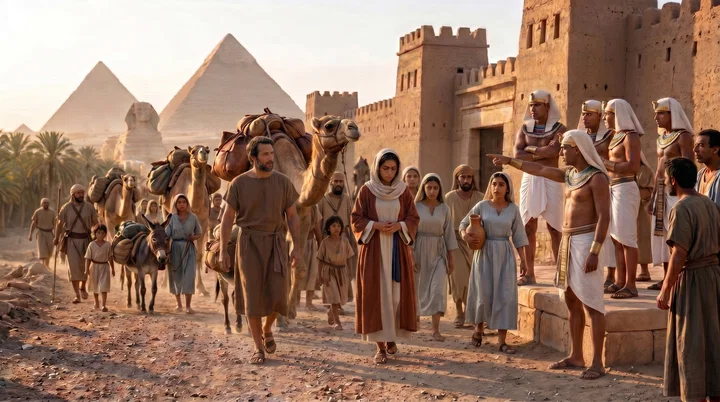
And it came to pass, that, when Abram was come into Egypt, the Egyptians beheld the woman that she was very fair.
Translations
American King James Version, King James Version, KJV Cambridge Paragraph Bible, Revised Version, American Standard Version
And it came to pass, that, when Abram was come into Egypt, the Egyptians beheld the woman that she was very fair.
And it came to pass, that when Abram had come into Egypt, the Egyptians beheld the woman that she was very fair.
And it cometh to pass, at the entering of Abram into Egypt, that the Egyptians see the woman that she [is] exceeding fair;
And it came to pass when Abram came into Egypt, that the Egyptians beheld the woman that she was very fair.
And so it was when Abram entered into Egypt, the Egyptians beheld the woman, that fair, was she exceedingly.
Berean Standard Bible, Majority Standard Bible
So when Abram entered Egypt, the Egyptians saw that the woman was very beautiful.
When Abram had come into Egypt, some Egyptians saw that the woman was very beautiful.
And so it was that when Abram came into Egypt, the men of Egypt, looking on the woman, saw that she was fair.
Nowe when Abram was come into Egypt, the Egyptians behelde the woman: for she was very faire.
Douay-Rheims (Challoner revision)
And when Abram was come into Egypt, the Egyptians saw the woman that she was very beautiful.
Pictures
Cross-references
- Genesis 20:2
And Abraham said of Sarah his wife, She is my sister: and Abimelech king of Gerar sent, and took Sarah.
Abraham again presents his wife Sarah as his sister.
- Genesis 12:1-9
Now the LORD had said unto Abram, Get thee out of thy country, and from thy kindred, and from thy father’s house, unto a land that I will shew thee:
Introduces Abram’s call and journey before his sojourn in Egypt.
- Genesis 13:8-11
And Abram said unto Lot, Let there be no strife, I pray thee, between me and thee, and between my herdmen and thy herdmen; for we be brethren.
Abram responds unselfishly to strife by allowing Lot to choose where to go.
Commentary
Each commentary is drawn from primary sources: the writings of Ellen G. White and Adventist pioneers and periodicals. Each commentary is separate. Its own words are not a quotation; follow the references to read the source passages.
Ellen G. White
3 sources
The arrival in Egypt came during another trial, when severe famine in the land led Abram to move down into Egypt.Ms 19, 1886, par. 4 When he arrived there, the Egyptians saw that his wife was very beautiful.PP 368.2 God gave him favor with the Egyptians, so that he left Egypt with more than he had when he went in.Ms 19, 1886, par. 4 By being in Egypt he served as a representative through whom God was revealed to its inhabitants.PP 368.2
The verse faithfully records his sin and human weakness instead of hiding the failings of a respected servant of God.ST May 31, 1910 Such honest records warn against sin by showing that even people entrusted with great responsibilities can yield to temptation.ST May 31, 1910 Their struggles and falls and their recovery through God's grace encourage later believers to renew the conflict and overcome.ST May 31, 1910
Sources
Pioneers and periodicals
18 sources
When Abram went down into Egypt to escape famine, the people there noticed that his wife was strikingly beautiful.ST Jul 31, 1901AUST Jun 14, 1920RH Mar 18, 1915 That notice belongs to his fearful presentation of her as only his sister, showing his trust in God's protecting care wavered, and it was sin that God did not approve, leaving a stain and reproach upon him.ST Dec 29, 1909AUST Jun 14, 1920ST Mar 10, 1887ST Apr 7, 1881ST Jan 29, 1885 Scripture tells the failure openly rather than hiding it, to warn against sin and to encourage believers that even greatly trusted servants can fall and yet recover by grace, while God in providence still guided and cared for the family that carried the promised Seed.ST May 31, 1910ST Jan 2, 1912ST Dec 29, 1909STST Apr 7, 1881 As with his descendants centuries later, the sojourn ended with divine vindication that brought fear upon the Egyptians and sent him out enriched with great substance from the heathen.ST Jul 31, 1901RH Mar 18, 1915 The coming into Egypt placed him as a witness to declare the living God amid gross idolatry, though those who held the other view taught that lack of faith led him to leave without sharing that light.RH Jan 2, 1913
Narrative Setting and History
When Abram came into Egypt during a sojourn caused by famine, the Egyptians beheld that Sarai was very beautiful.ST Jul 31, 1901AUST Jun 14, 1920RH Mar 18, 1915 That notice belonged to Abram's deception about her identity, which showed lack of trust in God's protecting care.AUST Jun 14, 1920 Through divine judgments manifested in his behalf fear of him fell upon the Egyptians, and enriched by gifts from the heathen he went out of Egypt with great substance.ST Jul 31, 1901 That Egyptian visit is connected with Pharaoh afterward sending Abram's household onward with rich gifts and goodwill.ST Jul 31, 1901RH Mar 18, 1915
The chapter belongs chronologically to God's call to Abraham in 1921 B.C., the starting point of the 430-year sojourn of Abraham and his descendants in Canaan and Egypt ending with the law at Sinai.ST Aug 12, 1913RH Oct 8, 1857 Of that sojourn 215 years were spent in each land.ST Aug 12, 1913
The account is true history, inspired by the Creator of the universe, not copied from Babylonian or other ancient sources.ST Dec 7, 1915 Its details about Egyptian customs and history are remarkably accurate, showing the writer knew Egypt and its customs.RH Nov 9, 1916 The first fourteen chapters of Genesis are confirmed in remarkable manner by the literature and traditions of ancient Babylon, Egypt, India, China, Persia, Japan, Siam, Greece, Rome, Mexico, Nicaragua, Brazil, Cuba, Borneo, Scandinavians, Tartars, North American Indians, South Sea Islanders and all civilized nations of antiquity.ST Dec 7, 1915 Their common elements point to a time when the human race occupied a common home and held a common faith, carried by early races wherever they wandered and presented today in different dresses, and among them the Genesis record is the purest, the least colored by extravagances, and the nearest to the original form.ST Dec 7, 1915 A voice out of the tombs of thirty centuries confirms the historical accuracy of Moses in this portion of Genesis and demolishes criticism that it is impossible of truth and pure imagination, reviving the credit and authority of the Bible against negative speculation.ST Dec 7, 1915
The verse stands at the beginning of the account of the covenant God made with Abraham, in which God chose Abraham because he was righteous.RH Nov 13, 1856 In that covenant God promised him innumerable descendants, blessing to all nations through them, and inheritance of the land forever.RH Nov 13, 1856 It belongs to God's providential dealings with Abraham's family, whose place in the history of the chosen line is tied to Abraham as progenitor of the promised Seed.RH Nov 13, 1856ST
Faith, Failure and Witness
The notice that the Egyptians saw Sarai was very beautiful belongs to Abram's deception in presenting Sarah as his sister, which showed lack of trust in God's protecting care and that his faith was not always strong.AUST Jun 14, 1920ST Mar 10, 1887 The incident was sin that God did not approve, for Abraham lied about Sarah, and that wrongdoing left a stain on his character and a reproach to the truth.ST Apr 7, 1881ST Jan 29, 1885 Sin in the account eventually bears consequences, warning that wrongdoing brings consequent punishment.ST Dec 29, 1909ST Jan 29, 1885 The Bible records this failure impartially rather than hiding the weakness of a respected servant of God.ST May 31, 1910ST Apr 7, 1881 Such records warn against sin and show that even people entrusted with great responsibilities can yield to temptation, while their struggles and falls and their recovery through God's grace encourage later believers to renew the conflict and overcome, and God's cause itself remained pure.ST May 31, 1910ST Apr 7, 1881
The sojourn in Egypt was one of Abram's early trials of faith in which God's providence guided him.ST Jan 2, 1912 It belongs to God's providential dealings with Abraham's family, whose place in the history of the chosen line is tied to Abraham as progenitor of the Seed, highlighting God's care for the promised Seed and His providential dealings with His children.ST Dec 29, 1909ST Abraham went down into Egypt on account of famine and sojourned there, and through divine judgments manifested in his behalf fear of him fell upon the Egyptians, so that enriched by gifts from the heathen he went out of Egypt with great substance.ST Jul 31, 1901RH Mar 18, 1915 This experience matches the later experience of his posterity centuries later, who likewise went down into Egypt on account of famine, sojourned there, were vindicated by divine judgments that brought fear upon the Egyptians, and went out enriched with great substance.ST Jul 31, 1901 The Egyptian visit connects that notice of Sarah's beauty with Pharaoh afterward sending Abraham's household onward with rich gifts and goodwill.RH Mar 18, 1915
The account through verse 20 shows the commandment against coveting was already known before Sinai, since Abraham's wife was desired by another man.ST Jun 6, 1906 Abraham's coming into Egypt was God sending a witness to declare the truth and make known the living God in a land filled with gross idolatry, proving God had not abandoned Egypt but sent His witnesses to it again and again. Yet Abram's lack of faith led him to leave Egypt without sharing the light of God with its people.RH Jan 2, 1913 The account is linked with Abraham and Sarah's human scheme to bring about God's promise through Hagar, which led to bondage and trouble rather than fulfilling God's plan, in contrast to God's promise fulfilled through Isaac by God's power.ST Sep 28, 1915
Sources