Genesis 12:20
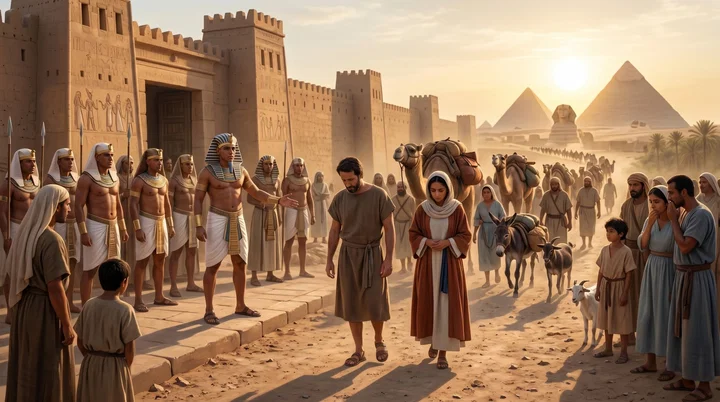
And Pharaoh commanded his men concerning him: and they sent him away, and his wife, and all that he had.
Translations
American King James Version, King James Version, KJV Cambridge Paragraph Bible, Webster Bible
And Pharaoh commanded his men concerning him: and they sent him away, and his wife, and all that he had.
Revised Version, American Standard Version
And Pharaoh gave men charge concerning him: and they brought him on the way, and his wife, and all that he had.
And Pharaoh chargeth men concerning him, and they send him away, and his wife, an all that he hath.
And Pharaoh commanded [ his] men concerning him, and they sent him away, and his wife, and all that he had.
And Pharaoh gave command concerning him unto certain men,—and sent him away, with his wife and all that he had.
Berean Standard Bible, Majority Standard Bible
Then Pharaoh gave his men orders concerning Abram, and they sent him away with his wife and all his possessions.
Pharaoh commanded men concerning him, and they escorted him away with his wife and all that he had.
And Pharaoh gave orders to his men, and they sent him on his way, with his wife and all he had.
And Pharaoh gaue men commandement concerning him: and they conueyed him forth, and his wife, and all that he had.
Douay-Rheims (Challoner revision)
And Pharao gave his men orders concerning Abram: and they led him away, and his wife, and all that he had.
Pictures
Cross-references
- Genesis 20:2
And Abraham said of Sarah his wife, She is my sister: and Abimelech king of Gerar sent, and took Sarah.
Abraham again says Sarah is his sister, and Abimelech takes her.
Commentary
Each commentary is drawn from primary sources: the writings of Ellen G. White and Adventist pioneers and periodicals. Each commentary is separate. Its own words are not a quotation; follow the references to read the source passages.
Ellen G. White
3 sources
A severe famine arose in the land as another trial for Abraham, and it caused him to move down into Egypt for a time.Ms 19, 1886, par. 4 When Pharaoh commanded his men concerning him and sent him away with his wife and all that he had, Abraham departed under that dismissal.Ms 19, 1886, par. 4 God had given him favor with the Egyptians, so that he left Egypt with more than he had when he went in.Ms 19, 1886, par. 4 That increase came not by his own scheming but by divine favor resting upon him even in a strange land.Ms 19, 1886, par. 4
The sojourn ending in this dismissal was one of the places where God revealed Himself to other nations through Abraham.PP 368.2 God called Abraham and prospered and honored him, and Abraham's fidelity was a light in every country where he stayed.PP 368.2 He did not shut himself away from the people around him but maintained friendly relations with the kings of the surrounding nations, by some of whom he was treated with great respect.PP 368.2 Through his integrity and unselfishness, his valor and benevolence, he represented the character of God, so that in Egypt the God of heaven was revealed through His representative.PP 368.2 Yet this same account belongs to the record of Abraham's sin under temptation, preserved to show that even those favored by God can fall into error and that their failures are recorded as warnings and lessons for later generations.ST May 31, 1910
Sources
Pioneers and periodicals
19 sources
Genesis 12:20 records that after his sojourn in Egypt during famine, Pharaoh ordered his men to send Abram out with his wife and household and all his possessions, enriched by the Egyptians.ST Jan 2, 1912ST Dec 29, 1909RH Jan 2, 1913 The expulsion followed Abram's deception in calling Sarai his sister, showing that even the father of believers did not yet trust fully in God's protection.AUST Jun 14, 1920RH Jan 2, 1913ST Mar 10, 1887 His fall under temptation is recorded impartially and not approved by God, to show that the favored of God can err to the reproach of the truth while God's cause remains pure, and to stand as a warning to later generations.ST May 31, 1910ST Dec 29, 1909ST Apr 7, 1881ST Jan 29, 1885 The chapter is where the covenant with Abraham begins with promise of innumerable descendants, blessing to all nations through his seed, and inheritance of the land, and through the whole trial God's providence overruled events in care for him and for the promised Seed.ST Jan 2, 1912ST Dec 29, 1909ST Dec 20, 1910RH Nov 13, 1856ST Jan 21, 1913 His going down into Egypt in famine and going out enriched through divine judgments bringing fear upon the Egyptians is a likeness of what his posterity would later experience when they sojourned in Egypt and came out enriched.ST Jul 31, 1901
Egypt Sojourn and Expulsion
Genesis 12:20 belongs to the account of Abram going down into Egypt on account of famine and sojourning there, and to his sojourn and trials of faith in which divine providence repeatedly overruled events for him.ST Jul 31, 1901ST Jan 2, 1912ST Dec 29, 1909 It records that Pharaoh commanded his men concerning him and ordered them to send Abram away with his wife and all that he had, with his possessions and substance and household.ST Jan 2, 1912ST Dec 29, 1909RH Jan 2, 1913RH Mar 25, 1858RH Mar 18, 1915 Through divine judgments manifested in his behalf fear fell upon the Egyptians, and enriched by gifts of the Egyptians he went out with great substance.ST Jul 31, 1901RH Mar 18, 1915 Pharaoh sent Abraham and his household on their journey with rich gifts and goodwill.RH Mar 18, 1915
The departure also illustrates providential care for the promised Seed and for His children even as people reap the consequences of sin.ST Dec 29, 1909 It stands in the larger comparison of Genesis 12 with Genesis 26:3-5, showing that Abraham's obedience involved more than leaving his people, traveling through the land, and offering Isaac, so that those three actions are not a substitute for keeping God's commandments.RH Mar 25, 1858 The Genesis account of patriarchal history to which the verse belongs is the inspired account of God's dealings with the human family up to the Exodus, given by Moses.ST Aug 11, 1914 The narrative of the sojourn in Genesis 12:10-20 including this verse is an accurate record of Egyptian customs and history reflecting familiarity with Egypt.RH Nov 9, 1916
Unbelief, Sin and Warning
The expulsion from Egypt followed Abram's deception in saying Sarai was his sister and passing her off as his sister, and that deception showed that his trust in God's protection was not yet complete.AUST Jun 14, 1920ST Mar 10, 1887ST Jan 29, 1885 His unbelief and lack of faith led to his being sent away by Pharaoh with his wife and all that he owned, and the episode shows that even Abraham, the father of believers, did not always trust God.AUST Jun 14, 1920RH Jan 2, 1913ST Mar 10, 1887 His sin in this deception was not approved by God but was recorded as a warning and brought consequences upon him.ST Jan 29, 1885 The taking of Abraham's wife in Genesis 12:14-20 is an example of coveting in violation of the tenth commandment, as taught by those who attributed this violation to Abimelech though the passage describes Pharaoh.ST Jun 6, 1906
Abraham's sin under temptation and mistake in Egypt was recorded impartially, to show that even people favored by God can fall into error.ST May 31, 1910ST Apr 7, 1881ST Jan 29, 1885 That failure left a stain on his character and a reproach to the truth, and brought consequences that men afterward still reap, while God's providential care for His children and for the promised Seed overruled in his behalf.ST Dec 29, 1909ST Apr 7, 1881ST Jan 29, 1885 Despite the failings of its professed friends, God's cause itself remained in its native purity.ST Apr 7, 1881 The record of such failures, including Abraham's sin, was preserved as a warning and lesson for later generations and was not to be taken as divine approval.ST May 31, 1910ST Jan 29, 1885
Through lack of faith Abraham departed without bringing Egypt the light of God.RH Jan 2, 1913 Those who held the other teaching held that during his time in Egypt Abraham made known the living God to the Egyptians.
Promise, Providence and Deliverance
Genesis 12 is where the covenant with Abraham begins and where God's first promise to him is found, given when he was chosen because he was righteous.RH Nov 13, 1856ST Jan 21, 1913 In that covenant God promised him innumerable descendants, that through his seed all nations would be blessed, and that his seed would inherit the land forever.RH Nov 13, 1856 The chronological date of this chapter is the starting point for counting 430 years to the giving of the law in Exodus 20 and to the departure of Israel from Egypt, marking the beginning of the dispensation of law.RH Oct 8, 1857ST Jan 21, 1913 The 400 years of affliction are counted separately, beginning 30 years later than the promise.ST Jan 21, 1913
The sending away with wife and all possessions belongs to Abram's sojourn and trials of faith, in which God's providence repeatedly overruled events.ST Jan 2, 1912ST Dec 20, 1910 It illustrates God's providential care for him and for His children, and for the promised Seed even as people reap the consequences of sin.ST Dec 29, 1909ST Dec 20, 1910 It belongs to the larger story from Genesis 12 to 21 in which Abraham failed to believe God's promise to bring forth the Seed through Sarah and tried to help by human scheming.ST Sep 28, 1915 He first looked to Eliezer of Damascus as heir and then, at Sarah's suggestion, fathered a child by Hagar the handmaid, which was not God's plan and led only to bondage and trouble.ST Sep 28, 1915 Hagar as a slave bears children to bondage, in contrast to Sarah the freewoman whose son Isaac came contrary to human order by the power and promise of God and represents the children of freedom saved in Christ Jesus through the new covenant.ST Sep 28, 1915
Abraham went down into Egypt on account of famine and sojourned there, and through divine judgments manifested in his behalf fear fell upon the Egyptians, so that enriched by their gifts he went out with great substance.ST Jul 31, 1901 This experience is a likeness of the experience of his posterity centuries later, who likewise went down into Egypt on account of famine and sojourned there, and through divine judgments in their behalf with fear falling upon the Egyptians went out enriched with great substance.ST Jul 31, 1901 Compared with Genesis 26:3-5, the chapter shows Abraham's obedience involved more than the three actions of leaving his people, traveling through the land, and offering Isaac.RH Mar 25, 1858 Those three actions therefore are not a substitute for keeping God's commandments.RH Mar 25, 1858
Sources