Genesis 12:19
Why saidst thou, She is my sister? so I might have taken her to me to wife: now therefore behold thy wife, take her, and go thy way.
Translations
Why said you, She is my sister? so I might have taken her to me to wife: now therefore behold your wife, take her, and go your way.
King James Version, KJV Cambridge Paragraph Bible
Why saidst thou, She is my sister? so I might have taken her to me to wife: now therefore behold thy wife, take her, and go thy way.
Why saidst thou, She is my sister? so I might have taken her to me for a wife: now therefore behold thy wife, take her, and go thy way.
Why saidst thou, She is my sister? so that I took her to be my wife: now therefore behold thy wife, take her, and go thy way.
why saidst thou, She is my sister, so that I took her to be my wife? now therefore behold thy wife, take her, and go thy way.
Why hast thou said, She [is] my sister, and I take her to myself for a wife? and now, lo, thy wife, take and go.'
Why didst thou say, She is my sister, so that I took her as my wife. And now, behold, there is thy wife: take [ her], and go away.
Wherefore saidst thou My sister, she; and so I was about to take her to me, to wife? But now, lo! thy wife take her and go thy way.
Berean Standard Bible, Majority Standard Bible
Why did you say, ‘ She is my sister,’ so that I took her as my wife? Now then, here is your wife. Take her and go!”
Why did you say, ‘ She is my sister,’ so that I took her to be my wife? Now therefore, see your wife, take her, and go your way.”
Why did you say that she was your sister? so that I took her for my wife: now, take your wife and go on your way.
Why saidest thou, She is my sister, that I should take her to be my wife? Nowe therefore beholde thy wife, take her and goe thy way.
Douay-Rheims (Challoner revision)
For what cause didst thou say, she was thy sister, that I might take her to my wife? Now, therefore, there is thy wife, take her, and go thy way.
Pictures
Cross-references
- Genesis 20:9
Then Abimelech called Abraham, and said unto him, What hast thou done unto us? and what have I offended thee, that thou hast brought on me and on my kingdom a great sin? thou hast done deeds unto me that ought not to be done.
Abimelech calls taking another man’s wife a great sin.
- Genesis 26:9-10
And Abimelech called Isaac, and said, Behold, of a surety she is thy wife: and how saidst thou, She is my sister? And Isaac said unto him, Because I said, Lest I die for her.
Abimelech warns that taking Isaac’s wife would bring guilt.
- Genesis 12:12-13
Therefore it shall come to pass, when the Egyptians shall see thee, that they shall say, This is his wife: and they will kill me, but they will save thee alive.
Abraham’s deception led Pharaoh to take Sarah and rebuke him.
- Genesis 12:1-3
Now the LORD had said unto Abram, Get thee out of thy country, and from thy kindred, and from thy father’s house, unto a land that I will shew thee:
God begins his dealings with Abraham and his family.
Commentary
Each commentary is drawn from primary sources: the writings of Ellen G. White and Adventist pioneers and periodicals. Each commentary is separate. Its own words are not a quotation; follow the references to read the source passages.
Ellen G. White
4 sources
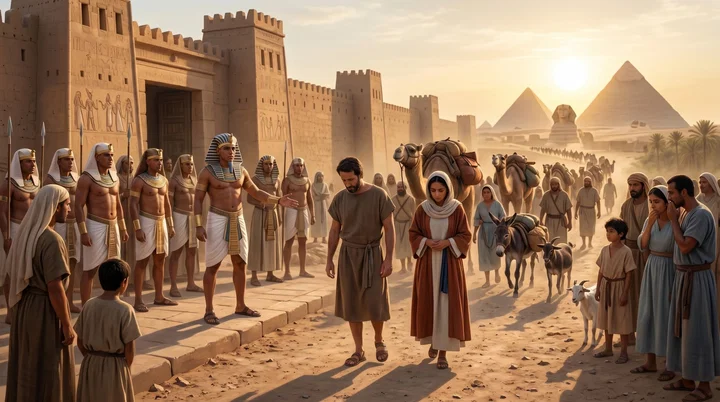
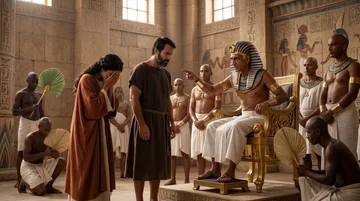
This rebuke belongs to Abraham's trial when severe famine came in the land and he went down into Egypt.Ms 19, 1886, par. 4 Pharaoh confronted him after learning that Sarah was his wife, charged him that calling her his sister had nearly led to taking her as wife, and commanded him to take his wife and go his way.PP 130.1–2 The confrontation shows that God had guarded the royal household from committing a great sin.PP 130.1–2 It also shows that Abraham's want of faith had placed Sarah in peril.PP 130.1–2
His sojourn in Egypt was one of the places where his life made God known to those around him by faithfulness and character.PP 368.2 The record proves that even a man charged with great responsibility and favored by God can give way to temptation and do wrong.ST May 31, 1910 In Egypt God gave him favor with the Egyptians, so that he came out with more than he had when he went in.Ms 19, 1886, par. 4
The keeping of this failure in Scripture stands as a warning and instruction to later generations.ST May 31, 1910 Those who believe and yet fall may take courage again and by God's grace rise above their evil nature and press on in the conflict.ST May 31, 1910
Sources
Pioneers and periodicals
23 sources
Pharaoh confronted Abram for hiding his marriage by calling his wife his sister, which nearly led to taking her as wife, so he gave her back to her husband and sent them away.ST Dec 24, 1912ST Dec 29, 1909AUST Jun 14, 1920 The rebuke shows that taking another man's wife was already known as a great sin bringing guilt on ruler and kingdom even when done in integrity of heart through deception.ST May 4, 1882RH Jan 15, 1875ST Jun 3, 1875 It proves the prohibition of adultery in the seventh commandment was understood and binding long before Sinai, not first made known there.ST May 4, 1882RH Aug 17, 1876ST Jun 3, 1875 Abram's deception came from failure to trust God's protection, showing even great faith can falter, and it brought reproach and harmful consequences for God's cause though it did not destroy it.ST Dec 29, 1909AUST Jun 14, 1920RH Jan 2, 1913ST Apr 7, 1881ST Jan 29, 1885 The record of his failing stands as a warning about sin and its punishment, yet also as encouragement that fallen believers can rise again by grace and continue on.ST May 31, 1910ST Jan 29, 1885
Pharaoh's Rebuke and Context
Pharaoh rebuked Abram for declaring Sarai to be his sister, saying the deception had nearly led him to take her as his wife, and he restored her to her husband and ordered Abram to take her and go his way.ST Dec 24, 1912ST Dec 29, 1909AUST Jun 14, 1920RH Jan 15, 1875ST Jun 3, 1875 She had been taken to be made a wife because of that claim, and when the truth became known Pharaoh confronted Abraham with what he had done.RH Jan 15, 1875ST Jun 3, 1875ST Apr 7, 1881 The rebuke exposed that Abraham's deception had brought reproach, showing that sin brings harmful consequences even when punishment is not immediate.ST Dec 29, 1909ST Apr 7, 1881
The verse stands in Genesis 12, which begins the account of the covenant made with Abraham, the righteous man chosen as progenitor of the Seed through providential dealings with his family.RH Nov 13, 1856ST In that covenant he was promised innumerable descendants, blessing to all nations through his seed, and inheritance of the land forever.RH Nov 13, 1856 Genesis 12 contains the promise from which the 430-year sojourning period is counted, with the 400-year period beginning thirty years after that promise.RH Oct 8, 1857ST Jan 21, 1913 Adding the 430 years to the chronological year of Genesis 12 reaches the chronological year of Exodus 20, fixing the beginning of the dispensation of law at Sinai long after Genesis 12.RH Oct 8, 1857
The verse belongs to Abraham's going down into Egypt to sojourn there because of famine, just as his descendants sojourned there centuries later.ST Jul 31, 1901 Divine judgments in his behalf caused fear of him to fall upon the Egyptians, and enriched by gifts sent with goodwill he went out of Egypt with great substance, foreshadowing Israel's deliverance.ST Jul 31, 1901RH Mar 18, 1915 Pharaoh sent Abraham's household on its journey with rich gifts after returning Sarah and ordering them to leave.RH Mar 18, 1915
The verse is part of a historically accurate record inspired by the Creator of the universe rather than a story copied from Babylonian sources.ST Dec 7, 1915 As part of the first fourteen chapters of Genesis it belongs to primeval traditions common to all civilized nations of antiquity, whose common elements point to a time when the race occupied a common home with a common faith, and the Genesis record preserves those traditions in their purest form, least colored by extravagance and nearest to the original form.ST Dec 7, 1915 Voices out of the tombs of thirty centuries confirm the historical accuracy of Moses in this portion and overturn the criticism that it is impossible of truth and pure imagination, reviving the credit and authority of the Bible.ST Dec 7, 1915 The account of Abraham's sojourn in Egypt is remarkably accurate in its details of Egypt and its customs, confirming that the writer knew Egypt.ST Dec 7, 1915RH Nov 9, 1916
Law Known Before Sinai
The rebuke shows the law against adultery was known and binding long before Sinai, for even a heathen ruler knew that to take another man's wife was sinful.RH Jan 15, 1875ST Jun 3, 1875RH Oct 18, 1853 He understood it as a great sin bringing guilt upon himself and his kingdom, and he held Abraham responsible for leading him toward that sin.RH Jan 15, 1875ST Jun 3, 1875RH Oct 18, 1853 Abraham's concealment that Sarah was his wife had put the king and his kingdom in danger of guilt, even when the taking was done in integrity of heart and innocency of hands through deception.ST May 4, 1882ST Jun 3, 1875 The weight of the teaching holds this ruler to be Pharaoh rebuking Abraham for saying Sarah was his sister so that she was taken to be made a wife and then restored to her husband and sent away, while those who held it of Abimelech teach it of Abimelech concealing that Sarah was his wife.ST May 4, 1882RH Jan 15, 1875ST Jun 3, 1875RH Oct 18, 1853
His rebuke for bringing another man's wife to him proves he understood the prohibition of the seventh commandment against adultery.RH Aug 17, 1876 The moral law substantially as later given from Mount Sinai was already enunciated and known in Genesis times and was not first made known at Sinai.RH Aug 17, 1876 Read with the order of God's calling of Abraham in Genesis 12 standing before Genesis 26:3-5 and Abraham's obedience, the verse helps prove the commandments and laws Abraham kept were not only to come out from his people, walk through the land, and offer Isaac.RH Mar 25, 1858 To reduce them to those three reverses cause and effect, for the Ten Commandments given on Sinai are the law in view, and keeping them under the covenant of grace develops better character than keeping only those three acts.RH Mar 25, 1858
Genesis 12 belongs to the chronological year to which Paul's 430 years are added to reach the chronological year of Exodus 20, and that calculation fixes the beginning of the dispensation of law at Sinai long after Genesis 12.RH Oct 8, 1857 Since the moral law already existed in Genesis times and still exists after Christ, the law of Galatians 3 that commenced at that later Sinai date and expired in the midst of the seventieth week must be some other law, not the moral law.RH Oct 8, 1857 The surrounding passage of Genesis 12:14-20 shows violation of the tenth commandment by coveting Abraham's wife, taught by those who hold the coveter to be Abimelech.ST Jun 6, 1906
Unbelief, Consequence and Warning
Abram's statement that Sarai was his sister came from unbelief and a failure to trust in divine protection, showing that even a great believer did not always exercise trust in God.AUST Jun 14, 1920RH Jan 2, 1913ST Mar 10, 1887 The deception nearly led Pharaoh to take her as wife, drawing Pharaoh's rebuke, the restoration of Sarai to her husband, and the order to take her and depart.ST Dec 29, 1909AUST Jun 14, 1920 That falsehood was an evil not approved by God, and it brought reproach upon the cause of God when the truth became known through Pharaoh taking Sarah into his house.ST Apr 7, 1881ST Jan 29, 1885
Sin in this account brings harmful consequences even where punishment is not immediate.ST Dec 29, 1909 Yet the failure did not destroy the cause of God, which remained pure despite the stain left upon Abraham's character.ST Apr 7, 1881 Because of lack of faith Abraham was sent away from Egypt without extending the light of God to the Egyptians.RH Jan 2, 1913 At the same time it is taught that during his time in Egypt Abraham made known the living God.
The record of the lie about Sarah and the punishment that followed stands as a warning concerning the sins of God's former servants.ST Jan 29, 1885 It preserves the failing of even a man entrusted with great responsibility and favored by God, who could yield to temptation and commit sin, as a lesson for later generations.ST May 31, 1910ST Jan 29, 1885 Believers who fall and commit sin may take heart again from it, for through God's grace they can rise above their evil nature and continue the struggle.ST May 31, 1910
Sources