Genesis 13:1
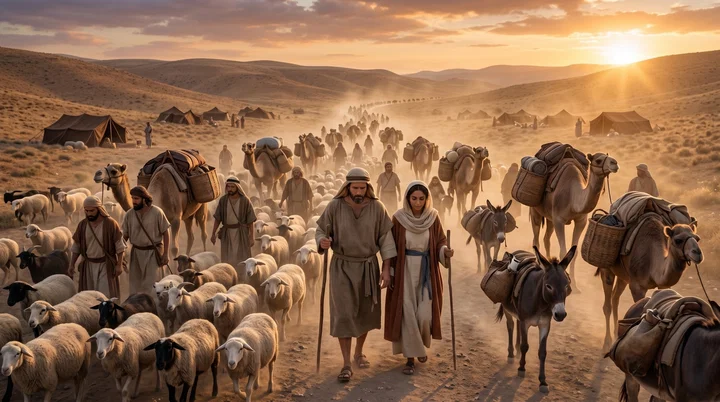
And Abram went up out of Egypt, he, and his wife, and all that he had, and Lot with him, into the south.
Translations
American King James Version, King James Version, KJV Cambridge Paragraph Bible
And Abram went up out of Egypt, he, and his wife, and all that he had, and Lot with him, into the south.
And Abram returned from Egypt, he, and his wife, and all that he had, and Lot with him, into the south.
Revised Version, American Standard Version
And Abram went up out of Egypt, he, and his wife, and all that he had, and Lot with him, into the South.
And Abram goeth up from Egypt (he and his wife, and all that he hath, and Lot with him) towards the south;
And Abram went up out of Egypt, he, and his wife, and all that he had, and Lot with him, towards the south.
So Abram came up out of Egypt he and his wife and all that he had and Lot with him, towards the South.
Berean Standard Bible, Majority Standard Bible
So Abram went up out of Egypt into the Negev— he and his wife and all his possessions— and Lot was with him.
Abram went up out of Egypt— he, his wife, all that he had, and Lot with him— into the South.
And Abram went up out of Egypt with his wife and all he had, and Lot with him, and they came in to the South.
Then Abram went vp from Egypt, he, and his wife, and all that he had, and Lot with him toward the South.
Douay-Rheims (Challoner revision)
And Abram went up out of Egypt, he and his wife, and all that he had, and Lot with him, into the south.
Pictures
Cross-references
- Genesis 13:9
Is not the whole land before thee? separate thyself, I pray thee, from me: if thou wilt take the left hand, then I will go to the right; or if thou depart to the right hand, then I will go to the left.
Abram offers Lot first choice of the land to avoid strife.
- Genesis 13:6-7
And the land was not able to bear them, that they might dwell together: for their substance was great, so that they could not dwell together.
Their great possessions left insufficient pasture, causing disputes between their herdsmen.
- Genesis 12:1-4
Now the LORD had said unto Abram, Get thee out of thy country, and from thy kindred, and from thy father’s house, unto a land that I will shew thee:
Abram is called to leave his country and kindred.
- Genesis 13:15
For all the land which thou seest, to thee will I give it, and to thy seed for ever.
The land is promised to Abram as an inheritance.
- Acts 7:2-5
And he said, Men, brethren, and fathers, hearken; The God of glory appeared unto our father Abraham, when he was in Mesopotamia, before he dwelt in Charran,
Recounts God’s promise to Abraham to give him the land.
- Hebrews 11:8-16
By faith Abraham, when he was called to go out into a place which he should after receive for an inheritance, obeyed; and he went out, not knowing whither he went.
Abraham leaves his former country and lives as a pilgrim, awaiting God’s promised inheritance.
- Genesis 14:1-15
And it came to pass in the days of Amraphel king of Shinar, Arioch king of Ellasar, Chedorlaomer king of Elam, and Tidal king of nations;
victory leads to vision of promise
Commentary
Each commentary is drawn from primary sources: the writings of Ellen G. White and Adventist pioneers and periodicals. Each commentary is separate. Its own words are not a quotation; follow the references to read the source passages.
Ellen G. White
2 sources
Abram went up out of Egypt into the south on the way toward Canaan, taking with him his wife and Lot and all that he had, being very rich in cattle and in silver and in gold.PP 132.1–2 Lot was still with him when they came again to Bethel and pitched their tents by the altar Abram had erected before.PP 132.1–2 Their increased possessions brought increased trouble, for the pasturage was not sufficient for the flocks and herds of both, and frequent disputes among their herdsmen had to be brought to their masters for settlement, making it evident that they must separate.PP 132.1–2
The account beginning here displays Abraham's noble, unselfish spirit in refusing to cling to individual rights and preferences in order to preserve peace with Lot, asking that there be no strife between them because they are brethren.PP 132.3 Brethren means not only natural relationship but fellow worshipers of the true God, showing that the children of God the world over are one family and that the same spirit of love and conciliation should govern them.PP 132.3 This calls for being kindly affectioned with brotherly love and in honor preferring one another, cultivating uniform courtesy and willingness to do to others as we would wish them to do to us, which would remove half the ills of life.PP 132.3 The spirit of self-aggrandizement is the spirit of Satan, but the heart where the love of Christ is cherished has charity that seeketh not her own and looks not only on its own interests but also on the interests of others.PP 132.3
Sources
Pioneers and periodicals
14 sources
Abram went up out of Egypt into the south with his wife and all that he had, and Lot with him, on his way back toward Bethel to the place where his tent had been at the beginning between Bethel and Hai.ST Jan 2, 1912ST Jan 20, 1887ST Jul 31, 1901 They left because they were no longer allowed to remain, moving back toward Canaan by slow daily marches across the uplands of the Negeb, as a great traveling caravan with immense wealth in household, herds and flocks.ST Aug 19, 1880ST Jan 20, 1887RH Apr 5, 1870 The verse opens the Lot part of Abraham's life, revealing the characters of Abram and Lot when their increased flocks and shared interests in water and pasture became hard to manage.ST Jan 2, 1912ST Aug 19, 1880ST Jul 31, 1901ST Aug 9, 1905 In that test Abram proved submissive, peace-loving, generous and unselfish while Lot proved selfish and covetous, and their separation was part of Abraham's gradual education in faith as he learned to trust God's promise instead of clinging to his kindred.ST Jan 2, 1912ST Jun 15, 1904ST Jul 31, 1901ST Aug 9, 1905 It belongs to God's providential dealings with Abraham as the chosen progenitor of the promised Seed, holding the larger promise of the whole world and the restored earth received through the righteousness of faith and to be realized through Christ, in whom those who believe become Abraham's heirs.STST Nov 11, 1930ST Jan 28, 1903
Return from Egypt
Abram went up out of Egypt into the south, he and his wife and all that he had, and Lot with him.ST Jan 2, 1912ST Jan 20, 1887ST Jul 31, 1901 He was on his way back toward Bethel to the place where his tent had been at the beginning, between Bethel and Hai.ST Jan 20, 1887ST Jul 31, 1901 They left Egypt because they were no longer allowed to remain there, traveling back toward Canaan by slow daily marches like an Arab tribe moving to new pasture grounds.ST Jan 20, 1887 Their route crossed the uplands of the Negeb or South Country, which was much more fertile then than now.ST Jan 20, 1887
The movement can be pictured as a large traveling caravan of people, animals, and household goods moving together.ST Jan 20, 1887ST Jul 31, 1901 Abram at this time had immense wealth, a large household, and vast herds and flocks.ST Aug 19, 1880ST Jul 31, 1901 Lot and his household also had great possessions with them when they left Egypt.RH Apr 5, 1870ST Jul 31, 1901
Character and Faith Tested
Genesis 13:1 begins the Lot part of Abraham's life, covering his whole experience with his nephew, with the word Lot summing up Genesis 13:1-18 and recalling especially the separation from Lot.ST Aug 19, 1880ST Aug 9, 1905 It opens an account that reveals the characters of Abram and Lot.ST Aug 19, 1880ST Jul 31, 1901 At this time Abram had immense wealth, a large household, and vast herds and flocks, so that water and pasture could become sources of difficulty.ST Aug 19, 1880 Returning from Egypt to Canaan with his wife, Lot, and great wealth, the increase in their flocks and herds brought their different characters into view when their shared property interests became difficult to manage.ST Jul 31, 1901
In that test Abram proved submissive, peace-loving, generous and unselfish, while Lot proved selfish and covetous.ST Jul 31, 1901 The chapter presents Lot's choice and Abram's unselfishness and their results.ST Jan 2, 1912 It shows Abram returning from Egypt to the south with his wife, everything he had, and Lot with him.ST Jan 2, 1912
Abraham's separation from Lot was part of his gradual education in faith.ST Jun 15, 1904 Although called to leave his kindred, he had continued to cling to Lot, and the separation eventually took place as he learned to trust God's promise.ST Jun 15, 1904
The chapter belongs to a period of Abraham's sojourn and trials of faith, during which God repeatedly showed His overruling providence.ST Jan 2, 1912 It belongs to Genesis 12 to 26, which records God's providential dealings with the family of Abraham as the chosen progenitor of the promised Seed.ST It continues the purpose of Genesis as a history of the beginning of things and a story of God's dealing with the Seed and the enemy's attempts to thwart God's plan, connected with the great facts of Creation, the Fall, the Seed, and the Deluge that run through the Bible.ST It falls within the account of Abraham and Sarah's attempts to secure by human planning what God had promised, showing how such schemes led to bondage and trouble, while God's promise was fulfilled through Isaac.ST Sep 28, 1915
Promise and Covenant Context
Genesis 12 to 26 records God's providential dealings with the family of Abraham as the chosen progenitor of the promised Seed.ST It continues the purpose of Genesis as a history of the beginning of things and a story of God's dealing with the Seed and the enemy's attempts to thwart God's plan, connected with the great facts of Creation, the Fall, the Seed, and the Deluge that run through the Bible.ST The chapter containing this return from Egypt comes before the account in Genesis 14:1 to 15:4 of Abraham's great victory over the five kings, after which the vision containing God's promise to Abraham was given.ST Aug 7, 1901
Genesis 13 holds God's larger promise to Abraham of an inheritance understood as the world and the restored and new earth, not merely the earthly land of Canaan.ST Nov 11, 1930ST Jan 28, 1903 As Romans 4:13 explains, that promise encompassed the whole world.ST Jan 28, 1903 Abraham received it through the righteousness of faith and lived as a pilgrim looking forward to its fulfillment in the heavenly country and God's city.ST Nov 11, 1930 It is to be realized through his seed, identified as Christ, so that those who belong to Christ by faith share in it as Abraham's heirs.ST Jan 28, 1903
Sources