Genesis 2:19
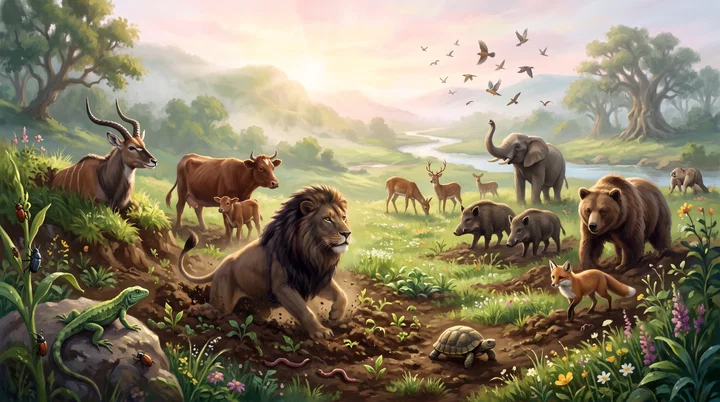
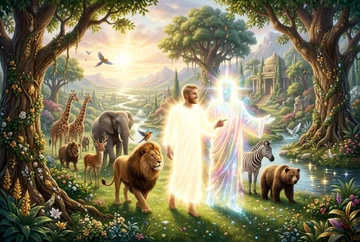
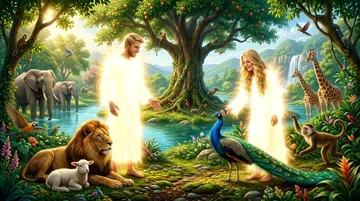
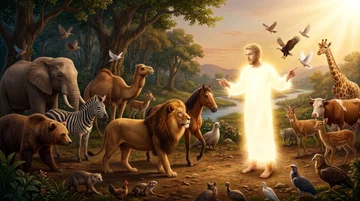
And out of the ground the LORD God formed every beast of the field, and every fowl of the air; and brought them unto Adam to see what he would call them: and whatsoever Adam called every living creature, that was the name thereof.
Translations
And out of the ground the LORD God formed every beast of the field, and every fowl of the air; and brought them to Adam to see what he would call them: and whatever Adam called every living creature, that was the name thereof.
And out of the ground the LORD God formed every beast of the field, and every fowl of the air; and brought them unto Adam to see what he would call them: and whatsoever Adam called every living creature, that was the name thereof.
And out of the ground the Lord God formed every beast of the field, and every fowl of the air; and brought them unto Adam to see what he would call them: and whatsoever Adam called every living creature, that was the name thereof.
And out of the ground the LORD God formed every beast of the field, and every fowl of the air, and brought them to Adam to see what he would call them; and whatsoever Adam called every living creature, that was its name.
And out of the ground the LORD God formed every beast of the field, and every fowl of the air; and brought them unto the man to see what he would call them: and whatsoever the man called every living creature, that was the name thereof.
And out of the ground Jehovah God formed every beast of the field, and every bird of the heavens; and brought them unto the man to see what he would call them: and whatsoever the man called every living creature, that was the name thereof.
And Jehovah God formeth from the ground every beast of the field, and every fowl of the heavens, and bringeth in unto the man, to see what he doth call it; and whatever the man calleth a living creature, that [is] its name.
And out of the ground Jehovah Elohim had formed every animal of the field and all fowl of the heavens, and brought [ them] to Man, to see what he would call them; and whatever Man called each living soul, that was its name.
Now Yahweh God had formed from the ground every living thing of the field and every bird of the heavens, which he brought in unto the man, that he might see what he should call it,—and, whatsoever the man should call it—any living soul, that, should be the name thereof.
Berean Standard Bible, Majority Standard Bible
And out of the ground the LORD God formed every beast of the field and every bird of the air, and He brought them to the man to see what he would name each one. And whatever the man called each living creature, that was its name.
Out of the ground the LORD God formed every animal of the field, and every bird of the sky, and brought them to the man to see what he would call them. Whatever the man called every living creature became its name.
And from the earth the Lord God made every beast of the field and every bird of the air, and took them to the man to see what names he would give them: and whatever name he gave to any living thing, that was its name.
So the Lord God formed of the earth euery beast of the fielde, and euery foule of the heauen, and brought them vnto the man to see howe he would call them: for howsoeuer the man named the liuing creature, so was the name thereof.
Douay-Rheims (Challoner revision)
And the Lord God having formed out of the ground all the beasts of the earth, and all the fowls of the air, brought them to Adam to see what he would call them: for whatsoever Adam called any living creature the same is its name.
Pictures
Cross-references 20 of 28
- Genesis 1:26-28
And God said, Let us make man in our image, after our likeness: and let them have dominion over the fish of the sea, and over the fowl of the air, and over the cattle, and over all the earth, and over every creeping thing that creepeth upon the earth.
Humanity is created and given dominion over the animals on the sixth day.
- Genesis 2:7
And the LORD God formed man of the dust of the ground, and breathed into his nostrils the breath of life; and man became a living soul.
Both use the same term for Adam and animals as living creatures.
- Genesis 3:1-6
Now the serpent was more subtil than any beast of the field which the LORD God had made. And he said unto the woman, Yea, hath God said, Ye shall not eat of every tree of the garden?
The serpent tempts Eve, and Adam and Eve disobey, introducing sin and the fall.
- Genesis 1:24
And God said, Let the earth bring forth the living creature after his kind, cattle, and creeping thing, and beast of the earth after his kind: and it was so.
Uses the same Hebrew phrase for land animals.
- Genesis 1:30
And to every beast of the earth, and to every fowl of the air, and to every thing that creepeth upon the earth, wherein there is life, I have given every green herb for meat: and it was so.
Both describe animal life and its place in the original provision.
- Genesis 1:1-2
In the beginning God created the heaven and the earth.
The general creation account precedes the more particular account.
- 1 Corinthians 15:45
And so it is written, The first man Adam was made a living soul; the last Adam was made a quickening spirit.
Calls Adam the first man and a living soul.
- 1 Timothy 2:13-14
For Adam was first formed, then Eve.
Paul refers to Adam’s formation and Eve’s transgression.
- Genesis 5:1-2
This is the book of the generations of Adam. In the day that God created man, in the likeness of God made he him;
Both texts describe God’s creation of Adam and Eve.
- Genesis 1:21
And God created great whales, and every living creature that moveth, which the waters brought forth abundantly, after their kind, and every winged fowl after his kind: and God saw that it was good.
Both texts call animals “living creatures.”
- Genesis 1:27
So God created man in his own image, in the image of God created he him; male and female created he them.
Both texts describe the creation of the same Adam.
- Genesis 3:20
And Adam called his wife’s name Eve; because she was the mother of all living.
Eve is named as the mother of all living.
- Genesis 9:10
And with every living creature that is with you, of the fowl, of the cattle, and of every beast of the earth with you; from all that go out of the ark, to every beast of the earth.
Both texts refer to living animals.
- Genesis 9:12
And God said, This is the token of the covenant which I make between me and you and every living creature that is with you, for perpetual generations:
Both texts use “living creature” for living animals.
- Genesis 9:16
And the bow shall be in the cloud; and I will look upon it, that I may remember the everlasting covenant between God and every living creature of all flesh that is upon the earth.
Both texts use “living creature” for beings on earth.
- Isaiah 40:26
Lift up your eyes on high, and behold who hath created these things, that bringeth out their host by number: he calleth them all by names by the greatness of his might, for that he is strong in power; not one faileth.
Adam names the creatures; God names and numbers the heavenly host.
- Psalms 147:4
He telleth the number of the stars; he calleth them all by their names.
Adam names the creatures; God names all the stars.
- Genesis 2:23
And Adam said, This is now bone of my bones, and flesh of my flesh: she shall be called Woman, because she was taken out of Man.
both show Adam learning creation firsthand
- Genesis 2:8-9
And the LORD God planted a garden eastward in Eden; and there he put the man whom he had formed.
Describes Eden and its trees, which Adam sees again.
- Luke 3:38
Which was the son of Enos, which was the son of Seth, which was the son of Adam, which was the son of God.
Both texts identify Adam as the son of God and connect him with creation.
Commentary
Each commentary is drawn from primary sources: the writings of Ellen G. White and Adventist pioneers and periodicals. Each commentary is separate. Its own words are not a quotation; follow the references to read the source passages.
Ellen G. White
16 sources
God formed every beast of the field and every fowl of the air out of the ground and brought them to Adam to see what he would call them, and whatever Adam called every living creature became its name.CE 207.1–208.1ST Jan 23, 1879 Adam named them from personal knowledge of their nature and habits, taught directly by the Creator, showing an intellect little less than angels.CE 207.1–208.1PP 50.3–51.1 This took place in Eden when humanity stood upright in holy innocence in communion with God and sinless angels.ST Oct 15, 1896MYP 254.2–255.1 The bringing of the creatures to Adam led to God giving Eve to Adam as his helpmeet and companion, Himself instituting and celebrating the first marriage.ST Nov 10, 1914ST Oct 15, 1896ED 250.2 Marriage thus has the Creator of the universe for its originator, honorable and designed to bless humanity, with God's order that one man be joined to one wife for all who should live upon the earth, while a plurality of wives is contrary to His wise arrangement and increases wickedness and wretchedness.ED 250.21SP 68.1SA 63.2PP 46.3PP 91.3
Eden Setting and Naming
The verse belongs to the creation account in which God formed every beast of the field and every fowl of the air out of the ground and brought them to Adam to see what he would call them, and whatsoever Adam called every living creature became its name.CE 207.1–208.1ST Jan 23, 1879 God thus brought the animals to Adam, and Adam named each living creature, with the naming expressing Adam's appointed role in the original creation and God's provision for him.CE 207.1–208.1ST Jan 23, 1879 Adam gave each its name from personal knowledge, for he was familiar with their nature and habits and acquainted with every living creature from the mighty leviathan among the waters to the insect mote in the sunbeam.CE 207.1–208.1PP 50.3–51.1 That familiarity was part of learning the laws and operations of nature, and the naming reflected his firsthand knowledge of the created world.CE 207.1–208.1PP 50.3–51.1 His naming came from direct instruction by the Creator and proves intellectual power but little less than angels.PP 50.3–51.1
The setting was Eden when humanity was upright and innocent.ST Oct 15, 1896MYP 254.2–255.1 There man's first parents lived in holy innocence in the inspired history of Eden.MYP 254.2–255.1 They enjoyed communion with God and sinless angels before sin and its consequences entered.MYP 254.2–255.1
Marriage Institution Established
The bringing of the beasts of the field and fowls of the air to Adam belongs to the same creation account in which God established marriage by giving Eve to Adam as his helpmeet and companion.ST Nov 10, 1914ST Oct 15, 1896ED 250.2SA 63.2 God Himself instituted and celebrated that first marriage in Eden, and the Eden home was set forth as the model for family life.ST Nov 10, 1914ST Oct 15, 1896ED 250.2PP 46.3 The naming of the living creatures expressed Adam's place in the original creation and God's provision for him, and alongside that provision God gave him Eve as his companion.ST Jan 23, 1879PP 46.3
Marriage has for its originator the Creator of the universe, it is honorable, it was one of the first gifts of God to man, and it was designed by Heaven to bless humanity.SA 63.2PP 46.3 It is one of the two institutions that Adam brought with him beyond the gates of Paradise after the fall.PP 46.3 By giving Adam one wife at the beginning, God showed to all who should live upon the earth His order and law that marriage is one man with one wife.1SP 68.1PP 91.3 That divine arrangement for one man with one wife established His order in that respect.1SP 68.1PP 91.3
A plurality of wives and polygamy are contrary to God's wise arrangement and change His order.1SP 68.1PP 91.3 Polygamy was introduced early after the fall when men chose to follow their own sinful and carnal desires against that order.1SP 68.1PP 91.3 Following carnal desires brought sin and wretchedness upon the human race, and the more men multiplied wives to themselves the more they increased in wickedness, unhappiness, sin and wretchedness.1SP 68.1PP 91.3
Adam's love for the companion given him was so strong that after she disobeyed he chose to share her fate rather than be separated from her.ST Jan 23, 1879 Marriage as God Himself instituted it in giving Eve to Adam is lawful and not sinful in itself, but the fulfillment of duty.Ms 24, 1891, par. 42–43 All God's laws are marvelously adapted to meet the nature of man, and the sin is in perverting that which in itself is lawful and corrupting God's gifts by using them to minister to selfish desires.Ms 24, 1891, par. 42–43 When divine principles are recognized and obeyed in this relation, marriage is a blessing that guards the purity and happiness of the race, provides for man's social needs, and elevates the physical, the intellectual, and the moral nature.PP 46.3
Fall and Restoration Hope
The Eden home shown in the verse is the home where Adam and Eve transgressed God's law and fell into the hands of Satan.Ms 84, 1886, par. 5–6 Jesus paid the price to ransom humanity from Satan so that humanity is brought back to that Eden home.Ms 84, 1886, par. 5–6 That return comes by perfect obedience to all of God's requirements, overcoming as Christ overcame by keeping His Father's commandments.Ms 84, 1886, par. 5–6 Adam stood in that Eden in innocence with unfallen human nature, and for the Son of God to take even that innocent nature would have been an almost infinite humiliation.ST Dec 9, 1913 Instead Jesus accepted humanity as weakened and defiled by four thousand years of sin, accepting like every child of Adam the results of heredity, to share human sorrows and temptations and to give the example of a sinless life.ST Dec 9, 1913
Adam's naming of living creatures was done while innocent, and that naming extended also to the flowers and trees of Eden.SG3 88.2–89.1 When Adam is restored to Eden he sees again the beauty of the garden he once knew.SG3 88.2–89.1 He had been placed among the beasts of the field and birds of the air in the Garden of Eden in a state of perfect happiness, without worry.Ms 85, 1899, par. 22–23 The Garden was an emblem of heaven and of the love of God, with beautiful fragrant flowers, fruit trees bearing precious treasures for the good of man, and birds caroling songs of praise to God from every tree, which Adam in untainted purity delighted to hear.Ms 85, 1899, par. 22–23 Those sights and sounds are what God still wants men and women to rejoice in today, reposing joyfully in His goodness, mercy, and love and filled with the peace of heaven, rather than being crowded into cities in terraces and tenements.Ms 85, 1899, par. 22–23 Crowded city life with its care and anguish that rends hearts is not in His order but comes from sin marring His purpose, and His purpose is that the image of God be impressed anew upon souls, that sinners be converted, and that His people delight again in the sights and sounds He made.Ms 85, 1899, par. 22–23
Sources
Pioneers and periodicals
129 sources
Out of the ground God formed every beast of the field and every fowl of the air and brought them to Adam to see what he would call them, and whatever Adam called every living creature became its appointed name.ST Jun 30, 1898RH Mar 26, 1867RH Dec 29, 1868RH Jun 12, 1860ST Jul 14, 1881 This forming, bringing, and naming took place on the sixth day, Adam's first day, after he was placed in Eden and before Eve was created, occupying several hours of that busy working day.ST May 22, 1879ST Jul 23, 1894ST May 22, 1879 Adam knew at sight the nature, habits, and character of every living thing and gave names expressing what each creature was like, showing perfect mind in unison with the Creator, complete language, and dominion over a sinless creation without death or bloodshed.ST Mar 30, 1904ST Sep 17, 1902ST Mar 11, 1897RH Jun 22, 1916RH Dec 25, 1900 Among all those creatures there was found no helpmeet answering to Adam, revealing his aloneness and why God would make woman, and thus the passage belongs to the institution of marriage in Eden as the sacred union of one man and one woman before sin.ST Oct 15, 1896ST Jun 30, 1898ST May 22, 1879ST May 22, 1879ST Oct 16, 1879 It belongs to the second detailed account of the one creation, literal true history as written, not myth or allegory, with Genesis 1 giving the general account and Genesis 2 the particular account of man, woman, and the Garden without contradiction.ST Apr 7, 1914ST Aug 9, 1910ST Jul 28, 1881ST Jan 31, 1911 Living creature renders Hebrew nephesh chaiyah, living soul, the same term used for man in Genesis 2:7, so beasts and man are formed of the same dust and share the same breath of life, and being called a living soul does not by itself prove possession of an immortal spirit assured of future life.ST Jan 30, 1879ST Oct 19, 1882RH Jun 8, 1916ST Jun 28, 1899RH Aug 29, 1854
Account Setting and Historicity
Genesis 2:19 belongs to the second account of the one creation, not to a separate creation, and the two accounts do not contradict each other.ST Aug 9, 1910ST Jan 31, 1911STST Oct 13, 1909 Genesis 1:1 through Genesis 2:3 gives the general concise account of the six days, while Genesis 2:4-25 gives the particular full detailed account concerning the first man and woman, their home, and the Garden, and the difference between whole and part is no contradiction.ST Aug 9, 1910ST Jan 31, 1911STST Oct 13, 1909ST Feb 28, 1911 Genesis 1 is the summary of the work of the six days with God's satisfaction in Genesis 1:31 that the completed work was very good, and Genesis 2:19 stands at the stage after man alone was created and before woman was made, when man was not complete and God's great plan was not yet filled out.ST Oct 13, 1909ST Feb 28, 1911 The statement that all was very good came after both man and woman were made, so there is no contradiction, and consecutive chapters do not always mean consecutive time.ST Oct 13, 1909 Genesis 2:7-25 gives the more detailed account of the sixth day of creation, focusing on the creation of the first man and woman.ST Feb 28, 1911
Genesis 2:19 falls within the creation account, which Genesis 1-2 presents as covering the creation of the world and its life, the Sabbath, and marriage.ST Aug 9, 1905 Genesis 1 is the general description of the world and Genesis 2 focuses in detail on Adam and Eve preliminary to their test and fall, and Genesis 2:18-23 does not describe a second creation but gives the detailed account of the creation of the first man and woman already given in Genesis 1.ST Aug 9, 1905ST Feb 28, 1911ST Jan 9, 1896 Genesis 2:19 belongs to the opening chapters of Genesis, which present the creation account as real history rather than merely a religious poem or story.ST Apr 7, 1914 The earth, the man, the garden, and the forming of the animals and their bringing to Adam to name all actually happened as stated, and Genesis 2:4-24 concerning the first man and woman is just as literal as the first chapter.ST Jan 31, 1911
The account is literal true history of what actually happened, to be believed as written and meant as it says, not myth, poetry, allegory, fable, legend, or hidden mystic sense.ST Apr 7, 1914ST Jan 28, 1903ST Jan 6, 1887ST Nov 25, 1889 It means exactly what it says and is to be understood and believed as written rather than set aside as too deep for theology, for it lies within theology's proper field along with the first and second chapters of Genesis, and surrendering its plain meaning to science leaves theology with neither true science nor true theology.ST Jan 6, 1887 Moses wove patriarchal narratives with artless truthfulness leaving each to tell its own story.ST Jul 28, 1881ST Aug 25, 1881 Genesis 2 more fully gives the creation of the first pair, their temptation, fall, and reception of the penalty, and is literal, clear, true history to be believed, not a false mortal and material history opposite to truth. It is a true record of creation, not a picture of error throughout and not a myth, presenting the real Adam, whose name is the Hebrew word for man in Genesis 1:26, 27, made in the image and likeness of God as part of the creation God pronounced very good, to whom dominion and inheritance over the earth were truly given.ST Jan 28, 1903
One hostile reading rejects the account as a lie that portrays God as repeating creation, but the verse records God bringing the creatures he had formed to Adam and giving Adam the role of naming them as true record of the real Adam.ST Jan 28, 1903RH Jun 22, 1911 The creation and fall record in Genesis 1-3 was received by divine inspiration and revelation from God, not mere tradition accepted and recorded by Moses, and its credibility rests on faithfully reporting what occurred.ST Jul 28, 1881ST Jul 28, 1881ST Aug 25, 1881 Its truth supports the authority of the fourth commandment and the other commandments, and if the creation account in Genesis 1 and 2 is false, the commandments that claim to come from God and the whole system of morality and religion lose their foundation.ST Jul 28, 1881 Genesis 1 and 2 are inseparably connected with the fourth commandment so that denying their literal truth undermines the commandment's basis and the ability to know which day was first kept as the Sabbath, and the literal historical character of the account makes it possible to identify the original Sabbath day.ST Aug 25, 1881ST Aug 25, 1881
Rejecting the creation and fall account is linked to rejecting other doctrines and the Bible and its teachings.ST Jan 3, 1911 That Mosaic account is factual truth and not fable, upheld as fact all through the Bible, with Christ and his apostles often referring to it as accepted truth, and interwoven into the very warp and woof of Bible doctrine and history.RH Apr 1, 1909 The geological and Darwinian doctrine of evolution that teaches man advanced through evolutionary processes from ape and animal creations to his present eminence sets this account aside and denies the Bible as a book of authority.RH Apr 1, 1909 To disown the creation account undermines the whole Bible structure of doctrine and authority, including the fall of man because of disobedience in the garden of Eden as the foundation of Christian theology and the grand Bible doctrine of the atonement by a Saviour coming to suffer and die to rescue the fallen race, which Christ declared he came to accomplish, and destroys the credibility of the Bible revelation.RH Apr 1, 1909 This denial marks the spiritual blindness of modern Babylon under blind leaders of the blind, progressing toward becoming the habitation of devils and the hold of every foul spirit.RH Apr 1, 1909
Disbelieving that Mosaic account would require treating Moses as either an honest but extremely credulous man or a deliberate deceiver, and treating the other Bible writers and Christ as either blindly following him or joining in deception.ST Jul 28, 1881 Its historical accuracy is supported by ancient traditions and evidence from monuments, among which Genesis 2 recording the formation of animals and their being brought to Adam for naming is cited among the early chapters.ST Dec 7, 1915 The Karen traditions are said to agree in essentials with the biblical account of creation, including the creation of a sinless pair in the garden, the fall, and the Flood.ST Oct 31, 1911ST Jul 25, 1911 Genesis 2:19 belongs to the account of the earth and humanity before the fall, told in detail in Genesis 2:4-25, included in the account of Eden before sin entered the world when Adam and Eve were in primeval innocence and the first three chapters of Genesis show sin entered through their fall when they yielded to temptation.ST Dec 20, 1910ST Mar 24, 1881
The verse belongs to the beginning of the highly favored antediluvian world, when Adam conversed with God in Paradise and then lived for almost one thousand years with succeeding generations as a living witness to truth and righteousness.RH Dec 17, 1861 It belongs to the account of Eden, the beautiful home God made for Adam and Eve, where they had everything needed for happiness and enjoyed God's presence, and after they disobeyed they were driven from that home.ST Mar 30, 1904 It belongs to humanity's first days in Eden in innocence, purity, and love in which Adam lived with a companion and learned language from God.RH Jul 5, 1915 Paradise, the Garden of Eden or Garden of God, was once on this earth, is now in the third heaven by the throne of God, and will be on this earth again when the New Jerusalem comes down, proving Paradise is the abode of the living only and not the abode of the dead.ST Jun 16, 1898
Genesis 2 presents Eden as Paradise, which is the same as the city above, the bride, the Jerusalem above that is the mother of us all because man was created from it.ST Sep 23, 1875 It became desolate when Adam was excluded from it and will remain desolate until its original possessor returns through the Mediator to claim its glories.ST Sep 23, 1875 The verse belongs to the account of the original world before the Flood, whose geography was later obliterated by a great cataclysm, so present-day places and rivers cannot be identified with those of Eden merely because they share names.ST Nov 28, 1906ST Mar 17, 1909 The Garden of Eden was planted upon this earth, including the description of four rivers, but the river names were given because of their meaning describing their streams and not as proper names to indicate present locality, and that whole world arrangement perished when overflowed with water in the Deluge, so the present arrangement of the earth's surface cannot prove where any Eden locality was and names with descriptive meanings could be used again.ST Nov 28, 1906ST Mar 17, 1909
The historical account of creation in Genesis rejects evolutionary ideas, pantheism, and evolutionary geology as incompatible with biblical revelation and in direct conflict with the major premise of evolution, presenting life as the work of God's creative power rather than as the result of evolutionary development.RH Aug 23, 1906 It supports the account that humanity originated about six thousand years ago, asserting in the first and second chapters of Genesis the origin of the race with human remains belonging only in the post-tertiary formation.ST Feb 12, 1880RH Oct 25, 1870 Finding human bones in the tertiary contradicts that account and would require giving up the common six-thousand-year theory and with it the first and second chapters of Genesis, against proposals of thirty, forty, and even seventy thousand years for man's origin, while the weight of scientific testimony thus far favors the six-thousand-year account.RH Oct 25, 1870 God brought the living creatures to the fully formed Adam, who named them, supporting the claim that Adam was created as a grown man, not descended from earlier creatures.ST Jan 13, 1914
Time and Sequence in Creation
The forming and bringing and naming took place on the sixth day, which was Adam's first day of life, after he had been created and placed in Eden with his charge and before Eve was created.ST May 22, 1879ST Jul 23, 1894ST May 22, 1879RH Jun 30, 1874ST Jun 24, 1889 God brought every beast of the field and every fowl of the air, cattle and wild animals and birds, to Adam to see what he would call them, and Adam viewed and named every living creature one by one.ST May 22, 1879ST May 22, 1879ST Jul 23, 1896RH Jun 30, 1874ST Jun 24, 1889 That viewing and naming was no small work but took several hours, no inconsiderable portion of the day and a great part of that very busy working day.ST May 22, 1879ST Jul 23, 1894ST May 22, 1879RH Jun 30, 1874ST Jun 14, 1877 In that survey Adam found among them no suitable helper and no companion for himself, which led to Eve's creation on that same sixth day.ST May 22, 1879ST May 22, 1879ST Jul 23, 1896RH Jun 30, 1874ST Jul 21, 1898
The brevity of the creation record can obscure how many significant events belong to creation week. Adam was created on the sixth day when God completed the living creatures of the earth and placed them under human rule, the first man formed from the ground and made alive by God, while Eve was created last as the mother of all living.RH Dec 25, 1913RH Dec 3, 1861 The whole period from man's creation to the expulsion was short, within the one hundred and thirty years before Seth was born, yet long enough for many important events including divinely directed religious worship, life in the garden, marriage and home, the institution of the Sabbath, the fall, and what Adam could recount of Paradise and the Creator's words when the rest day was set apart for holy use.RH Dec 25, 1913
Adam lived through the seventh day and for nine hundred and thirty years afterward, so God's rest day was not Adam's first day or first complete day.RH Jun 30, 1874RH Oct 20, 1868ST Jun 14, 1877 Before the seventh day he already had consciousness and life experience and converse with God, with instruction about dominion and food and manner of life, given after the naming and after he was put to sleep for Eve to be created and after marriage, all before the evening and morning of the sixth day.RH Jun 30, 1874ST Jun 14, 1877ST Jun 3, 1880 By that wisdom to name the creatures and converse with the Creator he was not ignorant of the work of creation and could not have mistaken which day was the seventh.ST Jun 14, 1877ST Jun 3, 1880 His first day of life therefore corresponded to Friday, God's rest day was his second day of life, and his first holy Sabbath kept by divine appointment came on the ninth day of his life.ST Jul 23, 1896
The naming thus occupied part of Adam's first day on the sixth day before Eve's formation and presentation as wife and before the dominion charge to them both, and the question is not what was Adam's first whole day but what is God's Sabbath day.ST Jun 14, 1877RH Jul 24, 1866ST Jul 21, 1898ST Jul 16, 1896 That sixth day was a very busy working day, with Adam's creation, the viewing of every beast and bird and naming each according to its character, Eve's creation, the giving of dominion over everything created, and instruction about food for man and beast.ST Jul 21, 1898ST Jul 16, 1896 This proves the first day Adam saw was not a Sabbath and the Sabbath had not yet been set apart, and that Adam and Eve were not made on the seventh day toward evening.ST Jun 24, 1889ST Jul 21, 1898ST Jul 16, 1896 The stated order supports the plain meaning of Genesis 2:3 that God blessed and sanctified the seventh day at creation.RH Sep 24, 1872 The more detailed account in Genesis 1-2 was written after and in harmony with the fourth commandment identifying God as Creator, and stands as direct evidence that the Sabbath was not given to the Jews only because they were brought out of Egypt.RH Sep 2, 1852RH Sep 24, 1872RH Sep 24, 1872
Formation Bringing and Naming
Out of the ground the Lord God formed every beast of the field and every fowl of the air and brought them to Adam to see what he would call them, and whatsoever Adam called every living creature became its name.ST Jan 23, 1879ST Jun 30, 1898RH Mar 26, 1867RH Dec 29, 1868RH Dec 25, 1900 Adam gave names to all cattle and to the fowl and to the beasts, naming them rightly one by one, and each creature's name was the one he gave it.ST Jun 30, 1898RH Mar 26, 1867 The giving of names to distinguish living creatures was an innocent and proper act, and the bringing and naming proved that among the animals there was not found a helpmeet answering to Adam, revealing why woman would be made for him.ST Jun 30, 1898RH Jun 12, 1860 Language was already available to Adam for this work, since language could not have been invented by children before they had understanding to form it, but came by divine inspiration.RH Mar 26, 1867 The forming from the ground and bringing to be named shows creation as ordered work emerging from the dust, identifies God as the giver of human life, and belongs to the work that death later undoes, for God instructed man that obedience would allow him to continue living.RH Dec 29, 1868RH Dec 25, 1900 The naming expressed Adam's role in the original creation and God's provision for him, alongside the gift of Eve as his companion, whom he loved so strongly that after she disobeyed he chose to share her fate rather than be separated from her.ST Jan 23, 1879
The names Adam gave became the appointed titles of the creatures as they came before him to receive them.RH Jun 12, 1860ST Jul 14, 1881 The animals were peaceful with one another and subject to humanity, and they ate plants, for their created world had no bloodshed, pain, or death.ST Jul 14, 1881 The naming scene therefore belongs to a creation that was very good, showing that matter itself is not inherently joined to sin, decay, or death.ST Jul 14, 1881
Fowls are spoken of as formed out of the ground, yet fowls were brought forth from water.ST Jan 17, 1911 God could create fowls from water as well as from earth, for the elements in fowls were in both earth and water, and He chose water, and many fowls are amphibious.ST Jan 17, 1911 Adam named every living creature at creation, including elephants, which are long-lived beasts.RH Dec 31, 1903 The mammoth found preserved in Siberia lived before the Flood when Siberia was warm and full of vegetation to feed great animals, and it may have been one of the very animals Adam named.RH Dec 31, 1903 It was killed suddenly at the time of the Flood while eating and was buried and preserved to stand in the last days as a witness testifying to the truthfulness of God's Word.RH Dec 31, 1903
Adam's Wisdom and Dominion
Adam knew at a glance the purpose, features, characteristics and individuality of every beast of the field and fowl of the air brought before him, and the name he gave to each living creature expressed its nature, habits, instincts, needs, character, most distinctive qualities and adaptability to uses.ST Mar 30, 1904ST Sep 17, 1902RH Jul 5, 1915RH Dec 25, 1900ST Jul 12, 1910 Each name was inspired, given without mistake, and stood as a type and summary and epitome of the creature's nature, conveying what the creature was like and remaining its appointed title.ST Mar 30, 1904ST Sep 17, 1902RH Jul 5, 1915RH Dec 25, 1900 This understanding came by a special gift of knowledge from God, by enlightened thought, by study of nature teaching the ways of the Lord, and by Christ the Creator teaching through the animals and their laws of being.ST Mar 30, 1904RH Dec 25, 1900 The work proves Adam had not only the form of God but the mind of God in perfect unison with the Creator, made in the image of Father and Son and endowed with the mind of Deity, so that he named each living creature at once from perception of its nature.ST Mar 11, 1897RH Jun 22, 1916RH Dec 25, 1900 God's bringing the creatures to see what Adam would call them, and letting whatsoever Adam called every living creature stand as its name, carries implied satisfaction and acceptance as expressing the mind of Jehovah and the verdict that everything made was very good.ST Mar 11, 1897RH Jun 22, 1916 Even to give correctly the names of so many kinds would reveal knowledge almost beyond human comprehension.ST Jul 12, 1910
Adam's knowledge in this naming was greater than that of anyone after him except Christ, and complete in the kinds and traits of animals beyond later zoologists, ichthyologists and ornithologists.ST Jul 12, 1910ST Jul 12, 1910 His giving of appropriate names proves the human family began high in civilized and social life with perfect body, capable brain, complete language and fully endowed intellect, not as ape, brutish cave-dweller or savage, but as observer of nature.ST Jul 12, 1910RH Sep 15, 1904RH Dec 6, 1870 Language was already available to him by divine inspiration and by learning from God in innocence, purity and love, since language could not have been invented by children before they had understanding to form it, and his intellect and speech were as capable as any person's now living.RH Mar 26, 1867RH Jul 5, 1915RH Sep 15, 1904
The naming exercised intelligence and authority and showed the dominion entrusted to man as earth's new sovereign, enthroned by Divine Majesty over a befitting kingdom and home.RH Jul 5, 1915ST Sep 17, 1902 The creatures came peacefully before him as companions and subjects, with lamb-like gentle wild beasts, divers-colored warbling birds, and serpents then beautiful, flying and perfectly harmless, all eating plants in a perfect sinless creation of six literal days with no bloodshed, pain or death.RH Jul 5, 1915ST Sep 17, 1902ST Jul 14, 1881 The work was done outdoors breathing the open air of the garden.ST Feb 10, 1914 By personal converse and instruction about position, dominion, future duty, means of sustenance and origins, Adam learned where the beasts came from and where he himself came from, with knowledge of the facts of creation from the beginning.RH Dec 15, 1874 The scene belongs to a creation that was very good, showing matter itself is not inherently joined to sin, decay or death.ST Jul 14, 1881
God's bringing the beasts and birds to see what Adam would name them, and Adam's choice of names, demonstrates free will, as his later disobedience also shows power to choose to disobey.ST Sep 13, 1905 Through that teaching Adam possessed perfect unclouded moral sense and intuition by which he saw his own dignity as crown of creation, his lowliness before God, his dependence on God, and the proper end of his appetites, desires and affections.ST Sep 17, 1902 In the view held by some, God had already named the creatures before bringing them, and Adam gave each its correct existing name, so the act did not make the names what they were but demonstrated that he knew them exactly.ST Jul 12, 1910 He was personally familiar with every living creature from the mighty leviathan among the waters to the insect mote in the sunbeam, holding converse with living things and gathering from each the secrets of its life.ST Oct 23, 1901 That knowledge belonged to a wider study of leaf and flower and tree, the glory of the heavens and innumerable worlds in orderly revolution, the balancings of the clouds, and the mysteries of light and sound and day and night, with God's name written on every leaf, stone, star, earth, air and sky, whose order and harmony speak infinite wisdom and power, continually filling the heart with deeper love and fresh gratitude and patterning how, when fallen man is brought back into harmony by the incorruptible seed, capacity to know God in created works, to enjoy and to love, will continually increase with new treasures of knowledge, fresh springs of happiness and clearer conceptions of immeasurable love.ST Oct 23, 1901
Soul and Human Nature
The phrase for living creature renders the Hebrew nephesh, or nephesh chaiyah, meaning living soul, living being, or individual, and the same term used for man in Genesis 2:7 is used for the beasts and birds brought to Adam, so beasts as well as humans have a nephesh.ST Jan 30, 1879ST Oct 19, 1882RH Jun 8, 1916ST Jun 28, 1899RH Aug 29, 1854 In this verse it refers to creature or animal life and can also be rendered soul, and living creature is as suitable a translation here as living soul is for man.ST Oct 19, 1882ST Jun 28, 1899RH Aug 29, 1854 Being called a living soul therefore does not by itself mean possession of an immortal or never-dying spirit assured of future life, and the wording gives no basis for distinguishing humans from animals on immortality.ST Jan 30, 1879ST Jun 28, 1899RH Aug 29, 1854 The beasts of the field and fowls of the air possess the same breath of life equally with man, have that breath in their nostrils as man does, and are called living souls equally with him, so the manner of imparting the breath to man gives him no added soul or separate principle of intelligence.RH Dec 8, 1859
Beasts, birds, and man were formed out of the ground of the same dust material of the whole organism of bones, muscles, nerves, tissues, organs, brain, and senses, a fact confirmed by chemical analysis showing the human body to be carbon, hydrogen, lime and all materials of dust and by dissolution of the body in death back to dust.ST May 14, 1896RH May 2, 1871 Man shares the same physical origin and makeup as the animals and differs from them in nothing that would prove possession of an immortal soul, though all flesh is not the same flesh with one kind of flesh of men, another of beasts and another of birds.ST May 14, 1896RH May 2, 1871 The man made in God's image in Genesis 1 and the dust-formed man in Genesis 2 who names every living creature are the same material man, belonging to the one creation of man and not to the creation of a second and different man.ST Nov 30, 1882 That man is the one who transgressed, upon whom sentence was pronounced, whose fall brought utter ruin, and for whom Christ died, so no immortal spirit part of man stayed unfallen and outside redemption.ST Nov 30, 1882 Alongside Genesis 2:7 the forming and naming identifies God as the giver of human life and creation as the work death later undoes, and God instructed man that obedience would allow him to continue living, while the devil's promise to Eve that sinning would bring her to a higher life brought death upon the race instead.RH Dec 29, 1868ST Dec 9, 1880
God made Adam of a middle nature neither wholly mortal nor altogether immortal but capable of either, so that by inclining to immortality and keeping God's commandments he could receive immortality as a reward, and by turning to death through disobedience he could lose life and become the cause of death to himself.RH May 1, 1879 God put man under law with obedience as the condition for continuing life forever, and Adam and Eve's eating of the forbidden tree was treated as sin and punished with death, expulsion from the garden, and suffering and death, with that penalty passing universally to the race, proving that the prohibition carried the whole perfect moral law behind it.RH Aug 3, 1876 Adam is the first man, the same man created by God rather than a man from a separate, later creation, and the account does not describe a pre-Adamic race.ST Jul 12, 1910 He was a real person and the first man, created with a perfect body and a fully endowed intellect, and his giving of appropriate names proves the human family began high up in civilized and social life rather than in a savage state, with body, brain, intellect, and language as capable and complete as those of any person now living.RH Sep 15, 1904
The first parents were created upright and innocent in primeval innocence before sin entered the world, with minds and bodies in harmony and no natural tendency toward evil, and sin entered through their fall when they yielded to temptation.ST Mar 24, 1881ST Jul 12, 1910 Adam as he stood in his innocence in Eden had unfallen human nature, so that for the Son of God even to take that innocent nature would have been an almost infinite humiliation.ST Dec 9, 1913 Instead Jesus accepted humanity as weakened and defiled by four thousand years of sin, accepting like every child of Adam the results of heredity, to share human sorrows and temptations and to give the example of a sinless life.ST Dec 9, 1913
Marriage Home and Sabbath
The bringing of every beast and bird to Adam to be named proved that among the animals there was not found a help corresponding to him, for none could hold converse with him or give him companionship.ST Jun 30, 1898ST May 22, 1879ST May 22, 1879ST Sep 27, 1910ST Mar 17, 1887 The naming took place after his creation and placing in Eden with his charge, on the sixth day, and to view and name each living creature rightly, one by one, occupied several hours.ST Jun 30, 1898ST May 22, 1879ST May 22, 1879ST Sep 27, 1910ST Mar 17, 1887 Though he stood in the strength of perfect manhood in a young and fair earth fresh from God's hand, with rare animals and beautiful birds and lovely flowers about him and the Creator's praise on his lips, he stood alone and his happiness was incomplete, like a sunset without color and a rose without perfume, his beautiful home giving only limited pleasure because he must enjoy it and sing his songs alone.ST Sep 27, 1910STST Mar 17, 1887 This lack revealed why the Lord would make woman for him, and led to her creation as his companion.ST Jun 30, 1898ST Sep 27, 1910ST
The passage belongs to the record of the first marriage and the first home, presenting God's creation of a companion as the answer to aloneness and Eve's role as helpmeet.ST Nov 10, 1914ST Jun 20, 1900RH Feb 3, 1852 Some treatments give no specific explanation of the naming itself, but set forth its surrounding account.ST Jun 20, 1900RH Feb 3, 1852 Marriage was instituted by the Creator in Eden before sin entered, when humanity was upright and innocent, as part of His original purpose for human life.ST Oct 15, 1896ST Aug 13, 1894STRH May 30, 1912 It was ordained as the sacred and indissoluble union of one man to one woman, the foundation of society, family, and home, with man as ruler over creation first shown alone before God made woman his companion.ST Oct 16, 1879STRH Nov 30, 1911RH Jul 10, 1913 The family was the first institution God made, preceding the Sabbath, and marriage obligation began when Eve was given to Adam.RH Feb 3, 1852RH Feb 4, 1904
The first home God founded was established upon the great principle of love to God and love to man, with God's Spirit ruling and each member's desires, appetites, and passions serving to glorify God.RH Apr 9, 1901ST May 21, 1912RH Jul 10, 1913 Love, joy, peace, and temperance marked that home, and its atmosphere brought heavenly happiness as the divine ideal that should have remained forever, with one man and one woman sharing a place to live, love, and work.RH Apr 9, 1901ST May 21, 1912RH Jul 10, 1913 Sin later displaced God's rule with selfishness, turning freedom into slavery and joy into sorrow and bringing strife, suffering, and death into family life, yet God intends to restore what sin has damaged.RH Apr 9, 1901RH Jul 10, 1913 Woman's original and rightful place therein was as man's equal and help-meet, his counterpart, friend, heart-to-heart companion, and co-worker with him in all good and holy things, a tyrant and slave in nothing.STRH Oct 16, 1860ST Oct 29, 1902 The gospel restores the blessedness of connubial life by raising woman to the companionship, duties, and confidence for which she was designed, and the light of Christianity has lifted women back to that place, without which the women of today would not hold that position, if they had existed at all.RH Oct 16, 1860ST Oct 29, 1902
Seeking to better one's condition by departing from monogamy for polygamy is yielding to Satan's temptation and is a fatal error that curses all who yield to it, as the families of Abraham, Jacob, and David show.ST Oct 16, 1879 The spread of polygamy required God to destroy the human race by the Flood to save virtue and religion from total extinction, while Noah and his sons preserved the institution in its purity.ST Oct 16, 1879 The original arrangement that Adam had one wife, with marriage joining two as one flesh, remains the standard that disapproves polygamy, and because marriage began in Eden as a sacred ordinance alongside the Sabbath it is not merely a business arrangement but a solemn relationship not to be entered hastily or treated lightly, condemning hasty, light, business-like divorce.ST Oct 16, 1879RH Nov 30, 1911ST Oct 21, 1930
The verse stands in the account of the divine institution of the Sabbath, where God blessed the seventh day and sanctified it, a blessing never taken from the seventh day and never given to another day, so the original institution still exists as the only Sabbatic institution.RH Dec 1850 It is a standing memorial of God's act of creation in six days with rest on the seventh, by which men would keep in memory the knowledge of the true God, comprehended by the fourth commandment which provides knowledge of God as Creator and established as the Creator's sign rather than a sign peculiar to Israel.RH Dec 1850RH Sep 30, 1852 The Sabbath was given to humanity in that same pre-sin creation setting in which God made Adam a companion and established marriage, intended for all people in every age, and its observance is henceforward a moral duty like the other precepts of the Decalogue, though not at first expressly enjoined in writing, with law and probation existing before the fall.RH Dec 1850RH May 30, 1912RH Mar 15, 1864 Marriage, like the Sabbath, was established at creation before the fall and made for humanity, and both originated as holy institutions, not as types instituted because of sin.ST Nov 17, 1881RH Mar 15, 1864
Sabbath and marriage are twin holy primeval institutions from Eden, two divine institutions and connecting links between earth and heaven and between man and God.ST Nov 17, 1881RH Mar 9, 1905ST Dec 29, 1909 Together with its surrounding verses the account sets forth marriage as the bond of the home ordained before sin to preserve the race and perpetuate godliness, alongside the Sabbath as the sign of the Creator, and the family relation and the Sabbath were provided in love for the comfort and happiness of His children.RH Mar 9, 1905ST Nov 23, 1904ST Dec 29, 1909 The family is the heaven-appointed school where children are to be instructed in the knowledge and fear of God, where father and mother tell them of the God who made them and the Saviour who died for them, and when religion is no longer taught in the home its high and holy purpose is frustrated and irreligion, godlessness, crime, and lawlessness surely result.RH Mar 9, 1905 The creation of Eve and the institution of marriage had a distinctly stated primary purpose and were not primarily designed as a type of Christ's union with the church.RH Feb 3, 1852RH May 27, 1852 The rest from the work of creation and the union of Adam and Eve may respectively illustrate the final rest of the redeemed and the perfect union of Christ and His church, but that illustration can never explain away the primary object in instituting the Sabbath and marriage.RH May 27, 1852
Creation Doctrine and Application
God made the earth to be the home of humanity, to be inhabited by a righteous people, and the curse brought by sin did not cancel that purpose.ST Sep 4, 1893 The first creation is the pattern for the new creation, which will possess the beauty of Eden and remain forever unmarred by sin.ST Oct 21, 1930
The beasts of the field and fowls of the air formed out of the ground and brought to Adam belonged to a perfect and sinless creation made in six literal days.ST Sep 17, 1902ST Jul 14, 1881 The wild beasts were of lamb-like gentleness and were companions of man, the birds of divers colors warbled sweet songs, and the serpents now venomous and revolting to sight were then beautiful flying creatures and perfectly harmless.ST Sep 17, 1902 The animals brought before Adam to receive their appointed titles were peaceful with one another and subject to humanity, eating plants with no bloodshed, pain, or death.ST Jul 14, 1881 Eden was a pleasant home and befitting kingdom for man as earth's new sovereign, enthroned by Divine Majesty, but the entrance of sin disfigured nature so that the sin-cursed earth now bears only faint traces of that primitive fertility and beauty until its restoration.ST Sep 17, 1902 That very good creation shows that matter itself is not inherently joined to sin, decay, or death.ST Jul 14, 1881
The creation of living kinds teaches that like produces like, and the human family likewise descends from Adam so that all people are one family with no ground for racial superiority.ST Aug 9, 1910 Divisions and claims of superiority among people result from sin, and God's purpose is for His human family to be one, with what failed in Adam restored through Christ for all who look to Him as Father.ST Aug 9, 1910 While God's voice gladdened Eden the perfect law of love remained unbroken.RH Mar 15, 1864 Adam's upright life in Eden shows humanity created in God's image in body, mind, and soul, and this is the pattern for restoring God's image through Christian education and living the truths learned.
Adam's work of naming the animals was done outdoors, breathing the open air in the garden, exemplifying the necessity of fresh air.ST Feb 10, 1914 God gave Adam a garden home and provided the living creatures for him to name, showing the abundance and care of the Creator's gifts.ST Nov 14, 1892 Adam named everything over which he was given dominion.ST Jun 30, 1898 That giving belongs with the giving of wife as heaven's best gift to man, the twin half of self.ST Jun 4, 1902
Sources