Genesis 2:7
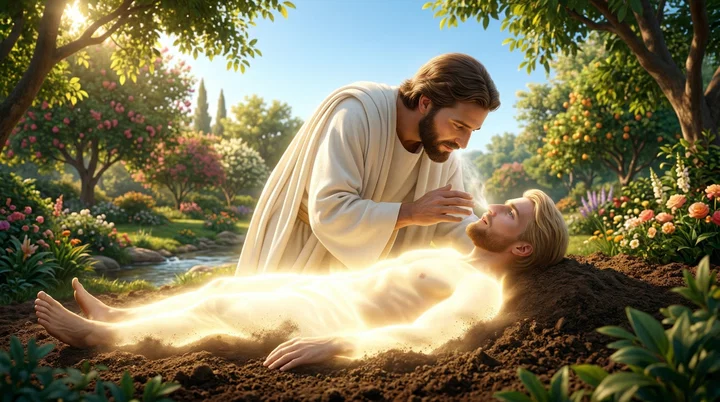
And the LORD God formed man of the dust of the ground, and breathed into his nostrils the breath of life; and man became a living soul.
Translations
American King James Version, King James Version, Webster Bible, Revised Version
And the LORD God formed man of the dust of the ground, and breathed into his nostrils the breath of life; and man became a living soul.
And the Lord God formed man of the dust of the ground, and breathed into his nostrils the breath of life; and man became a living soul.
And Jehovah God formed man of the dust of the ground, and breathed into his nostrils the breath of life; and man became a living soul.
And Jehovah God formeth the man — dust from the ground, and breatheth into his nostrils breath of life, and the man becometh a living creature.
And Jehovah Elohim formed Man, dust of the ground, and breathed into his nostrils the breath of life; and Man became a living soul.
So then Yahweh God formed man of the dust of the ground, and breathed in his nostrils the breath of life—and man became a living soul.
Berean Standard Bible, Majority Standard Bible
Then the LORD God formed man from the dust of the ground and breathed the breath of life into his nostrils, and the man became a living being.
The LORD God formed man from the dust of the ground, and breathed into his nostrils the breath of life; and man became a living soul.
And the Lord God made man from the dust of the earth, breathing into him the breath of life: and man became a living soul.
The Lord God also made the man of the dust of the grounde, and breathed in his face breath of life, and the man was a liuing soule.
Douay-Rheims (Challoner revision)
And the Lord God formed man of the slime of the earth: and breathed into his face the breath of life, and man became a living soul.
Pictures
Cross-references 20 of 103
- Genesis 3:19
In the sweat of thy face shalt thou eat bread, till thou return unto the ground; for out of it wast thou taken: for dust thou art, and unto dust shalt thou return.
Adam is sentenced to return to the dust from which he was formed.
- Genesis 1:27
So God created man in his own image, in the image of God created he him; male and female created he them.
both describe how man came to be
- Ecclesiastes 12:7
Then shall the dust return to the earth as it was: and the spirit shall return unto God who gave it.
Describes death as the reversal of the formation in Genesis 2:7.
- Genesis 7:22
All in whose nostrils was the breath of life, of all that was in the dry land, died.
All land creatures with the breath of life died in the flood.
- Psalms 146:4
His breath goeth forth, he returneth to his earth; in that very day his thoughts perish.
When breath departs, a person returns to the earth.
- Ecclesiastes 3:19-20
For that which befalleth the sons of men befalleth beasts; even one thing befalleth them: as the one dieth, so dieth the other; yea, they have all one breath; so that a man hath no preeminence above a beast: for all is vanity.
Humans and animals share one breath, die alike, and return to dust.
- 1 Corinthians 15:45
And so it is written, The first man Adam was made a living soul; the last Adam was made a quickening spirit.
Calls Adam a living soul and contrasts him with Christ, the life-giving Spirit.
- Revelation 16:3
And the second angel poured out his vial upon the sea; and it became as the blood of a dead man: and every living soul died in the sea.
Both use “living soul” for a living creature, and the sea creatures die.
- Genesis 1:26
And God said, Let us make man in our image, after our likeness: and let them have dominion over the fish of the sea, and over the fowl of the air, and over the cattle, and over all the earth, and over every creeping thing that creepeth upon the earth.
Humanity is created by God in his image and likeness.
- Genesis 3:22-24
And the LORD God said, Behold, the man is become as one of us, to know good and evil: and now, lest he put forth his hand, and take also of the tree of life, and eat, and live for ever:
Expulsion bars Adam from the tree of life, preventing him from living forever.
- Job 27:3
All the while my breath is in me, and the spirit of God is in my nostrils;
Job identifies the breath in his nostrils as God’s Spirit, recalling the breath God gave man.
- 1 Corinthians 15:47
The first man is of the earth, earthy: the second man is the Lord from heaven.
The first man is called earthly, matching his formation from the ground.
- Genesis 2:19
And out of the ground the LORD God formed every beast of the field, and every fowl of the air; and brought them unto Adam to see what he would call them: and whatsoever Adam called every living creature, that was the name thereof.
both man and beasts formed from ground
- Genesis 2:16-17
And the LORD God commanded the man, saying, Of every tree of the garden thou mayest freely eat:
The command made continued life conditional on obedience.
- Job 33:4
The Spirit of God hath made me, and the breath of the Almighty hath given me life.
Both identify God’s breath as the source of human life.
- Job 34:14-15
If he set his heart upon man, if he gather unto himself his spirit and his breath;
God gathers spirit and breath, and all flesh perishes and returns to dust.
- Psalms 104:29
Thou hidest thy face, they are troubled: thou takest away their breath, they die, and return to their dust.
God withdraws breath, and creatures die and return to dust.
- Genesis 7:15
And they went in unto Noah into the ark, two and two of all flesh, wherein is the breath of life.
Animals also have the breath of life.
- Genesis 1:24
And God said, Let the earth bring forth the living creature after his kind, cattle, and creeping thing, and beast of the earth after his kind: and it was so.
same Hebrew word applied to animals
- Genesis 2:21-22
And the LORD God caused a deep sleep to fall upon Adam, and he slept: and he took one of his ribs, and closed up the flesh instead thereof;
Eve is formed from Adam’s rib without a separate account of God breathing life into her.
Commentary part 1 of 4
Each commentary is drawn from primary sources: the writings of Ellen G. White and Adventist pioneers and periodicals. Each commentary is separate. Its own words are not a quotation; follow the references to read the source passages.
Ellen G. White
48 sources
God formed man from the dust of the ground and breathed the breath of life into his nostrils, and man became a living soul.CTBH 165.1ST Apr 29, 18752T 300.1–2 The account is plain with no mystery and leaves no ground for supposing man came by slow evolution from lower animal or vegetable life, but shows the agency of a personal, self-existing God working through Jesus Christ.7MR 371.3–373.2Ms 16, 1899, par. 2–48T 264.1PP 44.3 The body was first formed perfect in God's image but without vitality, then the inbreathed holy breath put the whole machinery in motion under physical law — heart, senses, mind and perceptions — making man a living, breathing, intelligent being.7MR 371.3–373.28T 264.1MH 415.1–2ST Dec 12, 1895 To be a living soul means the whole man, soul and body, made a partaker of God's own life with will and conscience and power to choose good, so man originates nothing and owns nothing, not even himself, but belongs to God.10MR 326.4–327.217MR 197.2–4ST Aug 26, 1897Ms 63, 1901, par. 7–11 The breath was not left to run by itself like wound machinery, but the same ever-present God constantly supervises the organism so each breath and heartbeat is His direct gift, and that same life-giving voice still gives spiritual life to those dead in sin and will raise them, while the wicked who transgress are mortal and return to dust rather than suffer endlessly.EW 185.1RH Mar 17, 1904Ms 117, 1898, par. 14–15DA 320.2Ms 92, 1898, par. 7
Forming and Breathing Life
God formed man from the dust of the ground and breathed into his nostrils the breath of life, so that man became a living soul.CTBH 165.1ST Apr 29, 18752T 300.1–2 The creation of man together with its provisions and surroundings attests to God's love for created beings in this life.CTBH 165.1 As humanity's Creator, God can discern the intents and purposes of the heart.2T 300.1–2
The body was first formed in God's image, perfect in all its arrangements, but without vitality or life.7MR 371.3–373.28T 264.1MH 415.1–2ST May 19, 19093MR 304.1 Then God breathed the breath of life into that form, into the nostrils, and man became a living soul, a living, breathing, intelligent being.7MR 371.3–373.28T 264.1MH 415.1–2ST May 19, 19093MR 304.1 That inbreathed breath put the whole human machinery in motion and placed it under physical law, setting in action the heart, arteries, veins, tongue, hands, feet, senses, and perceptions of the mind.7MR 371.3–373.28T 264.1MH 415.1–2ST May 19, 19093MR 304.1 The work was done through Jesus Christ, who endowed man with intelligence and power, showing the agency of a personal, self-existing God and not nature.8T 264.1MH 415.1–2ST May 19, 1909Ms 117, 1898, par. 9–11 That breathing also gives understanding, and shows man as fearfully and wonderfully made by a living Creator worthy of thought, praise, and adoration.7MR 371.3–373.2
The dust of the ground from which man was formed was pure, and the breath of life breathed into his nostrils was holy.ST Dec 12, 1895 God spoke and it was done, and the creation of man was perfect and complete and needed no undoing.ST Dec 12, 1895 Man was placed in Eden, the garden of God, where the undefiled atmosphere, the sunbeams blessing the earth, and the fountains and streams watering the garden were all holy, spotlessly pure, and unsurpassed in loveliness, in harmony with the character of the Father and the Son.ST Dec 12, 1895 The Father and the Son made the worlds, and in Christ was life, and the life is the light of men.ST Dec 12, 1895
The account is plain with no mystery and leaves no ground for supposing that man was evolved by slow degrees of development from lower forms of animal or vegetable life, from developing germs, mollusks, and quadrupeds.PP 44.3 It belongs to the record in Scripture that gives God's unchangeable standard of right-doing.Ms 131, 1907, par. 13–14 It presents eternal truth that can never be changed and is to be read together with the law in Exodus 20 and the instruction in Exodus 31.Ms 131, 1907, par. 13–14
Humanity was made after the earth and its living creatures were made, when the Father and Son carried out their purpose formed before Satan's fall to make humanity in God's image.SG3 33.2 Adam came from his Creator's hand with noble stature, balanced proportions, and perfect, beautiful features.SG3 33.2 Eve was slightly shorter and likewise noble, symmetrical, and beautiful.SG3 33.2
Personal Creator Revealed
Genesis 2:7 reveals the agency of a personal, self-existing God, not nature and not an impersonal principle or energy, working through Jesus Christ as Commander in the heavenly courts, who endowed man with intelligence and power.Ms 16, 1899, par. 2–48T 264.1MH 415.1–2ST May 19, 19093MR 304.1 God first formed the human body in His own image, perfect in all its arrangements yet without vitality or life, then breathed the breath of life into the nostrils of that form.7MR 371.3–373.28T 264.1MH 415.1–2ST May 19, 19093MR 304.1 That inbreathed breath put the whole machinery in motion and placed it under physical law — heart, arteries, veins, tongue, hands, feet, senses, and perceptions of the mind — so that man became a living soul, a living, breathing, intelligent being.7MR 371.3–373.28T 264.1MH 415.1–2ST May 19, 19093MR 304.1 That inspiration gives understanding and shows man as fearfully and wonderfully made by a living Creator worthy of thought, praise, and adoration.7MR 371.3–373.2Ms 117, 1898, par. 14–15
Man is the crowning work for whom the beautiful earth had been fitted up, made by the direct act of the great Creator as a being worthy of the hand that made him.ST May 19, 1909PP 44.3 Though formed from dust, Adam was a son of God, bearing dignity of origin in God's image.PP 44.3 He was appointed monarch of the world under God's supervision, placed above all lower orders to rule the earth under God, to express God's thought and reveal His glory.Ms 16, 1899, par. 2–4ST May 19, 1909PP 44.3
The creation of man together with its provisions and surroundings attests God's love for created beings in this life.CTBH 165.1 The breathing of the breath of life reveals the ever-present God, the great I AM, in whom all unselfish ministry originates, who does not live unto Himself but for the benefit and blessing of every being and every object of His creation.Ms 21, 1900, par. 16 That upholding did not end with Adam, for every leaf growing, every flower blooming, and every fruit developing happens by His power.Ms 21, 1900, par. 16
The breath was not left to run by itself like a wound clock or like machinery set in motion and left alone.Ms 117, 1898, par. 14–15Ms 92, 1898, par. 7 The same ever-present God still constantly supervises the physical organism and the whole human being, preserving His wonderful workmanship.RH Mar 17, 1904Ms 117, 1898, par. 14–15Ms 92, 1898, par. 7 Each breath and each heartbeat now is His direct inspiration and gift, and in Him men live and move and have their being.RH Mar 17, 1904Ms 92, 1898, par. 7Ms 21, 1900, par. 16 Those God-given powers can be kept in health and soundness by being worked intelligently and proportionately, and more people die from idleness than from overwork.Ms 117, 1898, par. 14–15
As the One who made man from dust and gave the breath of life, God as Creator understands the human body and mind completely.2T 300.1–2Lt 53, 1876, par. 21 He can discern the intents and purposes of the heart and knows a person's true condition when earthly physicians cannot.2T 300.1–2Lt 53, 1876, par. 21 He can discern real physical disease from diseased imagination and morally diseased thoughts, and knows when a person is physically sound despite claims of sickness.Lt 53, 1876, par. 21
Human Nature Formed
Man was fearfully and wonderfully made in God's image with flesh and blood, nerve and muscle, and with mind, intellect and reasoning powers created by God Himself.7MR 371.3–373.217MR 197.2–4 That inspiration breathed into the nostrils gives understanding and brings man's powers into activity.7MR 371.3–373.2Ms 117, 1898, par. 14–15 By that breath the whole man became a living, breathing, intelligent being, a living soul.7MR 371.3–373.217MR 197.2–4
Adam came from his Creator's hand in perfect, beautiful form — noble in stature, well proportioned, strong, comely and pure, with perfect features.SG3 33.2ST Jan 9, 187910MR 326.4–327.2 He was more than twice the height of men now living, with a healthy ruddy complexion.ST Jan 9, 1879 Eve was slightly shorter than Adam, likewise noble, symmetrical and beautiful.SG3 33.2ST Jan 9, 1879
To be a living soul means the whole man, soul and body, made a partaker of God's own life and nature by the breath of the Almighty.10MR 326.4–327.217MR 197.2–4 In that state man is capable of living through eternal ages.17MR 197.2–4 Therefore man originates nothing and owns nothing, not even himself, but belongs to God.17MR 197.2–4Ms 63, 1901, par. 7–11
The inbreathed spark of divine life makes human powers a sacred gift with moral endowments — a will to direct action and a conscience that under God's control approves right and condemns wrong.ST Aug 26, 1897 It brings the privilege of becoming a partaker of the divine nature, with power to conquer evil and to love and choose good.ST Aug 26, 1897 It brings also the privilege of fellowship, of walking and talking with God as Enoch did, open to all who believe.ST Aug 26, 1897
Human beings were designed for equal use of mental and physical powers, for active use of brains, nerves and muscles.Lt 382, 1908, par. 6–8ST Apr 29, 1875 They were created to till the ground and to dress and keep the garden planted in Eden.Lt 382, 1908, par. 6–8ST Apr 29, 1875 Adam's life breathed by God was dependent on God and was to be perpetuated through access to the tree of life.ST Jun 17, 1897 Adam was appointed monarch of the world under God's supervision.Ms 16, 1899, par. 2–4
The forming of man leads directly to the making of woman from Adam's rib as a help meet for him.Ms 16, 1899, par. 2–4 From this comes the marriage union in which a man leaves father and mother and cleaves to his wife and they become one flesh.Ms 16, 1899, par. 2–4
Original Purity and Fall
Adam was created and placed in Eden pure and noble, with no tendency to evil, for sin was no part of God's purpose for humanity.RH Jun 4, 1901 He came from the Creator's hand in a perfect and beautiful form, filled with great vital force, standing in innocent, unfallen human nature.RH Jun 4, 1901FE 23.2ST Dec 9, 1913 The weakness and disease later known came only through violation of physical law and indulgence of appetite and passion.FE 23.2
Adam and Eve were created for life in Eden, humanity's true home, but by transgressing God's law they lost that home.Ms 84, 1886, par. 5–6 Man was made of the dust of the earth, and after sin the appointed end is to return to dust in dissolution.1SP 43.2 That return comes at the close of a life of perpetual toil and anxiety instead of happy labor, afflicted by Satan's temptations and subject to disappointment, grief, and pain.1SP 43.2 Adam's life was breathed into him by God and was therefore dependent on God, to be perpetuated through access to the tree of life, but by disobedience he forfeited that privilege and the human family came under the penalty of death.ST Jun 17, 1897 People must not transgress as Adam and Eve did but be obedient to all of God's requirements, overcoming by perfect obedience as Christ overcame His Father's commandments, and through that obedience be brought back to the Eden home, bending footsteps heavenward and pointing others there.Ms 84, 1886, par. 5–6
By infinite power God formed Adam from the dust of the earth into a living, beautiful form and in love gave him Eve as his companion.1SP 39.2ST Nov 18, 1913PP 55.3–56.2 That merciful and benevolent Creator had power to give life, and that same creative power could have supplied Eve's place if she must die for disobedience, so Adam did not need to share her transgression and death to avoid separation from her.1SP 39.2ST Nov 18, 1913PP 55.3–56.2 Adam failed to trust and realize this, letting love for Eve overbear love, gratitude, and loyalty to the Creator, wrongly fearing the loss of Eve more than the loss of faithfulness and its blessings, and resolved to share her fate and die with her.1SP 39.2ST Nov 18, 1913PP 55.3–56.2
For the Son of God to take even Adam's innocent nature would have been an almost infinite humiliation, exchanging the throne of heaven for fallen earth and rebuking human pride and self-sufficiency.ST Dec 9, 1913 He did not take that innocent nature but accepted humanity as weakened and defiled by four thousand years of sin.ST Dec 9, 1913 Like every child of Adam He accepted the results of the working of the great law of heredity shown in the history of His earthly ancestors, to share human sorrows and temptations and to give the example of a sinless life.ST Dec 9, 1913
Death Not Endless Torment
Man was formed from the dust of the earth, from the dust of the ground.EW 185.11SP 43.2SG1 118.1 After sin the appointed end is to return to dust in dissolution.1SP 43.2 That return comes at the end of a life of perpetual toil and anxiety instead of happy labor.1SP 43.2 That life is afflicted by Satan's temptations and subject to disappointment, grief, and pain.1SP 43.2 The wicked are mortal beings who are consumed by fire and return to dust.EW 185.1SG1 118.1 They are destroyed utterly as though they had never been, rather than suffering endlessly in hell or living in heaven.EW 185.1SG1 118.1
Spiritual Life Through Christ
The word that gave life to the first man still gives spiritual life to those dead in sin when it is received in faith.DA 320.2 The same God who breathed the breath of life into man and made him a living soul has breathed a vital, life-giving power into the Scriptures.ST Oct 3, 1900 In the same way He breathed the breath of life into His Word, so Scripture carries life-giving power.Lt 29, 1900, par. 17
The expiration of breath by the Lord of life is the inspiration of every Christian.Lt 201, 1900, par. 1–6 The Lord formed man from the clay of the ground and breathed the breath of life into him, so that the vital, living element gave life to the lifeless form and he became a living soul.Lt 201, 1900, par. 1–6 That same breathing was repeated when Jesus Christ breathed upon His disciples almost immediately after His resurrection, and they received the Spirit of Christ into their inner lives and became His living witnesses.Lt 201, 1900, par. 1–6 Christ likewise gives life to every human worker, and ministers who bear the most solemn message ever given must in these last days be breathed upon by the Lord Jesus to have life and vitality by the Holy Spirit's quickening influence.Lt 201, 1900, par. 1–6
The church needs the breath of life breathed into its people by Christ so they can rise from spiritual sluggishness to active service and help others.RH Apr 28, 1904 The breath God breathed into man is the breath of divine life that must be breathed into believers now.8T 46.1 Receiving it cures the leprosy of unbelief that makes service weak and inefficient, and brings reconversion and reconsecration.8T 46.1 It makes workers of one accord with freshness and power, makes them channels through which light and grace are sent to the world, reclaims backsliders, and pours floods of spiritual power upon those prepared to receive it.8T 46.1 That preparation comes through wrestling prayer for the Holy Spirit in every heart and through putting away sin by confession and repentance and humbling the proud heart before God.8T 46.1
The voice that gave life to man formed from the dust of the earth is the creative voice that gave life to the paralytic's dying, decaying body.STMH 77.2DA 269.5–270.3 Human life came by the creative voice speaking life into man formed from dust, and restoring health to the decaying paralytic required nothing less than that same creative power.DA 269.5–270.3 The same voice that first gave life to dust spoke life to the dying man.DA 269.5–270.3 The same power that gave life to the body renewed the heart dead in trespasses and sins, bringing life to a soul dead in sin, so healing of the body is evidence of power to forgive sins and give spiritual life.STDA 269.5–270.3 Christ still has that same life-giving power to forgive all iniquities, destroy the works of the devil, give abundant life, and impart vigor to the mind and health to the body.DA 269.5–270.3
As God gives life by breathing into humanity, Christ can likewise breathe life into people who are fallen, diseased, and weak, and make them partakers of the divine nature.ST Oct 10, 1900 God longs to breathe the breath of life into prostrate humanity.RH Jun 24, 1915 Heaven's plan of salvation is broad enough to embrace the whole world, including sincere seekers in heathen lands with no knowledge of the written law or of Jesus.RH Jun 24, 1915 This inbreathing meets sincere longing for something higher and nobler than the world can offer, so no sincere soul will be disappointed.RH Jun 24, 1915
Daily Life Application
The forming of man from dust and the breathing of life into him established equal use of mental and physical powers as part of the original design.Lt 382, 1908, par. 6–8 He was created to till the ground and to dress and keep the garden planted in Eden, so true education carries out that design by combining study of books with useful physical employment such as cultivation of the land.Lt 382, 1908, par. 6–8
Human beings were made for active use of brains, nerves, and muscles, and useful labor and exercise preserve health and happiness.ST Apr 29, 1875Ms 117, 1898, par. 14–15 The powers of the body are gifts that are brought into activity by divine inspiration and are to be worked intelligently and proportionately rather than weakened.ST Apr 29, 1875Ms 117, 1898, par. 14–15 Kept in health and soundness they enable the body to be offered as a living sacrifice, and more people die from idleness than from overwork.ST Apr 29, 1875Ms 117, 1898, par. 14–15 The organism was not furnished as machinery set in motion like a clock and left to itself, but is constantly preserved by divine agency.Ms 117, 1898, par. 14–15
Life is to be sustained by full, free breathing of pure fresh air according to the laws of being.Ms 2, 1877, par. 2 The chest must have room to expand fully so the lungs can take full inspirations, because strength depends in great degree on the amount of oxygen received.Ms 2, 1877, par. 2 Restriction by tight bands, waists, or corsets hinders the free flow of blood, limits oxygen, vitiates the blood, and brings disease.Ms 2, 1877, par. 2 Observing this law of life enables living the allotted term instead of dying of consumption, while confinement indoors without invigorating sunlight and exercise in the pure open air completes the ruin begun by wrong dress toward feebleness and premature death.Ms 2, 1877, par. 2
By receiving the breath of life man originates nothing and owns nothing, not even himself.Ms 63, 1901, par. 7–11 All skill, tact, ability, capabilities, and possessions come from liberal divine supply as Guardian and Counselor, which man only collects as first originated by God.Ms 63, 1901, par. 7–11 Therefore everything a person is and has belongs to the Lord and is to be used in doing Him service.Ms 63, 1901, par. 7–11 By creation, soul and body with flesh and blood, nerve and muscle, mind, intellect, and reasoning powers are entrusted with abilities and talents to be used, improved, and returned in the appointed way of service.17MR 197.2–4 Because a living soul is capable of living through eternal ages and is bought by redemption with the blood of the only begotten Son, the salvation of one soul is worth more than costly buildings, gold, or silver.17MR 197.2–4 Therefore no human leader may treat men as mere machines, take them under human control, dictate to and seek to control chosen instrumentalities, or drive them away by partiality, insincerity, and unjust dealing, for those souls will be required at the hands of those who wrong them.17MR 197.2–4
Sources
Pioneers and periodicals
648 sources
God formed man from the dust of the ground and breathed the breath of life into his nostrils, and the dust-formed man himself became a living soul.RH Nov 11, 1858ST Feb 7, 1878RH Sep 26, 1854RH Sep 19, 1865RH Apr 30, 1872 To become a living soul is to become a living person, a living creature, the same word used for the animals, not to receive a separate conscious immortal soul put inside the body.RH Nov 11, 1858RH Sep 26, 1854ST Jan 8, 1880ST Oct 5, 1882ST The breath of life is the life-giving power from God that makes the lifeless body live, shared in common with all breathing creatures, not itself a conscious person and not man's own inherent immortality.RH Nov 11, 1858ST Feb 7, 1878RH Jul 21, 1868RH Sep 18, 1855RH Nov 28, 1865 Man's life is therefore borrowed and dependent, continued only in connection with God and made conditional by obedience, and death undoes the creation when the body returns to dust and the breath returns to God, leaving the whole person unconscious until life is given again in the resurrection.RH Sep 26, 1854RH Sep 7, 1869ST May 13, 1886RH Jul 21, 1868RH Jan 14, 1873 As the last and crowning direct act of creation, forming man by God's own hand and breath in God's image, it shows man did not come by evolution from lower animals but by miracle as son of God, mortal by nature with immortality to be sought only through Christ the second Adam.RH Aug 29, 1907ST Jul 28, 1881ST Apr 7, 1914ST Feb 21, 1911ST Oct 29, 1902
Words and Phrasing
God formed man of dust of the ground, breathed into his nostrils the breath of life, and the dust-formed man himself became a living soul in one act where the formed body was quickened and set in motion and changed from dead to living.RH Sep 19, 1865RH Apr 30, 1872ST Oct 23, 1884ST Nov 24, 1909ST Dec 9, 1880 The breath did not add a separate independent soul put into man to make him live, for man himself is the soul, with body, soul and spirit all from dust and not a dual being of dust body plus pure spirit soul.RH Apr 30, 1872ST Oct 23, 1884ST Nov 24, 1909 That which was formed of dust was already man before breath was bestowed, a complete and perfect body ready for every human function but still lacking the vitalizing spark, and the breath was simply life itself enabling man to live, not a conscious spirit that had lived in bliss before birth nor a glorious angel dwelling in dust.ST Oct 23, 1884ST Nov 24, 1909ST Dec 9, 1880 There is no more blissful existence for that breath after death than before birth, for what came from God to make man live returns to God when man ceases to live.ST Dec 9, 1880
Nostrils names the nose breathing passages because breathing and the giving of the power of respiration are chiefly visible there, and breathing into them speaks in human terms of God's life-giving act of causing breath to enter through respiration.ST Feb 7, 1878RH Sep 19, 1865RH Nov 28, 1865 The breath of life is associated with the air man breathes, with oxygen diluted with nitrogen supplying power for life, thought and action and sustaining bodily functions, setting heart, blood and brain in motion, so that when breathing ceases life ends.RH Jul 21, 1868RH Mar 26, 1867 The verse gives less explicit evidence for a sentient immaterial principle able to live and act apart from the body than is commonly supposed, and does not establish an immortal indivisible soul as a separate substance lodged in the body.ST Feb 7, 1878RH Sep 19, 1865RH Nov 28, 1865
Became describes passing into a new state from dead to living, and the contrast is that Adam became a living soul, not that he became a soul.RH Apr 30, 1872ST Oct 23, 1884ST Nov 24, 1909 He was already a soul but not yet living, a lifeless organized soul before breath, and when breath was given he became a living soul, being no more a soul afterward than before, with Scripture likewise speaking of a dead soul when breath is taken away.RH Apr 30, 1872ST Oct 23, 1884ST Nov 24, 1909 The verse therefore does not teach that an immortal soul was added to the body, and the breath of life is shared with the animal creation while soul in Hebrew can also be used for a dead body.RH Apr 30, 1872ST Nov 24, 1909 Those who held the soul to be the breath of life allowed as a fallback that Adam was already a soul before God breathed into him.RH May 10, 1870
The word translated breath means a puff or wind, air in motion, from nshamah from nasham meaning to blow, defined as wind and vital breath.ST Nov 21, 1900ST Aug 18, 1909ST Mar 14, 1878 It is also rendered blast, breath, inspiration, soul and spirit, and its meaning is nearly the same as the different Hebrew word for breath in Genesis 6:17, which is why both are rendered breath of life.ST Aug 18, 1909ST Feb 6, 1879 The same word is used for breath in Genesis 7:22 and for the breath in the nostrils of creatures that died in the Flood in Genesis 7:21-22, and it primarily means breath and does not mean an immortal entity.ST Nov 21, 1900ST Feb 6, 1879RH Feb 15, 1870 The breath of life is associated with air on which active life depends, given by divine energy as cause and continuance of animal life, and when sin finishes its work man returns to dust and that life returns to God as breath.RH Jul 21, 1868RH Mar 26, 1867ST Nov 21, 1900
The word translated life comes from chay, from chayah meaning to live and to keep alive, also translated live, quicken and recover, and in Genesis 2:7 it refers to men as simply the breath of life from God.ST Aug 18, 1909 Breath is rightly called life rather than something mortals ignorantly mistake for life, for God breathed into man the breath of life.ST Aug 18, 1909ST May 17, 1883 The Hebrew nshamah can mean breath or life in humans and animals, as well as mind or intellect and concretely a living creature.ST Aug 18, 1909ST Mar 14, 1878
Soul translates Hebrew nephesh, from a verb meaning to breathe, also spelled nephesh chayyah or neh-phesh khay-yah and nephesh chaiyah, meaning a breathing creature, a living sensing being, a living animal or living being.RH Oct 9, 1860RH Apr 30, 1872ST Oct 9, 1907ST Jan 30, 1879ST Oct 19, 1882 Man is a soul because he lives by breathing vital air, a breathing creature that can be seen and felt, and every bird, reptile, fish and beast that lives by breathing is a nephesh, a soul, as certainly as man is.RH Oct 9, 1860 The Hebrew phrase translated living soul can be rendered living animal and does not itself teach that man received a separate immaterial immortal spirit, for living souls can die and the word living matters as marking imparted life rather than an independent entity.RH Apr 30, 1872ST Jan 30, 1879RH Apr 30, 1872 The New Testament equivalent is psyche, Greek psuche, whose adjective psychikon designates the corruptible natural body in contrast to the pneumatikon spiritual immortal body received at the resurrection, confirming the soul as mortal and perishable.RH Oct 9, 1860
The verse uses nephesh for soul and nshamah, also given as n'shah-mah and neh-phesh, for breath as distinct words, with soul able to mean the living person, animal life, life, creature, person, body, appetite, emotions and other things decided by context, while breath is distinct.ST May 28, 1896ST Jul 16, 1896RH Sep 1, 1859ST Feb 24, 1898ST Jul 4, 1911 Soul is primarily the whole person, for man became a living soul, and here it stands for the complete man, while in Matthew 10:28 it means life.ST May 28, 1896ST Jul 16, 1896ST Feb 24, 1898 Soul and spirit can both mean life though meanings vary with context, soul meaning a whole person or the physical earth-life shared by humans and animals, while spirit can mean life given by God and received through faith, so that everyone has physical life but only the converted have spiritual life.ST Feb 15, 1905 This does not establish the soul as an immortal part separate from the person, capable of existence apart from the body, and soul is never once called immortal soul or never-dying soul or deathless soul.ST May 28, 1896ST Jul 16, 1896RH Sep 1, 1859ST Jul 4, 1911
The Hebrew plural breath of lives does not prove man received two lives, a two-fold nature, or an animal plus immortal spiritual life, and its exact sense is uncertain, being like the idiom blood.ST Feb 7, 1878RH Mar 24, 1874RH Sep 19, 1865RH Oct 13, 1868RH May 2, 1871 It may suggest the different kinds of life in human beings, even vegetative, animal and distinctively human rational life, but the meaning remains uncertain.ST Feb 7, 1878RH Sep 19, 1865 It denotes breath common to all living breathing animals in whose nostrils is the breath of life, for they have all one breath, the ruah, shared by all creatures possessing life and subject to death, with similar and even fuller language used of animals and of the tree of life.RH Mar 24, 1874RH Nov 28, 1865RH Oct 13, 1868RH May 2, 1871 Man's continued life depended on access to the tree of life, and after being barred from it he could not live forever, so the verse presents man as mortal and dependent, with eternal life given through Jesus Christ in the first resurrection.RH Mar 24, 1874
The word rendered spirit in Ecclesiastes 12:7 is linked to the same original term used here, for the life-giving spirit God gave man was the breath of life, not a conscious entity able to exist apart, with body returning to dust and breath returning to God who gave it.RH Jul 19, 1870RH Sep 18, 1855 The breath breathed into the nostrils is the Hebrew ruach meaning spirit, the vital principle of animal life residing in and animating the body, and the breath of life in human beings is life given by God.ST Mar 18, 1903ST Jan 30, 1912 The Spirit of God in Job's nostrils refers to this life sustaining human life by God's goodness, the same as the spirit of God in man's nostrils because it came directly from God, so that if He gathered spirit and breath back to Himself all flesh would perish and man turn again to dust.ST Jan 30, 1912ST Oct 23, 1884
The word for man is adam, name both of the first father and of the race, mankind as a whole and the totality of human beings including women and not males or Jews alone, long before Jews or the Jewish nation existed.RH Mar 2, 1852ST Aug 26, 1889ST Apr 19, 1883RH Apr 26, 1860ST Jan 6, 1888 Adam is said to mean red earth or earth or ground, marking physical makeup from dust and the event of making, with first names designed to signalize event or trait.RH Mar 2, 1852ST Aug 26, 1889 Humanity was created before the Jewish nation, so man in the statement that the Sabbath was made for man cannot mean only the Jews but applies to the whole human race.RH Mar 2, 1852ST Aug 26, 1889ST Apr 19, 1883ST Jul 22, 1880RH Apr 26, 1860
History and Creation Setting
Genesis 2:7 gives the detailed, specific account of the creation briefly declared in Genesis 1, especially Genesis 1:27 and Genesis 2:4-6, and with Genesis 2:21-22 and Genesis 2:4-25 it is the full account of the first pair.ST Aug 9, 1910RH Dec 8, 1859ST Jan 31, 1911ST Oct 13, 1909 It does not contradict Genesis 1 and does not describe a second or different man, for the man formed of dust is the same man made in God's image, and consecutive chapters do not always mean consecutive time.ST Aug 9, 1910ST Nov 30, 1882RH Apr 15, 1858ST Oct 13, 1909 Together the accounts show man made from dust in God's image, innocent and pronounced very good but without formed moral character distinguishing him, made only of dust and breath with no immaterial spirit-man infused to escape at death, the whole dust-man involved in transgression and ruin and the subject of redemption for whom Christ died.ST Aug 9, 1910RH Nov 24, 1863ST Nov 30, 1882RH Apr 15, 1858 Genesis 1:26-27 is the brief general account of male and female and Genesis 2:7 with Genesis 2:18-25 the specific detailed account of that same creation, recording the first Adam head of the human race distinct from Jesus the last Adam head of the spiritual race. Those who held that the soul was added to the bodily part and not produced from earth taught that by this addition man was constituted a living soul with superiority and dominion before the fall, and because not of the same material it does not perish.RH Dec 8, 1859
One position treats Genesis 2:4-25 as a second narrative set side by side with the first with all divergences and contrasts and no editorial explanation to adjust or harmonize them, each left to tell its own story in artless conscious truth.ST Jun 14, 1877 The account is real literal sacred history with literal earth, literal man from dust and literal garden, revealed by God, meaning what it says and exactly what it says, not tradition, allegory, parable, religious poem, myth, fable, folklore, fairy tale or figurative meaning.ST Jul 28, 1881ST Apr 7, 1914ST Jan 31, 1911ST Jul 28, 1881ST Apr 15, 1913 Genesis 2:4-24 is just as literal as Genesis 1, giving the particular account of the first pair while Genesis 1:1-2:3 gives the general, with literal earth, literal man, and literal garden with trees pleasant to sight and good for food.ST Jan 31, 1911RH Apr 9, 1901 It is supported as historically accurate, preserving primeval traditions closer to original than varied accounts among ancient peoples, confirmed by astronomy, geology, archaeology, science, philosophy, criticism, anatomy, philology, ethics and theology, with true facts of microscope, telescope and rocks showing order and masterly design when weighed in relation to sin's effects.ST Dec 7, 1915ST Jan 9, 1901
Rejecting its truth undermines Genesis, the Bible, verbal and plenary inspiration, the church under human reason, and doctrines including the Trinity, resurrection, cross, miracles, fall and atonement, and makes skeptics and infidels of youth.ST Jul 28, 1881RH Jun 11, 1914ST Jan 25, 1910ST Apr 15, 1913 Taking Genesis as true history keeps Scripture as unquestioned final authority, while denying Adam's direct creation from dust puts Bible and church under human reason and changes theology to question or deny the Trinity, resurrection, sacrifice of the cross and all miracles.ST Jan 25, 1910 Denying literal Adam and Eve who actually existed sets aside the whole Bible, since Moses wrote of Christ and Christ affirmed Moses, so disbelief of Moses is disbelief of Christ's words, and teaching scientific conclusions contradicting the true portrait of God forming man makes skeptics of thousands of youth.RH Jun 11, 1914ST Apr 15, 1913 Man did not evolve over numberless ages from protoplasm, monad, mollusks, fishes, frogs, monkeys, apes, simian stock or tadpole, nor by slow evolution, spontaneous emergence, self-operating process or progressive development from irrational animals.RH Aug 29, 1907ST Dec 2, 1913ST Aug 3, 1882ST Apr 15, 1913 He was formed directly from dust by God's own hand, spoken word and miracle as child and son of God, introduced as king with dominion over fish, fowl, cattle, all earth and every creeping thing, and evolution and biblical revelation are incompatible so that fitting them together undermines historic character.ST Dec 2, 1913ST Aug 3, 1882RH Aug 23, 1906
There is a gulf between highest animal and lowest human that evolution cannot bridge, for by God's command man becomes a living soul marking divine origin.ST Jun 24, 1889ST Apr 13, 1882ST Aug 24, 1882 There never was an animal midway between brute and man because God did not suffer such to exist, so the missing link will always be missing, and theories of development over hundreds of thousands of years cannot create what God never made.ST Jan 2, 1901 On one view no matter in any organization can think apart from God's gift, while on another organized matter by God can think without proving a separate immaterial soul, the verse supporting that humans are living organized matter from dust.RH Jan 28, 1873ST Jun 19, 1879 A theory about how the body developed would not by itself contradict made from dust since the verse does not explain process.ST Dec 16, 1886 But making it fit evolutionary hypotheses over hundreds of thousands or millions of years, tens of thousands of years, or thirty to seventy thousand years undermines it, and finding human bones in the tertiary would disprove Genesis 1 and 2, which allow remains only in post-tertiary formations.RH Aug 23, 1906RH Oct 25, 1870ST Jan 9, 1901
The creation of man stands at the beginning of human history about six thousand years ago, sixty centuries ago, on the sixth day of the six-day making of heaven and earth, before the seventh day and later years of life.ST Feb 12, 1880ST Jan 28, 1897RH Oct 20, 1868RH Oct 25, 1870 Adam lived 930 years so generations could hear from him about creation, life with God, and the creation week and Sabbath, in one continuous historical narrative rather than long periods.RH Oct 20, 1868 Humanity originated on earth rather than transplanted from Mars, with no preadamic man thirty-five thousand years ago at Lansing, Kansas proved by sloping skull, and ages of thirty, forty and seventy thousand years contradict the Mosaic record.ST Feb 12, 1880ST Aug 13, 1894RH Oct 25, 1870 Events of the sixth day include God forming Adam, placing him in Eden and giving its care, stating probation, bringing animals to name, creating Eve during sleep and joining them in marriage with food appointed and creation very good, so Adam existed from early sixth day and the seventh day was his second day.ST May 22, 1879ST Oct 13, 1909 The woman was created the same day immediately after, man not complete until the plan was filled by woman, both made before God said all was very good.ST Oct 13, 1909
The verse does not specify time of day, and the claim Adam was created Saturday afternoon and first saw Sunday is perversion.ST Aug 31, 1882 Adam and Eve were not made on the seventh day toward evening.ST Jul 16, 1896 One position holds Adam and Eve were made on Saturday toward night so Adam's first day was a Sabbath beginning with Sabbath on the first day, with six days as indefinite periods and the seventh great rest day of Sabbath and redemption lasting about six thousand years not completed, so Adam did not live long enough to keep God's Sabbath, the creation Sabbath on Adam's first day being the same as the Christian Sabbath on the first day.ST Jul 23, 1896 Another position holds Adam was formed on the sixth day the day before rest and first saw a busy workday not a Sabbath not yet set apart, on which animals came for naming, Eve was afterward created and presented, dominion given and food instruction given.ST Jul 16, 1896
The garden in whose record the verse stands was on this earth planted by God with trees pleasing and good for food including tree of life and tree of knowledge.ST Nov 28, 1906RH Apr 9, 1901 It was obliterated by the Flood when the ordered world perished by water, mountains rose, valleys sank, present land submerged as shown by fossil sea shells on high elevations, and no spot can now be identified.ST Nov 28, 1906ST Mar 17, 1909 River names like Euphrates and Gihon meaning breaking forth or rushing describe any similar stream, present rivers drain into salt sea whereas before they sprang from central fountain beautifully irrigating earth, and four rivers cannot fix present location since names are given for meaning not locality and the then arrangement perished in the Deluge.ST Nov 28, 1906ST Mar 17, 1909 On one view the Eden described is the Paradise, city above, bride, heavenly Jerusalem to come to earth, from which man was created as mother of all, desolate when Adam was excluded until possessor returns through Christ.ST Sep 23, 1875 On another view Paradise was once on earth in Eden, now in third heaven by God's throne with tree of life, to be on earth again when New Jerusalem comes, not abode of dead but of living only.ST Jun 16, 1898
The Genesis 2 description of earth in original perfection before sin is starting point for renewed earth's glory and pattern for promised new creation, an Eden-like new earth remaining forever never marred by sin.RH Jun 15, 1916ST Oct 21, 1930 The essentials including a sinless pair in the garden are preserved in Karen traditions of Burma agreeing in all essentials with Scripture.ST Oct 31, 1911ST Jul 25, 1911 The Eden account begins the Bible story leading to fall, plan of salvation and final restoration, part of opening events with world, Sabbath, garden life, woman, marriage, fall and expulsion.RH Dec 25, 1913RH Apr 10, 1913RH Sep 3, 1903 Only short time passed to expulsion since Seth was born when Adam was 130, yet with ample time for divinely directed worship, and it belongs with testing by forbidden fruit, temptation, fall, condemnation and sentence of death, told as beginning of message of salvation alongside fall and promise of Saviour.RH Dec 25, 1913ST Mar 24, 1881RH Sep 3, 1903
The verse belongs to the Bible's record leaving no room for human race before Adam.ST Mar 9, 1888RH Jul 18, 1865RH Jan 11, 1912 It identifies Adam as first man, first father and earthly origin directly created rather than descended from human father or animal ancestor.ST May 9, 1906ST Mar 9, 1888 Earth's first human and animal inhabitants were much larger than today, with size affected by curse over nearly six thousand years.RH Jul 18, 1865RH Jan 11, 1912 Adam was the only person made directly from soil while descendants for 6,000 years have wonderfully made bodies passed as organized matter, while death dishonors and breaks them to earth.RH Sep 23, 1873 Forming man from dust was the act by which God created him, where creation means bringing into existence though not necessarily from nonexistent material and formation means shaping existing material, and both happened at the same time.ST The earth was made to be humanity's home.ST Sep 4, 1893
A cited book calls the account an addition to creation and declares it false, rejecting the biblical account of human origin.RH Jun 22, 1911 Create does not mean only to make or form out of nothing, since man was created from existing dust, though not existing as man until God created him, with God creating out of His own infinite fullness by mighty power and wisdom.ST Jun 7, 1910 Man came out of the ground from under the surface in common with animals and plants.RH Jan 12, 1860 People living at the day of wrath will be alive with strength, health and activity as humans have been throughout history, marking the beginning of human life with no universal death first emptying the earth.RH Jun 10, 1875 The verse depicts the Eden dawn of human life as happy, lovely, glorious and blessed, when innocent man walked on the virgin soil of Paradise.RH Jul 27, 1876
Sources