Genesis 21:31
Wherefore he called that place Beer-sheba; because there they sware both of them.
Translations
Why he called that place Beersheba; because there they swore both of them.
King James Version, KJV Cambridge Paragraph Bible, Revised Version, American Standard Version
Wherefore he called that place Beer-sheba; because there they sware both of them.
Wherefore he called that place Beer-sheba: because there they swore both of them.
therefore hath he called that place 'Beer-Sheba,' for there have both of them sworn.
Therefore he called that place Beer-sheba, because there they had sworn, both of them.
On this account, was the name of that place called Beer-sheba [="oath well"],—because there, had they two sworn.
Berean Standard Bible, Majority Standard Bible
So that place was called Beersheba, because it was there that the two of them swore an oath.
Therefore he called that place Beersheba, because they both swore an oath there.
So he gave that place the name Beer-sheba, because there the two of them had given their oaths.
Wherefore the place is called Beer-sheba, because there they both sware.
Douay-Rheims (Challoner revision)
Therefore that place was called Bersabee: because there both of them did swear.
Pictures
Cross-references
- Genesis 21:23-24
Now therefore swear unto me here by God that thou wilt not deal falsely with me, nor with my son, nor with my son’s son: but according to the kindness that I have done unto thee, thou shalt do unto me, and to the land wherein thou hast sojourned.
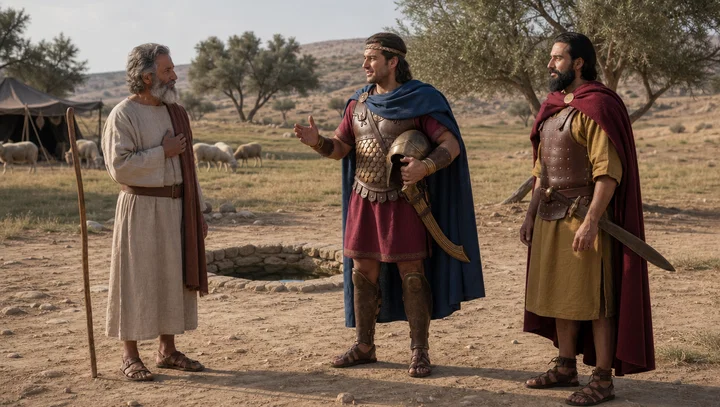
Abraham and Abimelech swear their agreement.
- Genesis 26:28-31
And they said, We saw certainly that the LORD was with thee: and we said, Let there be now an oath betwixt us, even betwixt us and thee, and let us make a covenant with thee;
Abimelech and Isaac make an oath and depart in peace.
- Genesis 20:2
And Abraham said of Sarah his wife, She is my sister: and Abimelech king of Gerar sent, and took Sarah.
The study also directs attention to Abraham’s earlier dealings with Abimelech.
Commentary
Each commentary is drawn from primary sources: the writings of Ellen G. White and Adventist pioneers and periodicals. Each commentary is separate. Its own words are not a quotation; follow the references to read the source passages.
Pioneers and periodicals
9 sources
The place was called Beer-sheba in connection with and in commemoration of the oath sworn there by both Abraham and Abimelech, confirming their agreement.STRH Jan 27, 1910ST Mar 4, 1886ST Aug 28, 1901RH Apr 10, 1866 The name was given to mark the oath-making and the covenant confirmed by it.RH Jan 27, 1910ST Mar 4, 1886ST Aug 28, 1901ST Sep 27, 1883RH Apr 10, 1866 The name Beer-sheba means well of the oath.RH Jan 27, 1910ST Aug 28, 1901
The oath and covenant there concerned a well of water.RH Jan 27, 1910ST Aug 28, 1901 The covenant was a mutual agreement or compact between people, involving mutual promises.ST Mar 4, 1886ST Sep 27, 1883ST Jul 1, 1875 The sense of the word covenant is determined by its context, so that here it means an agreement or mutual promises.ST Sep 27, 1883
It confirmed a covenant of friendship.RH Apr 10, 1866 It was an agreement between equal rulers, marked by the oath they swore together. This human agreement is distinct from the covenant God made with Israel.ST Jul 1, 1875 The agreement shows that human agreements are called covenants in the Bible, alongside promises called covenants and commanded law called a covenant.RH Aug 13, 1872
The covenant made there was respected throughout Abraham's life.ST Aug 28, 1901 The event belongs among God's providential dealings with Abraham's family as the chosen progenitor of the Seed.ST
Sources