Genesis 21:32
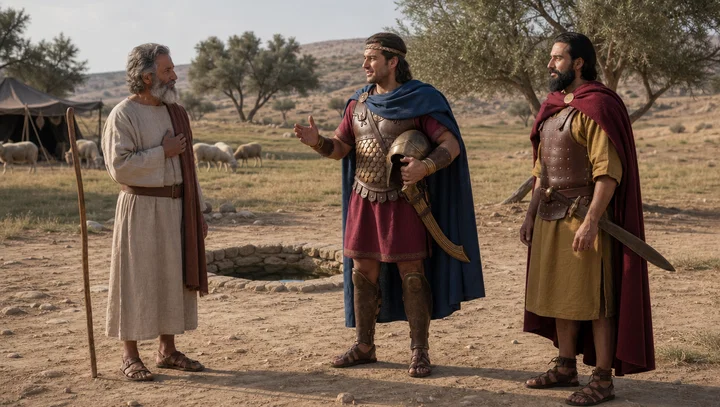
Thus they made a covenant at Beer-sheba: then Abimelech rose up, and Phichol the chief captain of his host, and they returned into the land of the Philistines.
Translations
Thus they made a covenant at Beersheba: then Abimelech rose up, and Phichol the chief captain of his host, and they returned into the land of the Philistines.
King James Version, KJV Cambridge Paragraph Bible
Thus they made a covenant at Beer-sheba: then Abimelech rose up, and Phichol the chief captain of his host, and they returned into the land of the Philistines.
Thus they made a covenant at Beer-sheba: Then Abimelech arose, and Phichol the chief captain of his host, and they returned into the land of the Philistines.
Revised Version, American Standard Version
So they made a covenant at Beer-sheba: and Abimelech rose up, and Phicol the captain of his host, and they returned into the land of the Philistines.
And they make a covenant in Beer-Sheba, and Abimelech riseth — Phichol also, head of his host — and they turn back unto the land of the Philistines;
And they made a covenant at Beer-sheba. And Abimelech rose up, and Phichol the captain of his host, and returned into the land of the Philistines.
And when they had solemnised a covenant in Beer-sheba,—then arose Abimelech, with Phicol chief of his host, and returned unto the land of the Philistines.
Berean Standard Bible, Majority Standard Bible
After they had made the covenant at Beersheba, Abimelech and Phicol the commander of his army got up and returned to the land of the Philistines.
So they made a covenant at Beersheba. Abimelech rose up with Phicol, the captain of his army, and they returned into the land of the Philistines.
So they made an agreement at Beer-sheba, and Abimelech and Phicol, the captain of his army, went back to the land of the Philistines.
Thus made they a couenant at Beer-sheba: afterward Abimelech and Phichol his chiefe captaine rose vp, and turned againe vnto the land of the Philistims.
Douay-Rheims (Challoner revision)
And they made a league for the well of oath.
Pictures
Cross-references
- Genesis 21:27
And Abraham took sheep and oxen, and gave them unto Abimelech; and both of them made a covenant.
Abraham and Abimelech make a covenant.
- Genesis 21:23-24
Now therefore swear unto me here by God that thou wilt not deal falsely with me, nor with my son, nor with my son’s son: but according to the kindness that I have done unto thee, thou shalt do unto me, and to the land wherein thou hast sojourned.
Abraham and Abimelech agree to make a covenant.
- Genesis 20
And Abraham journeyed from thence toward the south country, and dwelled between Kadesh and Shur, and sojourned in Gerar.
The study pairs this chapter with Genesis 21 to examine Abraham’s relations with Abimelech.
- Genesis 26:1
And there was a famine in the land, beside the first famine that was in the days of Abraham. And Isaac went unto Abimelech king of the Philistines unto Gerar.
Isaac later faces famine and goes to Abimelech at Gerar.
- Genesis 26:28
And they said, We saw certainly that the LORD was with thee: and we said, Let there be now an oath betwixt us, even betwixt us and thee, and let us make a covenant with thee;
A similar agreement is made with Isaac.
- Genesis 21:9-21
And Sarah saw the son of Hagar the Egyptian, which she had born unto Abraham, mocking.
Hagar and Ishmael’s expulsion illustrates trouble in Abraham’s household.
- Genesis 15:18
In the same day the LORD made a covenant with Abram, saying, Unto thy seed have I given this land, from the river of Egypt unto the great river, the river Euphrates:
both cited as things called a covenant
Commentary
Each commentary is drawn from primary sources: the writings of Ellen G. White and Adventist pioneers and periodicals. Each commentary is separate. Its own words are not a quotation; follow the references to read the source passages.
Pioneers and periodicals
12 sources
Thus they made a covenant at Beer-sheba records the conclusion of the agreement about the well, after which Abimelech and Phichol the chief captain of his host returned into the land of the Philistines, and Beer-sheba, an old camping-ground of Abraham meaning well of the oath, commemorated that agreement.RH Mar 1, 1870ST Aug 28, 1901 The covenant was a mutual agreement, compact, or arrangement involving promises or conditions and a covenant of friendship confirmed by an oath, belonging to the class of covenants that are agreements rather than a divine covenant or a law commanded.ST Mar 4, 1886RH Apr 12, 1860ST Sep 27, 1883RH Apr 10, 1866 Abraham made it with Abimelech, king of the Philistines, as an equal and as a sovereign, showing that he exercised independent authority in Canaan.ST Aug 28, 1901 It belongs to the account of God's providential dealings with Abraham's family as the chosen family, supporting the place of Isaac, the miraculous child of promise, in the line through which the promised Seed would come.RH Jul 5, 1915ST
Historical Setting and Wording
The verse records the conclusion of the covenant at Beer-sheba, after which Abimelech rose up with Phichol the chief captain of his host and they returned into the land of the Philistines.RH Mar 1, 1870ST Aug 28, 1901 Beer-sheba was an old camping-ground of Abraham, and its name, meaning well of the oath, commemorated the agreement made concerning the well there.ST Aug 28, 1901 The account belongs to the history of Abraham's family life, in which the unhappiness brought by polygamy is exemplified.RH Mar 1, 1870
The covenant between Abraham and Abimelech was a mutual agreement, compact, or arrangement involving promises or conditions.ST Mar 4, 1886RH Apr 12, 1860ST Jul 1, 1875RH Aug 13, 1872 It illustrates that the word covenant can refer to an agreement as well as to a law.ST Mar 4, 1886RH Apr 12, 1860ST Sep 27, 1883 Here it does not mean a divine covenant or a law, but belongs to the class of covenants that are agreements, distinct from promises called covenants and from a law commanded called a covenant.ST Jul 1, 1875RH Aug 13, 1872
The covenant was a covenant of friendship confirmed by an oath, made before Abraham reproved Abimelech about the wrong his servants had done him over a well.RH Apr 10, 1866 Abraham made it with Abimelech, king of the Philistines, as an equal and as a sovereign, showing that he exercised independent authority in Canaan.ST Aug 28, 1901 It was respected as long as Abraham lived, but after his death the Philistines stopped up the wells Abraham had dug.ST Aug 28, 1901
Theological Meaning and Application
The covenant at Beer-sheba belongs to the larger account of Abraham's two sons, Ishmael and Isaac, and it confirms the place of Isaac as the miraculous child of promise in the line through which the promised Seed would come.RH Jul 5, 1915 It falls within the record of God's providential dealings with Abraham's family as the chosen family through which that promised Seed would come.ST The timing of this history places Isaac in a period when he could converse with Shem for fifty years, which gave Abraham opportunity to pass on the divine truths he had learned.ST Oct 4, 1883
The same history stands as an example of the unhappiness that polygamy brought into families.RH Mar 1, 1870 The covenant of friendship with Abimelech, confirmed by an oath, was made before Abraham reproved him about the wrong his servants had done over a well, and it shows that a small disagreement need not break a friendship, since meekness allows the matter to be discussed and settled without hostility.RH Apr 10, 1866 That covenant was respected as long as Abraham lived, but after his death the Philistines stopped up the wells Abraham had dug.ST Aug 28, 1901
Sources