Genesis 24:21
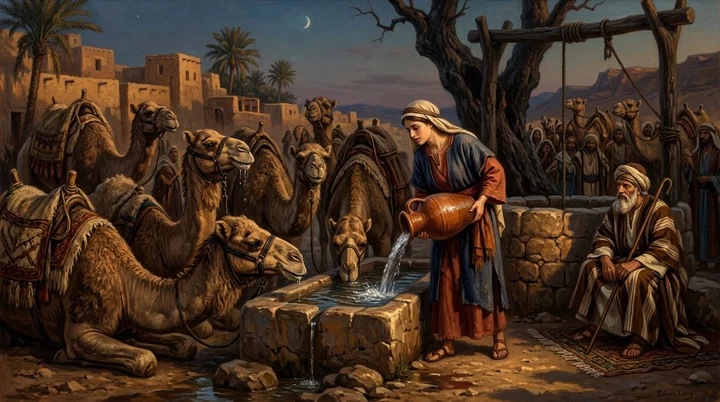
And the man wondering at her held his peace, to wit whether the LORD had made his journey prosperous or not.
Translations
American King James Version, King James Version
And the man wondering at her held his peace, to wit whether the LORD had made his journey prosperous or not.
And the man wondering at her held his peace, to wit whether the Lord had made his journey prosperous or not.
And the man, wondering at her, held his peace, to know whether the LORD had made his journey prosperous, or not.
And the man looked stedfastly on her; holding his peace, to know whether the LORD had made his journey prosperous or not.
And the man looked stedfastly on her, holding his peace, to know whether Jehovah had made his journey prosperous or not.
And the man, wondering at her, remaineth silent, to know whether Jehovah hath made his way prosperous or not.
And the man was astonished at her, remaining silent, to know whether Jehovah had made his journey prosperous or not.
Now the man, was eagerly watching her,—keeping silence to see—whether Yahweh had prospered his way., or not.
Berean Standard Bible, Majority Standard Bible
Meanwhile, the man watched her silently to see whether or not the LORD had made his journey a success.
The man looked steadfastly at her, remaining silent, to know whether the LORD had made his journey prosperous or not.
And the man, looking at her, said nothing, waiting to see if the Lord had given his journey a good outcome.
So the man wondred at her, and helde his peace, to knowe whether the Lord had made his iourney prosperous or not.
Douay-Rheims (Challoner revision)
But he musing beheld her with silence, desirous to know whether the Lord had made his journey prosperous or not.
Pictures
Cross-references
- Genesis 24:12-14
And he said, O LORD God of my master Abraham, I pray thee, send me good speed this day, and shew kindness unto my master Abraham.
The servant prays for guidance and a sign in finding Isaac’s wife.
- Genesis 24:27
And he said, Blessed be the LORD God of my master Abraham, who hath not left destitute my master of his mercy and his truth: I being in the way, the LORD led me to the house of my master’s brethren.
The servant recognizes the Lord’s guidance and gives thanks.
- Genesis 24:7
The LORD God of heaven, which took me from my father’s house, and from the land of my kindred, and which spake unto me, and that sware unto me, saying, Unto thy seed will I give this land; he shall send his angel before thee, and thou shalt take a wife unto my son from thence.
Abraham assures the servant that God will send His angel ahead.
- Genesis 24:50-51
Then Laban and Bethuel answered and said, The thing proceedeth from the LORD: we cannot speak unto thee bad or good.
Rebekah’s family recognizes the Lord’s direction and agrees to the marriage.
- Genesis 24:67
And Isaac brought her into his mother Sarah’s tent, and took Rebekah, and she became his wife; and he loved her: and Isaac was comforted after his mother’s death.
Isaac marries Rebekah and finds comfort in her.
Commentary
Each commentary is drawn from primary sources: the writings of Ellen G. White and Adventist pioneers and periodicals. Each commentary is separate. Its own words are not a quotation; follow the references to read the source passages.
Ellen G. White
7 sources
Genesis 24:21 belongs to the account of Abraham's servant seeking a wife for Isaac, a mission entrusted to God's guidance with the assurance that God would send His angel before the servant.PP 171.3 It depicts Abraham's servant quietly and silently watching Rebekah and waiting to learn whether the Lord had prospered his journey.ST Apr 10, 1879CE 228.1–230.11SP 104.3PP 171 His watching was to discern God's answer in his search to find a wife for Isaac.CE 228.1–230.11SP 104.3 He watched silently at the well to see whether her actions confirmed that his journey had been prospered.PP 171
Abraham's course in arranging the marriage is an example for parents to guide their children's affections toward suitable companions and to teach them respect for parental authority.SG3 112.3ST Apr 10, 1879 Isaac trusted God to direct the choice and submitted to his father's judgment by accepting the wife chosen through his father's experienced, God-fearing servant.SG3 112.1–2CE 228.1–230.11SP 104.3
The account is an example for children who profess to fear God to seek God's direction and divine guidance in choosing a marriage partner.SG3 112.1–2CE 228.1–230.11SP 104.3 It is an example for children to respect their parents' judgment and seek experienced parental counsel in choosing a marriage partner.SG3 112.1–2CE 228.1–230.1 Rebekah became Isaac's wife, he loved her, and she comforted him after Sarah's death, presenting a tender picture of domestic happiness.CE 228.1–230.1
Sources
Pioneers and periodicals
17 sources
Abraham's servant stands at a town fountain in Mesopotamia and Padan-Aram, where he has come to seek a wife for Isaac on a journey that succeeds when he returns with Rebekah.ST Feb 19, 1894ST May 19, 1898 After Rebekah has drawn water for him and his camels, he watches her closely and in silence, wondering whether the LORD has made his journey prosperous by leading him to her.ST Jan 14, 1886ST Sep 15, 1898ST Mar 17, 1914 His silent pause is careful attention to events by which he seeks to recognize God's providential guidance, trusting the outcome to the Lord in an ordinary practical matter rather than to mere chance.ST Jan 14, 1886ST Mar 17, 1914ST Jan 14, 1886ST Sep 15, 1898 Her appearance follows his prayer for guidance and answers it, for her act of giving water and her family connection confirm the sign he asked for, and he responds by worshiping God.RH Jul 25, 1912ST Sep 5, 1900RH Aug 1, 1871 The meeting preserves the godly line through which the promised Seed is to come by preventing its amalgamation with the ungodly, and the marriage of Isaac and Rebekah stands as a sacred institution ordained by God and an example of parents guiding their children toward suitable companions.ST Apr 10, 1879ST Jan 9, 1912ST Aug 3, 1915ST Jan 14, 1913ST Apr 5, 1905
Servant's Silent Watching
Abraham's servant is at a town fountain on his journey to Mesopotamia and to Padan-Aram to seek a wife for Isaac.ST Feb 19, 1894ST May 19, 1898 A fountain is a natural place to meet people and to make such a search.ST May 19, 1898 That journey succeeded, for he returned with Rebekah.ST Feb 19, 1894
After Rebekah has drawn water for him and for his camels, the servant Eliezer watches her closely and in silence.ST Jan 14, 1886ST Sep 15, 1898ST Mar 17, 1914RH Jul 25, 1912ST Jan 14, 1886 He wonders and waits to learn whether the LORD has made his journey prosperous by leading him to her.ST Apr 10, 1879ST Jan 14, 1886ST Sep 15, 1898ST Mar 17, 1914RH Jul 25, 1912 His silent watching includes reflection and conversation with her as part of their meeting.ST Sep 15, 1898 Her actions in giving water and her family connection confirm the sign he had asked for, and he responds by worshiping God.RH Jul 25, 1912 Abraham's course in arranging Isaac's marriage in this account is an example of parents guiding their children's affections toward suitable companions and teaching them to respect parental authority.ST Apr 10, 1879
The arrival recorded in Genesis 24:10-27 came about one hundred years before Jacob's arrival in the same country.ST Oct 6, 1898 Both arrivals are in Padan-Aram.ST Oct 6, 1898 The earlier arrival of Abraham's servant provides a parallel for comparing with Jacob's arrival.ST Oct 6, 1898
Providential Guidance and Prayer
The silent pause at the well is careful attention to unfolding events by which to recognize providential leading, a close and quiet watching to discern whether the Lord has made the journey successful by bringing the right maiden forward.ST Jan 14, 1886ST Mar 17, 1914 It is not idle curiosity but deliberate discernment, holding back speech in order to weigh what is seen against what was sought from God.ST Jan 14, 1886ST Mar 17, 1914 After she has drawn water for the traveler and his camels, the observer continues to watch in silence, waiting to learn whether the Lord has prospered the errand.ST Jan 14, 1886ST Sep 15, 1898
That waiting shows trust in divine direction in an ordinary, practical matter, the conviction that the outcome of the mission rests with the Lord.ST Jan 14, 1886 It is faith in the Lord's guidance rather than belief in mere chance, a refusal to treat the meeting as accident.ST Jan 14, 1886ST Sep 15, 1898 The servant seeks God's hand and looks for His answer in the common duties of the roadside.ST Jan 14, 1886
Her coming follows prayer for guidance and answers it, proving the power of prayer to obtain direction in need.RH Jul 25, 1912ST Sep 5, 1900RH Aug 1, 1871 Her act of giving water to the man and his camels, together with her family connection, confirms the sign that had been asked for beforehand.RH Jul 25, 1912 Upon seeing that confirmation the servant responds by worshiping God for answered prayer.RH Jul 25, 1912 He is the tried and trusted servant of Abraham, and his conduct here displays piety, unselfishness, and faithfulness as one whom the Lord led while he was in the way.ST Jan 9, 1912
Marriage Preserving Promised Seed
Abraham had waited a full twenty-five years in faith for the promised son and had seen that son come to manhood, and then faced the great perplexity of securing for Isaac a wife as nearly as possible in the godly line.ST Aug 3, 1915 The care was to prevent the amalgamation of the godly seed with the ungodly and the pollution of God's people, and so to preserve the channel for the coming Deliverer.ST Aug 3, 1915
The verse belongs to the account that follows the family through which the Seed was to come, where the promises given to Abraham extend to Isaac and onward to Jacob.ST Jan 14, 1913 In that setting it is one of God's special providences over the progenitors of the promised Seed.ST Jan 9, 1912 It stands at the end point of the progressive steps of God's dealing with Abraham from his call in Genesis 12 to Genesis 24, when Abraham the father of the faithful came fully to trust God and sent his tried servant to obtain a wife for Isaac.ST Dec 20, 1910 There are shown God's providential care and interest among men, His favors to him who chooses unselfishly, His warnings before punishment, and His repeated lessons in the school of faith, alongside the clearly revealed characters of Abram and Lot and the influence of worldly associations upon a good man, all to be kept in mind with the Promised Seed.ST Dec 20, 1910
The marriage of Isaac and Rebekah arranged in this way illustrates marriage as a sacred institution ordained by God and as a fitting, blessed union.ST Apr 5, 1905 Abraham's course in arranging it is an example of parents guiding their children's affections toward suitable companions and teaching them to respect parental authority, while the servant quietly watches Rebekah and waits to learn whether the Lord has prospered his journey.ST Apr 10, 1879
Sources