Genesis 24:20
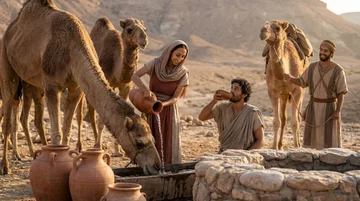
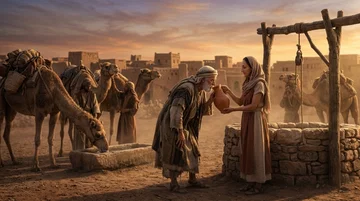
And she hasted, and emptied her pitcher into the trough, and ran again unto the well to draw water, and drew for all his camels.
Translations
And she hurried, and emptied her pitcher into the trough, and ran again to the well to draw water, and drew for all his camels.
King James Version, KJV Cambridge Paragraph Bible
And she hasted, and emptied her pitcher into the trough, and ran again unto the well to draw water, and drew for all his camels.
And she hasted, and emptied her pitcher into the trough, and ran again to the well to draw water, and drew for all his camels.
Revised Version, American Standard Version
And she hasted, and emptied her pitcher into the trough, and ran again unto the well to draw, and drew for all his camels.
and she hasteth, and emptieth her pitcher into the drinking-trough, and runneth again unto the well to draw, and draweth for all his camels.
And she hasted and emptied her pitcher into the trough, and ran again to the well to draw [ water]; and she drew for all his camels.
So she hastened and emptied her pitcher into the drinking-trough, and ran again unto the well, to draw,—and she drew for all his camels.
Berean Standard Bible, Majority Standard Bible
And she quickly emptied her jar into the trough and ran back to the well to draw water, until she had drawn water for all his camels.
She hurried, and emptied her pitcher into the trough, and ran again to the well to draw, and drew for all his camels.
And after putting the water from her vessel into the animals' drinking-place, she went quickly back to the spring and got water for all the camels.
And she powred out her pitcher into the trough speedily; and ranne againe vnto the well to drawe water, and she drewe for all his camels.
Douay-Rheims (Challoner revision)
And pouring out the pitcher into the troughs, she ran back to the well to draw water: and having drawn she gave to all the camels.
Pictures
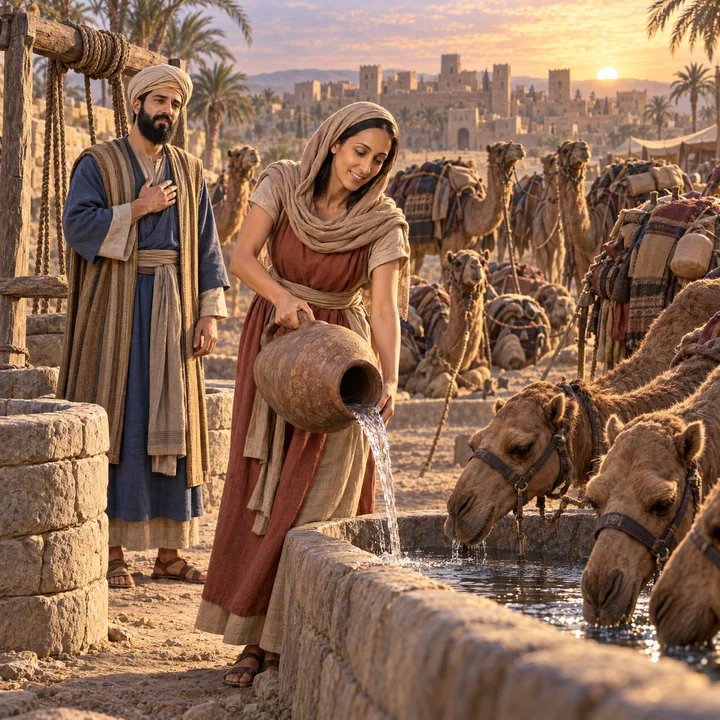
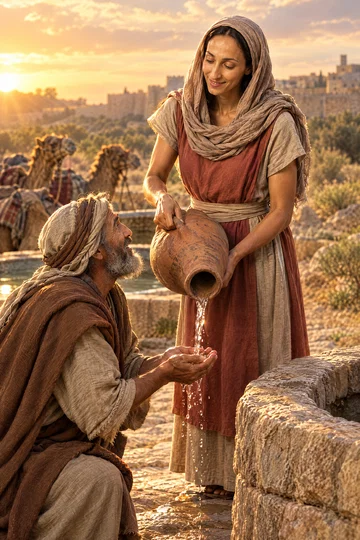
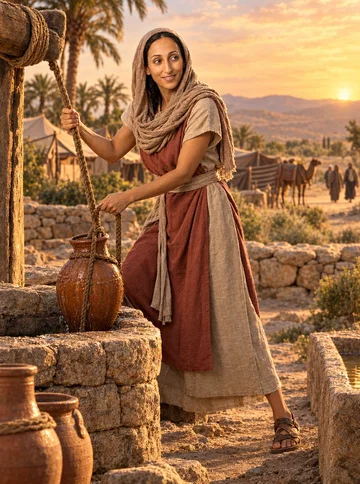
Cross-references
- Genesis 24:14
And let it come to pass, that the damsel to whom I shall say, Let down thy pitcher, I pray thee, that I may drink; and she shall say, Drink, and I will give thy camels drink also: let the same be she that thou hast appointed for thy servant Isaac; and thereby shall I know that thou hast shewed kindness unto my master.
Rebekah fulfills the sign Eliezer prayed for by drawing water for the camels.
- Exodus 2:16-19
Now the priest of Midian had seven daughters: and they came and drew water, and filled the troughs to water their father’s flock.
Both describe a well encounter in Midian involving drawing water for a flock.
- Genesis 24:50-51
Then Laban and Bethuel answered and said, The thing proceedeth from the LORD: we cannot speak unto thee bad or good.
Rebekah’s family recognizes God’s leading through the sign.
- Genesis 24:67
And Isaac brought her into his mother Sarah’s tent, and took Rebekah, and she became his wife; and he loved her: and Isaac was comforted after his mother’s death.
Isaac marries Rebekah and finds comfort after his mother’s death.
- Genesis 29:1-2
Then Jacob went on his journey, and came into the land of the people of the east.
Jacob encounters a well while journeying to find his relatives.
- Genesis 25:20
And Isaac was forty years old when he took Rebekah to wife, the daughter of Bethuel the Syrian of Padan-aram, the sister to Laban the Syrian.
Gives Isaac’s age when he married Rebekah.
Commentary
Each commentary is drawn from primary sources: the writings of Ellen G. White and Adventist pioneers and periodicals. Each commentary is separate. Its own words are not a quotation; follow the references to read the source passages.
Ellen G. White
5 sources
Rebekah hastened and emptied her pitcher into the trough and ran again to the well to draw water, and her prompt, diligent, courteous, willing and generous service extended to the servant and to all his camels.CE 228.1–230.11SP 102.1 That service was part of how Isaac's wife was chosen, for it provided the evidence the servant had asked God to give and confirmed that Rebekah was the woman God had selected to become Isaac's wife.CE 228.1–230.11SP 102.1
The verse stands within the record of Abraham's course in educating Isaac to love a life of noble obedience and in guiding his marriage, a record given as an example for parents to follow.SG3 112.3ST Apr 10, 1879 Parents are thereby taught to command their households after them and to instruct their children to yield to and respect parental authority.SG3 112.3ST Apr 10, 1879 They are to take responsibility to guide and restrain their children's affections toward suitable companions for both sons and daughters, because Satan controls the affections of the young to a great extent and leaving those affections unguided is rebuked.SG3 112.3ST Apr 10, 1879
Isaac's part in the marriage account is an example for young people to trust God to guide the choice of a wife and to submit to godly parental guidance exercised through a God-fearing servant.1SP 104.3
Sources
Pioneers and periodicals
20 sources
The verse belongs to the true account of Abraham's servant meeting Rebekah at sunset at the well just outside Haran, where women came to draw water.ST Jan 14, 1886ST Feb 17, 1914ST May 19, 1898 She hasted and quickly emptied her pitcher into the trough, then hurried and ran again to the well and drew and carried enough water for all his camels, showing eager, prompt, generous and willing service.ST Sep 15, 1898ST Sep 15, 1898RH Nov 13, 1900ST Feb 19, 1894ST Feb 17, 1914 Her act fulfilled the sign the servant had asked God to give, that the woman appointed for Isaac would offer water for the camels as well as for him.RH Jul 25, 1912ST Feb 17, 1914RH Jan 30, 1872 It shows answered prayer in a temporal matter, with God directing her ordinary actions naturally without her knowing it and guiding even small, everyday events.RH Jan 30, 1872ST Jan 14, 1886ST Sep 5, 1900 It belongs to the time when Abraham in full trust sent his tried servant to obtain a wife for Isaac in the godly line, to prevent amalgamation of the godly seed with the ungodly and to preserve a channel for the coming Deliverer in whom all families would be blessed.ST Dec 20, 1910ST Aug 3, 1915ST
Historical Setting in Abraham's Life
Genesis 24:20 belongs to the true account of ancient Oriental life in which Abraham's servant meets Rebekah at a well in Mesopotamia.ST Jan 14, 1886 The meeting took place at sunset at the well just outside Haran, after prayer for guidance in finding a wife for Isaac, when asked for water she gave drink and also drew for all the camels.ST Feb 17, 1914 The well was a place where women came to draw water, making it a natural setting for the encounter.ST May 19, 1898
The verse belongs to the time when Abraham has come fully to trust God and sends his tried servant to obtain a wife for Isaac, marking one of the progressive steps in God's dealing with Abraham as the father of the faithful.ST Dec 20, 1910 It falls within God's providential dealings with Abraham's family, the chosen family through whom the promised Seed would come, and is to be kept in mind in connection with the Promised Seed.ST Dec 20, 1910ST
It belongs to the time when Abraham, after waiting a full quarter of a century for the son promised by Jehovah, faced one of his greatest perplexities when that son of promise had come to manhood, over securing for Isaac a wife as nearly as possible in the godly line.ST Aug 3, 1915 The aim was to prevent the amalgamation of the godly seed with the ungodly and its pollution, to preserve God's name and His truth in the earth, to keep His people a factor in the evangelization of the world, and to provide through the godly line a channel for the coming of the Deliverer in whom all the families of the earth would be blessed.ST Aug 3, 1915 This was so that God's eternal purpose to fill the earth with a people all righteous could be carried to completion at a time when the race was fast drifting into idolatry.ST Aug 3, 1915
The chapter to which the verse belongs shows the piety, unselfishness, and faithfulness of Abraham's trusted servant, and God's leading in answer to his faith.ST Jan 9, 1912 The verse belongs to the account of Abraham's servant arriving in Padan-Aram about one hundred years before Jacob arrived there, and the two arrivals are to be compared with each other.ST Oct 6, 1898
Rebekah's Willing Generous Service
Rebekah's act is eager, prompt, generous and willing service, and it reveals her character.ST Sep 15, 1898ST Sep 15, 1898ST Feb 19, 1894RH Jul 25, 1912RH Jan 30, 1872 She hasted and quickly emptied her pitcher into the trough for the stranger's need.ST Sep 15, 1898ST Sep 15, 1898ST Feb 19, 1894RH Jan 30, 1872ST Jan 14, 1886 She then hurried and ran again unto the well to draw more, and drew and carried enough water for all his camels.ST Sep 15, 1898ST Sep 15, 1898ST Feb 19, 1894RH Jul 25, 1912ST Jan 14, 1886
She treated drawing water for the camels as light work, which illustrates her willingness to labor.RH Nov 13, 1900 The same deed reveals gracious courtesy and deference to age as part of her character.ST Feb 17, 1914
Providence Prayer and Obedience
Rebekah's hastening to empty her pitcher into the trough and running again to draw for all the camels fulfilled the very sign the servant had asked God to appoint, that the woman chosen for Isaac would offer water to the camels as well as to himself.RH Jul 25, 1912ST Feb 17, 1914 Having prayed at the well just outside Haran at sunset for guidance in finding a wife for Isaac, he asked for water and she gave him drink and then promptly drew and carried water for his camels.RH Jul 25, 1912ST Feb 17, 1914 Her act answered his prayer for direction and for kindness toward Abraham's household, and it filled him with joy and thanksgiving when he learned she was the daughter of Abraham's kinsman.RH Jul 25, 1912ST Feb 17, 1914
Her ordinary actions happened naturally without her knowing that God was directing her, showing that God can guide events even in small, everyday matters.RH Jan 30, 1872 The servant prayed and Rebekah appeared, and he watched Providence lead him and gratefully recognized God's mercy in this temporal matter.RH Jan 30, 1872ST Jan 14, 1886ST Sep 5, 1900 The scene is an answer to prayer and shows the power of prayer.ST Jan 14, 1886ST Sep 5, 1900RH Aug 1, 1871
The meeting belongs to the record of Abraham educating Isaac to love a life of noble obedience and guiding his son's affections toward a suitable companion in marriage.ST Apr 10, 1879 That record is given for parents to command their households after them, to instruct children to yield to and respect parental authority, and to take responsibility to guide and restrain the affections of sons and daughters in placing them upon suitable companions, because Satan controls the affections of the young to a great extent and Abraham's course rebukes leaving them unguided.ST Apr 10, 1879 Isaac accepted his father's judgment in choosing a wife, reflecting a life of obedience shaped by parental training in love and concern for children's welfare, while Rebekah willingly served by drawing for the camels. In deferring to his father's wishes Isaac honored his father, showing that honor to parents as required by the fifth commandment was already binding and obeyed by God's servants long before Sinai, proving the decalogue governed mankind from the beginning.ST Jul 9, 1874 The marriage of Isaac and Rebekah thus stands as a simple, romantic example of the sacred marriage institution ordained by God.ST Apr 5, 1905
Sources