Genesis 24:46
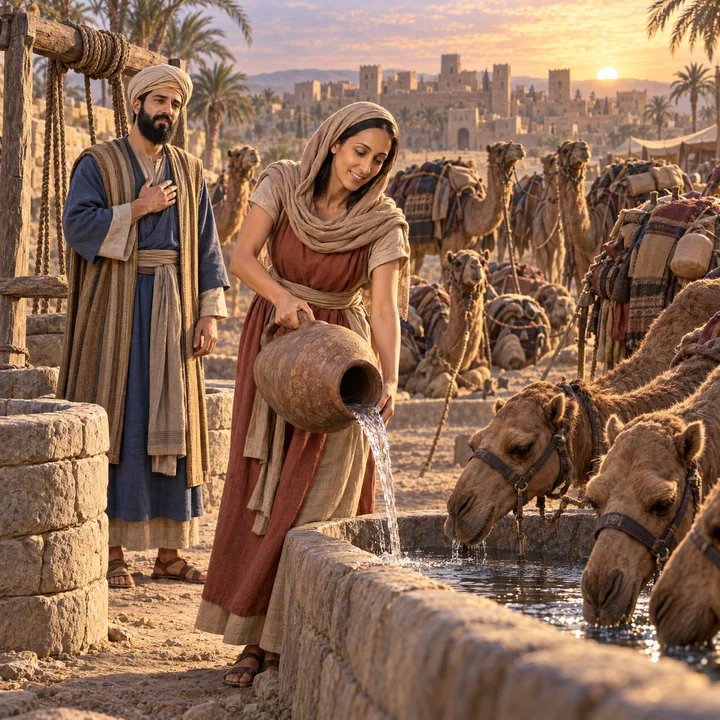
And she made haste, and let down her pitcher from her shoulder, and said, Drink, and I will give thy camels drink also: so I drank, and she made the camels drink also.
Translations
And she made haste, and let down her pitcher from her shoulder, and said, Drink, and I will give your camels drink also: so I drank, and she made the camels drink also.
King James Version, KJV Cambridge Paragraph Bible, Webster Bible, Revised Version, American Standard Version
And she made haste, and let down her pitcher from her shoulder, and said, Drink, and I will give thy camels drink also: so I drank, and she made the camels drink also.
and she hasteth and letteth down her pitcher from off her and saith, Drink, and thy camels also I water; and I drink, and the camels also she hath watered.
And she hasted and let down her pitcher from her [shoulder], and said, Drink, and I will give thy camels drink also. And I drank; and she gave the camels drink also.
So she hastened and lowered her pitcher from off her, and said. Drink! and to thy camels also, will I give to drink,—So I drank and the camels also, she let drink.
Berean Standard Bible, Majority Standard Bible
She quickly lowered her jar from her shoulder and said, ‘ Drink, and I will water your camels as well.’ So I drank, and she also watered the camels.
She hurried and let down her pitcher from her shoulder, and said, ‘ Drink, and I will also give your camels a drink.’ So I drank, and she also gave the camels a drink.
And straight away she took down her vessel from her arm, and said, Take a drink, and I will get water for your camels.
And she made haste, and tooke downe her pitcher from her shoulder, and said, Drinke, and I will giue thy camels drinke also. So I dranke, and she gaue the camels drinke also.
Douay-Rheims (Challoner revision)
And she speedily let down the pitcher from her shoulder, and said to me: Both drink thou, and to thy camels I will give drink. I drank, and she watered the camels.
Pictures
Cross-references
- Genesis 24:3-4
And I will make thee swear by the LORD, the God of heaven, and the God of the earth, that thou shalt not take a wife unto my son of the daughters of the Canaanites, among whom I dwell:
Abraham directs the servant to find Isaac a wife from his kindred.
- Genesis 25:20
And Isaac was forty years old when he took Rebekah to wife, the daughter of Bethuel the Syrian of Padan-aram, the sister to Laban the Syrian.
Cited for Isaac’s age when he married Rebecca.
Commentary
Each commentary is drawn from primary sources: the writings of Ellen G. White and Adventist pioneers and periodicals. Each commentary is separate. Its own words are not a quotation; follow the references to read the source passages.
Ellen G. White
6 sources
Genesis 24:46 belongs to the account of God guiding Abraham's servant to find Rebekah as a wife for Isaac.PP 171.3SG3 112.3CE 228.1–230.1ST Apr 10, 1879SG3 112.1–2 It falls within the account of Isaac's marriage and of how the servant chose Rebekah to be Isaac's wife.CE 228.1–230.1SG3 112.1–21SP 104.3 Rebekah promptly let down her pitcher from her shoulder and gave drink to the servant and also drew for his camels.PP 171.3CE 228.1–230.1 In doing so she displayed the kind, helpful, hospitable character that the servant had asked God to use as the sign of her suitability as Isaac's wife.PP 171.3CE 228.1–230.1
Abraham guided the choice of a suitable companion for his son.SG3 112.3ST Apr 10, 1879 That course shows the responsibility of parents to guide their children's affections toward suitable marriage partners rather than leaving them wholly unguided.SG3 112.3ST Apr 10, 1879 Isaac, trained to obey God, trusted God to direct the choice and accepted his God-fearing father's servant choosing a wife for him.SG3 112.1–21SP 104.3 His acceptance of his father's servant's role in choosing a wife rested on that trust in God's direction.SG3 112.1–21SP 104.3
The account is left as an example for children, especially those who profess to fear God.ST Apr 10, 1879SG3 112.1–21SP 104.3 It teaches their duty to respect parental authority.ST Apr 10, 1879SG3 112.1–2 That duty and that parental responsibility belong together in the lesson of the marriage.ST Apr 10, 1879SG3 112.1–21SP 104.3
Sources
Pioneers and periodicals
15 sources
Genesis 24:46 records the moment at the well in Mesopotamia when Rebekah hastily lowered her pitcher from her shoulder and gave Abraham's trusted servant a drink and then drew water for his camels also, an act of hospitality he afterward retold as the proof of the success of his errand to obtain a wife for Isaac and bring her back to him.ST Jan 14, 1886ST Dec 20, 1910ST Sep 15, 1898ST Feb 19, 1894RH Oct 1, 1901 It belongs to God's special providence over the progenitors of the promised Seed, continuing the chosen family and its promises from Abraham to Isaac and on to Jacob.ST Jan 9, 1912ST Jan 14, 1913 Her quick, generous response fulfilled the servant's requested sign and answered his prayer, showing him led by the Lord while in the way and marking her as the woman chosen to become Isaac's wife.ST Jan 9, 1912RH Nov 18, 1909ST Dec 20, 1910 Abraham's care to seek a wife from the godly line to preserve His people from religious corruption teaches parents to guide their children's affections toward suitable partners and children to respect parental authority.ST Apr 10, 1879ST Dec 20, 1910ST Aug 3, 1915 Isaac's deference to his father's judgment in this simple yet romantic marriage shows marriage to be a holy thing from sinless Eden, ordained in the beginning and honorable in all, symbolizing the union of Christ with the individual soul, with His church, and with His everlasting kingdom when Bride and Bridegroom rejoice together.ST Apr 5, 1905ST Jul 9, 1874
Narrative Setting and Action
Abraham sent his tried servant to Mesopotamia to obtain a wife for Isaac, and this verse belongs to that mission and to the servant's meeting with Rebekah at a well there.ST Jan 14, 1886ST Dec 20, 1910ST Feb 19, 1894 It falls within the account of the journey, its success, and the return with Rebekah for Isaac.ST Jan 14, 1886ST Dec 20, 1910ST Feb 19, 1894 The meeting at the well is presented as a true story of ancient life that offers lessons for later readers.ST Jan 14, 1886
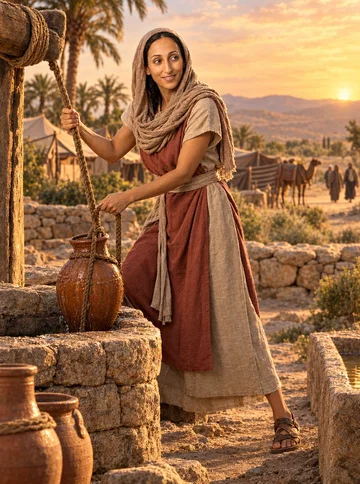
The verse records Rebekah hastily letting down her pitcher and promptly offering the servant a drink and then drawing water for his camels also.ST Sep 15, 1898RH Oct 1, 1901 That prompt offer of water to him and watering of his camels was an act of hospitality.ST Sep 15, 1898RH Oct 1, 1901 It afterward formed part of the servant's own account of their meeting at the well.ST Sep 15, 1898 Her letting the pitcher down from her shoulder reflects the practice of women carrying a water jar on the shoulder after filling it, as women elsewhere were likewise seen carrying heavy earthen jars after filling them at the fountain.ST Sep 23, 1886
The account marks the point where Abraham has come fully to trust God after progressive steps from his call through lessons in the school of faith.ST Dec 20, 1910 It continues God's dealing with the father of the faithful with the Promised Seed kept in view.ST Dec 20, 1910
Providence and Divine Guidance
The verse belongs to the account of God's special providence over the progenitors of the promised Seed.ST Jan 9, 1912 It stands in the continuing history of the family through which the Seed was to come, with the promises extending from Abraham to Isaac and on to Jacob.ST Jan 9, 1912ST Jan 14, 1913 It helps display the piety, unselfishness, and faithfulness surrounding Abraham's trusted servant, whose experience was that the Lord led him while he was in the way.ST Jan 9, 1912
Rebekah's hasty, generous act of giving the servant drink and then drawing for his camels also fulfilled the servant's requested sign at the well.RH Nov 18, 1909ST Dec 20, 1910 That prompt offer answered his prayer and identified her as the woman chosen to become Isaac's wife.RH Nov 18, 1909ST Dec 20, 1910 The account thus shows faith in the Lord's guidance and the place of prayer and thanksgiving in important acts.RH Nov 18, 1909ST Sep 15, 1898 It illustrates that God can help people choose friends and companions who will not lead them away from Him.RH Nov 18, 1909
Abraham's concern in sending for Isaac's marriage was to obtain a wife from the godly line.ST Dec 20, 1910ST Aug 3, 1915 That care helped preserve God's people from religious corruption.ST Aug 3, 1915 God's dealing with the father of the faithful continued here with the Promised Seed kept in view.ST Dec 20, 1910
Marriage Doctrine and Application
The meeting at the well belongs to the finding of a wife for Isaac, and in that setting it teaches the responsibility of parents to guide the affections of their children toward suitable partners for marriage.ST Apr 10, 1879 In the same setting it teaches the duty of children to respect parental authority in the choice of a companion for life.ST Apr 10, 1879 Isaac's marriage illustrates a son's deference to his father's wishes, for Isaac accepted his father's judgment in the choosing of his wife.ST Jul 9, 1874 That obedience had grown out of training in a life of obedience, and it was joined to a tender and happy marriage.
The marriage that followed was simple yet romantic, and as such it shows that marriage is a holy thing come down from sinless Eden.ST Apr 5, 1905 It was ordained in the beginning and is honorable in all.ST Apr 5, 1905 Like marriage itself, that marriage symbolizes the union between Christ and the individual soul, between Christ and His church, and between Christ and His everlasting kingdom.ST Apr 5, 1905 It points to the time when He takes His bride to Himself, when the children all come home, and when Bride and Bridegroom rejoice together.ST Apr 5, 1905
Sources