Translations
American King James Version, King James Version, KJV Cambridge Paragraph Bible, Revised Version, American Standard Version
And he made them a feast, and they did eat and drink.
Webster Bible, Darby Translation
And he made them a feast, and they ate and drank.
And he maketh for them a banquet, and they eat and drink,
So he made for them a banquet, and they did eat and drink,—
Berean Standard Bible, Majority Standard Bible
So Isaac prepared a feast for them, and they ate and drank.
He made them a feast, and they ate and drank.
Then he made a feast for them, and they all had food and drink.
Then hee made them a feast, and they dyd eate and drinke.
Douay-Rheims (Challoner revision)
And he made them a feast, and after they had eaten and drunk:
Pictures
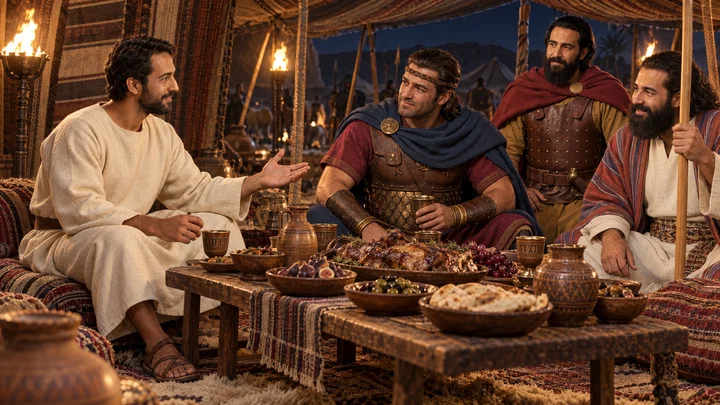
Cross-references
- Genesis 26:7-11
And the men of the place asked him of his wife; and he said, She is my sister: for he feared to say, She is my wife; lest, said he, the men of the place should kill me for Rebekah; because she was fair to look upon.
The passage recounts Abimelech’s earlier encounter with Isaac.
- Genesis 20:14-16
And Abimelech took sheep, and oxen, and menservants, and womenservants, and gave them unto Abraham, and restored him Sarah his wife.
Abimelech’s dealings with Abraham parallel his later dealings with Isaac.
- Genesis 31:54
Then Jacob offered sacrifice upon the mount, and called his brethren to eat bread: and they did eat bread, and tarried all night in the mount.
Jacob shared a meal after making a covenant with Laban.
Commentary
Each commentary is drawn from primary sources: the writings of Ellen G. White and Adventist pioneers and periodicals. Each commentary is separate. Its own words are not a quotation; follow the references to read the source passages.
Pioneers and periodicals
8 sources
Genesis 26:30 belongs to the account of God's providential dealings with Abraham's family, the chosen family through which the Seed would come.ST Its setting is Isaac's experience when famine carries him into the land of the Philistines, where he receives abundant blessing and has differences with the Philistines, and the chapter then closes with Esau's marriages.ST Jan 3, 1911 Genesis 26 presents Isaac's life in this chapter as following in the way of his father.ST Sep 22, 1898 His faithful, practical life and prosperity led his neighbors and the king to recognize that the Lord was with him.RH Jul 5, 1906 The blessing that came to Isaac came because Abraham obeyed God's laws.RH Sep 8, 1859
God worked for Isaac and blessed him in consequence as he yielded more than justice required, refrained from contending for his rights, and committed his cause to God.ST Jan 3, 1911ST Jan 9, 1912 The verse shows Isaac welcoming Abimelech and his companions and officers, who had come to make peace with him, and making a feast for them, and they ate and drank.RH Sep 8, 1859ST Jan 9, 1912 After agreeing on a covenant and peaceful agreement, he sealed it by sharing a meal with them.ST Aug 28, 1901RH Mar 7, 1912 His hospitality in receiving them with a feast reflects his willingness to live peaceably with them and do them no harm.ST Aug 28, 1901
Their visit acknowledged that Isaac's God was superior to the Philistine gods. The feast of eating and drinking that followed the agreement illustrates the custom of sealing engagements, treaties, or oaths with a feast.RH Mar 7, 1912 Likewise the Lord's Supper marks the covenant Christ completed through his sacrifice and gives believers a season to renew their covenant with him.RH Mar 7, 1912
Sources