Genesis 20:14
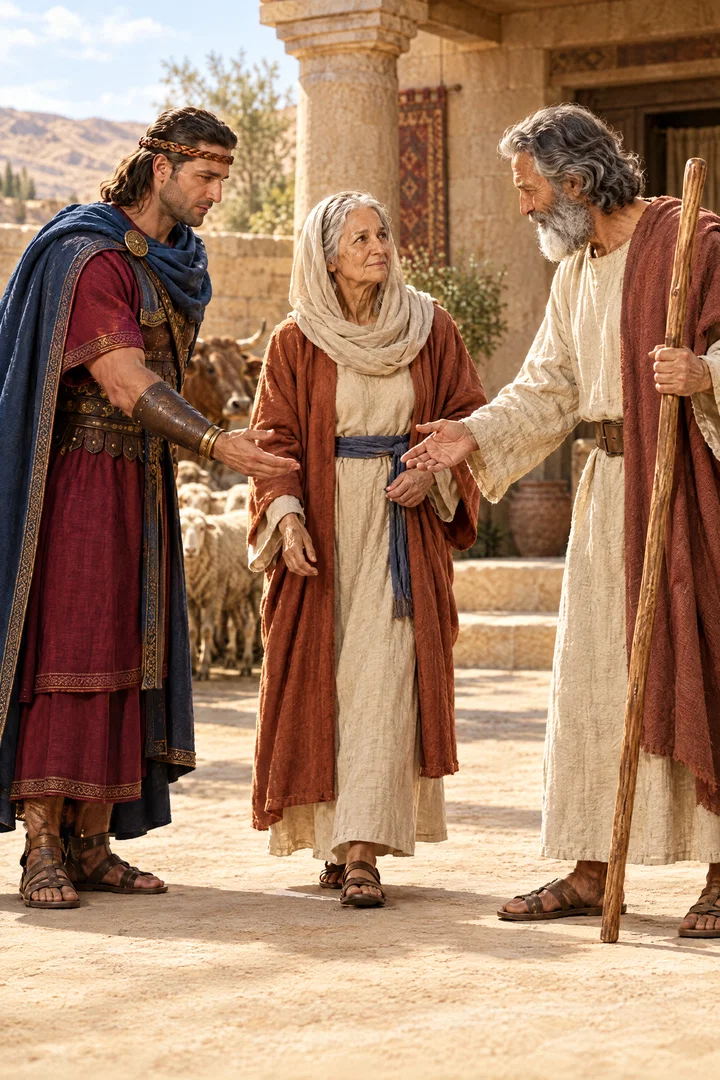
And Abimelech took sheep, and oxen, and menservants, and womenservants, and gave them unto Abraham, and restored him Sarah his wife.
Translations
And Abimelech took sheep, and oxen, and menservants, and womenservants, and gave them to Abraham, and restored him Sarah his wife.
King James Version, KJV Cambridge Paragraph Bible
And Abimelech took sheep, and oxen, and menservants, and womenservants, and gave them unto Abraham, and restored him Sarah his wife.
And Abimelech took sheep, and oxen, and men-servants, and women-servants, and gave them to Abraham, and restored to him Sarah his wife.
And Abimelech took sheep and oxen, and menservants and womenservants, and gave them unto Abraham, and restored him Sarah his wife.
And Abimelech took sheep and oxen, and men-servants and women-servants, and gave them unto Abraham, and restored him Sarah his wife.
And Abimelech taketh sheep and oxen, and servants and handmaids, and giveth to Abraham, and sendeth back to him Sarah his wife;
And Abimelech took sheep and oxen, and bondmen and bondwomen, and gave [ them] to Abraham, and restored him Sarah his wife.
Then took Abimelech sheep and oxen and men—servants and maid-servants, and gave to Abraham,—and restored to him Sarah his wife.
Berean Standard Bible, Majority Standard Bible
So Abimelech brought sheep and cattle, menservants and maidservants, and he gave them to Abraham and restored his wife Sarah to him.
Abimelech took sheep and cattle, male servants and female servants, and gave them to Abraham, and restored Sarah, his wife, to him.
Then Abimelech gave to Abraham sheep and oxen and men-servants and women-servants, and gave him back his wife Sarah.
Then tooke Abimelech sheepe and beeues, and men seruants, and women seruants, and gaue them vnto Abraham, and restored him Sarah his wife.
Douay-Rheims (Challoner revision)
And Abimelech took sheep and oxen, and servants and handmaids, and gave to Abraham: and restored to him Sara, his wife.
Pictures
Cross-references
- Genesis 12:16
And he entreated Abram well for her sake: and he had sheep, and oxen, and he asses, and menservants, and maidservants, and she asses, and camels.
Both accounts list Abraham’s servants and possessions given after Sarah is returned.
- Genesis 16:1-3
Now Sarai Abram’s wife bare him no children: and she had an handmaid, an Egyptian, whose name was Hagar.
Both show imperfect faith trying to help God fulfil his promise.
- Genesis 20:2
And Abraham said of Sarah his wife, She is my sister: and Abimelech king of Gerar sent, and took Sarah.
The passage cites Abraham’s earlier fear in the same account.
- Genesis 26:7-11
And the men of the place asked him of his wife; and he said, She is my sister: for he feared to say, She is my wife; lest, said he, the men of the place should kill me for Rebekah; because she was fair to look upon.
This recounts Abimelech’s dealings with Isaac, echoing his dealings with Abraham.
- Genesis 12:13
Say, I pray thee, thou art my sister: that it may be well with me for thy sake; and my soul shall live because of thee.
The passage compares this earlier failure with Abraham’s conduct before Abimelech.
- Genesis 12:18-19
And Pharaoh called Abram, and said, What is this that thou hast done unto me? why didst thou not tell me that she was thy wife?
Pharaoh recognizes that taking another man’s wife would be wrong.
Commentary
Each commentary is drawn from primary sources: the writings of Ellen G. White and Adventist pioneers and periodicals. Each commentary is separate. Its own words are not a quotation; follow the references to read the source passages.
Pioneers and periodicals
14 sources
Abimelech restored Sarah to Abraham as his wife and enriched him with sheep and oxen and male and female servants after Abraham had called her his sister during his sojourn among the Philistines, the second time he used that deception.ST Jan 2, 1912RH Mar 10, 1863AUST Jun 14, 1920STST Feb 12, 1894 The deception came from a failure to trust God's protecting care and shows a faith that was not yet perfect but had to learn through repeated failure to trust Him.ST Jan 2, 1912AUST Jun 14, 1920ST Mar 10, 1887 God overruled the danger to preserve Abraham's family as the chosen line of the promised Seed, even using Abimelech, who knew the true God, to rebuke Abraham sternly.ST Jan 2, 1912STST Aug 28, 1901ST Feb 12, 1894RH Mar 18, 1915 The restoration of Sarah to her husband shows marriage was already known and sacred in the patriarchal age before Sinai, when God's law was already in force against adultery and lying and for respect for property.RH Aug 17, 1876STRH Mar 5, 1857ST Jun 10, 1875RH Jan 21, 1875 The men and women given to Abraham became servants in his household, understood by some as showing he was a slaveholder, while others held they were dependent laborers and attendants passing with the flocks from one care to another by consent rather than as chattel slaves.RH Mar 10, 1863RH Mar 10, 1863
Narrative Context and Providence
Genesis 20:14 belongs to Abraham's sojourn among the Philistines and to his trials of faith, showing God's overruling providence in his life.ST Jan 2, 1912ST Feb 12, 1894 It is the second of two times Abraham said Sarah was his sister.AUST Jun 14, 1920 He did not come at once to fullness of faith, but learned the lesson over and over.ST Jan 2, 1912
The deception came from want of trusting faith in God's protecting care and shows that his faith was not then perfect.AUST Jun 14, 1920 It was an act connected with his failure to trust God, passing Sarah off as his sister.ST Mar 10, 1887 That failure was learned over and over through lack of trust.ST Jan 2, 1912AUST Jun 14, 1920ST Mar 10, 1887
The account presents Abimelech as knowing the true God and the Philistines as having a strong regard for morality.ST Feb 12, 1894 God used Abimelech in administering a stern rebuke to Abraham.ST Aug 28, 1901
The gifts of sheep and oxen and male and female servants and the restoration of Sarah to him as his wife show God's overruling providence.ST Jan 2, 1912RH Mar 18, 1915 They belong to God's providential dealings with the family of Abraham as the chosen progenitor of the promised Seed.ST They are part of the history of the beginning of things and the story of God's dealing with the Seed against the enemy's attempts to thwart God's plan, in a book where God's law was already in force and shining with gospel promises and prophecies made to His chosen.ST These gifts formed part of Abimelech's goodwill toward Abraham as his household continued its pilgrimage.RH Mar 18, 1915
Law and Marriage Before Sinai
Genesis stands as the history of the beginning of things and of God's dealing with the chosen progenitor of the promised Seed against the enemy's attempts to thwart that plan, a book where God's law was already in force and shining with gospel promises and prophecies made to His chosen.ST Within that setting, the giving of sheep and oxen and male and female servants and the restoring of Sarah to her husband shows that people in the time before Moses knew and practiced moral principles, including respect for property.RH Mar 5, 1857 Abimelech knew the prohibition against adultery by God's direct instruction to him, and the taking of another man's wife was recognized as wrong.RH Aug 17, 1876RH Jan 21, 1875 The whole account stands as proof that God condemns lying.ST Dec 17, 1902
Abimelech's act of giving livestock and servants to Abraham and restoring Sarah to him as his wife after learning she was Abraham's wife proves that the marriage institution was known and treated as sacred in the patriarchal age before Sinai.RH Jan 21, 1875 That sacredness is not erased by violations of marriage.ST Jun 10, 1875 It does not come from the Decalogue itself, but the seventh commandment guards that pre-existing sacredness, just as the fourth commandment guards the pre-existing sacredness of the Sabbath.RH Jan 21, 1875
Abraham's Servants and Slavery
Abimelech gave Abraham sheep and oxen and male and female servants when he gave Sarah back to him as his wife.RH Mar 10, 1863RH Mar 10, 1863 That giving shows Abraham had servants attached to his household.RH Mar 10, 1863 It forms part of the case made that he was a holder of slaves.RH Mar 10, 1863 The word servant is broad enough to mean hired laborers or dependents, so by itself it does not prove they were slaves in the sense of owned property.RH Mar 10, 1863 The men and women here were attendants passing with the flocks and herds, a movement of subjects by their own consent from one ruler's government to another rather than a transfer of human chattels.RH Mar 10, 1863
Sources