Genesis 29:1
Then Jacob went on his journey, and came into the land of the people of the east.
Translations
American King James Version, King James Version, KJV Cambridge Paragraph Bible, Webster Bible
Then Jacob went on his journey, and came into the land of the people of the east.
Revised Version, American Standard Version, World English Bible
Then Jacob went on his journey, and came to the land of the children of the east.
And Jacob lifteth up his feet, and goeth towards the land of the sons of the east;
And Jacob continued his journey, and went into the land of the children of the east.
Then Jacob lifted up his feet,—and went his way towards the land of the sons of the East.
Berean Standard Bible, Majority Standard Bible
Jacob resumed his journey and came to the land of the people of the east.
Then Jacob went on his journey till he came to the land of the children of the East.
Then Iaakob lift vp his feete and came into the East countrey.
Douay-Rheims (Challoner revision)
Then Jacob went on in his journey, and came into the east country.
Pictures
Cross-references
- Genesis 28:15
And, behold, I am with thee, and will keep thee in all places whither thou goest, and will bring thee again into this land; for I will not leave thee, until I have done that which I have spoken to thee of.
God promises to be with Jacob and guard him on his journey.
- Genesis 24:10
And the servant took ten camels of the camels of his master, and departed; for all the goods of his master were in his hand: and he arose, and went to Mesopotamia, unto the city of Nahor.
Abraham’s servant arrived in the region earlier.
- Genesis 29:18-30
And Jacob loved Rachel; and said, I will serve thee seven years for Rachel thy younger daughter.
Jacob serves Laban for two seven-year periods.
Commentary
Each commentary is drawn from primary sources: the writings of Ellen G. White and Adventist pioneers and periodicals. Each commentary is separate. Its own words are not a quotation; follow the references to read the source passages.
Ellen G. White
1 source
Jacob pressed on eastward with faith in God's promises made new and with confidence that angels would guard him.PP 188.2 He came into the country of the eastern peoples as a solitary, footsore traveler carrying nothing but his staff.PP 188.2 His coming stood in sharp contrast to the earlier mission of Abraham's servant, who had made the same journey attended by servants and laden with costly gifts.PP 188.2 On arrival he paused beside a well where he met Rachel, lent his strength to watering the flocks, and through that meeting was received into Laban's household.PP 188.2
Sources
Pioneers and periodicals
18 sources
Jacob went on in joy from his experience at Bethel to Padan-aram in the east, in Syria, where his uncle Laban lived and where he went to find a wife.ST Jan 3, 1911ST Oct 6, 1898ST Feb 2, 1915ST Mar 19, 1894ST Oct 6, 1898 His coming there begins his sojourn with Laban and his fourteen years of service for Laban's two daughters before his return to Palestine.ST Jan 3, 1911ST Jan 3, 1911ST Mar 19, 1894 It belongs to his checkered sufferings after his selfish plotting, where the deceiver is deceived and meets overreaching himself, showing that God's providence over the promised Seed brings retribution sooner or later.ST Jan 9, 1912ST Jan 9, 1912 Yet it shows God caring for Jacob despite his selfishness and unfaithfulness, and in mercy bringing him to gradual faith and complete change of heart until he became Israel, meaning prevailer with God.ST Jan 3, 1911STST Jan 6, 1909 His family there proves that polygamy brings very great unhappiness wherever it enters and is evil and wrong, even though it was tolerated among God's ancient people contrary to the order in Eden.RH Mar 1, 1870
Journey and Setting
After his rich experience at Bethel Jacob continued his journey onward to the land of the children of the east.ST Oct 6, 1898ST Mar 19, 1894 He lifted up his feet and went on in exultation and joy.ST Oct 6, 1898 The land of the people of the east to which he came was Padan-aram, broadly called the east, in Syria.ST Jan 3, 1911ST Feb 2, 1915ST Oct 6, 1898 It was where his mother's brother Laban lived and where Jacob went to obtain a wife.ST Jan 3, 1911ST Feb 2, 1915
The verse begins the account of Jacob's visit to Laban, his sojourn in Syria and his service to Laban.ST Jan 3, 1911ST Jan 3, 1911 There he met Laban and began serving him, serving fourteen years for his two daughters.ST Mar 19, 1894 This sojourn in Syria came before his later return from Syria to Palestine.ST Jan 3, 1911ST Jan 3, 1911
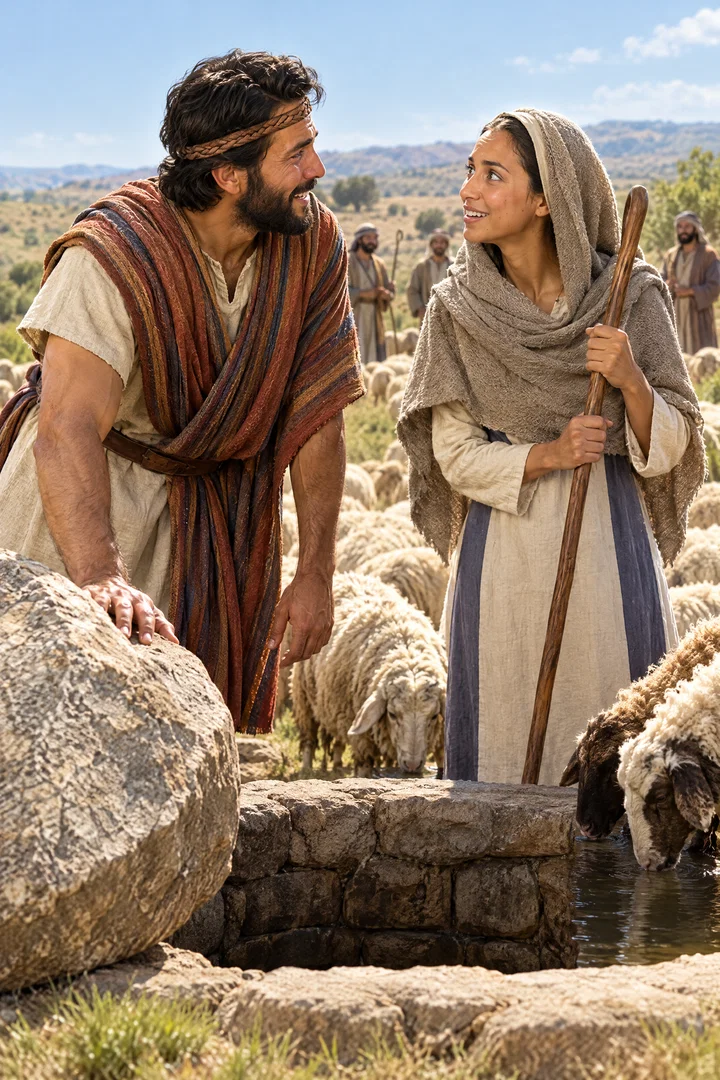
On arriving, weary and thirsty, Jacob went to the fountain or well by Haran to find his relatives.ST Mar 27, 1907ST May 19, 1898 The scene recalls the public wells where villagers gathered to draw water.ST Mar 27, 1907 It illustrates that the village fountain serves as a sort of bureau of information where the news of the day is passed about and where one goes to learn of people and find those sought, as Abraham's servant did when seeking a wife for Isaac and as Moses did when he fled to Midian.ST May 19, 1898 Jacob's arrival in Padan-aram thus invites comparison with Abraham's servant arriving there about a century earlier.ST Oct 6, 1898
Lessons from Jacob's Experience
Genesis 29:1 stands in that second half of Genesis, chapters 12 to 50, which records God's dealings with the chosen race.ST Mar 17, 1914 It continues the story of Abraham and his family, following the family through which the Seed was to come, with the promises extending from Abraham to Isaac and from Isaac to Jacob.ST Mar 17, 1914ST Jan 6, 1909ST Jan 14, 1913 It shows the gradual development of faith through Isaac and his two sons with their defects, moving toward Jacob's victory which made him Israel, meaning prevailer with God.ST Jan 6, 1909 It is included in the lesson on God's providence over the family line of the promised Seed.ST Jan 9, 1912
The verse belongs to the checkered and unsatisfactory experiences of Esau and Jacob and to Jacob's trials and victories.ST Jan 9, 1912STST Jan 9, 1912 It shows Jacob in the suffering that followed his selfish plottings, having overreached and supplanted and now meeting overreaching himself in the east where the deceiver is deceived.ST Jan 9, 1912 God's providence over the promised line, though seeming slow, brings retribution sooner or later.ST Jan 9, 1912ST Jan 9, 1912
Much of Jacob's later trouble that could have been saved grew from lack of better earlier experience.ST Jan 14, 1913 That trouble grew out of family division caused by the aged father's overfond affection for Esau and the mother's stronger sympathy for her neglected child Jacob, whom she favored while ever keeping before him the importance of the Seed in a material way without the fullest appreciation of the spiritual blessings.ST Jan 14, 1913 It grew also out of Jacob's own material overreaching all the way through that demonstrated the fitness of his name supplanter.ST Jan 14, 1913 Yet the account shows God caring for Jacob despite his selfishness and unfaithfulness and in mercy bringing a change afterward, culminating in a complete change of heart and his place among the Israel of God.ST Jan 3, 1911STST Jan 14, 1913 In the east Jacob sets his face homeward, teaching readiness always to obey God's leading.
Doctrine and Wider Connections
Genesis 29 belongs to the evidence that in the patriarchal age holy men of old reckoned time by weeks and sevens of days, showing that the seven-day week was known before the law was given at Sinai and was connected with the creation week.RH Nov 8, 1853ST Jun 10, 1875RH Feb 25, 1875 That week-long division of time has nothing in nature to explain it and comes from only one source, the six days of creation work and the rest of the seventh.ST Jun 10, 1875RH Feb 25, 1875 It is not likely that the work of creation was remembered and commemorated while the rest and sanctification of the holy Sabbath was forgotten.ST Jun 10, 1875 It stands as a trace that the Sabbath was positively appointed at creation, set apart without limit of age or country and therefore obligatory on the whole human race.ST Jun 10, 1875RH Feb 25, 1875
Jacob's family in Genesis 29 proves that polygamy causes very great unhappiness in every family where it enters and is evil and wrong.RH Mar 1, 1870 This was so even though polygamy was allowed among God's ancient people through the whole Old Testament period and was tolerated by Moses because of hardness of heart, contrary to the original order in Eden.RH Mar 1, 1870 The patriarchal departure from the marriage institution in Genesis 29 no more destroys the sacred character of marriage made for man before the fall than a violation of the Sabbath in the patriarchal age would destroy the sacred character of the Sabbath.ST Jun 10, 1875
Sources