Genesis 30:31
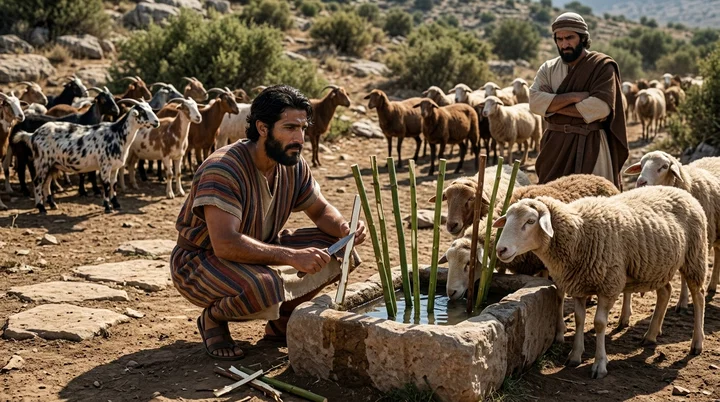
And he said, What shall I give thee? And Jacob said, Thou shalt not give me any thing: if thou wilt do this thing for me, I will again feed and keep thy flock:
Translations
And he said, What shall I give you? And Jacob said, You shall not give me any thing: if you will do this thing for me, I will again feed and keep your flock.
King James Version, KJV Cambridge Paragraph Bible
And he said, What shall I give thee? And Jacob said, Thou shalt not give me any thing: if thou wilt do this thing for me, I will again feed and keep thy flock:
And he said, What shall I give thee? And Jacob said, Thou shalt not give me any thing; if thou wilt do this thing for me, I will again feed and keep thy flock:
Revised Version, American Standard Version
And he said, What shall I give thee? And Jacob said, Thou shalt not give me aught: if thou wilt do this thing for me, I will again feed thy flock and keep it.
And he saith, 'What do I give to thee?' And Jacob saith, 'Thou dost not give me anything; if thou do for me this thing, I turn back; I have delight; thy flock I watch;
And he said, What shall I give thee? And Jacob said, Thou shalt not give me anything. If thou doest this for me, I will again feed [ and] keep thy flock:
And he said, What shall I give thee? And Jacob said: Thou shall give me, nothing at all, If thou wilt do for me this thing, I will return, I will shepherd thy flock I will keep it:
Berean Standard Bible, Majority Standard Bible
“ What can I give you?” Laban asked.“ You do not need to give me anything,” Jacob replied. “If you do this one thing for me, I will keep on shepherding and keeping your flocks.
Laban said, “ What shall I give you?”Jacob said, “ You shall not give me anything. If you will do this thing for me, I will again feed your flock and keep it.
And Laban said, What am I to give you? And Jacob said, Do not give me anything; but I will again take up the care of your flock if you will only do this for me:
Then he saide, What shall I giue thee? And Iaakob answered, Thou shalt giue mee nothing at all: if thou wilt doe this thing for mee, I will returne, feede, and keepe thy sheepe.
Douay-Rheims (Challoner revision)
And Laban said: What shall I give thee? But he said: I require nothing: but if thou wilt do what I demand, I will feed, and keep thy sheep again.
Pictures
Cross-references
- Genesis 29
Then Jacob went on his journey, and came into the land of the people of the east.
Cited with Genesis 30 as a patriarchal example concerning marriage.
- Genesis 31:7-12
And your father hath deceived me, and changed my wages ten times; but God suffered him not to hurt me.
God protects Jacob amid Laban’s changing wages and provides for him.
- Genesis 31:1-2
And he heard the words of Laban’s sons, saying, Jacob hath taken away all that was our father’s; and of that which was our father’s hath he gotten all this glory.
Laban’s sons react to Jacob’s prosperity under his agreement with Laban.
Commentary
Each commentary is drawn from primary sources: the writings of Ellen G. White and Adventist pioneers and periodicals. Each commentary is separate. Its own words are not a quotation; follow the references to read the source passages.
Pioneers and periodicals
11 sources
Genesis 30:31 records Jacob refusing any present gift or advance payment from Laban and offering instead to again feed and guard Laban's flock if Laban will agree to his proposal.ST Jan 3, 1911ST Oct 6, 1898RH Oct 1, 1901 Under that proposed arrangement certain marked animals would become his wages rather than a direct payment.ST Jan 3, 1911ST Oct 6, 1898 He asks for nothing in advance but agrees to continue tending the flock if Laban will grant his request.ST Jan 3, 1911ST Oct 6, 1898RH Oct 1, 1901
The verse belongs to the account of Jacob's service and dealings with Laban over the flock, in which God blessed Jacob's labor and prospered him in flocks and herds despite Laban's efforts to deprive him of his right.ST Mar 19, 1894RH Dec 30, 1915 Through that service he returned with a prosperous family and abundant flocks and herds.ST Mar 19, 1894RH Dec 30, 1915 The blessing rested on his labor even under unjust dealing.ST Mar 19, 1894RH Dec 30, 1915
The verse also belongs to the record of Jacob's trials and victories, which culminate in a complete change of heart and his place among the Israel of God.STST Jan 9, 1912ST Jan 9, 1912 It falls within his checkered and unsatisfactory experience, in which selfish plotting and overreaching led to suffering.STST Jan 9, 1912ST Jan 9, 1912 He himself encountered overreaching in turn, for his overreaching was followed by being overreached, while God's providence brings retribution sooner or later and in time.ST Jan 9, 1912ST Jan 9, 1912
The verse belongs to the history of Jacob's family in Genesis 29-31, which plainly violates the marriage institution through polygamy.RH Feb 3, 1852RH Mar 1, 1870 That polygamous household shows that polygamy was always evil and wrong and was the cause of very great unhappiness in every family where it entered.RH Mar 1, 1870 The ancient people of God allowed it through the whole Old Testament period because Moses tolerated it for hardness of heart, while the true standard remains the original order in Eden from which there should have been no departure.RH Feb 3, 1852RH Mar 1, 1870 This violation does not destroy the sacred character of marriage, just as violation of the Sabbath in the patriarchal age would not destroy the sacred character of the Sabbath.RH Feb 3, 1852 Marriage was made for man before the fall and does not derive its sanctity from the Decalogue, with the seventh commandment guarding marriage as the fourth guards the Sabbath.RH Feb 3, 1852RH Mar 1, 1870
Jacob's agreement to keep tending the flock includes care of animals on the Sabbath.ST Jun 19, 1907 Keeping stock requires daily work for the life and welfare of people and animals that must be performed on the Sabbath the same as on any day.ST Jun 19, 1907 That work is to be reduced to a practical, merciful minimum such as feeding, milking, and watering.ST Jun 19, 1907
Sources