Genesis 30:37
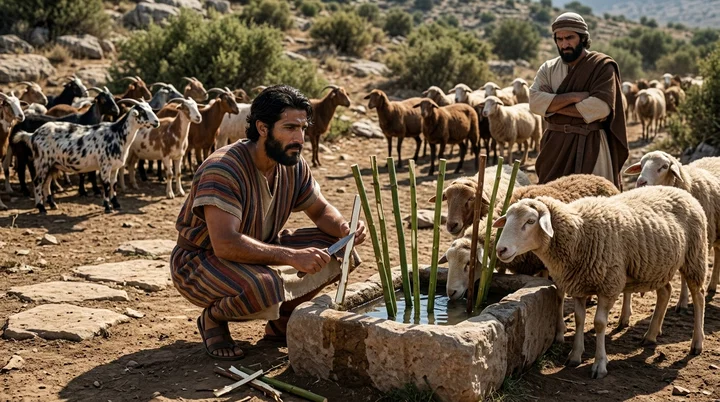
And Jacob took him rods of green poplar, and of the hazel and chesnut tree; and pilled white strakes in them, and made the white appear which was in the rods.
Translations
And Jacob took him rods of green poplar, and of the hazel and chestnut tree; and pilled white strakes in them, and made the white appear which was in the rods.
King James Version, KJV Cambridge Paragraph Bible
And Jacob took him rods of green poplar, and of the hazel and chesnut tree; and pilled white strakes in them, and made the white appear which was in the rods.
And Jacob took to him rods of green poplar, and of the hazel and chesnut-tree; and peeled white streaks in them, and made the white appear which was in the rods.
And Jacob took him rods of fresh poplar, and of the almond and of the plane tree; and peeled white strakes in them, and made the white appear which was in the rods.
And Jacob took him rods of fresh poplar, and of the almond and of the plane-tree; and peeled white streaks in them, and made the white appear which was in the rods.
And Jacob taketh to himself a rod of fresh poplar, and of the hazel and chesnut, and doth peel in them white peelings, making bare the white that [is] on the rods,
And Jacob took fresh rods of white poplar, almond-tree, and maple; and peeled off white stripes in them, uncovering the white which was on the rods.
So then Jacob took him rods of young storax, and hazel and maple,—and peeled in them white stripes, laying bare the white which was on the rods.
Berean Standard Bible, Majority Standard Bible
Jacob, however, took fresh branches of poplar, almond, and plane trees, and peeled the bark, exposing the white inner wood of the branches.
Jacob took to himself rods of fresh poplar, almond, and plane tree, peeled white streaks in them, and made the white appear which was in the rods.
Then Jacob took young branches of trees, cutting off the skin so that the white wood was seen in bands.
Then Iaakob tooke rods of greene popular, and of hasell, and of the chesnut tree, and pilled white strakes in them, and made the white appeare in the rods.
Douay-Rheims (Challoner revision)
And Jacob took green rods of poplar, and of almond, and of plane trees, and pilled them in part: so when the bark was taken off, in the parts that were pilled, there appeared whiteness: but the parts that were whole remained green: and by this means the colour was divers.
Pictures
Cross-references
- Genesis 31
And he heard the words of Laban’s sons, saying, Jacob hath taken away all that was our father’s; and of that which was our father’s hath he gotten all this glory.
Jacob’s family history illustrates the harm of polygamy.
Commentary
Each commentary is drawn from primary sources: the writings of Ellen G. White and Adventist pioneers and periodicals. Each commentary is separate. Its own words are not a quotation; follow the references to read the source passages.
Pioneers and periodicals
7 sources
The verse belongs to the years Jacob spent serving Laban in Haran, in Padan-aram in Syria, for his two daughters.ST Jan 3, 1911ST Mar 19, 1894RH Dec 30, 1915 During that time sons were born to him, and God blessed his work and prospered him in flocks and herds despite Laban's efforts to deprive him of his right.ST Mar 19, 1894RH Dec 30, 1915 Before he left Syria for Palestine he had a prosperous family and abundant flocks and herds.ST Jan 3, 1911RH Dec 30, 1915 It belongs to the checkered and unsatisfactory experiences of Esau and Jacob in Genesis 27 to 31.ST Jan 9, 1912
It describes Jacob taking rods of green poplar and of hazel and chestnut and peeling white stripes in them so that the white within the rods appeared.ST Jan 3, 1911ST Jul 23, 1912 He set them before Laban's cattle so that the cattle brought forth ring-straked young.ST Jul 23, 1912 It shows Jacob was a herdsman with direct charge of flocks and cattle, whose work involved daily handling, feeding, and care of the animals.ST Jun 19, 1907 In its wider passage Jacob's cattle were mixed in color and not uniform, giving a picture of variety and disunity rather than oneness.ST May 10, 1883
The verse shows Jacob's selfish plotting, overreaching and supplanting, and his consequent suffering in meeting overreaching himself.ST Jan 9, 1912 It demonstrates that God's providence, though seeming slow, brings retribution sooner or later.ST Jan 9, 1912 It teaches the physiological law that by beholding we become changed into the same image, and what is looked upon impresses itself upon offspring.ST Jul 23, 1912
Applied to women, especially mothers shaping human destinies, what a mother beholds can mark her unborn child.ST Jul 23, 1912 Foolish fashions such as hats with absurdly enlarged crowns risk producing children with deformed enlarged heads.ST Jul 23, 1912 Women should be not high-minded but fear lest mad pursuit of folly bring dreadful judgment upon themselves and upon their children.ST Jul 23, 1912 That kind of care for the life and welfare of people and stock, such as feeding, watering, and milking, reduced to a practical, merciful minimum, must be done on the Sabbath the same as on any day.ST Jun 19, 1907
Sources