Genesis 33:5
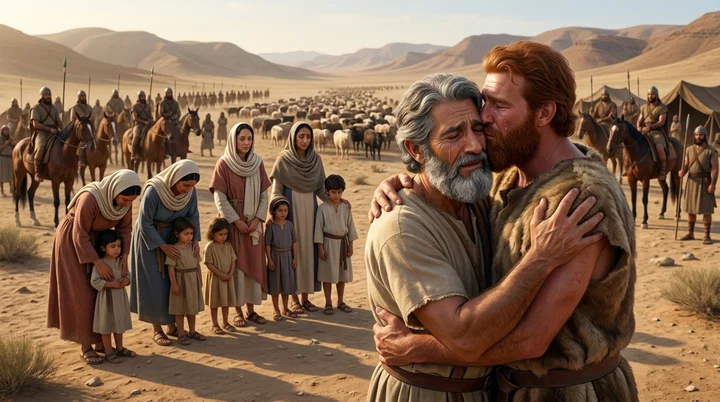
And he lifted up his eyes, and saw the women and the children; and said, Who are those with thee? And he said, The children which God hath graciously given thy servant.
Translations
And he lifted up his eyes, and saw the women and the children; and said, Who are those with you? And he said, The children which God has graciously given your servant.
And he lifted up his eyes, and saw the women and the children; and said, Who are those with thee? And he said, The children which God hath graciously given thy servant.
And he lift up his eyes, and saw the women and the children; and said, Who are those with thee? And he said, The children which God hath graciously given thy servant.
And he lifted up his eyes, and saw the women and the children, and said, Who are those with thee? And he said, The children which God hath graciously given to thy servant.
And he lifted up his eyes, and saw the women and the children; and said, Who are these with thee? And he said, The children which God hath graciously given thy servant.
And he lifted up his eyes, and saw the women and the children; and said, Who are these with thee? And he said, The children whom God hath graciously given thy servant.
and he lifteth up his eyes, and seeth the women and the children, and saith, 'What [are] these to thee?' And he saith, 'The children with whom God hath favoured thy servant.'
And he lifted up his eyes and saw the women and the children, and said, Who are these with thee? And he said, The children that God has graciously given thy servant.
Then lifted he up his eyes, and beheld the women and the children, and said What are these to thee? And he said—The children wherewith God hath favoured thy servant,
Berean Standard Bible, Majority Standard Bible
When Esau looked up and saw the women and children, he asked, “ Who are these with you?”Jacob answered, “These are the children God has graciously given your servant.”
He lifted up his eyes, and saw the women and the children; and said, “ Who are these with you?”He said, “ The children whom God has graciously given your servant.”
Then Esau, lifting up his eyes, saw the women and the children, and said, Who are these with you? And he said, The children whom God in his mercy has given to your servant.
And he lift vp his eyes, and sawe the women, and the children, and saide, Who are these with thee? And he answered, They are ye childre whome God of his grace hath giuen thy seruant.
Douay-Rheims (Challoner revision)
And lifting up his eyes, he saw the women and their children, and said: What mean these? And do they belong to thee? He answered: They are the children which God hath given to me thy servant.
Pictures
Cross-references
- Genesis 32:24-32
And Jacob was left alone; and there wrestled a man with him until the breaking of the day.
Together with the next chapter, it recounts Jacob’s deliverance from Esau.
- Genesis 27:41
And Esau hated Jacob because of the blessing wherewith his father blessed him: and Esau said in his heart, The days of mourning for my father are at hand; then will I slay my brother Jacob.
Esau gave up planned revenge
- Genesis 18:3
And said, My Lord, if now I have found favour in thy sight, pass not away, I pray thee, from thy servant:
both use servant for one who is no slave
Commentary
Each commentary is drawn from primary sources: the writings of Ellen G. White and Adventist pioneers and periodicals. Each commentary is separate. Its own words are not a quotation; follow the references to read the source passages.
Ellen G. White
1 source
The question about the women and children marks the genuine reconciliation of Jacob and Esau.ST Dec 4, 1879 Esau had once purposed to take revenge on Jacob for stealing his father's blessing as soon as Isaac died, but that purpose was now abandoned.ST Dec 4, 1879 His feelings toward his brother were greatly changed, so that no threat remained in the meeting.ST Dec 4, 1879 Jacob himself had been changed and refined by the blessing received from the angel in the night of conflict, and he was reverenced by all who saw him.ST Dec 4, 1879 Being now wealthy, he returned to Esau in gifts the material blessing of possession that Esau had once recklessly sold for a single meal of pottage.ST Dec 4, 1879
Enmity, jealousy, and hatred no longer separated the brothers from that time onward.ST Dec 4, 1879 They later met and united their grief at their father's deathbed without division.ST Dec 4, 1879 When they finally parted it was not from strife but only because their possessions had grown too great to dwell together.ST Dec 4, 1879 Their religious faith had also become too unlike for them to live together in one household.ST Dec 4, 1879
Sources
Pioneers and periodicals
10 sources
Esau ran to meet Jacob and embraced him and kissed him, and they wept together, and then he lifted up his eyes and saw the women and the children and asked who those with Jacob were, and Jacob answered in humility as his servant that they were the children God had graciously given him.ST Oct 20, 1898 The meeting took place after Jacob's struggle and prayer at Peniel, after he had been met by angels and had received blessing, a changed heart, and a changed name, and it belonged to his coming in peace to the city of Shechem ten or eleven years after his rejoicing under God's blessing at Peniel, with his family beside him.ST Jan 16, 1912ST Mar 26, 1894
Jacob met Esau no longer as Jacob the supplanter but as Israel, a prince of God, having wrestled and fully surrendered and received a change of heart and a new name.ST Jul 31, 1901 His rough cunning was gone, he had been changed and refined and was reverenced by all, and he came humble and kind and truly noble, with a heart full of heavenly tenderness and the persuasive power of love.ST Dec 4, 1879ST Jul 31, 1901 Having power with men because he had power with God, he needed no army against Esau's armed band.ST Jul 31, 1901
The verse belongs to a genuine reconciliation showing the Lord's power to change men's hearts and to Jacob's miraculous deliverance from Esau by God's protection without use of the sword.ST Mar 26, 1894RH Oct 2, 1900 Esau's former purpose to take revenge on Jacob for stealing his father's blessing when Isaac died was abandoned and his feelings were greatly changed.ST Dec 4, 1879 His murderous anger found no ground for quarrel but was transformed into tender love and friendliness when he met the converted prince instead of the scheming supplanter, so that enmity and jealousy and hatred no longer separated the brothers.ST Dec 4, 1879ST Jul 31, 1901 The reconciliation shows forgiveness and calls each reader to examine whether the spirit of forgiveness is in the heart. Afterward the brothers united their grief at their father's death-bed, and when they parted it was only because their possessions were too great and their religious faith was too unlike for them to live together.ST Dec 4, 1879
By calling the women and children the children God had graciously given him, Jacob acknowledged with his family beside him that his children were gifts graciously given by God.ST Oct 20, 1898ST Jan 16, 1912ST Jan 3, 1911ST Oct 20, 1898 Being now wealthy, he returned to Esau the blessing of possession recklessly sold for a mess of pottage.ST Dec 4, 1879 By calling himself Esau's servant, Jacob used the common Eastern deferential address of an inferior to a superior in polite self-designation, not a claim to be owned.ST Oct 20, 1898RH Oct 1, 1861 The word servant, evedh, there means only inferiority or political subjection and is applied to all classes of laborers and dependents, so by itself it does not imply a chattel slave bought with money, for Jacob was not Esau's slave and the reverse was true since Esau's brethren were given to Jacob for servants, and having servants does not prove slaveholding and gives no justification for American slavery.RH Mar 10, 1863RH Oct 1, 1861 Jacob's attitude in meeting Esau with his women and children signifies his mind with reference to his former course concerning the birthright and invites comparison of the lives of Jacob and Esau, showing the difference between them in that Jacob erected altars to the Lord and Esau did not.ST Oct 20, 1898
Sources