Genesis 33:4
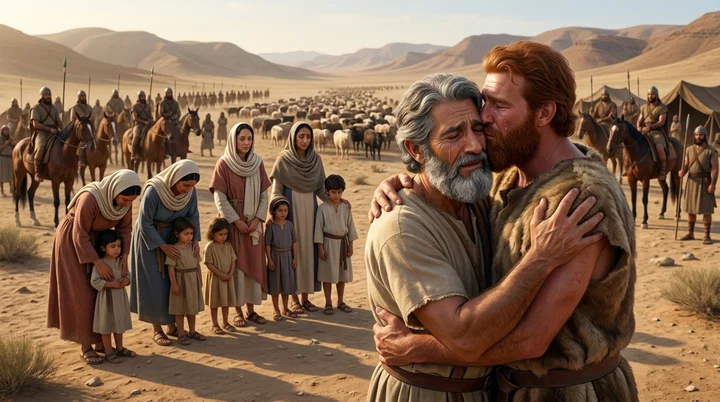
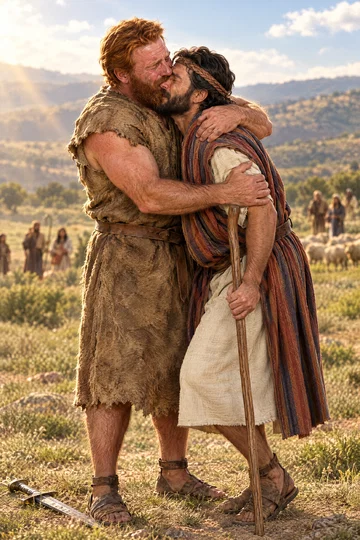
And Esau ran to meet him, and embraced him, and fell on his neck, and kissed him: and they wept.
Translations
American King James Version, King James Version, KJV Cambridge Paragraph Bible, Webster Bible, Revised Version, American Standard Version
And Esau ran to meet him, and embraced him, and fell on his neck, and kissed him: and they wept.
and Esau runneth to meet him, and embraceth him, and falleth on his neck, and kisseth him, and they weep;
And Esau ran to meet him, and embraced him, and fell on his neck, and kissed him; and they wept.
Then ran Esau to meet him, and embraced him, and fell on his neck,—and they wept.
Berean Standard Bible, Majority Standard Bible
Esau, however, ran to him and embraced him, threw his arms around his neck, and kissed him. And they both wept.
Esau ran to meet him, embraced him, fell on his neck, kissed him, and they wept.
Then Esau came running up to him, and folding him in his arms, gave him a kiss: and the two of them were overcome with weeping.
Then Esau ranne to meete him, and embraced him, and fell on his necke, and kissed him, and they wept.
Douay-Rheims (Challoner revision)
Then Esau ran to meet his brother, and embraced him: and clasping him fast about the neck, and kissing him, wept.
Pictures
Cross-references
- Genesis 32:24-30
And Jacob was left alone; and there wrestled a man with him until the breaking of the day.
Jacob’s night of wrestling and prayer precedes his reconciliation with Esau.
- Genesis 32:11
Deliver me, I pray thee, from the hand of my brother, from the hand of Esau: for I fear him, lest he will come and smite me, and the mother with the children.
Jacob prays for deliverance from Esau before their reunion.
- Genesis 27:41
And Esau hated Jacob because of the blessing wherewith his father blessed him: and Esau said in his heart, The days of mourning for my father are at hand; then will I slay my brother Jacob.
Esau’s planned revenge contrasts with his welcoming reunion with Jacob.
- Genesis 33:10
And Jacob said, Nay, I pray thee, if now I have found grace in thy sight, then receive my present at my hand: for therefore I have seen thy face, as though I had seen the face of God, and thou wast pleased with me.
Jacob sees God’s favor in Esau’s welcoming face.
- Genesis 32:6
And the messengers returned to Jacob, saying, We came to thy brother Esau, and also he cometh to meet thee, and four hundred men with him.
Esau approached with four hundred men, but their meeting ended peacefully.
- Genesis 25:29-34
And Jacob sod pottage: and Esau came from the field, and he was faint:
The birthright sale underlies the estrangement and reconciliation between Jacob and Esau.
- Genesis 33:11
Take, I pray thee, my blessing that is brought to thee; because God hath dealt graciously with me, and because I have enough. And he urged him, and he took it.
Esau accepted Jacob’s gift after their reunion.
- Genesis 32:1-2
And Jacob went on his way, and the angels of God met him.
Jacob sees God's angelic host as he travels toward Esau.
- Genesis 36:6-7
And Esau took his wives, and his sons, and his daughters, and all the persons of his house, and his cattle, and all his beasts, and all his substance, which he had got in the land of Canaan; and went into the country from the face of his brother Jacob.
parting came from wealth not hatred
- Genesis 45:15
Moreover he kissed all his brethren, and wept upon them: and after that his brethren talked with him.
Joseph kisses his brothers in a family reunion.
- Genesis 32:26
And he said, Let me go, for the day breaketh. And he said, I will not let thee go, except thou bless me.
Jacob persists until blessed, preparing him to meet Esau.
- Proverbs 16:7
When a man’s ways please the LORD, he maketh even his enemies to be at peace with him.
Pleasing God brought peace between Jacob and Esau.
Commentary
Each commentary is drawn from primary sources: the writings of Ellen G. White and Adventist pioneers and periodicals. Each commentary is separate. Its own words are not a quotation; follow the references to read the source passages.
Ellen G. White
5 sources
Esau ran to meet Jacob and embraced him and fell on his neck and kissed him, and they wept together, showing affection and reconciliation rather than the expected violence.1SP 120.3PP 198.3–5SG3 130.4Ms 190, 1905, par. 19–20 The meeting followed Jacob's humble and fearful approach in which he bowed to the ground seven times before Esau.1SP 120.3SG3 130.4 Afterward Jacob urged Esau until he accepted his gift as a peace offering.1SP 120.3SG3 130.4
At the meeting Jacob was pale and disabled and walking painfully after his night of conflict, yet his face showed joy and peace because God's blessing shone in it, so that his weakness had become strength.PP 198.3–5Ms 190, 1905, par. 19–20 The reconciliation followed Jacob's desperate appeal to God and his prevailing with God to receive a blessing, sustained by God's promise to pardon and accept the repentant sinner.PP 198.3–5Ms 190, 1905, par. 19–20 Although Esau had been marching against Jacob with an army and with a band of soldiers intending to kill him, God changed his heart and mind overnight and moved him to meet Jacob in harmony, impressing Esau that Jacob was with the angel of God.SG3 130.4Ms 190, 1905, par. 19–20
While Jacob wrestled, God sent another angel to influence Esau in sleep, showing him in a dream that Jacob had been an exile from his father's house for twenty years for fear of his life.SG3 130.4 The dream showed him Jacob's sorrow at finding his mother dead, Jacob's humility, angels of God around him, and himself meeting Jacob with no desire to harm him.SG3 130.4 When Esau awoke he told his four hundred men the dream and commanded that none harm Jacob because the God of his father was with him.SG3 130.4
Esau's armed bands were stilled before Jacob when Jacob was halted upon his thigh, for only when Jacob fell crippled and helpless upon the breast of the covenant angel did he learn the victory of conquering faith and receive the standing of a prince with God, and it was in that lameness and weakness that Esau's hostility was quieted. Surrender of the will to God is profitable even though it is bitter and painful to the willful heart, as a sacrifice of the lower for the higher, the earthly for the spiritual, and the perishable for the eternal, in which the will is yielded to receive it back purified and refined and linked in sympathy with the divine, so that the weak become strong and conquer. The embrace shows reconciliation after confession of wrong, in which prayer leads to embracing and weeping on each other's necks with childlike tenderness.Lt 18, 1874, par. 4–5
Sources
Pioneers and periodicals
30 sources
Jacob came home fearing his brother, bowing seven times as he drew near while Esau advanced at the head of four hundred armed men to destroy him and his helpless family.ST Oct 20, 1898RH Jan 7, 1915ST Jun 12, 1884 Instead of striking, Esau ran to meet him, embraced him, fell on his neck and kissed him, and the two brothers wept together, ending twenty years of enmity, jealousy and murderous hatred over the birthright and the blessing.ST Dec 4, 1879ST Mar 26, 1894ST Oct 20, 1898RH Sep 27, 1870RH Jan 7, 1915 The peaceful meeting was a miraculous deliverance and answer to prayer, won in Jacob's lonely night of weeping and wrestling at the ford of Jabbok, where he surrendered fully, was broken, received a changed heart, and was made Israel, a prince of God.ST Nov 20, 1879RH Nov 21, 1912ST Dec 11, 1884ST Dec 8, 1914 There God interposed to turn Esau's heart from revenge and malignity to brotherly love, kindness and tender forgiveness, so that fratricidal hatred became fraternal affection and tears of joy.ST Nov 20, 1879ST Jan 3, 1911ST Apr 29, 1908ST Jun 12, 1884 Having first gained power with God, Jacob then had power with men without sword or army, proving that prevailing prayer softens even a hardened heart and turns murderous anger into love.ST Nov 20, 1879RH Jan 7, 1915ST Dec 8, 1914ST Jul 31, 1901
Fearful Meeting Becomes Reconciliation
Genesis 33:4 marks Jacob's anxious reunion with Esau on his return, coming after Jacob had humbled himself before God, sought mercy, and gained victory through faith at the Brook Jabbok, while also trying to make amends to his offended brother with gifts.ST Jan 16, 1912ST Jan 21, 1913 The verse belongs to a meeting of brothers after Jacob's fear and distress, the reunion that followed his night of struggle and humbling.ST Jan 16, 1912ST Jan 21, 1913
The meeting brings together Jacob as a humble shepherd and Esau as a warrior chief.ST Oct 20, 1898 Esau advanced with four hundred armed men to destroy Jacob and his helpless family, seen in the distance at the head of his men probably mounted on camels and sweeping down like a Bedouin band, while Jacob bowed seven times as he approached.RH Jan 7, 1915ST Jun 12, 1884 Instead of smiting and beginning slaughter, the armed men quietly stopped and Esau ran to meet Jacob, embraced him, fell on his neck, kissed him, and they wept together.ST Oct 20, 1898RH Jan 7, 1915ST Jun 12, 1884
That embrace and kiss was a customary family greeting of affection and joyful embrace as brothers, the falling on each other's necks and calling each other brother with tears that marks former enemies reconciled when bondage is lifted.ST Oct 20, 1898RH Sep 27, 1870RH Sep 17, 1908 The same kind of kiss as a customary sign of love was used by Judas while pretending friendship to betray Jesus for selfish gain, in contrast to Esau's affectionate greeting.RH Sep 27, 1870
The estrangement had come from Jacob's selfish, sinful dealing in taking advantage of Esau's weakness over the pottage and birthright and stealing his father's blessing.ST Dec 4, 1879RH Jan 7, 1915 After that Esau harbored revengeful, murderous hatred for twenty years, looking forward to Isaac's death as the time to be revenged upon Jacob.ST Dec 4, 1879ST Sep 5, 1900RH Dec 18, 1913 That long-cherished revengeful purpose and hostility then gave way to a joyful reunion.ST Sep 5, 1900RH Dec 18, 1913
At the meeting all enmity, jealousy, and hatred ended and the brothers united their grief with no revenge between them.ST Dec 4, 1879 Jacob, now wealthy, returned to Esau the blessing of possession so recklessly sold for a mess of pottage, and Jacob came in peace to the city of Shechem.ST Dec 4, 1879ST Mar 26, 1894 Their later parting from each other afterward was not from hatred but because of their possessions, and because their religious faith was so unlike that it was better for them to live apart.ST Dec 4, 1879
Jacob's attitude in meeting Esau signifies his mind with reference to his former course concerning the birthright.ST Oct 20, 1898 That attitude invites comparison of the lives of Jacob and Esau.ST Oct 20, 1898
Prevailing Prayer Wins Peace
The embrace and weeping mark a miraculous deliverance accomplished without the use of a sword, an answer to prayer in which God heard Jacob when he was afraid and protected him in the dangerous encounter.RH Nov 21, 1912RH Nov 18, 1909RH Oct 2, 1900 Peace came after long estrangement, with affection and weeping together and with a changed heart and the spirit of forgiveness.RH Nov 21, 1912RH Nov 18, 1909 Through God's interposition Esau's purpose was changed, his murderous hatred removed, and revenge and malignity turned to brotherly love, kindness, forgiveness and tender affection.ST Jan 3, 1911ST Apr 29, 1908ST Feb 18, 1913ST May 4, 1904RH Aug 1, 1871 Fratricidal hatred became fraternal love, and Esau's face shone as it were the face of God with divine light.ST Jun 12, 1884ST Feb 18, 1913
The change was the visible result of Jacob's secret night of weeping, wrestling prayer and struggle at the ford of Jabbok at Peniel.ST Nov 20, 1879ST Dec 11, 1884ST Dec 8, 1914 Left alone to commune with God, he was tested for a time by God's angel, surrendered fully, fell on the Rock and was broken, and in utter helplessness and dependence upon God he prevailed with God.ST Nov 20, 1879ST Dec 8, 1914 In that struggle he was crippled for life and limps as a token of the victory.ST Dec 11, 1884RH Jul 27, 1916 He learned that human help is vain and trust in human power groundless, received a change of heart and the blessing he sought, and had his name changed from Jacob, supplanter, to Israel, prince of God, as a lasting reminder of power with God and with men through importunate prayer.ST Jun 12, 1884RH Jul 27, 1916ST Jul 31, 1901
Having first obtained power with God as Israel, Jacob then had power with men and won his brother without talking over the trouble and without need of an army against Esau's army, through the persuasive power of love.RH Jan 7, 1915ST Jul 31, 1901 The rough, cunning supplanter was gone, and Esau no longer met the supplanting, scheming Jacob but a humble, kind, truly noble prince of God, which took away all ground for quarrel and turned murderous anger into tender love.ST Jul 31, 1901 The gift sent ahead, together with God's Spirit, had also softened Esau's heart. God touched Esau's heart and made him Jacob's friend even before they met, put His own presence into Esau's face so he met Jacob with favor, quietly stopped the armed men, and melted Esau in love and tenderness to shed tears of joy.ST Nov 20, 1879ST Jun 12, 1884RH Jul 24, 1860 Even a hardened person can thus be changed and moved to love, proving that prevailing with God brings prevailing with man.ST Dec 8, 1914ST Oct 8, 1885
Prayer gone up by the Spirit is followed by God working all things together for good and speaking clearly by His works to guide continually.RH Jul 24, 1860 God works in a manner out of the common order and contrary to human planning, taking the lines into His own hands, so difficulties pass quickly when troubles are left with God instead of worked out by human scheming.ST Feb 18, 1913ST Oct 20, 1898 The meeting therefore illustrates the utter futility of human planning and scheming to accomplish God's designs, which are known by spreading every plan before God with fasting, humbling of soul, and committing ways to the Lord.ST Oct 20, 1898 The same way fixes roots of bitterness making a time of trouble among brethren in the perils of the last days, by surrender, strong crying and tears, and power with God.RH Jan 7, 1915 Thorough preparation of heart through prayerful Bible study, going to people in the spirit of Christ and presenting truth in tender love, enables God to touch hearts, and the reconciliation is an example of peace with former enemies following a life pleasing to the Lord, like the brotherhood and joy when bondage is lifted and liberty, freedom and justice come.RH Sep 9, 1902ST Jan 27, 1914 Worldly onlookers like Esau's rude soldiers could see the outward reconciliation and be impressed by it, but could not discern the secret inner life with God that produced it.ST Nov 20, 1879RH Jul 27, 1916
Sources