Genesis 38:17
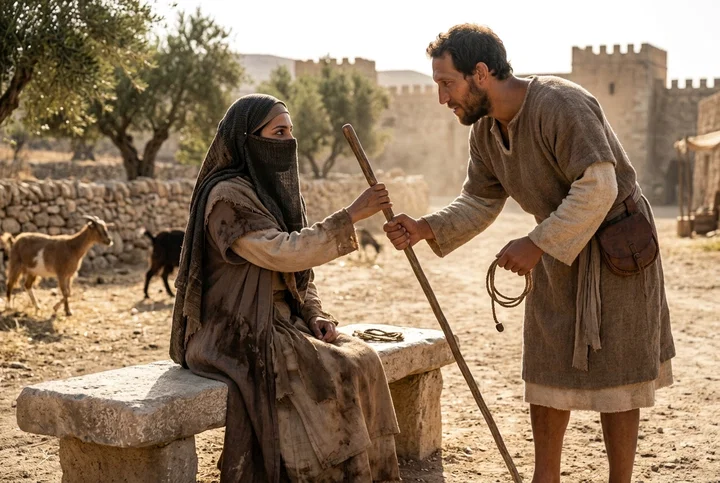
And he said, I will send thee a kid from the flock. And she said, Wilt thou give me a pledge, till thou send it?
Translations
And he said, I will send you a kid from the flock. And she said, Will you give me a pledge, till you send it?
King James Version, KJV Cambridge Paragraph Bible
And he said, I will send thee a kid from the flock. And she said, Wilt thou give me a pledge, till thou send it?
And he said, I will send thee a kid from the flock: and she said, Wilt thou give me a pledge, till thou sendest it?
Revised Version, American Standard Version
And he said, I will send thee a kid of the goats from the flock. And she said, Wilt thou give me a pledge, till thou send it?
and he saith, 'I — I send a kid of the goats from the flock.' And she saith, 'Dost thou give a pledge till thou send [it]?'
And he said, I will send [thee] a kid of the goats from the flock. And she said, Wilt thou give [ me] a pledge, until thou send it?
And he said, I, will send a kid of the goats from the flock. And she said, Wilt thou give a pledge until thou send it?
Berean Standard Bible, Majority Standard Bible
“ I will send you a young goat from my flock,” Judah answered.But she replied, “ Only if you leave me something as a pledge until you send it.”
He said, “ I will send you a young goat from the flock.”She said, “ Will you give me a pledge, until you send it?”
And he said, I will give you a young goat from the flock. And she said, What will you give me as a sign till you send it?
Then said he, I will sende thee a kid of the goates from the flocke. and she said, Well, if thou wilt giue me a pledge, till thou sende it.
Douay-Rheims (Challoner revision)
He said: I will send thee a kid out of the flock. And when she said again: I will suffer what thou wilt, if thou give a pledge, till thou send what thou promisest,
Pictures
Cross-references
- Matthew 1:3
And Judas begat Phares and Zara of Thamar; and Phares begat Esrom; and Esrom begat Aram;
Names Tamar and Pharez in Christ’s genealogy.
Commentary
Each commentary is drawn from primary sources: the writings of Ellen G. White and Adventist pioneers and periodicals. Each commentary is separate. Its own words are not a quotation; follow the references to read the source passages.
Pioneers and periodicals
6 sources
Judah promises to send a young goat from the flock, and Tamar asks for a pledge to hold until he sends it, in an encounter where she is disguised so that he does not recognize her.RH Nov 4, 1858 The verse belongs to the account of the sin of Judah and of his family, in which Tamar acted as a harlot with her father-in-law.STST Apr 9, 1894RH Oct 2, 1900 Within that history it comes after Joseph was sold into Egypt and before the account of Joseph being bought by Potiphar in Egypt.ST Apr 9, 1894 It is part of the account of the low standards of morality and crime that arose among Jacob's descendants amid the consequences of his having more than one wife.ST
The Bible records Judah's sin not to excuse sin or to appeal to lust, but to reveal sin so that it may be shunned.ST Tamar stands in Christ's ancestry, and Pharez, born of a harlot, stands in the human line from which Christ came according to the flesh, showing that his family history includes women whose lives were not exemplary and offering hope to the fallen.RH Oct 2, 1900ST Oct 21, 1889
That tainted birth, together with Jacob's selfish, crafty, deceitful disposition passed to his sons, Rahab's unenlightened heathen background, and the weakness, idolatry and sin of Solomon, Rehoboam, Abijah, Jehoram, Ahaz, Manasseh, Amon and other kings of Judah, tended to concentrate in Christ all the weaknesses and sinful tendencies of fallen humanity.ST Oct 21, 1889 Although his mother was pure and godly, his human nature was therefore more subject to infirmities of the flesh than if he had been born before the race deteriorated physically and morally.ST Oct 21, 1889 This condition of his birth was not accidental but a necessary part of redemption, for only by taking the flesh of sinful man that is subject to death could he suffer death and be made like his brethren to sympathize with and succor the tempted.ST Oct 21, 1889
Sources